
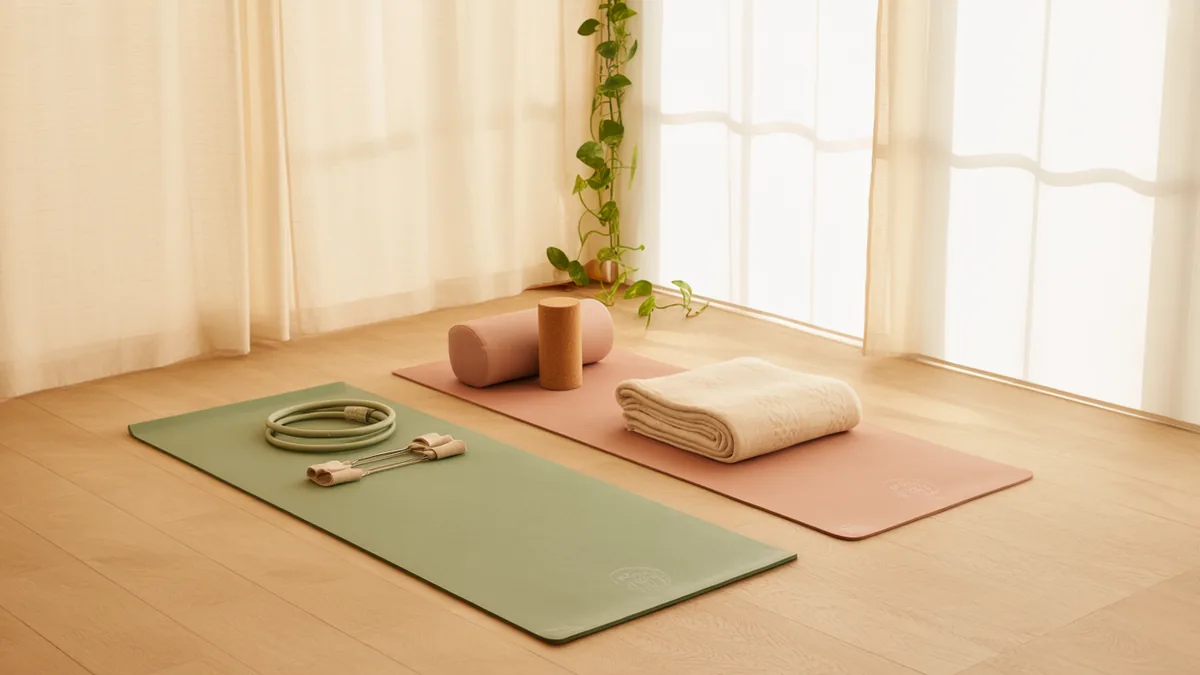
I get asked this more than almost anything else, usually by a friend standing in a studio lobby holding a phone with two class schedules open. She wants someone to just tell her which one. And the honest answer is that they are not competing for the same job, which means the question is not really pilates or yoga. It is what do you want your body to be able to do in six months.
I have done both for years, badly and then better. Mat pilates has been my steady thing since a physiotherapist put me on the floor with a resistance band after months of low back grumbling. Yoga came earlier, drifted away, and came back as the thing I do when my head is loud and my hips have not moved properly in a week. They have never once felt interchangeable.
So this is the comparison written the way I wish someone had written it for me. Not which one is better, because that is unanswerable, but what each one is genuinely training, how a class of each actually feels from the inside, which fits which goal, and three real ways to run both in one week without needing a different life. Some of this is research, some of it is eight years of my own mat, and I will tell you which is which.
| What you are comparing | Pilates | Yoga |
|---|---|---|
| Primary aim | Controlled strength and stability, especially through the trunk | Mobility, balance, breath awareness and calm |
| Where it came from | Rehabilitation and conditioning work in early 1900s Europe | A several thousand year old practice, physical postures being one branch |
| Breath pattern | Lateral breathing into the ribs, timed to effort | Long even breathing, often a whole practice built around it |
| Typical pace | Steady, repetitive, small ranges, constant tension | Varies enormously, from held stillness to fast flowing |
| Equipment | Mat, sometimes a ring, band, ball or a reformer machine | Mat, sometimes blocks, a strap, a bolster and a blanket |
| Best for | Core control, posture, injury-adjacent rebuilding, glute and deep abdominal work | Flexibility, hip and spine mobility, stress regulation, balance |
| Usual class length | 40 to 55 minutes, and 20 minutes is genuinely useful | 45 to 90 minutes, with restorative classes running longer |
| What it will not do | Make you notably more flexible on its own | Build much strength unless the style is deliberately strong |
| Cost to start | Free at home on a mat, or 30 to 50 dollars a reformer class | Free at home on a mat, or 15 to 30 dollars a studio class |
The short version, and why it is incomplete
The short version: Pilates builds controlled strength and stability through the trunk and hips, yoga builds mobility, balance and breath regulation. Pilates asks you to hold tension precisely. Yoga asks you to let go of it.
That distinction gets you most of the way, and it is what I say when someone asks me in a hallway. Pilates is a strength practice disguised by the fact that you are lying down. Yoga is a mobility and nervous system practice that sometimes happens to make you strong. If you only remember one line, remember that pilates trains control and yoga trains range.
The reason it is incomplete is that both words cover an enormous amount of ground. A power vinyasa class and a restorative class share a name and almost nothing else. A reformer class with heavy springs and a gentle mat class share a name and almost nothing else. When someone says they tried yoga and hated it, they usually mean they tried one style, in one room, with one teacher.
There is also the person doing it. I have watched two women take the identical mat pilates class and come out with completely different reports, because one has hypermobile joints and needs the stability work desperately, while the other is stiff through the thoracic spine and would have gotten more from an hour of slow yoga. The right answer depends on the body walking in.
Cleveland Clinic has a useful side-by-side comparison of yoga and pilates if you want a clinical framing before you read mine. What follows is more practical, because in the end you are choosing a class time on a Tuesday, not a philosophy.
What each one is actually training
The training effect: Pilates trains the deep stabilizing muscles around the spine, pelvis and shoulders through slow repetition under constant tension. Yoga trains joint range, balance, proprioception and breath control through held and flowing positions.
In pilates you spend most of the hour in small ranges doing many repetitions while trying not to let anything else move. That constraint is the whole point. When you lift one leg without letting your pelvis tilt, the muscles that stop the tilt are the ones getting trained, and they are usually the ones nobody trains. Transverse abdominis, the deep glutes, the muscles between your ribs and hips.
In yoga you spend most of the hour moving through larger ranges, holding shapes, and coordinating that with breath. The adaptation is different. You are asking joints to work at end range under load, teaching your nervous system that those positions are safe, and building the kind of balance that only comes from standing on one leg while slightly wobbling.
Neither builds cardiovascular fitness particularly well, which is worth saying plainly since both get sold as complete solutions. If your goal is heart and lung capacity you need walking, cycling, swimming or something that makes you breathe hard for a sustained stretch. The federal physical activity guidelines ask adults for a weekly amount of moderate aerobic activity plus strength work twice a week, and pilates or yoga alone will not cover the aerobic half.
The National Institute on Aging groups movement into four types worth having: endurance, strength, balance and flexibility. Pilates lands mostly in strength with some balance. Yoga lands mostly in flexibility and balance. Between the two you cover three of the four, which is a rather good argument for not choosing at all.
What a class of each really feels like
The felt experience: Pilates feels like burning, shaking concentration in one small area while a teacher counts. Yoga feels like an unfolding sequence with pauses for breath, and it usually ends with you lying still on the floor.
My first mat pilates class was humiliating in a way I found funny afterward. We did a movement where you lie on your side and lift the top leg about ten inches, and I could not do twenty of them. I could hike for six hours. I could not lift my leg twenty times. That is the pilates experience in miniature: it finds a weakness you did not know you had and sits on it politely.
The soreness is specific and strange. The day after a good pilates session I feel it in places I could not name, along the outside of the hip, deep under the ribs, in a band across the upper back. It is rarely dramatic. It is the ache of muscles that have been quietly unemployed for years and have just been asked to clock in.
Yoga feels wider. There is more floor to cover, more transitions, more time upside down or on one foot, and there is a rhythm to it that a pilates class does not have. Classes typically end with several minutes lying still, and I have watched deeply skeptical people leave that final rest looking twenty percent less braced than when they walked in.
The mental experience differs too. Pilates keeps my attention narrow, because if I stop paying attention to my pelvis the movement stops working. Yoga lets my attention widen and sometimes wander, and I finish feeling like I have set something down. On weeks when my mind will not stop churning, I choose yoga without thinking about it.
Choosing by your goal, not by the vibe
The decision rule: Pick pilates if you want posture, core control, or to rebuild after a niggle. Pick yoga if you want flexibility, calmer evenings, or something to do with a body that feels permanently tight.
Here is the decision tree I actually use with friends, and it takes about ninety seconds. If your complaint is that you feel weak, unstable, or that your back gives you trouble sitting at a desk, go to pilates. If your complaint is that you feel stiff, wound up, unable to sleep, or that you cannot touch your knees let alone your toes, go to yoga. If your complaint is both, start with the one whose class time you will actually attend.
If your goal is visible change in how you carry yourself, pilates tends to get there faster, and I say that as someone who watched her own shoulders drop and her ribs stop flaring after about four months. That is a personal observation, not a study result. But posture is a strength and awareness matter more than a stretching matter, and pilates drills exactly that.
If your goal is stress, the evidence base is genuinely stronger on the yoga side. The National Center for Complementary and Integrative Health summarizes research associating yoga practice with improvements in stress, sleep quality and general wellbeing, while noting that many studies are small. That hedge matters. Small studies are not nothing, and they are not proof.
If your goal is a specific injury or a chronic condition, this is where you stop reading blogs and talk to a physical therapist or your doctor. I am not a clinician. My back improved on a program a physiotherapist wrote for me, and the program looked like pilates because she chose those movements deliberately for my particular problem, not because pilates fixes backs generally.
The styles hiding inside each word
Styles: Pilates splits mainly into mat and reformer, with classical and contemporary lineages. Yoga splits into vinyasa, hatha, yin, restorative, iyengar and hot, and those differ from one another more than pilates and yoga differ overall.
On the pilates side, mat is the version you can do on a towel in a hotel room, using your own body weight plus small props. Reformer uses a spring-loaded carriage, which both assists and resists, and it lets a good teacher load a movement precisely. Reformer costs considerably more and is worth trying at least once if there is a studio near you, because the feedback the machine gives is genuinely instructive.
Classical pilates follows the original sequence in a set order. Contemporary pilates borrows from physiotherapy and modern movement science and will happily change the order. Neither is better. Classical suits people who like knowing exactly what comes next, and contemporary suits people who want the work adapted to their body on a given day.
On the yoga side, the spread is much wider. Vinyasa flows continuously and gets your heart rate up. Hatha holds shapes longer with pauses. Iyengar is precise and uses props heavily, which makes it excellent for anyone rebuilding carefully. Yin holds passive positions for three to five minutes to work on connective tissue. Restorative uses bolsters so you can hold a shape for ten minutes without effort.
This is why I push back when someone says yoga is not for them. Trying one hot vinyasa class in a packed studio and deciding you dislike yoga is like eating one anchovy and deciding you dislike food. If you want the calm and not the workout, look for yin or restorative on the schedule. If you want the workout, look for vinyasa or power.
Back, core, flexibility, bones and stress
By outcome: For nagging low back discomfort both have supportive evidence. For flexibility, yoga wins clearly. For deep core control, pilates wins clearly. For stress and sleep, yoga has the larger research base. For bone density, neither is sufficient alone.
Low back discomfort is where both get recommended and where the research is most active. Reviews on yoga for chronic low back pain have generally found modest short-term improvements in function, and pilates-style exercise has similar findings. Neither is a treatment, and neither replaces a proper assessment. If your back pain radiates down a leg, wakes you at night, or follows an injury, that is a doctor conversation.
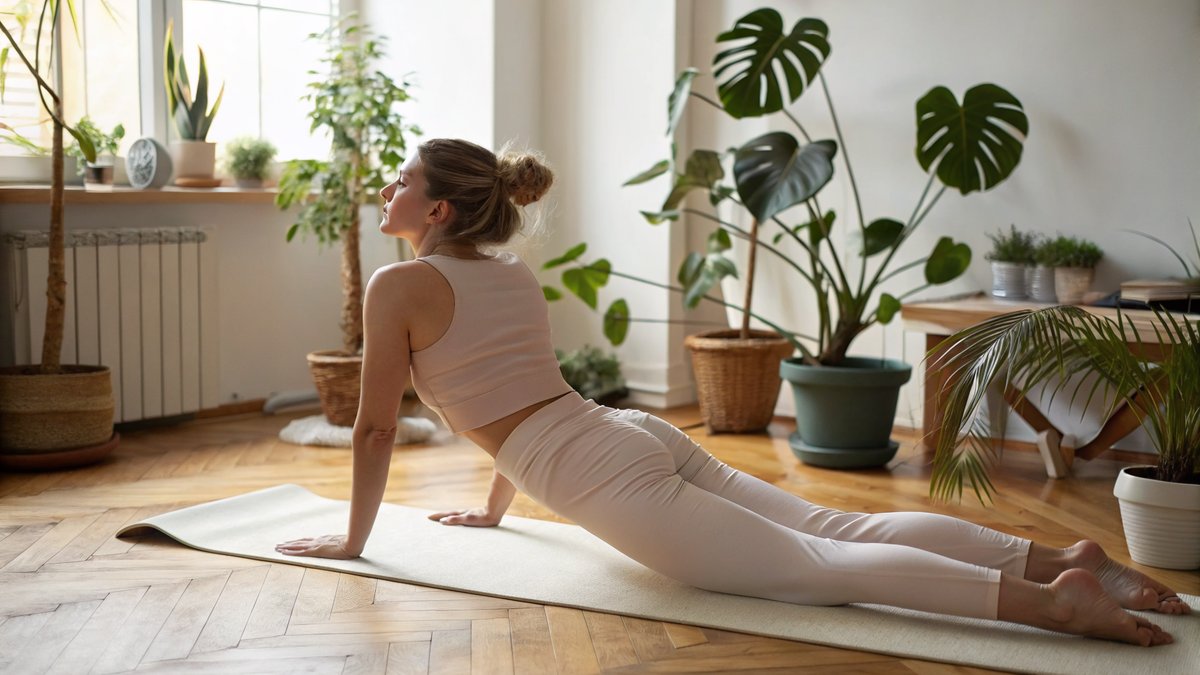
Flexibility is not really a contest. Yoga puts joints through end range repeatedly and that is precisely the stimulus that increases range. Pilates keeps you in controlled middle ranges on purpose. I did pilates exclusively for about a year and my hamstrings were exactly as tight at the end as at the start, which surprised me at the time and should not have.
Deep core control goes the other way just as clearly. Yoga will strengthen your midsection somewhat, particularly in arm balances and planks, but it does not systematically train the small stabilizers the way an hour of pilates does. The difference showed up for me in something ordinary: carrying a full laundry basket up stairs stopped making my low back complain.
On bone density, be careful with what you read. Weight-bearing and resistance loading support bone, and both practices involve some of that, but neither is designed as a bone protocol. If bone health is your concern, particularly after menopause, that is a conversation with your doctor about actual loaded strength training, and possibly testing, rather than a class choice.
Doing both in one week, three schedules
Combining: Two pilates sessions and one yoga session suits most people wanting strength with some mobility. Reverse it if stress is the main problem. Never stack a hard pilates class the morning after a long yoga session on the same target area.
This is where most articles stop and mine should not, because combining is what almost everyone ends up doing. Here are three schedules I have actually run, laid out day by day, in order of how much time they take.
Schedule one: the two hour week, strength leaning
- Monday. Thirty minutes of mat pilates, before the day gets loud.
- Wednesday. Thirty minutes of mat pilates, same sequence, so it becomes automatic.
- Saturday. Forty-five minutes of slow yoga or yin, hips and spine.
- Sunday. A long walk, forty minutes or more, outside if the weather allows.
That is the version I run most of the year. It fits around a full work week without special arrangements and it never requires me to leave the house on a weekday evening, which is the reason it survives.
Schedule two: the two hour week, calm leaning
- Tuesday. Forty-five minutes of vinyasa or hatha, whichever the schedule offers.
- Thursday. Twenty minutes of mat pilates aimed at hips and glutes only.
- Sunday. Forty-five minutes of restorative or yin, ideally in the late afternoon.
Use this in the stretches when your head is the problem rather than your strength. I switch to it in January and again in whatever month work goes strange, and I switch back when I notice I feel less solid carrying things.
Schedule three: three and a half hours, if you have the room
- Monday. Forty-five minutes of reformer, or a strong mat class if a studio is out of reach.
- Tuesday. Thirty minutes of gentle yoga, treated as recovery rather than training.
- Thursday. Forty-five minutes of pilates, the harder session of the two.
- Friday. Twenty minutes of yin before bed, no phone in the room.
- Sunday. Sixty minutes of vinyasa, then a walk while you still feel loose.
The sequencing rule that matters is not to do a demanding pilates session the morning after a long deep-stretch yoga session that hit the same area. Connective tissue held at end range for minutes at a time does better with a day before you ask it for maximum stability. I learned this by ignoring it and having a very unhappy right hip for a fortnight.
If you only have two sessions a week total, and most people realistically do, my honest recommendation is one of each rather than two of the same. You get strength and mobility, you get two different mental experiences, and you are far less likely to get bored in month three, which is when most movement habits quietly die.
Which to start with if you have done neither
Starting out: Start with beginner mat pilates if you feel weak or unstable, and with a slow hatha or gentle yoga class if you feel tight or wound up. In both cases take three classes before deciding anything.
Three classes, not one. The first class of anything is mostly logistics, working out where to put your feet and whether you are doing it wrong. The second is where you can actually pay attention. The third is where you find out whether you like it. I have judged too many things on their first hour and been wrong.
For pilates, look for a class called beginner mat, fundamentals, or pre-pilates. Avoid a reformer class as your very first exposure, not because it is dangerous but because you will spend the whole hour looking at the machine instead of at your own body. Learn the ideas on a mat where the feedback is simpler.
For yoga, look for hatha, gentle, slow flow, or beginners. Skip the hot room for now, since heat masks how far you are actually going and beginners often overstretch in it. And tell the teacher before class that it is your first time. Every good teacher I have met has quietly adjusted the whole class a little when someone says that.
At home, both are entirely legitimate. I started mat pilates at home with a free video and a folded towel because a studio membership was not in the budget that year. My account of what six months of pilates actually changed covers what came out of that, and my gentle wellness guide covers how I fit movement around everything else.
Cost, gear and the logistics nobody mentions
Practicalities: Both start free at home with a mat. Studio yoga usually runs 15 to 30 dollars a class, reformer pilates 30 to 50. Yoga needs more floor space, pilates needs more consistency to show results.
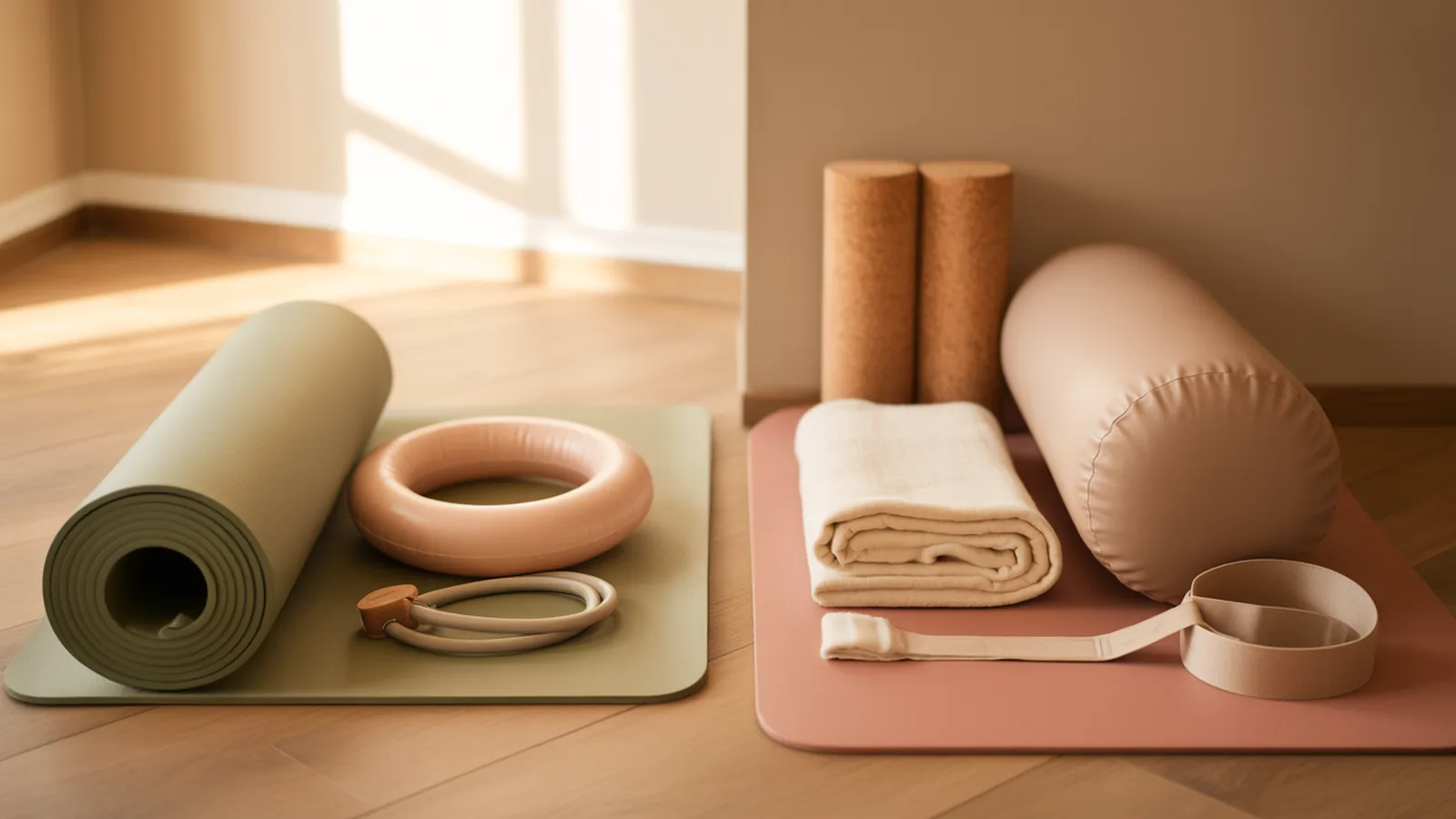
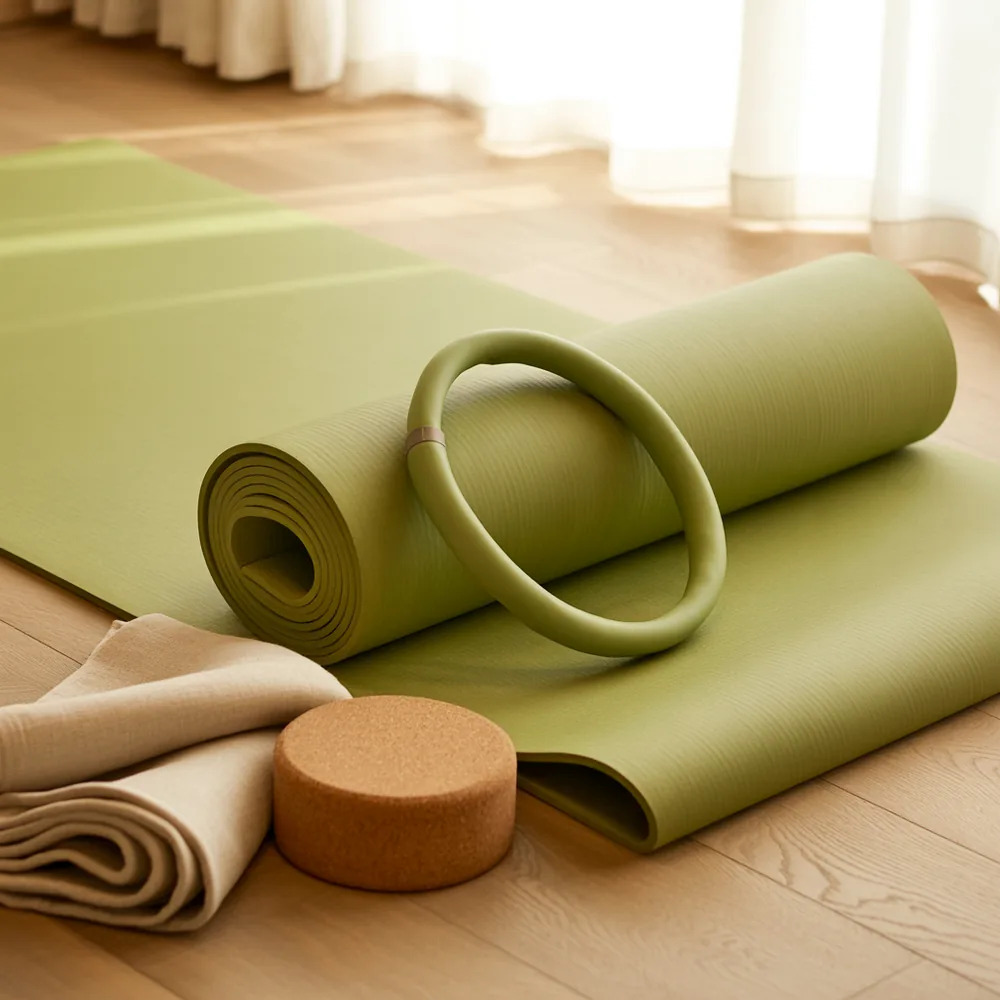
The gear question is smaller than the internet suggests. A mat, and that is it, for months. Later a resistance band and a small ball for pilates, and a block and a strap for yoga, all of which cost under fifteen dollars each and none of which are urgent. I used a rolled bath towel instead of a block for a year and nothing bad happened.
Space is the sleeper issue. Yoga needs enough room to extend your arms in every direction and to step your feet wide, which in a small apartment can genuinely be the deciding factor. Pilates mostly happens within the footprint of your own mat, which is why it survived my studio apartment years when yoga did not.
Reformer pilates is the expensive option and I want to be honest that the price is real. Where I live a single class runs about forty dollars, which puts a twice-weekly habit at over three hundred a month. That is a lot for something you can approximate at home with a band. Try a few, learn what the movements should feel like, then take that knowledge back to your mat.
The logistic that actually decides this for most women is class time. A yoga studio near your office with a six-fifteen class beats a pilates studio across town with an unhelpful schedule every single time, regardless of which is theoretically better for your goal. The practice you attend beats the practice you researched.
How my own week is actually split
My split: Two short mat pilates sessions midweek, one longer yoga session at the weekend, and a walk most days. Roughly two hours of deliberate movement a week, done at home, in ordinary clothes.
Monday and Wednesday I do thirty minutes of mat pilates in the front room before the day gets loud, on a sage green mat that lives rolled up against the bookshelf because if I put it in a cupboard I will not use it. There is a resistance band and a small inflatable ball in a basket beside it. That basket is doing more work than any gym membership I have ever paid for.
Saturday or Sunday, depending on the week, I do about forty-five minutes of yoga, usually slow, sometimes yin if my hips feel like concrete. This is the session I look forward to. It happens later in the morning, with coffee already drunk, and it is the only one where I light a candle, which tells you what mood I am in when I do it.
What I dropped was the ambition. For about two years I tried to do five sessions a week and consistently managed one, because a plan that requires an unusual week fails in an ordinary one. Two hours, split two ways, has held for four years now. That consistency has done more for me than any single perfect month of training ever did.
I should separate what is established from what is mine. That pilates trains stabilizing strength and yoga trains range is well supported. That thirty minutes twice a week is enough for meaningful change is my experience with my body and my starting point, not a research finding. Yours may need more, or less, and the only way to find out is a few honest months.
When choosing between them won't fit your life
When to skip the question: If you are not moving at all right now, walking beats either. During pregnancy, injury recovery, or a chronic condition flare, the right answer comes from a clinician, not from a comparison article.
If you currently do no deliberate movement at all, this whole comparison is a distraction. Twenty minutes of walking most days will do more for you in the next three months than agonizing over a class schedule, and it requires nothing you do not already own. I spent a genuinely embarrassing amount of time researching studios during a period when I was moving almost not at all.
Pregnancy and the postpartum months change the answer completely, and they change it in ways a general article cannot address. Some movements become unsuitable, some become especially valuable, and the timeline for returning is individual. Prenatal-specific classes exist for good reason, and a pelvic floor physiotherapist is worth more than any amount of reading.
If you have a diagnosed condition, an unhealed injury, uncontrolled blood pressure, osteoporosis, a hypermobility disorder, or you are recovering from surgery, get medical advice before you start either. Some yoga positions are genuinely inadvisable with certain conditions, and some pilates loading is too. This is not a formality. It is the part where a general recommendation stops being useful.
And there are seasons where the honest answer is neither. Newborn months, a hard grief, a stretch of work that eats every evening. During those, movement looks like carrying things and walking to the shop, and that counts. A practice you abandon guiltily is worse than a season you sit out on purpose, with a plan to come back when there is room.
Helpful sources and next reads
Reliable external sources
- National Center for Complementary and Integrative Health: yoga, what the research shows
- Cleveland Clinic: yoga versus pilates, compared
- US Physical Activity Guidelines for Americans
- National Institute on Aging: the four types of exercise worth having
More from Sabrina Saturno
You may also love


FAQ
Is pilates or yoga better for weight loss?
Neither is particularly effective for weight loss on its own, and I would be suspicious of any source that claims otherwise. Both burn modest calories compared with brisk walking or cycling. What they do well is build strength and mobility that make other movement easier and more enjoyable, which matters more over years.
Which is better for a bad back?
Both have supportive research for non-specific low back discomfort, with modest short-term improvements in function. Pilates-style work is more often prescribed by physiotherapists because it targets stabilizing muscles directly. If your back pain is new, severe, or travels down a leg, see a doctor before choosing a class.
Can I do pilates and yoga on the same day?
Yes, and it works well if you order them sensibly. Pilates first while you are fresh and can hold form, yoga afterward as the release. Avoid doing a demanding version of both on the same day repeatedly, since recovery matters more than volume once you are past the first month.
Which one makes you more flexible?
Yoga, clearly and by design. It moves joints through end range repeatedly, which is the stimulus that increases range of motion. Pilates deliberately works in controlled middle ranges to build stability, so it will not improve your flexibility much even after a year of consistent practice.
Which is harder for a beginner?
Pilates is usually harder in the first three sessions because the movements are small and demand precision most people have never practiced. Yoga is harder to sustain for beginners in fast or hot styles. A beginner mat pilates class and a slow hatha class are both entirely manageable on day one.
Do I need a reformer to get results from pilates?
No. Mat pilates with body weight, a resistance band and a small ball produces real change, and it is what I have used for years. A reformer offers precise loading and useful feedback, which makes it valuable to try, but it is an upgrade rather than a requirement.
How often should I practice to see a change?
Two sessions a week is the realistic floor for noticing something, and three is where change comes faster. Consistency across months matters far more than intensity in any given week. I saw more from thirty minutes twice weekly for a year than from ambitious plans that lasted three weeks.
Is yoga a good workout?
It depends entirely on the style. A vinyasa or power class is genuinely demanding and will leave you breathing hard. A yin or restorative class is not a workout in any conventional sense and is not trying to be. Read the class description rather than assuming the word yoga means one thing.
Which is better for stress and sleep?
Yoga has the larger research base here, with studies associating regular practice with improvements in stress and sleep quality, though many of those studies are small. In my own experience the difference is noticeable, and the final rest at the end of a class does a lot of that work.
Can pilates replace strength training?
Partly, and not fully. Pilates builds real strength in stabilizing muscles that conventional lifting often misses, which is genuinely valuable. It does not load your body heavily enough to build maximum strength or to serve as the resistance training recommended for bone and muscle health as you age.
Which should I do in the morning versus the evening?
I find pilates suits mornings because it requires concentration and wakes me up, and gentle yoga suits evenings because it settles me. That is preference rather than physiology. Practice at whatever time you will consistently show up, since the schedule you keep beats the schedule that is theoretically optimal.
Is one safer than the other?
Both are low risk for most healthy adults when taught well. Yoga has more reported injuries in practice, largely from overstretching in fast or hot classes and from pushing into end range. Pilates injuries are rarer and usually come from loading a movement before the control is there.
What if I genuinely cannot decide?
Book one beginner class of each within the same fortnight, at the same time of day, and pay attention to which one you find yourself thinking about afterward. That answer is more reliable than any comparison, including this one, because it accounts for the teacher, the room and the version of you that has to show up.
The version that lasts
After eight years I have stopped treating this as a choice and started treating it as a ratio. Some seasons are two pilates to one yoga, because my back is grumbling or I have been at a desk too long. Some are the reverse, because my head is loud and my hips are locked. The ratio moves and the total stays roughly the same, and that flexibility is why I still practice at all.
The version that survived is small and unglamorous. Two thirty-minute pilates sessions before the house wakes up, one longer yoga session at the weekend, a mat that lives in plain sight, and no membership to feel guilty about. Nothing about it would make a good video. It has outlasted three studio memberships and every ambitious plan I ever wrote down.
If you are still standing in a lobby with two schedules open, pick the class that starts at a time you can actually reach without rearranging your life, go three times, and decide after that. The comparison in this article will still be true in a month. What you will not get back is the month spent deciding rather than moving.