

For a long time my Sundays had no shape at all. I would wake late, lose two hours to my phone, notice at four in the afternoon that nothing had happened, then panic-clean for an hour and go to bed feeling like the day had been taken from me. The problem was never that I lacked a list of tasks. It was that I had no sense of when anything belonged.
What changed it was giving the day a rough timetable instead of a checklist. Not a schedule I follow to the minute, because that would be its own kind of misery, but a shape: this is a morning thing, this happens before lunch, this block is protected and nothing is allowed into it. Once I knew the order, the tasks stopped competing with each other and the whole day got easier.
So this is my Sunday written out hour by hour, honestly, including the parts that are just sitting down. There is a shorter ninety-minute version for the Sundays that are already spoken for, a longer version for the rare empty ones, and notes on adapting it if you work Sundays, share a home, or have small people who do not respect time blocks. If you want the tasks themselves rather than the timing, my Sunday reset checklist is the list-shaped companion to this.
| Time block | What happens in it | How long it takes |
|---|---|---|
| 8:00 to 10:00 | Wake without an alarm, coffee, no screens, breakfast eaten sitting down | Two hours, mostly unstructured |
| 10:00 to 11:30 | The household block: laundry running, surfaces cleared, bathroom, floors | Ninety minutes, timer set |
| 11:30 to 12:30 | Groceries, either the shop or the delivery order, list already written | One hour |
| 12:30 to 14:30 | Lunch, then the food block: two components cooked, produce washed | Two hours including eating |
| 14:30 to 15:00 | The week ahead: calendar, one list, three things that must happen | Thirty minutes, no longer |
| 15:00 to 18:00 | Genuinely free. A walk, a friend, a book, a nap, nothing planned | Three hours, protected |
| 18:00 to 20:00 | Dinner, kitchen reset, clothes chosen for Monday, bag by the door | Two hours, unhurried |
| 20:00 to 21:30 | Phone away, shower, skincare, tea, reading, lights out by ten | Ninety minutes |
The shape of the day, before the details
The shape: Slow morning, one household block, one food block, thirty minutes on the week ahead, a protected free afternoon, then a long unhurried evening. Six blocks, roughly in that order, with the free one non-negotiable.
The reason order matters more than content is that Sunday tasks have wildly different energy costs, and doing them in the wrong sequence wrecks the day. Cleaning is easiest when you have eaten and are slightly awake but not yet tired. Planning the week is worst first thing, when you are still soft, and worst last thing, when you are already anxious. Food prep needs to happen while the shops are still an option.
So the order goes: nothing, then the physical work, then the food, then the thinking, then the reward, then the descent. Each block hands off to the next one reasonably. The physical work wakes you up enough to shop. The shopping supplies the food block. The food block leaves the kitchen clean enough that the thinking block does not happen at a sticky table.
The protected free afternoon is the piece people cut first and it is the piece that makes the rest work. If Sunday is entirely admin, you will start dreading Sunday, and then you will stop doing any of it. Three hours where nothing is required is the payment for the two hours of chores, and I treat it as a genuine appointment.
None of these blocks are precise. If the household block takes an hour rather than ninety minutes, the free block starts earlier. If groceries are delivered, that hour disappears entirely. The clock times in the table are not instructions, they are a picture of what the day looks like when it goes well, so you can see the proportions.
8:00 to 10:00, the slow open
The morning block: Two hours with nothing required, no alarm, no phone for the first hour, coffee made properly and breakfast eaten sitting down rather than standing at the counter.
The rule that does the heavy lifting here is that my phone stays face down until I have finished the first coffee. Not for any purity reason. Because the first thing I read sets the tone of the whole day, and a work email or a bad news headline at eight on a Sunday reliably costs me the morning. The National Institute of Mental Health lists routine and rest among basic self-care practices, and this hour is where mine sits.
I make coffee in a way that takes longer than it needs to, grinding beans, warming the cup, standing at the window while it brews. On weekdays I would find that ridiculous. On Sunday the slowness is the point, because it is the only signal my body gets that this day is different from the five that came before it.
Breakfast is sitting down, at the table, with a plate. This sounds small and it is not. For years I ate standing up over the sink on weekends and then wondered why Sunday never felt restful. Eating at a table for twenty minutes with nothing else happening is one of the cheapest changes I have ever made to a day.
Around nine-thirty I open the planner. Not to plan yet, that happens in the afternoon, but to write down anything already rattling around so it stops taking up space. Usually four or five things. This takes six minutes and it is the reason the household block that follows does not get interrupted every ten minutes by remembering something.

10:00 to 11:30, the household block
The household block: Ninety minutes with a timer, laundry started first so it runs in the background, then surfaces, then the bathroom, then floors. Stop when the timer stops, whatever state things are in.
The timer is the whole technique. Without it, cleaning expands to fill Sunday, and I have lost entire days to a cupboard I decided to reorganize at eleven in the morning. Ninety minutes is enough to make a flat feel genuinely different and short enough that I do not resent it. When it goes off, I stop, even mid-task.
Order within the block matters for the same reason as order within the day. Laundry goes in first because it runs while I do everything else, so the machine is working even when I am not. Then surfaces get cleared, because you cannot clean anything you cannot see. Then the bathroom, which is the room that most changes how a home feels. Floors last, because everything else drops crumbs.
I do not do a deep clean on Sundays and I have stopped feeling bad about it. Windows, the oven, under the bed, all of that happens once a season on an afternoon I have deliberately set aside. Trying to fold seasonal jobs into a weekly routine is exactly how weekly routines die, usually around week five.
A specific thing that helps: I put a podcast or an album on at the start of the block and let it run. When the album ends I am usually near the end of the time anyway. Music has been a better timer than an actual timer, because it removes the sense of being watched by a clock while you scrub a sink.
11:30 to 14:30, groceries and the food block
The food block: Shop or receive a delivery with the list already written, eat lunch, then cook two components rather than full meals, wash and store produce, and clear the kitchen completely before moving on.
The list gets written on Saturday evening, not Sunday morning, which is a small ordering change that saves about twenty minutes of standing in an aisle trying to remember whether there are eggs. If the shop is a delivery, the order goes in Saturday night and lands Sunday around midday, which is honestly the better version if it is available where you live.
Lunch is deliberately easy and often uses whatever is about to turn. Eggs, toast, the last of a bag of greens, something from the fridge that needs eating. Sunday is not the day for an ambitious lunch, because the cooking energy is going into the block that follows and there is only so much of it.
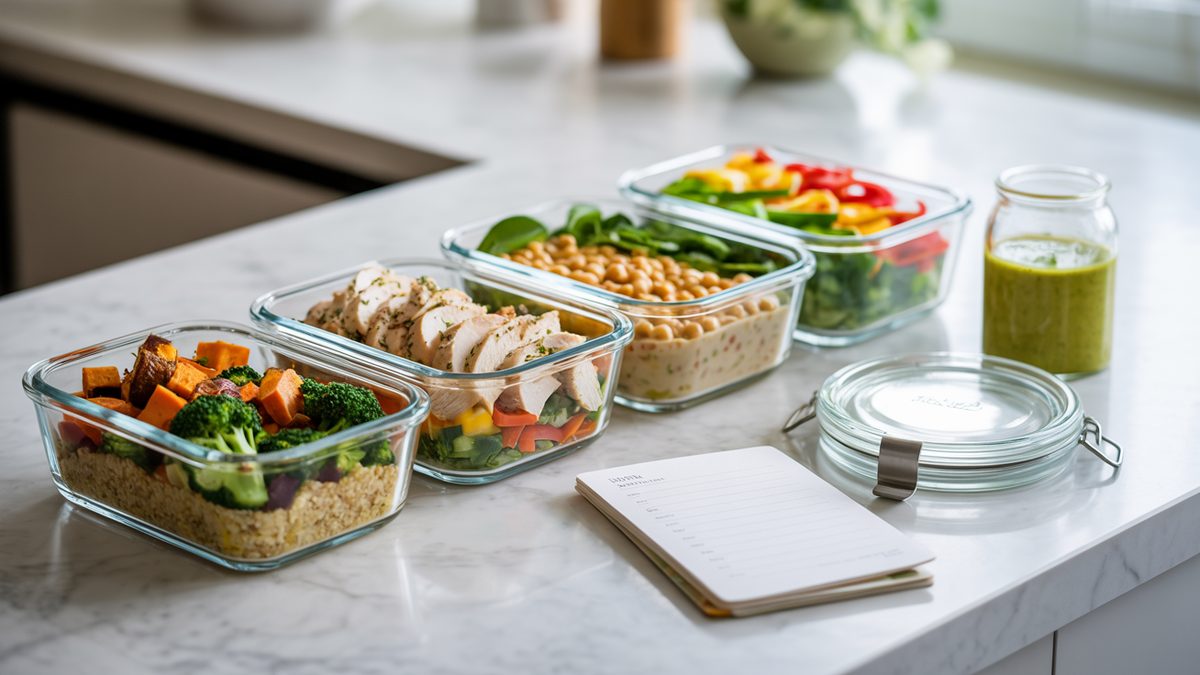
Then two components, not meals. A grain, and a protein, or a tray of roasted vegetables and a sauce. That is it. Two things that can become five different plates during the week rather than five identical containers that I will be bored of by Wednesday. I go into how the whole week's cooking is spaced out in my weekly meal prep schedule, and the Sunday portion of it is exactly this block.
Produce gets washed and stored properly before anything else, because that is the difference between eating the spinach and finding it liquefied on Thursday. Greens washed, dried, into a container with a paper towel. Herbs into a jar of water. Berries left unwashed until eaten, which I got wrong for years. The kitchen gets fully cleared before I leave it, because walking back into a clean kitchen at six is a gift to future me.
14:30 to 15:00, thirty minutes on the week ahead
The planning block: Thirty minutes, timed, spent on the calendar and one list. Identify the three things that genuinely have to happen, name the one hard thing, and close the notebook when the time is up.
Thirty minutes is a ceiling, not a target. Planning is the block most likely to turn into anxiety wearing productivity clothes, and I have spent entire Sunday afternoons making beautiful systems that I never opened again. The cap is what keeps it useful. If it cannot be sorted in half an hour, it is a bigger problem than a Sunday can solve.
First I look at the calendar for the actual week, not the ideal one. What is fixed, what needs travel, which evenings are already gone. That takes about five minutes and it prevents the most common planning failure, which is making a list for a week that has eleven free evenings in it when in reality there are two.
Then three things. Not twelve. Three things that, if they happen, make the week a success, and I write them at the top of the page where I will see them on Wednesday when everything has gone sideways. Everything else goes underneath in whatever order it arrives. This one habit did more for my weeks than any app I ever downloaded.
Last, I name the hard thing. Every week has one: a conversation I am avoiding, a form, a call to a company that will keep me on hold. Writing it down and deciding which day it happens removes about eighty percent of its weight, in my experience. Nothing about the task changes. It just stops following me around.

15:00 to 18:00, the part that is actually yours
The free block: Three hours with nothing scheduled and nothing productive required. A walk, a friend, a book, a nap. This block is the payment for the rest of the day and cutting it makes the routine collapse.
I want to be firm about this because it is the part everyone deletes. If your Sunday reset is entirely tasks, you have not built a routine, you have built a second work day, and you will abandon it within two months. The free block is not a reward for finishing. It is a structural part of the thing working at all.
In practice this is usually a walk. Forty minutes, no destination, sometimes with a friend and sometimes with nothing in my ears, and it is the block where my brain quietly finishes processing the week that just ended. Sometimes it is a nap, unashamedly, in the afternoon light with the blanket from the sofa.
What it is not is errands I did not finish, or the deep clean I skipped, or a work thing I told myself I would get ahead on. The moment those creep in, the block stops working, because the value comes precisely from it being unconditional. Guarding it feels ridiculous for about three weeks and then feels obvious.
The most common mistake is scheduling something social that requires performance right in the middle of it. Brunch with a large group at one, a family obligation at four. Those are lovely and they are not rest, and if a Sunday has one of them, I move the free block rather than pretending the obligation covered it.
18:00 to 21:30, the landing
The evening block: An unhurried dinner, a full kitchen reset, Monday's clothes chosen and bag packed by eight, then ninety minutes with the phone away before lights out around ten.
Dinner on Sunday is cooked rather than assembled, and it is usually the nicest meal of my week, partly because there is time and partly because it marks the end of something. The kitchen gets fully reset afterward, dishwasher running, counters wiped, one clean mug left out for the morning. That mug is a genuinely absurd detail that I would defend to anyone.
By eight, Monday is physically ready. Clothes hanging on the back of the door, bag by the door with everything in it, lunch decided if not made. This takes about eight minutes and it removes every small decision from a morning where I have the least capacity to make them. Monday mornings stopped being frantic when I moved this to Sunday evening.
Then the phone goes on the shelf in the hall and stays there. Not in the bedroom, not face down on the table, on a shelf in a different room. The National Heart, Lung, and Blood Institute lists a consistent bedtime and a dark, quiet, screen-free wind-down among its healthy sleep habits, and this is the one night a week I actually manage all of it.
The last ninety minutes are shower, skincare, tea, and reading something on paper. Lights out around ten, which is earlier than my weeknight and deliberately so, because Sunday night sleep sets up the whole week. My evening reset routine covers what this looks like on ordinary weeknights when there is far less time for it.
The 90-minute version for a Sunday that is not free
The short version: Ninety minutes total, split into three thirty-minute pieces: one household sweep, one food and grocery push, one planning and Monday-prep block. Skip everything else without negotiation.
Most Sundays are not empty, and a routine that only works on an empty Sunday is a fantasy. This is the version I run when the day already has a wedding, a drive to see family, or a work deadline sitting in the middle of it. It fits in a morning or an evening and it captures perhaps eighty percent of the benefit.
- Thirty minutes, household. Laundry on, kitchen surfaces, bathroom sink and mirror, floors in the two rooms you actually see. Timer on, stop when it stops.
- Thirty minutes, food. Grocery order placed or a fast shop, produce washed and stored, one component cooked while you do the rest.
- Thirty minutes, ahead. Calendar check, three priorities written, Monday clothes and bag ready, phone on the hall shelf.
The pieces do not have to be consecutive. I have run this as thirty minutes before leaving in the morning, thirty in the afternoon gap, and thirty after dinner, and it worked fine. What matters is that all three happen, because skipping the food piece means eating badly all week and skipping the ahead piece means Monday starts in a hole.
If you can only do one of the three, do the third. Knowing what the week holds and having Monday physically ready buys more calm than a clean bathroom does. That surprised me when I first noticed it, since the clean bathroom is the more visible achievement, but the Monday preparation is what actually changes how the week feels.
Adapting it: kids, shift work, a shared home
Adaptations: If Sunday is a work day, move the whole shape to your actual day off. With small children, run the household and food blocks during naps or a screen hour and shrink the free block to one hour.
The word Sunday is the least important part of this. My sister is a nurse and her reset happens on Wednesday, with exactly the same shape and none of the cultural weight. If anything hers works better, because nothing else is competing for a Wednesday and shops are empty. If your week ends on a Tuesday, run this on a Tuesday and stop trying to make Sunday work.
With small children, two things change. The blocks get shorter and they land inside whatever windows exist, usually a nap or a stretch of independent play. And the free block shrinks to about an hour, which is honest rather than defeatist. A friend of mine runs the household block with her two-year-old carrying a cloth around, which achieves almost nothing except that it happens at all.
In a shared home, the single most useful move is telling people the shape out loud. Not assigning tasks, just saying the kitchen is being cleaned between ten and eleven-thirty and the afternoon is free. Housemates and partners who know when things are happening tend to either join in or stay out of the way, and both are helpful. Silent resentment while cleaning around someone is not a routine, it is a grievance.
In a very small flat the whole thing compresses. My studio years had a forty-minute household block because there was not more than forty minutes of flat to clean, which left more room for everything else. Small spaces are genuinely easier here and nobody says so. If you want the fully unplugged version of the day, I wrote about that separately in my digital sabbath weekend.
What to do about the Sunday dread specifically
Sunday dread: The anxious feeling usually arrives in the unstructured late afternoon. Naming the week's hard thing in the planning block and physically preparing Monday by eight in the evening are the two moves that reduce it most.
The feeling has a reliable arrival time in my life, somewhere between four and six on Sunday afternoon, and knowing that changed how I handle it. It is not a comment on my job or my life. It is what happens when the day's structure runs out and the next day's has not started, and the gap fills with anticipation.
The planning block is the main intervention, and specifically the naming of the hard thing. Vague dread is much heavier than specific dread. When I write down the actual task I am avoiding and put a day beside it, the feeling usually deflates into something ordinary and manageable, because a named thing has edges and an unnamed one does not.
The second intervention is physical readiness. Clothes out, bag packed, one clean mug. It sounds far too small to matter against a real feeling of dread and it consistently does matter, because a large part of the anxiety is a low hum of anticipated friction. Removing the friction removes the hum. Relaxation techniques are also worth knowing about, and the National Center for Complementary and Integrative Health has a clear plain summary of what the evidence does and does not support.
I do want to say clearly that persistent Sunday dread that does not lift, or that comes with sleep problems, low mood, or a sense that most of the week is unbearable, is worth taking to a doctor or a therapist rather than a routine. I am not a clinician, and a reset routine is a good tool for an ordinary week, not a treatment for anxiety or depression.
When a Sunday reset routine won't fit your life
When to skip it: Skip the routine during illness, grief, newborn months, or any week where a full day of tasks would be one more thing to fail at. Keep only the food piece and let the rest go.
There have been whole seasons where I did none of this and that was correct. The months after my grandmother died, I did not clean on Sundays. I ordered food and I slept and the flat got messy and none of it mattered in the way I had been pretending it mattered. A routine is a tool for ordinary weeks. It is not a moral standard.
If you are ill, actually ill rather than tired, the entire day should be nothing. If you have a newborn, the concept of a Sunday shape is close to comedy, and the only piece worth keeping is anything that means food exists later without cooking. If you work six days and Sunday is your one free day, spending it on chores may genuinely be the wrong trade.
There is also a version of this that becomes its own pressure, and I have been there too. When the routine turns into a checklist you are failing rather than a shape that helps, the fix is to cut it in half, not to try harder. My reset has been through at least four rounds of getting smaller, and each round made it more likely to actually happen.
And if Sundays are simply not your day, because of shift work or family or the shape of your particular life, none of this is lost. Take the six blocks and put them on whatever day you have. The order is the useful part. The name is just what most people happen to call it.
Helpful sources and next reads
Reliable external sources
- National Heart, Lung, and Blood Institute: healthy sleep habits
- National Institute of Mental Health: caring for your mental health
- National Center for Complementary and Integrative Health: relaxation techniques
More from Sabrina Saturno
You may also love



FAQ
How long should a Sunday reset routine take?
The full version in this article spans a day but only about five hours of it involves tasks, with three hours deliberately free. The ninety-minute version captures most of the benefit. Anything longer than five active hours tends to turn Sunday into a second work day, which is when people stop doing it.
What time should I start a Sunday reset?
Later than you think. I start the household block at ten, after two unstructured hours, because starting tasks immediately on waking makes the day feel like an obligation from the first minute. If you are a genuine early riser, shift everything forward by an hour rather than adding tasks at the front.
What is the difference between a reset routine and a reset checklist?
A checklist tells you what to do and a routine tells you when to do it. I found the timing was the part I was actually missing, since I already knew the flat needed cleaning. The two work well together, with the list living inside the time blocks.
Do I have to do it on a Sunday?
No, and plenty of people should not. If you work Sundays, run the same shape on your actual day off. My sister does hers on Wednesday and it works better, because shops are quieter and nothing cultural is competing for the day. The order of the blocks is what matters.
What if I only have two hours?
Use the ninety-minute version and spend the extra half hour on the free block rather than more chores. The three thirty-minute pieces are household, food and week-ahead, and if you can only manage one, do the week-ahead piece, since Monday readiness buys more calm than a clean bathroom.
Should I meal prep as part of the reset?
Cook components rather than complete meals, which takes about an hour and leaves you flexible. Full-week batch cooking on a Sunday is where a lot of people burn out, because five identical containers get boring by Wednesday and the effort is concentrated into one exhausting block.
How do I stop the reset from taking the whole day?
Set a timer for the household block and stop when it goes off, even mid-task. Cleaning expands to fill whatever space you give it. A ninety-minute cap makes a real difference to how a home feels and leaves the afternoon intact, which is what keeps the habit alive.
What should I do about the Sunday scaries?
Name the specific thing you are dreading during the planning block and assign it a day, then get Monday physically ready by eight in the evening. Vague dread is heavier than specific dread. If the feeling is persistent or comes with low mood, that is worth discussing with a doctor.
Can I do this with young children around?
Yes, with shorter blocks that land in naps or independent play, and a free block of roughly an hour instead of three. Involving children in the household block achieves very little practically and quite a lot in terms of the routine actually happening rather than being abandoned.
Is a Sunday reset just cleaning?
No, and treating it that way is why most people quit. Cleaning is one block of six. The food block, the thirty minutes on the week ahead, the protected free afternoon and the unhurried evening matter at least as much, and the free afternoon is what makes the rest sustainable.
What if I share a home and my housemate does not do this?
Say the shape out loud rather than assigning anyone tasks. People who know the kitchen is being cleaned between ten and eleven-thirty tend to either help or stay out of the way. Cleaning silently around someone while resenting them is not a routine, it is a slow argument.
How do I keep it going past the first month?
Cut it down every time it starts feeling like failure. Mine has shrunk four separate times and each shrink made it more durable. Protect the free block above everything else, since a Sunday that is entirely tasks stops being appealing somewhere around week six and then quietly ends.
Should I plan the whole week in detail?
Thirty minutes and three priorities is enough. Detailed weekly planning on a Sunday tends to be anxiety in a productive costume, and the elaborate systems I built never survived to Wednesday. Look at the real calendar, pick three things that matter, name the hard one, and close the notebook.
The version that lasts
The version I still run four years later is smaller than the one I started with and it holds because of that. Six loose blocks, ninety minutes of actual cleaning, an hour of cooking, half an hour of thinking, and an afternoon nobody is allowed to take. On a good week it fills the day. On a bad week it is three half-hour pieces squeezed around something else, and it still works.
What made it stick was giving up on the idea that Sunday should look like the videos. There is no styled tray, no four-hour deep clean, no perfect fridge. There is a flat that feels calm enough, a fridge with two cooked things in it, a list with three items on it, and a mug on the counter for the morning.
The part worth borrowing is the order rather than the times. Nothing, then the physical work, then the food, then the thinking, then the reward, then the descent. Put that sequence on any day you have and it will do most of the work, whether you have seven hours to give it or ninety minutes.