
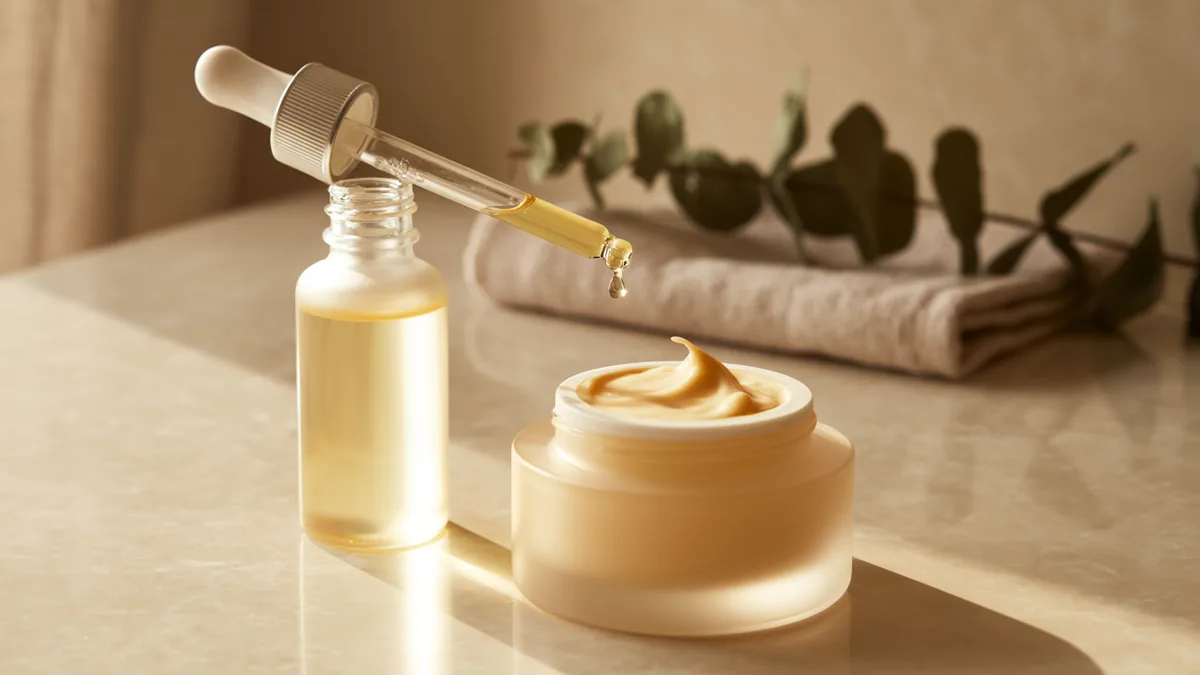
For about six years I bought serums and moisturizers as if they were interchangeable, picking whichever bottle had the prettiest label and the word my skin seemed to need that month. Hydrating. Brightening. Calming. I owned nine bottles and a face that still felt tight by lunchtime, and I could not have told you which product was supposed to be doing what.
The thing that finally sorted it out for me was not a dermatologist appointment or a viral video. It was noticing that my thin, expensive vitamin C bottle ran out in five weeks while my drugstore cream lasted five months, and wondering why two things I was using the same way behaved so differently. They behave differently because they are built for two completely separate jobs.
So this piece is the comparison I wanted back then. Not a list of product recommendations, but a plain look at what a serum is actually doing, what a moisturizer is actually doing, which one your money belongs in, and what happens if you only want to keep one. I have used both badly and both well, and the difference in my skin was larger than any single product swap ever made.
| What you are comparing | Face serum | Moisturizer |
|---|---|---|
| Its actual job | Carries a concentrated active down into the skin | Softens the surface and slows water loss |
| Texture and feel | Thin, watery, gel-like, sinks in fast | Lotion, cream or balm, opaque, sits and cushions |
| Usual bottle size | 1 fl oz or less, sold in a dropper or pump | 1.7 to 2 fl oz, sold in a jar, tube or pump |
| How much per use | Two to four drops, or one small pump | A pea for a light lotion, a hazelnut for a rich cream |
| Where it goes | Straight after cleansing, on damp skin | After the serum, before sunscreen in the morning |
| Can you skip it | Yes, on tired nights or if your skin has no complaint | Rarely, and only if very oily skin is genuinely comfortable |
| What it will not do | Seal in water on its own for hours | Deliver a meaningful dose of one targeted ingredient |
| Where the money goes | Worth spending on, the actives cost something | Cheap ones are often excellent, spend less here |
The real difference, in one paragraph
The difference: A face serum is a thin, high-concentration treatment designed to deliver one or two active ingredients into the skin, while a moisturizer is a thicker blend of humectants, emollients and occlusives designed to soften the surface and slow water loss.
Think of it as treating versus protecting. A serum walks in carrying something specific, a dose of vitamin C, niacinamide, retinol, peptides, hyaluronic acid, and its whole formula is built to get that ingredient past the top layer without dragging along a lot of heavy filler. That is why it feels like water and disappears in seconds. There is very little in there apart from the active and the vehicle carrying it.
A moisturizer has a broader, dumber, more important job. It is trying to leave your skin comfortable, and it does that three ways at once. Humectants like glycerin pull water toward the surface. Emollients like squalane and fatty alcohols fill in the rough gaps between skin cells so everything feels smooth. Occlusives like petrolatum, shea butter or dimethicone lay a soft film on top that slows how fast that water escapes.
Those three functions need bulk to work. You cannot spread a film with four drops of watery fluid, which is exactly why a serum cannot replace a cream no matter how expensive it is. And a cream cannot replace a serum either, because in order to feel good on the face it has to be mostly base, which leaves very little room for a real dose of anything targeted.
The American Academy of Dermatology describes moisturizer's role in terms of trapping water in the skin, which is a useful frame. Trapping is a passive, physical job. Treating is an active, chemical one. Two jobs, two bottles, and once I understood that I stopped being annoyed that my serum did not stop the tightness.
How to tell them apart when the label is vague
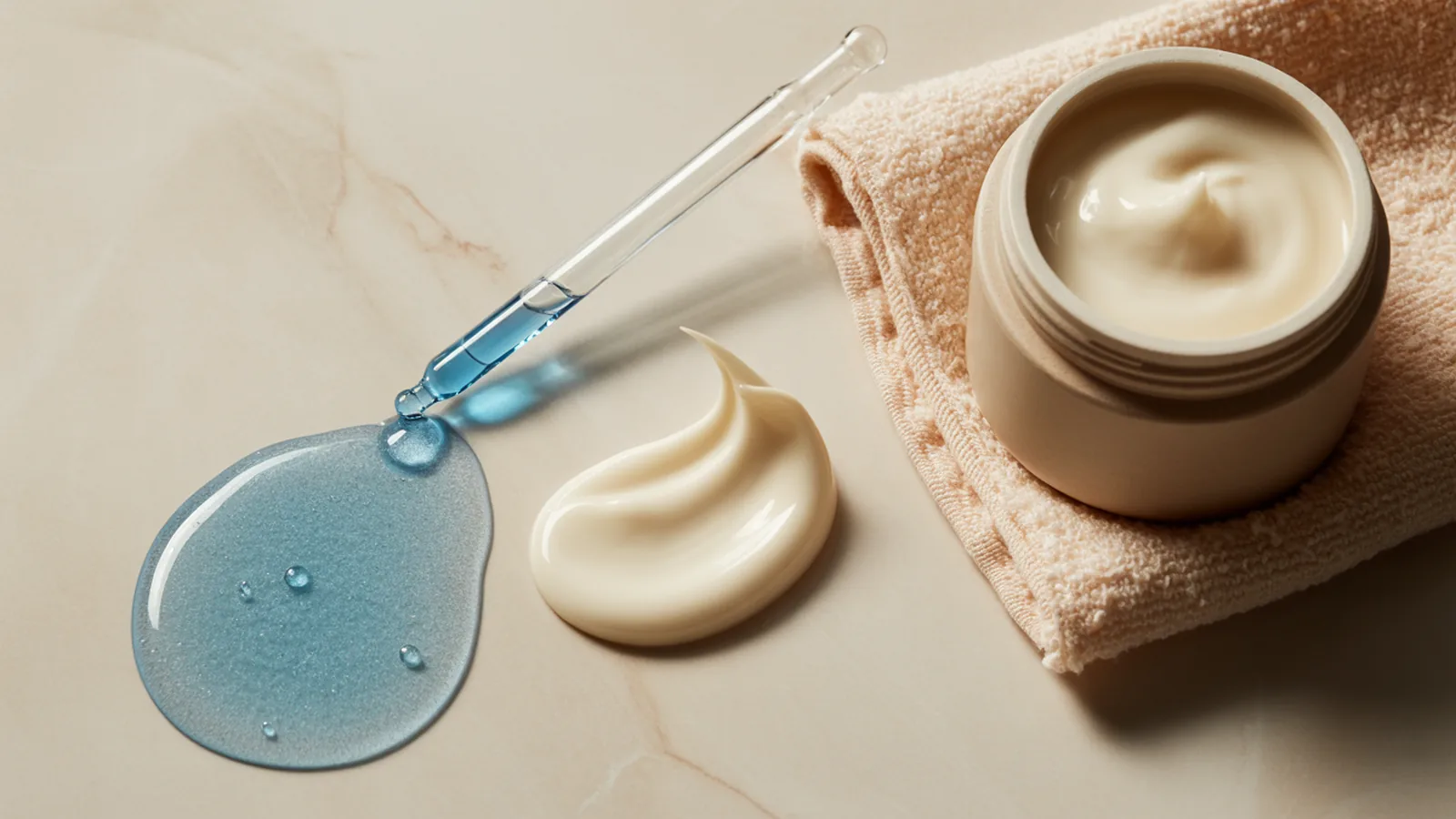
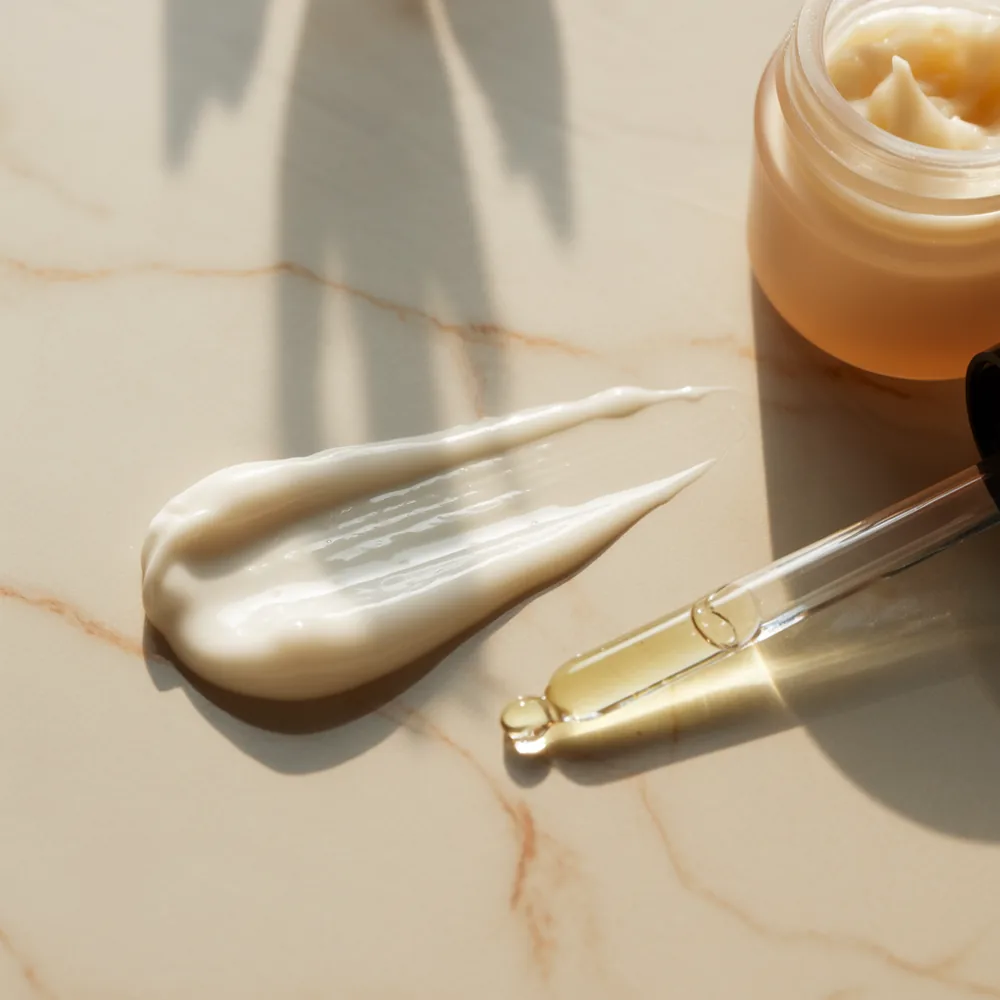
The quick test: Put a drop on the back of your hand and tilt it. If it runs, it is a serum. If it holds its shape and needs spreading, it is a moisturizer, regardless of what the front of the bottle calls it.
Brands are not obligated to be honest about categories, and plenty are not. I have bought a product labeled a serum that was thick enough to sit in a peak on my hand, and a product called a moisturizing lotion that ran off my palm like milk. The word on the front tells you what the marketing team wanted; the tilt test tells you what you actually bought.
Packaging is a decent second clue. Serums come in small glass bottles with droppers or fine-mist pumps because you need a tiny amount and many actives dislike air and light. Moisturizers come in tubs, tubes and big pumps because you need volume. When a one ounce glass dropper costs more than a two ounce tub, you are usually looking at a real serum and a real cream, priced according to what is inside.
The ingredient list is the honest answer. Flip the bottle and read the first five ingredients. A serum will typically show water, then a humectant or two, then the active reasonably high up. A moisturizer will show water, then glycerin, then something rich like caprylic triglyceride, shea butter, squalane, or dimethicone, and often several of them stacked together in the top eight.
This matters practically because if you own two products that are both thin and both watery, you do not own a routine, you own two serums, and your face will still feel tight at three in the afternoon. That was my exact situation for two years. I had a hydrating essence, a hyaluronic serum, and nothing at all whose job was to keep any of it there.
Which goes first, and how long to wait
The order: Serum first, moisturizer second, always. Wait about sixty seconds between them, or until the serum stops feeling wet, then apply moisturizer while your face still feels slightly cool and tacky.
Serum goes on first because it is thinner and because it needs contact with skin, not with a layer of cream. Put the cream down first and the film is already built when the treatment shows up, so the active spends its energy on a layer engineered to keep things out. Some of it gets through. Not the amount you paid for.
The waiting question comes up constantly and the honest answer is that sixty seconds is plenty for most serums. Nothing deep is happening during that minute. The point is simply that a shiny, wet surface makes the cream skid and ball up, so you give it long enough to lose the shine. When the gloss has gone and your face still feels cool to the back of your fingers, go.
Two exceptions are worth knowing. Prescription or high-strength retinoids sometimes come with a wait of several minutes on completely dry skin, because for those the goal is a slower, gentler delivery, and your dermatologist may tell you to apply moisturizer first as a buffer. And thick anhydrous oil-based serums behave more like a light moisturizer, so if you use one, it goes after your cream, not before.
I time it with the rest of my morning rather than with a clock. Serum goes on, then I brush my teeth, then moisturizer, then sunscreen while the coffee finishes. That sequencing has survived every busy week I have had, which is more than I can say for any routine I built around counting minutes in front of a mirror. If you want the whole sequence including toner, essence, eye cream and sunscreen, I mapped it out in my skincare routine order guide.
Can you skip one? An honest answer
Skipping: Skipping the serum costs you targeted results but nothing structural. Skipping the moisturizer costs you comfort and barrier support, so it is the riskier omission for almost everyone except genuinely oily, comfortable skin.
If you are building a routine from nothing and can only buy one bottle, buy the moisturizer. This is not the answer beauty marketing wants, and it is the one I give every friend who asks. A moisturizer plus a gentle cleanser plus sunscreen is a complete, functional routine that will keep most faces comfortable for years. A serum on bare skin with nothing over it is a partial routine wearing a lab coat.
The exception is real oiliness. Some people, especially in humid summers, produce enough of their own surface lipids that a light hydrating serum genuinely leaves them comfortable all day, and adding cream on top makes them shiny and congested by noon. If that describes you, a humectant serum plus sunscreen in the morning is a legitimate routine. Test it for two weeks and judge by how your skin feels at four in the afternoon, not by how it looks at eight in the morning.
Skipping the serum is much lower risk. Serums are where you buy a specific outcome: fading a patch of sun damage, softening fine lines, calming redness, evening tone. If you have no particular complaint, you may simply not need one, and there is no penalty for going without. I skipped serums entirely for three months while my skin was reacting to something, and nothing bad happened. It was just skin, doing fine.
The situation I would push back on is skipping moisturizer at night in your thirties and beyond, on dry or normal skin, because you used a hydrating serum. Hyaluronic acid draws water into the upper layers, and in dry indoor air with nothing sealing it, some of that water leaves again. You can end up feeling tighter than if you had used nothing. That is the one combination I would call a genuine mistake rather than a preference.
The right pair for your skin type
By skin type: Dry skin wants a humectant serum under a rich cream. Oily skin wants a niacinamide serum under a gel. Combination skin can use one serum everywhere and two different moisturizers by zone.
Dry skin, which is skin missing oil, does best with a serum full of humectants and a moisturizer that is genuinely rich. Glycerin and hyaluronic acid in the serum, then a cream with shea butter, ceramides or squalane on top. If your face still feels tight an hour later, the problem is nearly always the cream being too light, not the serum being too weak.
Dehydrated skin, which is skin missing water, is a different animal and can happen on an oily face. Here the serum is doing most of the work, and the moisturizer just needs to hold the line. A lightweight gel cream over a hydrating serum often solves it in a week or two, faster than any heavy balm, because heaviness was never the missing piece.
Oily and breakout-prone skin does well with niacinamide or a low-strength salicylic serum, then a gel or fluid moisturizer that says non-comedogenic and feels like nothing. The instinct to skip moisturizer entirely tends to backfire, because stripped skin often compensates with more oil. I watched a friend cut her shine substantially by adding a light lotion, which sounded backwards until it worked.
Combination skin gets to cheat. Use one serum across the whole face, then two moisturizers: a gel on the forehead, nose and chin, something richer on the cheeks and jaw. It sounds fussy written down and takes about eight extra seconds in practice. Sensitive and reactive skin is its own case, and I would start with the moisturizer alone for two weeks, get calm, then introduce a single fragrance-free serum. My skin barrier repair routine covers that slower entry in detail.
Ingredients that belong in each bottle
What belongs where: Vitamin C, retinol, niacinamide, peptides and exfoliating acids belong in a serum. Ceramides, shea butter, squalane, fatty alcohols and dimethicone belong in a moisturizer. Glycerin and hyaluronic acid appear in both.
The actives that get the marketing budget almost all live on the serum side. Vitamin C for tone and antioxidant support, retinol and its relatives for texture and fine lines, niacinamide for redness and oil regulation, peptides for firmness signals, azelaic acid for bumps and post-blemish marks, glycolic or lactic acid for surface exfoliation. These need a thin base and a stable formula, which is precisely what a serum is.
The barrier ingredients almost all live on the moisturizer side. Ceramides, cholesterol and fatty acids because they mimic the mortar between your skin cells. Shea butter, squalane and plant oils because they soften. Dimethicone and petrolatum because they slow evaporation without clogging as often as people assume. None of these need to travel anywhere. They work exactly where you leave them, on the surface.
Two ingredients cross the line and confuse everyone. Glycerin and hyaluronic acid appear in both categories, because pulling water toward the surface is useful in a treatment and in a cream. If you see hyaluronic acid high in your moisturizer's list, you may not need a separate hydrating serum at all. That single realization let me delete a step and a bottle from my shelf without losing anything.
One practical note on stacking: if your moisturizer already contains niacinamide, which many now do, and you also use a niacinamide serum, you are not doubling the benefit. You are just spending twice. Read both labels once and you will often find you own two products aimed at the same problem while nothing in your routine addresses the thing that actually bothers you.
Where the pairing goes wrong
Common errors: Using two serums and no cream, applying moisturizer to bone-dry skin, using too much serum and too little moisturizer, and buying an expensive cream while using a cheap serum with no real active.
The most common mistake I see is a shelf holding three thin products and nothing thick. A toner, an essence and a serum are all in the same textural family, and none of them will keep water in your skin for eight hours. If your routine has no step that feels substantial, add one, even a basic drugstore lotion, and give it two weeks.
The second is applying both to completely dry skin. Both products work better on skin that is still slightly damp from cleansing, because humectants need available water to pull on. Not dripping wet, just not fully dried. This is a free upgrade that costs nothing and changed how my moisturizer performed more than switching brands ever did.
The third is a quantity imbalance. People use a generous amount of the cheap cream and a stingy amount of the expensive serum, when the serum is the one where dose matters for results. Four drops is a real dose. One nervous drop spread thin is not going to do much. Conversely, piling on cream past the point of comfort does nothing except leave a residue that makes sunscreen pill.
The fourth is a money mistake. A forty dollar cream and an eight dollar serum with no meaningful active in it is backwards. Good moisturizers exist at drugstore prices in a way that good high-dose actives generally do not. If your budget is fixed, and mine was for years, spend it on the serum and buy the boring reliable cream.
Where to spend and where to save
Budget rule: Spend on the serum, save on the moisturizer. Actives cost money to formulate and stabilize, while excellent ceramide and glycerin creams sell for under fifteen dollars at any drugstore.
My total skincare spend went down when I understood this and my results went up, which is not a sentence I expected to write. The cream I have used for the past two years costs about twelve dollars, comes in an unremarkable white tub, and has ceramides and glycerin near the top of the list. It has outperformed a sixty dollar cream I once saved up for and treasured.
The serum is different. A stable vitamin C formula, a well-buffered retinoid, or an encapsulated active takes formulation work and packaging that protects it, and that shows up in the price. This is not always true, and there are genuinely good affordable serums, but the gap between a cheap serum and a good one is wider than the gap between a cheap cream and a good one.
A practical way to test whether your serum is worth it: use it consistently for twelve weeks on one specific concern and photograph the area in the same light every two weeks. If nothing has moved, it is not the right serum for you, whatever it cost. Skin renews slowly, and twelve weeks is roughly the honest window for most actives to show something visible.
Cost per use is the number that actually matters, and serums quietly win there more often than people expect. A one ounce bottle at four drops twice a day lasts me about ten weeks. That works out to a manageable weekly number even for a bottle that felt uncomfortable at the register. Meanwhile a jar of cream I go through in six weeks at twelve dollars is genuinely cheap.
What sits on my shelf, morning and night
My pair: Mornings are a vitamin C serum under a light lotion and sunscreen. Nights are a retinol serum two or three times a week under a richer ceramide cream, with plain moisturizer on the off nights.
In the morning I cleanse with water only unless I wore makeup, pat until my face is barely damp, and press in three drops of a vitamin C serum. Then a light lotion, then sunscreen. The whole thing takes under two minutes and I do it standing at the bathroom sink with the door open and the kettle going, which is the only reason it has survived four years.
At night the retinol goes on Tuesday, Thursday and Sunday, on skin that is dry rather than damp, and then a thicker ceramide cream goes over it once the serum has stopped feeling wet. On the other four nights I skip the serum entirely and just use the cream, sometimes with a few drops of squalane oil pressed over the top when the heating has been on all week.
The thing I removed and never missed was the third product. For a while I had a hydrating serum, a treatment serum and a cream, which meant three waiting periods and a face that pilled under sunscreen. Cutting the hydrating serum and choosing a moisturizer with glycerin and hyaluronic acid already in it gave me the same comfort in one step less.
I want to be clear about what is evidence and what is my experience. That serums carry actives more efficiently than creams is well established. That vitamin C in the morning suits me better than at night is a personal preference with no strong data behind it. When I say something worked for my face, treat it as one woman's report, not a finding.
What to expect, and how long it takes
Timeline: Moisturizer changes how your skin feels within minutes and how it behaves within days. A serum works on a much slower clock, with visible tone and texture changes usually taking eight to twelve weeks of consistent use.
The moisturizer is the instant one. Comfort arrives while you are still standing at the sink, and within about a week you will know whether the one you chose is right, because your face will either stop feeling tight in the afternoon or it will not. That fast feedback is why I tell people to fix the moisturizer first. You find out quickly.
Serums ask for patience in a way that is genuinely hard. Cells at the surface renew across about four weeks, and trials of cosmetic ingredients rarely report anything before the three month mark. So giving up at week three produces no information at all, and I have thrown away real money doing precisely that, twice, on bottles that may well have been fine.
Some changes come sooner. Niacinamide often calms visible redness within a few weeks. Exfoliating acids can smooth texture in days. Retinol usually gets worse before it gets better, with a dry, flaky stretch around weeks two to four that makes people quit right before the useful part. The American Academy of Dermatology keeps a plain-language skin care basics hub that is worth ten minutes of your evening.
None of this is medical advice, and I am not a dermatologist. If you have persistent acne, rosacea, eczema, a reaction that will not settle, or a mole that has changed, see a board-certified dermatologist rather than adjusting bottles. Skincare products are cosmetics, and there are skin conditions that need actual treatment.
When keeping both won't fit your life
When to simplify: Drop to one product during flare-ups, in the first weeks after a baby, while traveling light, when money is tight, or any time the two-step routine has quietly stopped happening at all.
There are stretches where two bottles is one bottle too many, and pretending otherwise is how routines die. In the first months after my sister had her second baby, she washed her face in the shower and used whatever cream was within reach, and that was the correct routine for that season of her life. A serum she never opened would have been an expense and a small daily failure.
If your skin is actively upset, red, stinging, peeling, or reacting to something you cannot identify, stripping back to a bland cleanser and a bland moisturizer is the standard advice and it is good advice. Actives are the first thing to remove, not the thing to add. Give it two calm weeks before you reintroduce anything, and reintroduce one product at a time.
Travel is another honest exception. I stopped decanting serums into little bottles because they oxidized, leaked, or arrived useless, and now I take one moisturizer and sunscreen for anything under a week. My skin has never once punished me for it. The idea that a routine must be unbroken to work is anxiety dressed up as diligence.
And if money is the constraint, the two-step routine that fits a tight budget is a drugstore ceramide cream and a sunscreen, full stop. That is not a lesser routine. It is the foundation, and every serum in the world is an optional upgrade sitting on top of it.
Helpful sources and next reads
Reliable external sources
- American Academy of Dermatology: dermatologists' tips to relieve dry skin
- American Academy of Dermatology: everyday skin care tips dermatologists use
- American Academy of Dermatology: skin care basics hub
- Cleveland Clinic: the right order to apply skin care products
More from Sabrina Saturno
You may also love

FAQ
Do I really need both a serum and a moisturizer?
You need a moisturizer far more than you need a serum. The moisturizer keeps your skin comfortable and supports the barrier, which is foundational. A serum is a targeted upgrade for a specific concern like tone, texture or redness, and it is genuinely optional if you have no complaint you are trying to address.
Which one goes on first, serum or moisturizer?
Serum first, then moisturizer. Serums are thinner and need direct contact with skin to deliver their active ingredient, while moisturizer forms a film on top. Reversing them puts the active up against a layer engineered to keep water in and other things out, so most of the dose goes nowhere.
How long should I wait between serum and moisturizer?
About sixty seconds is enough for most water-based serums. You are waiting for the visible wetness to disappear so the next layer spreads without pilling, not for deep absorption. If your skin still looks shiny, give it another thirty seconds before you apply the cream.
Can a serum replace my moisturizer?
For most skin, no. Serums lack the emollients and occlusives that slow water loss, so they cannot hold moisture in over a full day. The exception is genuinely oily skin in humid weather, where a hydrating serum plus sunscreen sometimes leaves the face comfortable without a cream.
Can a moisturizer replace my serum?
It can if your only goal is hydration, since many moisturizers already contain glycerin and hyaluronic acid. It cannot replace a serum if you want a real dose of vitamin C, retinol or an exfoliating acid, because a cream base leaves too little room for a meaningful concentration.
Is a face oil a serum or a moisturizer?
Neither exactly, though it behaves more like a moisturizer. A face oil is mostly emollient and occlusive, so it softens and seals but does not pull water in. Because it is oil-based, it goes on after your water-based moisturizer rather than before, at the very end of the routine.
Why does my moisturizer pill over my serum?
Usually because the serum was not dry yet, or because one of the products contains a silicone or film former that does not play well with the other. Wait longer between layers, use less of each, and if it persists, swap one product rather than trying to force the pair to cooperate.
Should I use a serum in the morning or at night?
It depends on the active. Vitamin C and niacinamide suit mornings under sunscreen. Retinol and exfoliating acids belong at night because they increase sun sensitivity and because the evening gives them uninterrupted hours. Hydrating serums are fine at either end of the day.
How many drops of serum should I use?
Two to four drops for the whole face, or one small pump. That is a real dose spread across five points, forehead, both cheeks, nose and chin, then pressed outward. Using less to make the bottle last longer is a false economy, since dose is part of why the active works.
Can I use two serums at once?
You can, though I would not start there. If you do, apply the thinner one first, wait, then the second, and avoid stacking two strong actives like retinol and a glycolic acid on the same night. Two serums also means two waiting periods, which is often where routines quietly collapse.
Does a serum work without moisturizer on top?
It works less well, particularly a hydrating one. Humectants draw water toward the surface, and in dry indoor air with nothing sealing it, some of that water evaporates away. On dry or normal skin this can leave you tighter than using nothing at all, which is the one combination I would call a genuine error.
Which should I spend more money on?
The serum. Actives require formulation work and protective packaging that cost real money, while excellent ceramide and glycerin moisturizers sell for around twelve dollars at any drugstore. If your budget is fixed, buy the cheap reliable cream and put the difference into a serum with a proven active.
How long before I see results from a serum?
Give it two to three months of steady use before you decide anything. Surface cells renew across about four weeks, and trials of cosmetic ingredients rarely report before three months. Take a photograph of the area that bothers you in identical light every fortnight, since slow change is impossible to see from memory.
The version that lasts
The version of this that has actually held for me over four years is two bottles and no debate. One cream that is genuinely rich enough for my face in February, bought cheaply and replaced without ceremony. One serum aimed at the single thing I most want to change, bought carefully and used at a real dose. Everything else I have owned was optional, and most of it left the shelf.
What made it stick was letting the moisturizer be boring. I stopped shopping for it, stopped reading reviews about it, and stopped hoping a new one would transform anything. It is infrastructure. The serum is where curiosity is allowed to live, and keeping that curiosity confined to one product per season saved me both money and the low-grade confusion of never knowing which bottle was responsible for what.
There are only two things here I would insist on, and they are the order and the dose. Serum on damp skin first, a real four drops, then a minute, then enough moisturizer to feel comfortable rather than coated. That sequence costs nothing extra, works with a twelve dollar cream, and will do more for your face than any bottle you are currently being told to buy.