
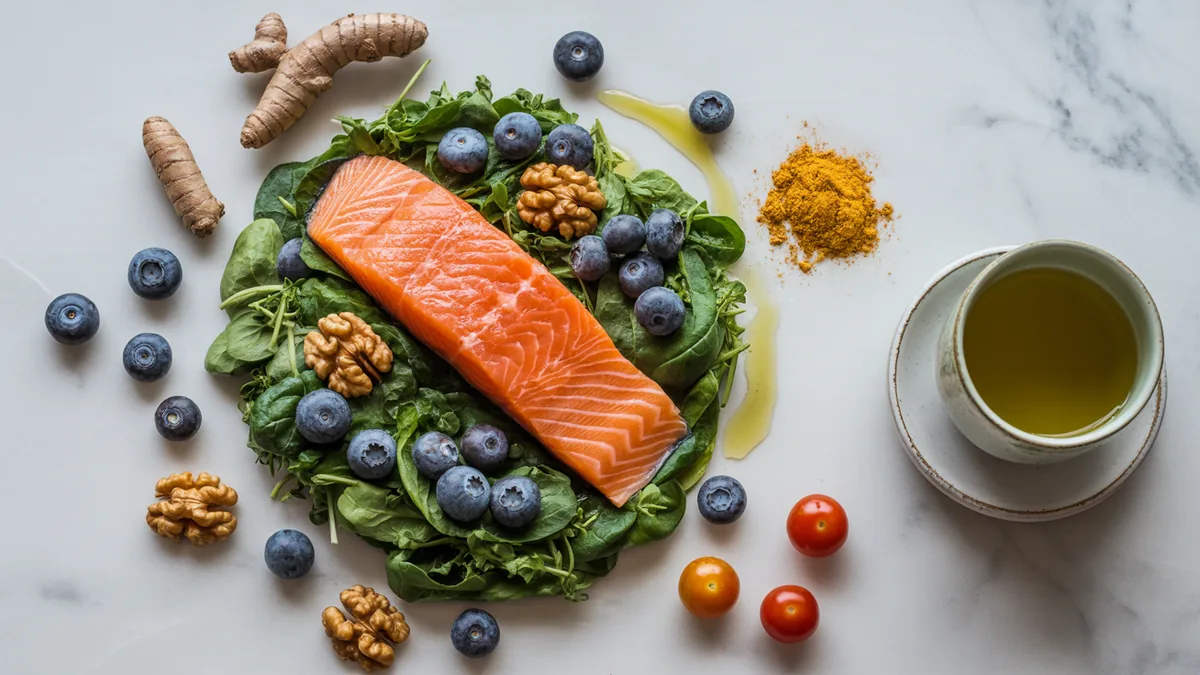
If you want the short answer, an anti-inflammatory way of eating is built from fatty fish, leafy greens, berries, extra-virgin olive oil, nuts and seeds, colorful vegetables, and warming spices like turmeric and ginger. No single item on that list is a fix, and I want to be honest about that from the first line. What the research keeps pointing to is a pattern, a way of filling the plate week after week, rather than one magic ingredient you buy and forget.
I started paying attention to these foods slowly, the way I come to most things now. There was no dramatic before and after, just a growing curiosity about which foods kept showing up when I read careful, sourced writing on the subject. The same handful appeared again and again, and they happened to be foods I already liked. That felt less like a diet and more like permission to lean into salmon, olive oil, and a bowl of berries without overthinking it.
I am not a doctor or a dietitian, and I will say that more than once here, because inflammation touches real medical territory. Chronic inflammation and any health condition belong in a conversation with a professional who knows your history. Food can support how you feel, but it does not replace medical care. What I can offer is a clear, organized list of the foods themselves, the compound behind each one, and the plain, unfussy ways I fold them into an ordinary week.
| Food | Key compound | How I use it |
|---|---|---|
| Salmon, sardines, mackerel | Omega-3 EPA and DHA | Twice a week, roasted or straight from a tin |
| Leafy greens (spinach, kale) | Vitamin K, polyphenols | A handful folded into most lunches |
| Blueberries, strawberries | Anthocyanins | Frozen, stirred into oats or yogurt |
| Extra-virgin olive oil | Oleocanthal | My default fat for cooking and dressing |
| Walnuts, chia, flax | ALA omega-3 | Sprinkled over breakfast most mornings |
| Broccoli, Brussels sprouts | Sulforaphane | Roasted as a simple side |
| Tomatoes | Lycopene | Cooked into sauces, which frees more of it |
| Turmeric with black pepper | Curcumin | In warm drinks and on roasting trays |
| Ginger | Gingerol | Grated into tea and stir-fries |
| Green tea | EGCG | In place of my third coffee |
What inflammation is, and the honest limits
Start here: Anti-inflammatory eating is a pattern, not a cure. The Mediterranean style of eating has the most research behind it.
Inflammation itself is not the villain it gets painted as. Short-term inflammation is how your body responds to a cut or a cold, and it is supposed to switch on and then settle back down. The concern people are usually reaching for is low-grade inflammation that lingers, the quiet kind associated with a diet heavy in ultra-processed foods and light on plants. Food is only one thread in that picture, alongside sleep, movement, and stress, so I hold the whole idea loosely.
Here is the honest limit I want you to carry through the rest of this list. No berry, spice, or fish fillet has been shown to cure anything on its own, and anyone selling a single food that way is overpromising. What the evidence supports is a broad pattern, and the pattern with the deepest research behind it is the Mediterranean style of eating, rich in vegetables, olive oil, fish, and whole grains. The foods below are simply the recurring characters in that pattern.
If you want the calm, long-form version of how I put this into practice, I wrote it all out in my anti-inflammatory eating complete guide, and this list is the companion piece to it. For outside reading from people far more qualified than me, the overview from Harvard Health on foods that fight inflammation is a grounded, non-hyped place to begin. Everything I share here is meant to sit alongside that kind of source, not replace it.
The omega-3 foods, fatty fish first
The anchor: Fatty fish like salmon, sardines, and mackerel carry omega-3 fats (EPA and DHA) most associated with a calmer inflammatory picture.
If I had to name the food group at the center of this whole list, it would be fatty fish. Salmon, sardines, mackerel, and anchovies carry long-chain omega-3 fats called EPA and DHA, and these are the fats most consistently linked in research to a lower inflammatory profile. Your body cannot make them in any real quantity, so they have to come from what you eat. This is the one group I make a genuine effort to hit a couple of times a week.
In practice this is easier and cheaper than the word salmon suggests. A tin of sardines on toast is one of my fastest lunches, and tinned salmon works the same way for a fraction of the price of a fresh fillet. When I do buy fresh, I roast it at a high heat with lemon and olive oil and call it dinner. The point is regular, not fancy. Two modest servings a week does more for the pattern than one expensive fillet you agonize over.
Plant eaters are not left out here, though the story is a little different. Foods like walnuts, chia, and flax carry a shorter-chain omega-3 called ALA, which the body converts to EPA and DHA only partly. That is worth knowing rather than fearing, and it is exactly why those seeds get their own spot further down this list. If fish is not part of your life, you lean harder on the plant sources and, in some cases, talk to a doctor about whether a supplement makes sense for you.
Leafy greens and berries
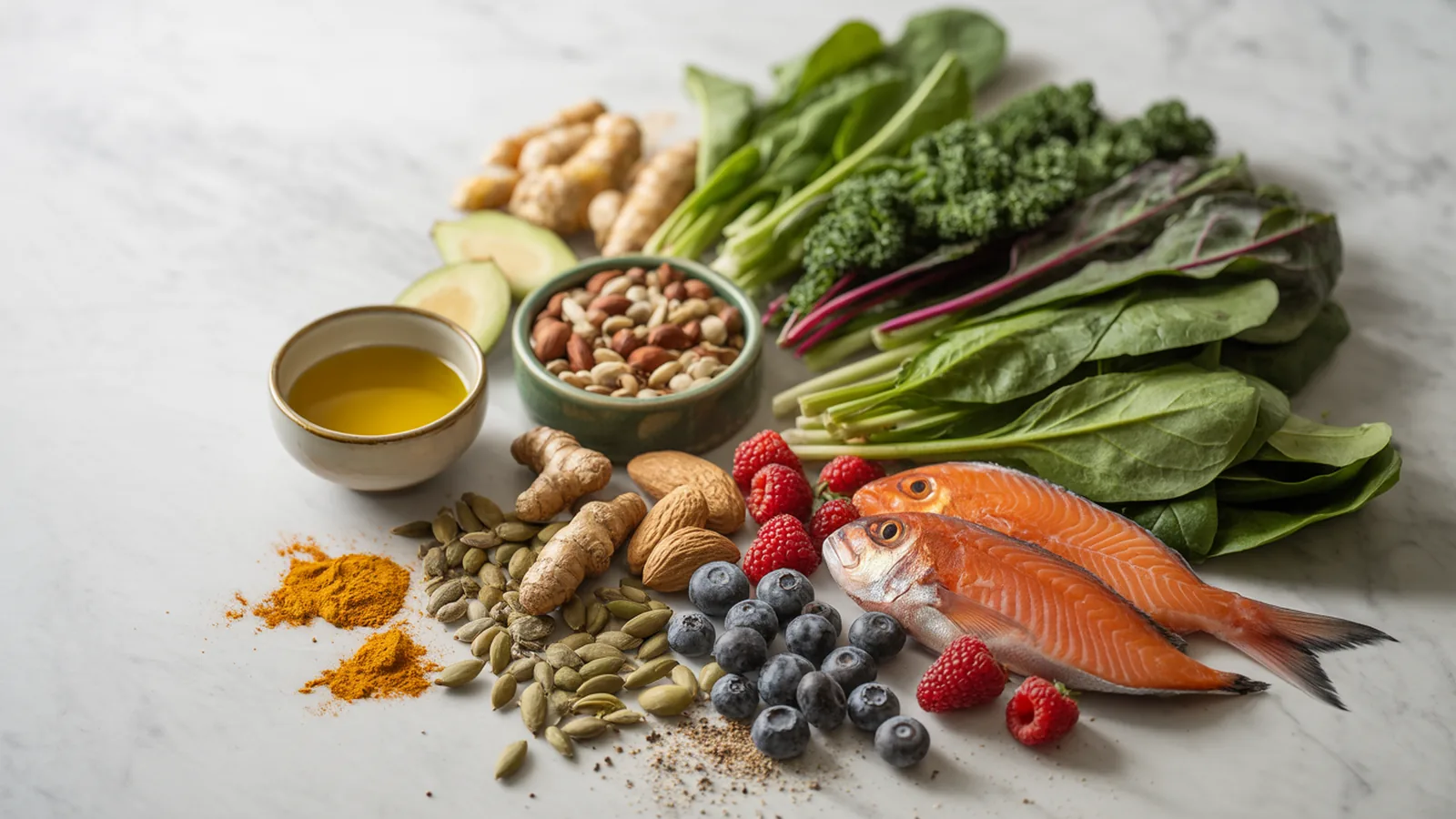
The color foods: Leafy greens bring vitamin K and polyphenols; berries bring anthocyanins, the pigment linked to their deep blue and red color.
Leafy greens are the least glamorous and most reliable foods on this list. Spinach, kale, chard, and their relatives carry vitamin K, folate, and a spread of plant polyphenols, the antioxidant compounds associated with dampening the low-grade inflammation I mentioned earlier. I have stopped treating greens as a salad-only event. A handful wilts into eggs in seconds, disappears into a pasta sauce, and hides completely in a smoothie, which is how I get them in on days I have no appetite for a salad.
Berries are the part of this list that feels like a treat, which is a lovely thing to be able to say about a health food. Blueberries, strawberries, blackberries, and raspberries owe their deep color to anthocyanins, the pigment compound studied for its antioxidant behavior. I buy them frozen without a shred of guilt, because frozen berries are picked ripe and hold their nutrients well, and they cost a fraction of the fresh punnets in winter.
The way I actually eat both is unremarkable and repeatable, which is the only kind of habit that survives. Berries go into oats, yogurt, or straight into my hand by the fistful. Greens go into whatever is already cooking. I do not measure any of it. I just try to make sure some green thing and some deeply colored fruit show up on the plate most days, and over a week that adds up to a genuinely produce-forward way of eating.
Cruciferous vegetables and tomatoes
Two quiet workhorses: Cruciferous vegetables carry sulforaphane; tomatoes carry lycopene, which your body absorbs better once they are cooked.
Cruciferous vegetables are the broccoli family, and they earn their place through a compound called sulforaphane, formed when you chop or chew them. Broccoli, Brussels sprouts, cauliflower, cabbage, and arugula all belong here. I used to boil these into sad, gray submission, which is the surest way to make anyone hate them. Roasting changed everything for me. A tray of broccoli or halved Brussels sprouts in olive oil and salt, browned at the edges, is a vegetable I actually reach for rather than endure.
Tomatoes bring lycopene, the pigment behind their red color and one of the more studied antioxidants in an everyday food. There is a lovely quirk here worth knowing. Lycopene becomes more available to your body when tomatoes are cooked and eaten with a little fat, so a simple tomato sauce simmered in olive oil is arguably doing more for you than a raw slice. That fact alone made me stop feeling like fresh was always the higher form of a vegetable.
Between these two groups you get a wide sweep of color and compounds for very little money, which matters to me. Cabbage and tinned tomatoes are among the cheapest foods in the store, and they carry real nutritional weight. If you are building a cart around this idea, my anti-inflammatory grocery list walks through exactly what I put in the trolley and roughly what it costs, so the pattern stays affordable rather than aspirational.
Olive oil, nuts, and seeds
The good fats: Extra-virgin olive oil carries oleocanthal; walnuts, chia, and flax carry ALA omega-3 plus fiber and minerals.
Extra-virgin olive oil is the fat I cook and dress almost everything with, and it belongs high on any anti-inflammatory list. Its standout compound is oleocanthal, a natural molecule in fresh, good-quality oil that has been studied for behavior loosely compared to mild anti-inflammatory action. I do not overthink the science of it. I just choose extra-virgin over refined oils, keep it away from heat and light, and use it generously enough that vegetables actually taste like something.
Nuts and seeds are the pocket-sized members of this group, and they pull double duty. Walnuts stand out for their ALA omega-3, while chia and flax bring that same fat alongside a genuinely useful amount of fiber. Chia in particular has become a staple in my kitchen, and I broke down its full profile in my piece on chia seeds nutrition if you want the numbers. A spoonful of any of these over breakfast is one of the lowest-effort upgrades I know.
The honest caveat with fats is portion, not fear. Olive oil, nuts, and seeds are calorie-dense by nature, and that is fine, because they are also filling and satisfying. I am not measuring tablespoons, but I am also not pretending a fistful of walnuts is a free food. A drizzle of oil and a small handful of nuts is the mental picture I keep. Enjoyed at that scale, they make the rest of the list taste good, which is what keeps me eating this way at all.
Turmeric and ginger
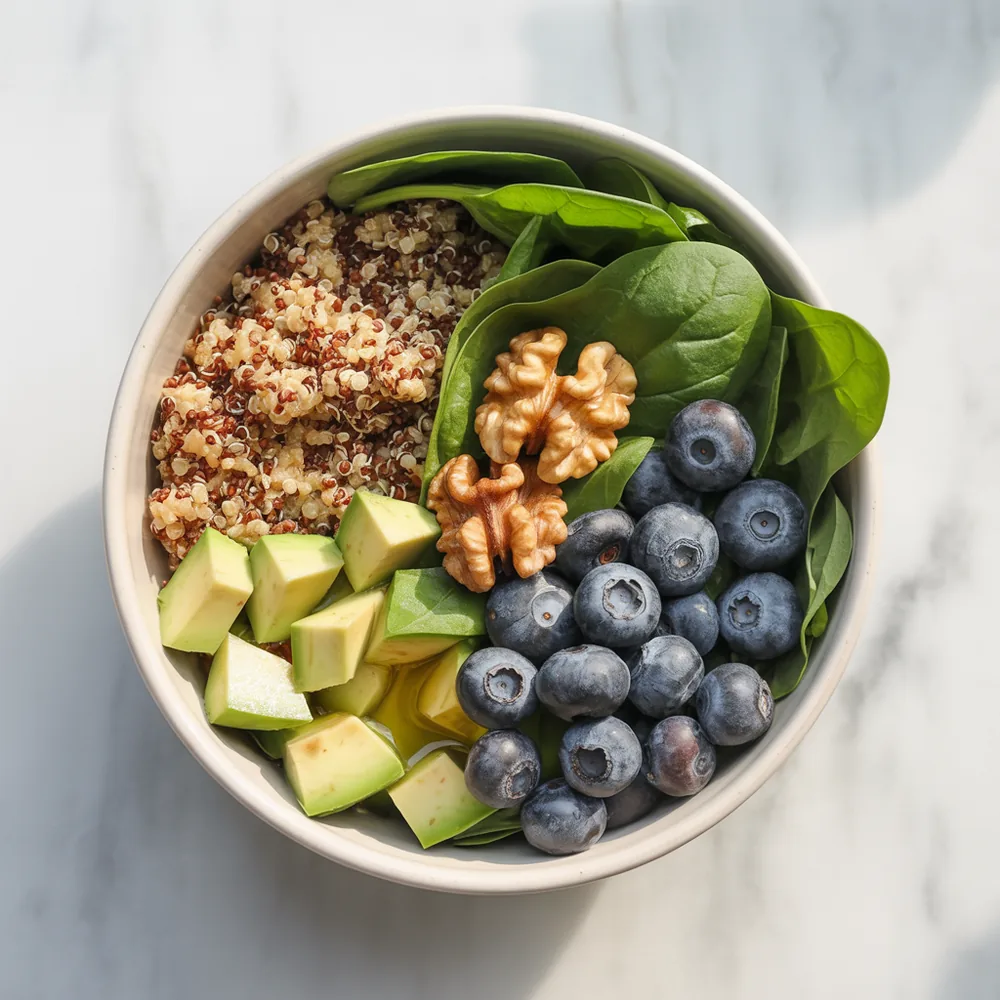
The warming spices: Turmeric's curcumin is absorbed far better with black pepper; ginger's gingerol is the compound behind its studied reputation.
Turmeric is the spice most people picture when they hear the words anti-inflammatory, and its active compound is curcumin. There is a practical detail that gets left out of the excited headlines, though. Curcumin is poorly absorbed on its own, and a pinch of black pepper dramatically improves how much of it your body can actually use. So I never cook with turmeric without adding pepper, whether it is stirred into a warm drink at night or rubbed onto vegetables before roasting.
Ginger sits right beside it, both in my spice drawer and in the research. Its warming bite comes from a compound called gingerol, and ginger has a long, studied reputation in the context of digestion and everyday comfort. I keep a knob of fresh ginger in the freezer and grate it, still frozen, into tea, stir-fries, and dressings. Fresh gives a brighter result than the dried powder, and freezing means it never goes soft and wasted at the back of the fridge.
I want to be careful here, because spices are where anti-inflammatory talk tips most easily into overclaiming. A latte does not undo a stressful week, and no amount of turmeric replaces the boring fundamentals of sleep and movement. What these spices genuinely offer is flavor that makes vegetables and whole foods more enjoyable, plus compounds that appear in the wider body of research. I treat them as a happy, aromatic bonus layered on top of the pattern, not as the point of it.
Green tea, and a square of dark chocolate
Small pleasures: Green tea carries EGCG, a studied polyphenol; dark chocolate and cocoa carry flavanols, best kept to a small square.
Green tea earns a quiet place on this list through a polyphenol called EGCG, one of the more researched plant compounds in a everyday drink. I am not precious about ceremony with it. Most days it is simply what I reach for when I want warmth and a little lift but have already had enough coffee. Swapping a third cup of coffee for green tea is one of the smallest changes I have made, and it costs nothing and asks nothing of me.
Dark chocolate is the item that makes this list feel human, and I include it honestly rather than as a gimmick. Cocoa carries flavanols, the same broad family of plant compounds found in tea and berries, and darker chocolate with a high cocoa percentage carries more of them with less sugar. The catch is obvious and I will not pretend otherwise. This only counts as a small square of genuinely dark chocolate, savored, not a bar of sweet milk chocolate treated as a health food.
I keep both of these in the category of small pleasures that happen to align with the pattern, which is a nice place for a food to live. They are not doing heavy lifting, and I would not build a day around them. But they show that eating this way is not about deprivation. A warm cup and a square of something bitter and good are proof, to me, that a calm way of eating still has room for the things I simply enjoy.
Whole grains and legumes
The fiber base: Whole grains and legumes bring fiber that feeds gut bacteria, a link researchers increasingly connect to the inflammatory picture.
Whole grains and legumes are the unglamorous foundation the rest of this list sits on, and I think they get overlooked because they are cheap and familiar. Oats, brown rice, barley, quinoa, lentils, chickpeas, and beans all bring fiber, and fiber is the thread that connects food to the gut in a way research keeps circling back to. The bacteria in your gut feed on that fiber, and a well-fed gut is increasingly linked, in careful studies, to a calmer inflammatory picture overall.
The swap from refined to whole is where most of the benefit lives, and it is a low-drama change. Brown rice instead of white some of the time, whole-grain bread instead of the fluffy white loaf, oats instead of a sugary cereal. I do not treat this as all or nothing, because that is how good habits die. Legumes in particular are a bargain I lean on hard. A pot of lentil soup or a tin of chickpeas roasted crisp stretches a food budget and adds fiber at the same time.
One gentle piece of advice from my own kitchen. If you are not used to much fiber, add these slowly and drink more water, because a sudden jump can leave your stomach unhappy for a few days. Your gut adjusts, but it likes a gradual introduction. Start with a serving a day, let your body catch up, and build from there. Done patiently, whole grains and legumes become the quiet, filling base that makes the whole pattern sustainable rather than something you white-knuckle through.
Fiber is also the thread running through digestion, and I built a separate structured list around that in Gut Health Foods List: What I Restock.
The foods I keep to the edges
The other side: Ultra-processed foods, refined carbs, excess added sugar, processed meats, and trans fats are the ones linked to more inflammation.
A foods-to-eat list is only half the story, so here is the other half, told without drama. The foods most often associated with more inflammation are ultra-processed products, refined carbohydrates, a heavy load of added sugar, processed meats, and trans fats. That is the general direction the research points, and it lines up with common sense about what a whole-food diet looks like. The Cleveland Clinic guide to anti-inflammatory eating covers this territory clearly if you want more detail.
I want to be firm about the tone here, because this is where healthy eating turns judgmental fast. I do not have banned foods, and I do not think a single doughnut or a plate of white pasta is doing you harm. The word that matters is pattern, again. It is the day-after-day baseline that shapes how you feel, not the occasional treat eaten with pleasure. Keeping these foods to the edges of the week, rather than the center, is the whole idea. Edges, not exile.
In real terms, that looks like cooking most of my meals from recognizable ingredients and letting the packaged, sugary, and heavily processed stuff be the exception rather than the routine. I still eat cake at a birthday. I still love a bag of crisps now and then. The difference is that these sit on top of a base of the foods higher up this list, instead of making up the base themselves. That balance is honest, livable, and, for me, far easier to keep than any rulebook.
How I build a week around this list
The practical part: Aim for fish twice a week, a green and a colorful vegetable most days, olive oil as your default fat, and legumes on repeat.
Lists are easy to admire and hard to live, so here is how I turn this one into an actual week without a spreadsheet. My loose targets are simple enough to hold in my head. Fatty fish twice a week. Some leafy green and some deeply colored vegetable most days. Olive oil as the default fat. Legumes a few times a week. Berries or fruit daily. Everything else is a bonus layered on when it is convenient, not a box I feel pressured to tick.
I shop around those anchors rather than around recipes, which keeps the whole thing flexible. A cart with greens, frozen berries, tinned fish, olive oil, a bag of lentils, some tomatoes, and a few pantry spices can become a dozen different meals depending on my mood. That is the same thinking behind my anti-inflammatory grocery list, which is basically this section turned into an actual shopping trolley you can copy or adapt.
Batching is the last piece that makes it real on a tired weeknight. I roast a big tray of mixed vegetables at the start of the week, cook a pot of grains or lentils, and keep tinned fish and frozen berries on standby. With those few things ready, assembling a bowl that hits most of this list takes minutes, not planning. The goal was never a perfect day. It was making the good default the easy default, so that the pattern holds even when I have no energy to think about it.
A realistic day on my plate
What it looks like: Berry-and-seed oats, a big lunch salad with tinned salmon and olive oil, and roasted vegetables with lentils for dinner.
To make all of this concrete, here is a genuinely ordinary day, not a staged one. Breakfast is oats stirred with frozen blueberries, a spoon of chia, and a few chopped walnuts, which quietly checks off a berry, a couple of omega-3 seed sources, and some whole grain before I have properly woken up. It takes the same five minutes as any other breakfast, which is the only reason it has lasted as a habit rather than a phase.
Lunch is the meal I lean on to carry most of the produce. A big bowl of leafy greens with a tin of salmon or sardines, halved tomatoes, whatever roasted vegetables are left from the week, and a proper glug of olive oil with lemon. It is filling, it is fast, and it single-handedly covers greens, fish, tomatoes, and good fat. On days I want something warm instead, that same combination goes into a lentil soup with a handful of spinach thrown in at the end.
Dinner stays loose because by evening I have no interest in a project. Often it is a tray of roasted broccoli or Brussels sprouts with olive oil, alongside a grain and either beans or a piece of fish. A square of dark chocolate and a cup of ginger tea close it out. Nothing about that day is impressive or difficult, and that is exactly the point. A day like this is repeatable, and repeatable is the only thing that actually matters over a year.
When this list won't fit your life
Honest fit: Allergies, budget, and medical conditions all matter more than any list. Some of these foods interact with medication, so talk to your doctor.
I would rather end with honesty than a tidy bow, because no single list fits every life. Allergies and intolerances rewrite it instantly. A shellfish or fish allergy takes a whole group off the table, a nut allergy takes another, and that is not a failure of the diet, it is just your reality, and it is entirely workable around. The pattern is generous enough that you can drop several foods and still eat beautifully from what remains. Hold the idea loosely and swap freely.
Budget and circumstance matter just as much, and I never want this to read as a list for people with money and time to spare. Frozen berries, tinned fish, cabbage, lentils, and oats are among the cheapest foods in any store, and they carry real weight here. If fresh salmon and specialty ingredients are out of reach, you are not locked out of this way of eating. The affordable core does most of the work, and the expensive extras are genuinely optional.
The most important caution is medical, and I will not soften it. Some of these foods interact with medication. Turmeric in large amounts, and other supplements, can affect blood thinners, and high-vitamin-K greens can matter for people on certain medications too. If you have a health condition or take any regular medication, raise these foods with your doctor before making big changes, especially with concentrated supplements. Food can support how you feel, but it does not replace medical treatment, and chronic inflammation in particular deserves proper care. This article is one person's honest experience, not medical advice.
Helpful sources and next reads
Reliable external sources
More from Sabrina Saturno
You may also love


FAQ
What are the top anti-inflammatory foods?
Fatty fish, leafy greens, berries, extra-virgin olive oil, nuts and seeds, cruciferous vegetables, tomatoes, turmeric, ginger, green tea, and whole grains with legumes. It is the overall pattern that matters, not any single one.
Is there one food that fights inflammation the most?
No single food does the job alone, and it is worth being wary of anything sold that way. Fatty fish and its omega-3 fats sit near the center, but the research supports a whole pattern of eating rather than one hero ingredient.
Do I have to eat fish to eat this way?
No. If fish is not for you, lean harder on plant omega-3 sources like walnuts, chia, and flax, and eat plenty of greens, legumes, and colorful vegetables. Some people also ask a doctor about an omega-3 supplement.
Why do you add black pepper to turmeric?
Curcumin, the active compound in turmeric, is poorly absorbed on its own. A small pinch of black pepper improves how much your body can actually use, so I never cook with turmeric without it.
Are frozen berries as good as fresh?
For this purpose, yes, and often cheaper. Frozen berries are usually picked ripe and hold their nutrients well, so I use them without hesitation, especially in the colder months when fresh ones are pricey.
Is dark chocolate really anti-inflammatory?
Cocoa carries flavanols, the same broad family of plant compounds found in tea and berries, and darker chocolate has more of them with less sugar. It only counts as a small square of genuinely dark chocolate, not a sweet milk bar.
What foods should I limit?
Ultra-processed foods, refined carbohydrates, a heavy load of added sugar, processed meats, and trans fats are the ones most linked to more inflammation. I keep them to the edges of the week rather than banning them outright.
Can anti-inflammatory foods cure a health condition?
No. Food can support how you feel, but it does not cure or replace medical care. Any health condition, and chronic inflammation in particular, should be managed with a doctor who knows your history.
Is this the same as the Mediterranean diet?
They overlap heavily. The Mediterranean pattern, rich in vegetables, olive oil, fish, and whole grains, has the most research behind it, and this list is essentially the everyday foods that make up that pattern.
Do I need supplements for this to work?
Not usually. The whole idea rests on ordinary foods rather than pills. Some people do consider an omega-3 supplement, especially if they skip fish, but that is a conversation to have with a doctor, not a default.
Can these foods interact with my medication?
They can. Turmeric in large amounts can affect blood thinners, and high-vitamin-K greens matter for some medications. If you take anything regularly, raise these foods with your doctor before making big changes or using supplements.
How long until I notice a difference?
There is no set timeline, and I would be cautious of anyone who promises one. This is about a long-term pattern that supports how you feel over months and years, not a quick reset you measure in days.
What is the cheapest way to eat anti-inflammatory foods?
Frozen berries, tinned fish, cabbage, tomatoes, oats, and lentils are among the cheapest foods in any store and carry real weight here. The affordable core does most of the work, and the pricey extras are optional.
The version that lasts
The version of this that lasts for me is looser than any list makes it look. I do not track compounds or tick boxes at the table. I just keep a short mental picture of the foods above and let it quietly shape what lands in my cart and on my plate. Some weeks I hit most of it, some weeks I do not, and neither outcome carries any guilt. The pattern is forgiving by design, which is the only reason it has stayed with me.
What changed for me was the shift from fear to preference. I stopped thinking about inflammation as something to fight and started thinking about these foods as ones I genuinely like eating. Roasted vegetables in good olive oil, a bowl of berries, a tin of sardines on toast, a cup of ginger tea. Framed that way, the list stopped feeling like a rulebook and started feeling like a description of how I already wanted to eat.
If a single lesson survives all of this, let it be that no food on the list is a cure, and the pattern is what counts. Eat the fish and the greens and the olive oil most of the time, keep the processed stuff to the edges, and check in with a doctor about anything that touches your health or your medication. Do that, and you have the whole idea. The rest is just choosing, week after week, the foods you will actually enjoy repeating. If you would like these arranged into actual meals for a fixed stretch, see my 10 day detox meal plan.