
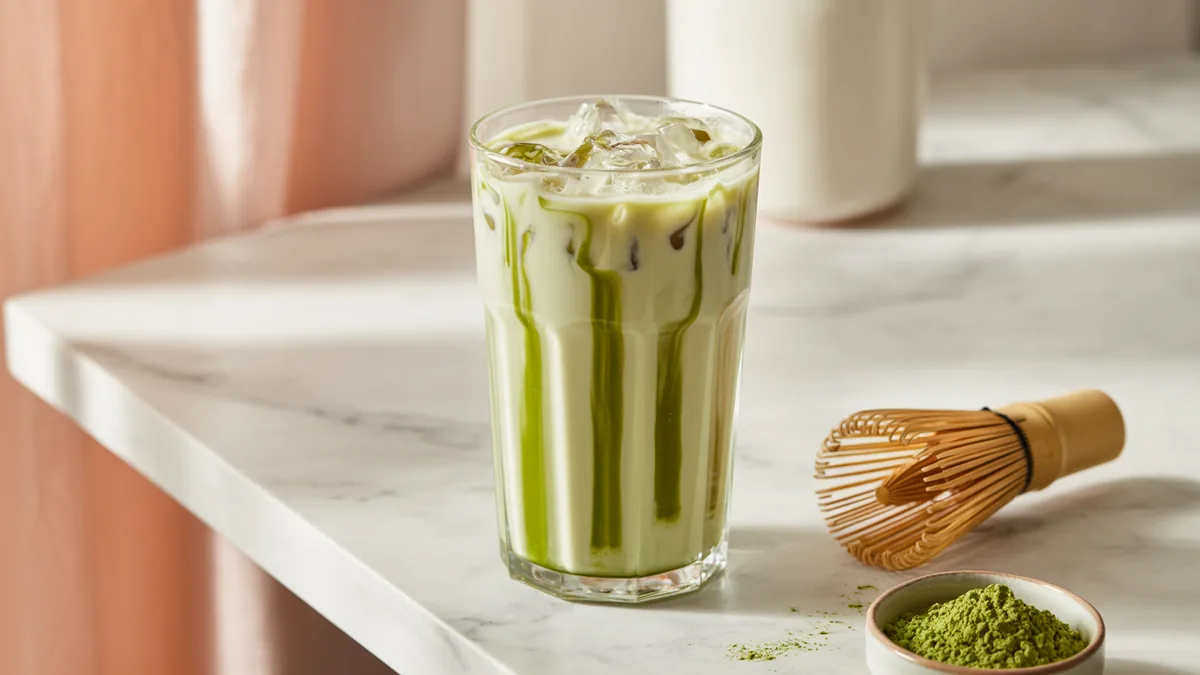
If you searched for an iced matcha latte with oat milk, here is the recipe in one line: sift a teaspoon of matcha, whisk it smooth with a little warm water, pour it over oat milk and ice, and sweeten to taste. That is the cafe drink, made at home for about a dollar instead of six.
The oat milk is not an accident. Its natural sweetness and creamy body round off matcha's grassy edge better than almost any other milk, which is exactly why the big coffee chains reach for it. Done right, this is bright green, lightly sweet, and gently caffeinated, the kind of cup that makes a hot morning feel handled.
This is the pure how-to. If you want the why, the caffeine details, and a four-way version, that lives in my matcha latte benefits guide. Here I am just going to get you a genuinely good iced oat milk matcha, including the sifting trick that keeps it from going clumpy and the brown-sugar version if you like the copycat.
| Step | What to use | Why it matters |
|---|---|---|
| Sift the matcha | 1 tsp through a small strainer | Breaks up clumps so it dissolves smooth |
| Add water | 2 tbsp warm water, around 175F | Boiling water turns matcha bitter |
| Whisk | Bamboo whisk or small frother | Makes a smooth paste with no grit |
| Build the glass | Ice, then 3/4 cup oat milk | Cold milk keeps it creamy and frosty |
| Sweeten | Optional syrup or honey to taste | You control it, usually less than a cafe |
What an iced matcha latte actually is
The short version: whisked green tea powder dissolved in a little water, poured over ice and oat milk, sweetened to taste.
An iced matcha latte is one of the simplest drinks you can make at home, and for years I made it harder than it needed to be. At its core it is just three things: matcha powder, water, and milk. The matcha is green tea leaves that have been ground into a fine powder, so when you whisk it into water you are drinking the whole leaf, not steeping it and throwing it away. That is why it tastes fuller and a little grassy, and why the color is that almost glowing green.
The latte part means you are softening that strong tea with milk. Iced means you build it cold over ice instead of drinking it warm. I use oat milk because it is creamy without fighting the matcha, but I will get into that more below. The whole thing takes about three minutes once you have your stuff out.
One thing I want to be clear about up front. This is a recipe and a how-to, not a health lecture. If you came here wanting the why behind matcha, the antioxidants, the slow-release energy, the calm-focus thing people talk about, I wrote a whole separate piece on that. Go read Matcha Latte Benefits: My Calm 4-Way Recipe for the why. This article is purely about making a genuinely good iced matcha latte with oat milk, the kind you would actually pay for, in your own kitchen.
It is also different from a couple of other drinks I love. It is not my lavender latte, which is coffee-based and floral. And it is not a warm cozy thing like golden milk. This is the bright, cold, slightly sweet green one. The summer one.
I started making my own because of the cost, honestly. I was buying one almost every weekday, and when I did the math on a month of that, I felt a little sick. A tin of decent matcha that lasts me weeks costs less than four cafe drinks. Once I learned the two or three small things that actually matter, the sifting, the water temperature, the whisking, my kitchen version stopped tasting like a sad imitation and started tasting better than the chain, because I could make it exactly as sweet as I wanted. That is the whole promise of this post. Not magic, just the handful of details nobody tells you.
What you need
Five things: matcha, warm water, oat milk, ice, and a sweetener if you want one. A whisk helps.
The ingredient list is short, which is part of why I love this. Here is exactly what goes into one tall glass:
- 1 teaspoon matcha powder. Use a culinary or everyday grade for iced lattes. You do not need pricey ceremonial grade here because the milk and ice mute the subtle stuff anyway.
- 2 tablespoons warm water, around 175F or 80C. Hot but not boiling. I just let the kettle sit a minute after it clicks off.
- 3/4 cup cold oat milk. A barista-style oat milk gives the creamiest result, but any unsweetened oat milk works.
- A big handful of ice. More ice than you think. It keeps it cold and dilutes the matcha just enough.
- Sweetener to taste, optional. I use anywhere from a teaspoon of maple syrup to a tablespoon of brown sugar syrup depending on my mood.
For tools, you want something to break up the powder. A bamboo whisk, called a chasen, is traditional and honestly fun to use. But a small handheld milk frother works great, and so does a jar with a tight lid that you shake hard. A tiny fine-mesh strainer for sifting is the one thing I would not skip. More on that next.
A quick word on quantities, since people ask. One teaspoon is my standard for a tall glass with a good handful of ice. If you like a stronger, more intense matcha flavor, go up to one and a half teaspoons. If you are caffeine-sensitive or making this in the late afternoon, drop to three-quarters of a teaspoon. The water amount stays about the same either way, because you only need enough to whisk the powder into a smooth paste. Everything else is just oat milk and ice scaled to the size of your glass.
How I make it, step by step
The order matters: sift, whisk with a little water first, then build the cold glass. Never dump powder straight into milk.

Here is the exact process I use every morning. It looks like a lot written out, but it is fast once your hands know it.
First, sift the matcha. Tap one teaspoon of matcha through a small strainer into your bowl or cup. I know it feels fussy. Do it anyway. Matcha clumps as it sits, and those little clumps are exactly what give you that grainy, chalky sip at the bottom of a bad homemade matcha. Sifting takes ten seconds and fixes it.
Second, add a little warm water and whisk. Pour in about two tablespoons of water that is hot but not boiling. Boiling water scorches matcha and makes it taste bitter and almost spinachy. Whisk in a quick zigzag, like writing the letter M over and over, not a round stirring motion. In maybe twenty seconds you get a smooth, almost frothy green paste with no specks. This is the step people skip, and it is the whole difference between cafe-smooth and sad-and-gritty.
Third, sweeten the concentrate if you want. I stir any syrup or honey into the warm matcha now, while it is still warm, so it dissolves completely instead of sinking to the bottom of a cold glass.
Fourth, build the glass. Fill a tall glass with ice. Pour in your cold oat milk until the glass is about three-quarters full. Then pour the green matcha over the top. You get that pretty layered look for a second before it all swirls together.
Fifth, stir and taste. Give it a good stir, take a sip, and adjust. Too strong, add a splash more oat milk. Not sweet enough, you will know. That is it. The recipe card below has the same thing in tidy numbers.
A couple of things I learned the hard way. If you do not have a strainer one morning, you can put the matcha and water in a small jar with a tight lid and shake it like a cocktail for fifteen seconds, which busts up most of the clumps. It is not quite as smooth as whisking but it is close. And if your matcha tastes bitter even when you do everything right, the water was probably too hot, or the powder is old. Try cooler water first. If it is still bitter, the tin has likely been open too long and oxidized, and it is time for a fresh one.
The pretty layered look, that two-tone green-over-cream moment, is a nice bonus but it does not last. The matcha sinks and swirls in within a few seconds, which is exactly what you want for an even sip. If you are making it for a photo, pour the matcha last and snap fast. If you are making it to drink, just stir and enjoy. The layers are not the point, the smoothness is.
The variations I actually make
Three I rotate: a brown sugar Starbucks copycat, a vanilla version, and a plain unsweetened one for hot days.
I do not drink the exact same version every day, so here are the three I actually rotate through, with real measurements.
Brown sugar iced matcha, the cafe copycat. This is my answer to the brown sugar oat milk version you get at the big chains. Make a quick brown sugar syrup by stirring two tablespoons brown sugar into two tablespoons hot water until it dissolves, then let it cool. Drizzle a tablespoon or so down the inside of the glass before you add ice and oat milk, so it streaks. Add the matcha on top. It tastes a little caramelly and is honestly less sweet than the original, which is the point. I keep a small jar of the syrup in the fridge for the week.
Vanilla iced matcha. Stir a quarter teaspoon of vanilla extract, or a splash of vanilla syrup, into the warm matcha concentrate. Vanilla rounds off the grassy edge and makes the whole thing taste softer. This is the one I make for friends who say they do not like matcha, and it usually wins them over.
Plain and barely sweet. On a really hot day I skip sweetener entirely, or use just half a teaspoon of maple syrup. Cold oat milk has its own gentle sweetness, so you need less than you think. This is the version that feels most like a treat and least like dessert.
If you want more cold drinks in this family, my iced turmeric latte is the golden cousin to this one, same iced-and-creamy idea, completely different flavor.
One more I make in late summer: a frozen blended matcha. Toss the whisked matcha, the oat milk, a small handful of ice, and a touch of syrup into a blender and blend until it is slushy and thick like a green frappe. It is more of a dessert than a drink, but on a ninety-degree afternoon it is exactly right. I will sometimes top it with a little cold oat foam, which is just oat milk frothed for a few seconds, for a fancier look with basically no extra effort.
Why oat milk pairs so well, and picking your matcha
Oat milk is the easy win: it is creamy and gently sweet without overpowering the tea. For matcha, culinary grade is fine for iced lattes.
I have tried this drink with basically every milk in the fridge, and oat milk keeps winning for iced matcha. It is naturally a little sweet and a little starchy, which gives you that thick, creamy mouthfeel without adding a strong flavor of its own. Almond milk is thinner and can taste a touch bitter against the matcha. Dairy milk is fine but can flatten the green tea taste. Coconut tastes like coconut. Oat just gets out of the way and makes it smooth.
If you can find a barista-style oat milk, grab it. They add a tiny bit more oil and stabilizer so it stays creamy over ice instead of separating. Regular unsweetened oat milk still works great, you just might see a little settling, which a stir fixes.
For the matcha itself, here is the honest breakdown. Ceremonial grade is the smoothest, sweetest, brightest green powder, meant to be whisked with just water and sipped on its own. Culinary or everyday grade is a little more robust and a little more bitter, and it is made for exactly this, lattes and smoothies where milk and sweetener are involved. Spending extra on ceremonial for an iced oat milk latte is a bit of a waste, because the ice and the milk cover up the delicate notes you paid for. A good mid-range culinary matcha that is still a vivid green, not dull and yellowish, is the sweet spot. Dull color usually means older, more bitter powder.
On storing it, since freshness is most of what determines whether your matcha tastes sweet or bitter: keep the tin sealed tight, away from light, heat, and air. I keep mine in the cupboard, not on the counter where the sun hits, and I use it within a couple of months of opening. Some people keep it in the fridge in an airtight container, which is fine, just let it come to room temperature before you open it so condensation does not clump the powder. A good fresh matcha smells sweet and grassy, almost like fresh-cut greens. If yours smells flat or hay-like, that is the oxidation talking, and no amount of technique will fully fix it.
The one honest note about caffeine
Real talk: matcha has caffeine. It is gentler than coffee for many people, but it is not caffeine-free.
I want to be straight with you, because the internet is not always. Matcha has caffeine. A teaspoon in your latte lands somewhere in the range of a strong cup of green tea, less than a typical coffee but not nothing. A lot of people, me included, feel like the lift from matcha is steadier and less jittery than coffee, and that is often credited to an amino acid called L-theanine that comes along with it. That is a real and pleasant thing to notice. It is not a license to drink four of these before noon.
So if you are caffeine-sensitive, pregnant, or trying to cut back, treat this like the tea it is. Keep an eye on how many you have, especially in the afternoon, and listen to your own body. If you are not sure what is right for you, that is a question for your doctor, not a blog. For the general, well-sourced picture on green tea, the Harvard Nutrition Source on tea and the NIH NCCIH page on green tea are both calm and balanced reads. Cleveland Clinic also has a good plain-English overview of matcha.
The other tiny note: if you are using a sweet syrup version, just know you are making a treat. A brown sugar iced matcha is a lovely thing and also basically a small dessert. I am not going to pretend it is a wellness shot. It is a delicious drink, and that is allowed.
If you want a rough sense of timing, I try to keep my last matcha before about two in the afternoon, because the caffeine can sit with me for a while and I am protective of my sleep. Everybody clears caffeine at a different speed, so your line might be earlier or later than mine. The nice thing about making it yourself is that you can dial the matcha down to half a teaspoon for a gentler afternoon cup, which is a lot harder to do when someone else is making it behind a counter.
How I actually drink it
My real routine: mid-morning, by a window, slightly under-sweetened, often as my one quiet thing before the day starts.

Here is the unglamorous truth about how this fits my life. I make it around nine or ten in the morning, after my first glass of water, usually before I have answered a single email. I keep a little jar of pre-sifted matcha on the counter, which sounds extra but saves me thirty seconds of fumbling, so the only morning task is whisk and pour.
I drink it standing at the kitchen window most days, which is a small thing I started doing on purpose. The making of it, the whisking, the green pouring over the cream, has become a tiny ritual that signals the day has started on my terms. I am not precious about it. Some days it is in a travel cup in the car. But when I can, the window version is the one I love.
I keep mine on the less-sweet side, usually just a teaspoon of maple, because I find a too-sweet matcha gets cloying by the bottom of the glass. If I am making it as an afternoon pick-me-up, I switch to a smaller amount of matcha so I am not wired at bedtime. And in true summer heat I will blend the whole thing with extra ice into a slushy frozen matcha, which is dangerously good.
If you like a cozy evening counterpart to this bright morning drink, my moon milk recipe is the warm, caffeine-free thing I make at night. Different end of the day, same homemade-and-calm spirit.
When this won't fit your life
Honest caveat: if you hate the grassy taste, can't have caffeine, or want zero fuss, this might not be your drink.
I am not going to tell you everyone needs to make this. A few times it genuinely will not fit.
If you truly dislike the green, grassy taste of matcha, no amount of oat milk and vanilla is going to fully hide it, and that is okay. Some people just are not matcha people, and forcing it because it photographs well is silly. If that is you, a turmeric or chai version of an iced latte might suit your palate better. If caffeine is off the table for you for any reason, this is not the drink, full stop, since the caffeine is baked into the leaf and you cannot strain it out.
And if you want absolutely zero fuss, the sifting and whisking, modest as it is, might be one step too many on a rough morning. On those days I will admit I just buy one. There is no medal for making it yourself. This recipe is here for the mornings you want it, not as another thing to feel behind on. Make it when it feels good, skip it when it does not.
Helpful sources and next reads
Reliable external sources
More from Sabrina Saturno
You may also love


FAQ
How much matcha do I use for one iced latte?
One level teaspoon, about 2 grams, per tall glass. Use a little less for a milder drink or if it is your afternoon cup and you want less caffeine.
Why do I have to sift the matcha?
Matcha clumps as it sits, and those clumps will not fully dissolve. Sifting through a small strainer takes ten seconds and is the difference between smooth and gritty.
What water temperature should I use?
Hot but not boiling, around 175F or 80C. Boiling water scorches matcha and makes it taste bitter. Let your kettle sit a minute after it clicks off.
Can I make it without a bamboo whisk?
Yes. A small handheld milk frother works great, and so does shaking the matcha and water hard in a sealed jar. The bamboo whisk is traditional but not required.
What is the best oat milk for iced matcha?
A barista-style oat milk gives the creamiest result because it resists separating over ice. Regular unsweetened oat milk also works, just give it a stir if it settles.
Ceremonial or culinary grade matcha for a latte?
Culinary or everyday grade is the right call for an iced oat milk latte. The milk and ice cover the delicate notes you would pay extra for in ceremonial grade.
How do I make the brown sugar Starbucks copycat version?
Stir 2 tablespoons brown sugar into 2 tablespoons hot water to make a syrup, cool it, then drizzle a tablespoon into the glass before adding ice, oat milk, and matcha.
Does iced matcha latte have caffeine?
Yes. A teaspoon has roughly the caffeine of a strong cup of green tea, less than coffee but not zero. Many people find the lift steadier and less jittery.
How do I make it less sweet than the cafe version?
Easy, you control the syrup. Start with a teaspoon of maple or skip it entirely. Cold oat milk is gently sweet on its own, so you usually need less than you expect.
Why is my homemade matcha gritty?
You probably skipped sifting, used too little water for the whisking step, or did not whisk long enough. Make a smooth paste with a little water first, then add the rest.
Can I make a batch ahead?
You can pre-sift matcha into a jar and make a syrup ahead, but whisk the actual drink fresh. Matcha settles and dulls if it sits whisked for too long.
Is this drink a health cure?
No. It is a tasty, mildly energizing drink. Matcha has some nice qualities, but a sweetened latte is a treat. For the benefits side, see my matcha latte benefits article.
Can I make it warm instead of iced?
Yes. Whisk the matcha the same way, then top with warm steamed or heated oat milk instead of ice and cold milk. Same concentrate, cozy result.
The version that lasts
The version that lasts, for me, is not the prettiest one or the sweetest one. It is the one I can actually make on a Tuesday when I am half awake. That is why I pre-sift the matcha and keep a little jar of syrup ready. Remove the friction and you will actually make it, which beats a perfect recipe you only pull off twice a year.
I also let go of the idea that it has to look like the cafe pour every time. Some mornings the matcha is a little too strong, or I forget the brown sugar streak, and it is still good. The point was never a photo. The point is three quiet minutes and a cold green drink I genuinely like, made for less than a dollar in my own kitchen.
So take the bones of this, the sift, the whisk-with-a-little-water-first, the oat milk over ice, and then make it yours. Sweeter, plainer, vanilla, brown sugar, frozen on a hot afternoon. Once the method is in your hands you stop needing the recipe at all, and that is when it becomes a real part of your day instead of a thing you tried once.