
I moved to Arizona thinking it was one landscape: hot, flat, and the color of a terracotta pot. It took exactly one wrong turn toward Flagstaff, where the road climbs into pine forest and the temperature drops twenty degrees, to teach me how wrong I was. Arizona is not one place. It is a stack of climates and centuries you can drive through in an afternoon, which makes it almost unfairly good for weekend getaways.
This is my list of ten Arizona weekend escapes, the slow kind. Not a checklist to speed-run, but towns and canyons I keep returning to because each one has a pace of its own. Most sit within a few hours of Phoenix or Tucson, so you can leave after work on Friday and be somewhere completely different by dinner. I have organized them by destination rather than by who you travel with, because the truth is most of these work for couples, friends, families, and solo wanderers alike.
A note before we start. I am not a travel agent, and I will not invent hotel names or quote prices that change by the season. What I can give you is the feel of each place, when to go, when absolutely not to go, and the real landmarks worth slowing down for. If you want the bigger philosophy behind why I travel this way, it lives in my complete guide to slow travel.
| Destination | Drive vibe from Phoenix | Best season | Known for |
|---|---|---|---|
| Sedona | About 2 hours, easy freeway then red rock | Spring and fall | Red rock canyons, Slide Rock State Park, Oak Creek Canyon |
| Flagstaff | About 2 hours 15 minutes uphill on I-17 | Summer escape and winter snow | Lowell Observatory, dark skies, ponderosa pines, Route 66 downtown |
| Prescott | About 1 hour 45 minutes, mile-high pines | Spring through fall | Watson Lake, Whiskey Row, mild mountain air |
| Jerome | About 2 hours, then a winding climb | Spring and fall | Cliffside mining town, art galleries, valley views |
| Tucson | About 1 hour 45 minutes south on I-10 | Late fall through spring | Saguaro National Park, Sonoran desert, food and culture |
| Bisbee | About 3.5 hours, deep southeast corner | Fall through spring | Historic copper district, Queen Mine, staircase streets |
| Lake Havasu | About 3 hours west to the river | Spring and fall, not high summer | London Bridge, Colorado River, water sports |
| Williams | About 2 hours 45 minutes on I-40 | Spring through fall | Route 66 main street, Grand Canyon Railway |
| Page and Antelope Canyon | About 4.5 hours north, a true road trip | Spring and fall | Antelope Canyon, Horseshoe Bend, Lake Powell |
| Grand Canyon South Rim | About 3.5 hours north | Spring, fall, and a quiet winter | The canyon itself, Rim Trail, sunrise and sunset |
Sedona: the red rock weekend everyone starts with
The Sedona weekend getaway in short: About two hours north of Phoenix, Sedona trades freeway for towering red rock, with Slide Rock State Park and Oak Creek Canyon as the headline acts.
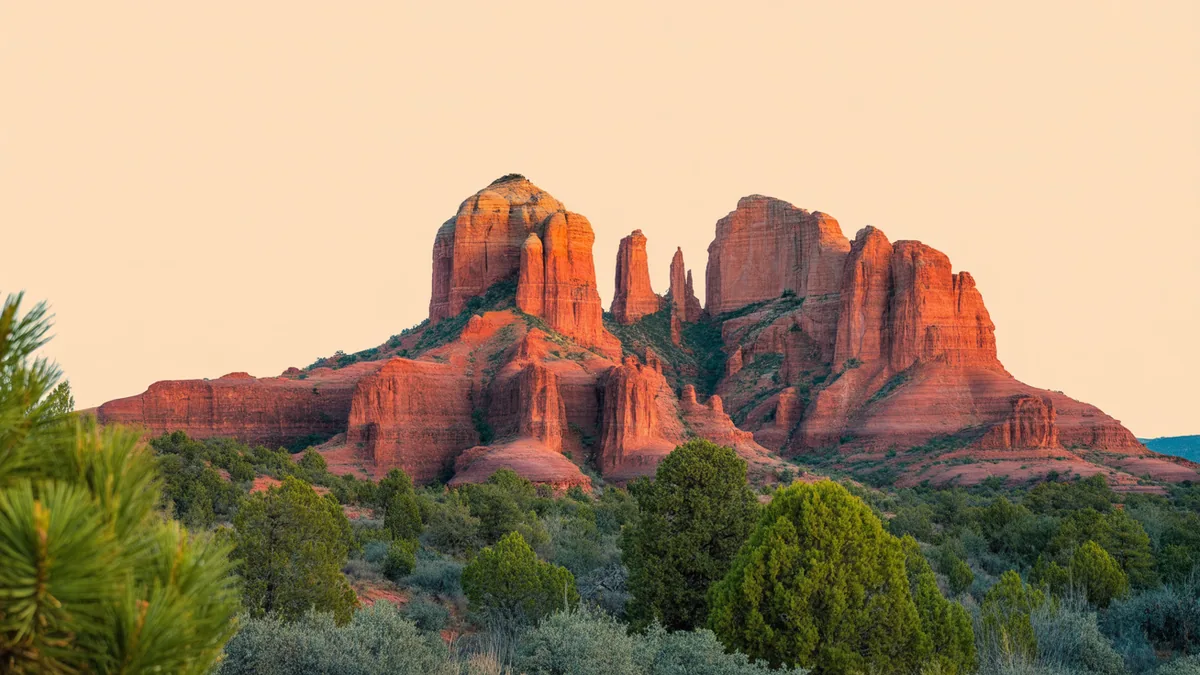
Most people's first Arizona weekend is a Sedona weekend getaway, and there is a reason it has become shorthand for the whole experience. You drive up from the valley, round a bend, and the earth turns a deep rust red in formations so large they feel staged. The light does extraordinary things here at sunrise and sunset, which is why I always tell people to book one more night than they think they need and waste a morning just watching the rocks warm up.
The slow version of Sedona skips the crowded vortex tours and heads for water and shade. Slide Rock State Park sits about seven miles north of town in Oak Creek Canyon, where a natural sandstone chute sends you down an eighty-foot stretch of creek into a cold pool. It fills up fast on summer weekends, so I go at opening or skip straight to a quiet creekside picnic instead. Red Rock State Park, on the other side of town, is calmer and built for gentle walking.
Sedona does get warm, though nothing like the valley floor, and its red dirt clings to everything you own. It is also where a lot of wellness travel happens, but if a spa-and-intention weekend is what you are after, I keep that angle separate in my guide to solo wellness retreats in the USA. Here, Sedona is simply a beautiful place to stand still and look up.
Flagstaff: pines, stars, and cool air
Flagstaff in short: A two-hour climb up I-17 lands you at 7,000 feet among ponderosa pines, with Lowell Observatory and a walkable Route 66 downtown waiting.
Flagstaff is the answer to the question every Phoenix summer eventually asks: where can I go to feel cold air on my arms again? Sitting at around 7,000 feet, the town is a full season cooler than the valley, wrapped in the largest contiguous ponderosa pine forest in the country. The drive up I-17 takes a little over two hours, and you can watch the saguaros give way to pines through the windshield, which never stops feeling like a small miracle.
This is a stargazing town in the official sense. Flagstaff was the world's first International Dark Sky City, and Lowell Observatory, where Pluto was discovered in 1930, runs evening programs where you can put your eye to a real telescope. I have spent slow Flagstaff weekends doing almost nothing but wandering the historic downtown along old Route 66, ducking into bookstores and gear shops, then driving five minutes to the observatory after dark.
Because it is so close to Sedona, about forty-five minutes down through Oak Creek Canyon, people try to do both in one weekend. I would not. Pick one, let it breathe. Flagstaff alone gives you cool hikes on Mount Elden, the volcanic strangeness of Sunset Crater, and air that smells like warm pine resin all afternoon.
Prescott and the mile-high lakes
Prescott in short: Under two hours from Phoenix, Prescott sits a mile high with mild air, granite-rimmed Watson Lake, and a historic main street called Whiskey Row.
Prescott is the one I send people to when they want a weekend that feels like a held breath rather than an adventure. It sits at about a mile high, so summers are mild and the pines are everywhere, but the drive is shorter than Flagstaff, well under two hours. It is one of the easiest answers when someone searches for weekend getaways within three hours of me and wants gentle over grand.
The landmark I love most here is Watson Lake, a bright blue reservoir about four miles from downtown, ringed by enormous rounded granite boulders called the Granite Dells. You can kayak among the rocks or just walk the shoreline trail and feel like the landscape was arranged by someone with a very specific aesthetic. Downtown, the old courthouse square and the saloons of Whiskey Row give the place a settled, lived-in charm that does not feel staged for tourists.
Prescott rarely tops anyone's bucket list, and that is exactly why I keep it on mine. It is unhurried, walkable, and forgiving of a weekend where the only plan is coffee, a lake, and an early night.
Jerome: the town that hangs off a mountain
Jerome in short: A former copper boomtown clinging to the side of Cleopatra Hill, Jerome is a few steep streets of galleries, history, and enormous valley views.
Jerome is the strangest, most charming small stop on this whole list. Once a roaring copper mining town of thousands, it nearly emptied out when the mines closed and earned the nickname of America's largest ghost town. Today it is a tiny community of a few hundred, with three main streets that zigzag up the side of Cleopatra Hill, connected by steep historic staircases and clinging improbably to the slope.
The drive from Phoenix is around two hours, with the last stretch a winding climb up Highway 89A that you take slowly whether you want to or not. What you get at the top is a town of art galleries, old saloons, wine tasting rooms, and views that spill across the entire Verde Valley toward the red rocks of Sedona. I like to pair Jerome with Prescott or the valley towns of Cottonwood and Clarkdale below it, making a loose loop of a weekend rather than a single destination.
Park once and walk, because the streets are narrow and the parking is tight. Jerome rewards the kind of traveler who reads every plaque, lingers in a single gallery, and treats a cup of coffee on a hillside porch as a legitimate activity.
Tucson: saguaros and slow southern desert
Tucson in short: Under two hours south of Phoenix, Tucson wraps around Saguaro National Park and serves up some of the best food and desert quiet in the state.

Tucson is the city that finally taught me to love the Sonoran desert instead of just enduring it. Under two hours south of Phoenix on I-10, it is ringed by mountains and split by Saguaro National Park, which protects forests of the giant saguaro cactus on two sides of town. The cacti can live two hundred years and stand taller than a house, and driving among them at dawn, when the light is soft and the air is still cool, is one of the great quiet pleasures of the state.
Tucson is a designated city of gastronomy, and a slow weekend here can revolve entirely around food, mountain views, and the historic neighborhoods downtown. The two districts of the national park sit about thirty-five miles apart, east and west of the city, so pick one for a morning rather than trying to cram both into a single day.
Crucially, Tucson sits a little higher than Phoenix and stays slightly more bearable, but it is still genuine desert. The window when it truly shines runs from late fall through spring. Come in July and the saguaros will be there, but so will brutal heat, and you will spend the weekend hiding indoors.
Bisbee: a copper town frozen in time
Bisbee in short: Tucked in Arizona's far southeast corner, Bisbee is a beautifully preserved old copper town of staircase streets, deep mine tours, and a creative, offbeat spirit.
Bisbee takes commitment to reach, roughly three and a half hours from Phoenix, deep in the southeast corner near the Mexican border. It is worth every mile. Once one of the richest copper districts in the world, the town went quiet when the mines closed in 1975 and was slowly reclaimed by artists and characters who fell for its tumbling Victorian houses and impossibly steep streets. It has been named one of the country's best historic small towns, and walking it feels like stepping into a different decade.
The signature experience is the Queen Mine Tour, where retired miners lead you 1,500 feet into the mountain wearing a hard hat and slicker, telling stories no museum placard could match. Above ground, the old town is a knot of narrow lanes and historic staircases built into the hillside, lined with antique shops, galleries, and cafes. Because Bisbee sits at a higher elevation than the surrounding desert, it stays milder than you would expect.
This is a destination for travelers who like their weekends with a little grit and a lot of character. There are no resorts or chains pretending you are somewhere generic. Bisbee is entirely, stubbornly itself, and a weekend here resets something.
Lake Havasu: water in the desert
Lake Havasu in short: Three hours west on the Colorado River, Lake Havasu City is built around the original London Bridge, shipped stone by stone from England in the late 1960s.
Lake Havasu City is the Arizona weekend that surprises people, because it answers a question the desert should not be able to answer: where do I go to be on the water? The town sits on the Colorado River about three hours west of Phoenix, and its centerpiece is genuinely the old London Bridge, dismantled in England, shipped across an ocean as 10,000-plus numbered stone blocks, and rebuilt here between 1967 and 1971. The Lord Mayor of London flew in for the rededication, which tells you how seriously the whole improbable thing was taken.
A slow weekend here is about the water and the warm evenings: kayaking under the bridge, a boat out on the lake, a long dinner near the channel as the light goes gold. It is a popular spring break destination, so it has a livelier energy than the mountain towns, but go in spring or fall and it calms considerably.
The hard rule for Havasu is the same as the desert rule everywhere: do not come in high summer. This is one of the hottest corners of the state, and a July afternoon on that water can be genuinely dangerous. Spring and fall are the sweet spots, when the river is warm enough to enjoy and the air will not flatten you.
Williams: Route 66 and the canyon train
Williams in short: A nostalgic Route 66 town less than sixty miles from the Grand Canyon's South Rim, with a historic main street and the Grand Canyon Railway.
Williams is small, friendly, and unapologetically nostalgic, a town that leans all the way into its Route 66 heritage with neon signs, diners, and a walkable main street made for an evening stroll. It sits about two and three-quarter hours north of Phoenix on I-40, up in the pines, which means it shares Flagstaff's cool mountain climate and its own quiet charm.
The reason Williams earns a spot here is geography. It is less than sixty miles south of the Grand Canyon South Rim, which makes it a relaxed base camp for the canyon without staying inside the park itself. The town runs the historic Grand Canyon Railway, a vintage train that carries you up to the rim and back so you can leave the car parked and the navigation to someone else. For a slow traveler, handing off the driving and watching the forest roll past a train window is a small luxury.
I think of Williams as the gentle on-ramp to the Grand Canyon. You get the pines, the diners, the easy pace, and then a single big day at one of the wonders of the world, without the logistics of staying at the rim.
Page and Antelope Canyon
Page in short: A four-and-a-half-hour drive to the far north, Page is the base for Antelope Canyon, Horseshoe Bend, and the red-walled expanse of Lake Powell.

Page sits at the very top of the state, about four and a half hours from Phoenix, which makes it less of a quick weekend and more of a deliberate road trip. It earns the drive. This little town is the gateway to Antelope Canyon, the sculpted slot canyon on Navajo land where shafts of light pour down through impossibly curved orange sandstone walls. You can only visit on a guided tour run by Navajo guides, which you book ahead, and it is the rare attraction that genuinely lives up to the photographs.
Just outside town is Horseshoe Bend, a dramatic curve of the Colorado River wrapped around a sandstone tower, reached by an easy mile-and-a-half round-trip walk. And then there is Lake Powell, a vast blue reservoir held in red rock that looks like nowhere else in the country. Between the three, Page is one of the most photogenic corners of Arizona.
Because the drive is long, I treat Page as a two-night minimum and build the trip around it slowly. Book Antelope Canyon tours well in advance, because they sell out, and aim for spring or fall to dodge both the summer crowds and the worst of the heat on those exposed trails.
Grand Canyon South Rim
Grand Canyon in short: About three and a half hours north, the South Rim is the year-round face of the canyon, with overlooks, the Rim Trail, and a hush at sunrise that nothing prepares you for.
It feels almost silly to put the Grand Canyon on a weekend list, as if it were just another stop, but the truth is you can absolutely do the South Rim as a long weekend from Phoenix, about three and a half hours each way. The South Rim is the developed, open-all-year side, with overlooks, shuttle buses, and the paved, mostly flat Rim Trail that lets you walk the edge for miles without committing to a descent.
My one piece of slow-travel advice for the canyon is to stay overnight inside or near the park rather than driving up for a single rushed afternoon. The day-trippers leave by late afternoon, and what remains, sunset over the canyon and then a silent, star-flooded sunrise, is the actual reason to come. The first time I watched the light fill the canyon at dawn, I understood why people travel across the world for it. If this is your first big national park, my national parks guide for first-timers covers the practical side.
The official source for planning, including shuttle and lodging logistics, is the National Park Service Grand Canyon page. Winter is quiet and genuinely beautiful with snow on the rim, but check road and weather conditions, because the elevation here means real cold and occasional closures.
Best season to go (and the heat talk)
The seasonal rule: Visit the low desert in the cooler months and head north for the mountains in summer. Arizona has two climates, and timing your weekend to the right one changes everything.
If you remember one thing from this whole article, make it this: Arizona has two seasons running at the same time, and they live at different elevations. The low desert, Phoenix, Tucson, Lake Havasu, Bisbee, is glorious from roughly October through April and brutally hot from May through September. The high country, Flagstaff, Williams, the Grand Canyon, Prescott, is the reverse, a blissful escape in summer and a snowy, sometimes closed, world in deep winter.
So I plan backward from the calendar. Spring and fall are the universal sweet spots, when nearly everywhere on this list is comfortable at once and the whole state opens up. Summer means north: pines, lakes, observatory nights, and that twenty-degree drop you can feel the moment you step out of the car. Winter pulls me south and low, to the warm desert towns where January feels like a gift.
The other thing to respect is the summer monsoon, roughly July into September, when sudden afternoon storms can flood washes and turn calm trails dangerous in minutes. They are dramatic and beautiful from a porch and genuinely risky out in a slot canyon or a dry creek bed. Arizona's official tourism board keeps current seasonal guidance at Visit Arizona, and it is worth a glance before you commit to dates.
Weekend getaway packing list
The Arizona weekend getaway packing list: Layers, real sun protection, far more water than feels reasonable, sturdy shoes, and a swimsuit, because one weekend can swing from desert heat to mountain chill.
Arizona makes a weekend getaway packing list more interesting than most states, because a single trip can cross thirty degrees of temperature. Here is the short version I actually use, refined over a lot of trips where I packed wrong.
- Layers, always. A desert morning can be cool, the afternoon hot, and a mountain evening genuinely cold. A light jacket or fleece earns its place in the bag every single time, even in summer if you are heading north.
- Sun protection that means it. A wide-brimmed hat, real sunglasses, and high-SPF sunscreen reapplied often. The high-elevation sun in Flagstaff and at the canyon burns faster than you expect, and so does the desert glare.
- More water than feels reasonable. A refillable bottle per person, and extra in the car. Dehydration sneaks up in dry air, and the next gas station can be far away.
- Sturdy closed shoes. Half these destinations involve uneven rock, steep staircases, or dirt trails. Save the cute sandals for dinner.
- A swimsuit and a quick-dry towel. Slide Rock, Lake Havasu, Lake Powell, Oak Creek. Water shows up more than you would guess in a desert state.
- A paper map or offline directions. Cell signal vanishes between towns and in the canyons. Do not rely entirely on your phone.
Everything else is negotiable. I keep my bag deliberately small, because the slow-travel secret is that you need far less than the packing posts suggest, and a lighter bag is a lighter weekend.
The romantic weekend angle
For romantic weekend getaways: Sedona, Jerome, and the Grand Canyon at sunset lead the list, with cozy mountain towns like Prescott and Flagstaff close behind.
Arizona quietly excels at romantic weekend getaways, mostly because the landscapes do the heavy lifting. Sedona is the obvious choice, all red rock and golden light, and it leans into couples travel with quiet inns and long sunset views. Jerome, with its hillside porches and valley vistas, has an unhurried, slightly out-of-time feeling that suits two people who just want to wander and talk.
For something cooler and cozier, the mountain towns deliver: a fireside evening in Flagstaff after a stargazing session, or a slow lakeside day at Prescott's Watson Lake. And nothing I know of beats standing at the Grand Canyon rim together as the sun goes down and the whole thing turns to fire and shadow. You do not need a fancy package for any of it. The romance here is the scenery and the slowness, not the price tag.
If you are traveling solo and want a weekend shaped around your own pace and safety rather than a couple's itinerary, I keep that whole conversation in my guide to solo female weekend getaways in the USA, which spans the country rather than just this state.
Winter weekend getaways in Arizona
For winter weekend getaways: Head to the warm low-desert towns, Tucson, Bisbee, and the Phoenix area, while the north turns to snow and quiet.
Winter is when Arizona becomes a refuge for the rest of the country, and it is my favorite season to travel here. While much of the map shivers, the low desert towns settle into perfect weather: sunny days in the sixties and seventies, cool nights, and trails that were unbearable in July suddenly inviting. Tucson and Saguaro National Park are at their absolute best from late fall through early spring, and Bisbee's mild winters make its steep streets a pleasure to climb.
The north flips into a different kind of winter weekend getaway entirely. Flagstaff and Williams get real snow, the Arizona Snowbowl ski area opens above Flagstaff, and the Grand Canyon's South Rim wears a dusting of white that thins out the crowds and quiets everything down. Just go in with open eyes about cold, icy roads, and the chance of weather closures at elevation. Check conditions before you leave, and keep the drive flexible.
The beauty of an Arizona winter is that you choose your climate. Want warmth, go south and low. Want snow and a fire, go north and high. Few states let you make that call on the same weekend, and it is one of the real gifts of having so much landscape stacked so close together. If you are open to crossing the state line, a Palm Springs weekend getaway in California sits only a few hours west and offers a similar warm-winter, desert-resort feeling, a nice out-of-state option when you want pools over pines.
Reliable external sources and next reads
Reliable external sources
- Visit Arizona: the state's official tourism board
- National Park Service: Grand Canyon
- National Park Service: Saguaro National Park
- Arizona State Parks: Slide Rock State Park
- Arizona State Parks and Trails: park directory
More from Sabrina Saturno
You may also love



When this won't fit your life
Arizona weekend getaways are not for everyone, every season, and I would rather be honest than sell you a trip that leaves you miserable. The biggest one is heat. If you are heat-sensitive, traveling with very young children or older relatives, or simply not someone who thrives at 105 degrees, the low-desert towns from May through September are off the table, full stop. The desert sun is not a backdrop to push through; it is a real hazard, and people are hospitalized for underestimating it every year.
The second is distance. Several of these places, Bisbee, Page, Lake Havasu, demand three to four and a half hours of driving each way, which can eat a Friday and a Sunday whole. If a weekend for you means rest rather than road, stick to the closer cluster of Sedona, Prescott, Jerome, and the Verde Valley, all within about two hours.
The third is the monsoon. From July into September, those sudden afternoon storms can flood washes and slot canyons fast, and a place like Antelope Canyon or any dry creek bed is exactly where you do not want to be when the sky opens. If your only free weekends fall in deep summer, plan north and high, watch the forecast honestly, and give yourself permission to change the plan.
FAQ
What are the best weekend getaways within 3 hours of Phoenix?
Sedona, Flagstaff, Prescott, Jerome, and Tucson all sit roughly an hour and a half to two and a half hours from Phoenix, which makes them the easy yes for a two-night trip. Sedona is the classic, Flagstaff is the cool-air escape, and Prescott and Jerome pair beautifully into one Verde Valley loop.
Is a Sedona weekend getaway worth it?
Yes, and I say that as someone who is suspicious of overhyped places. The red rocks really are that good in person, especially at sunrise before the crowds and again at golden hour. Go midweek or in shoulder season if you can, because Sedona on a peak Saturday can feel busy enough to dull the magic.
How many days do you need for an Arizona weekend trip?
Two nights is the sweet spot for the closer towns. You arrive Friday evening, get a full Saturday, and have a slow Sunday morning before driving home. For the farther places like Page, Bisbee, or the Grand Canyon, I would stretch it to three nights so the long drive does not swallow the trip.
What is the best time of year for weekend getaways in Arizona?
Spring, from March to May, and fall, from late September to November, are the gentlest statewide. Summer belongs to the high country like Flagstaff, Williams, and the Grand Canyon, where the air stays cool. The low desert around Tucson and Phoenix is loveliest from November through March.
Which Arizona getaways work as winter weekend trips?
The low desert shines in winter. Tucson, with Saguaro National Park, is warm and clear, and Bisbee stays mild. If you want actual snow, Flagstaff and the Grand Canyon South Rim turn into quiet white landscapes, just pack for real cold and check road conditions before you drive up.
What are the most romantic weekend getaways in Arizona?
Sedona leads for couples, with its red rock views, slow mornings, and quiet canyon drives. Jerome is a charming runner-up, all hillside lanes and sunset views over the Verde Valley. Both reward couples who want to wander, eat well, and watch the light change rather than chase a packed itinerary.
Do I need a car for an Arizona weekend getaway?
For almost all of these, yes. Arizona is wide and the good light tends to be at trailheads and viewpoints outside town, so a car is what makes the trip feel free. The one exception is the Grand Canyon Railway from Williams, which is a lovely car-free way to reach the South Rim.
Is Page or Antelope Canyon doable as a weekend?
It is, but plan it as a longer weekend because Page sits about four and a half hours from Phoenix. Antelope Canyon requires a booked tour with a Navajo guide, so reserve well ahead, and pair it with Horseshoe Bend and Lake Powell to make the long drive feel worth it.
What about a Palm Springs weekend getaway instead?
Palm Springs is just over the California line, roughly three and a half to four hours from Phoenix, so it is a fair out-of-state alternative if you want pools, mid-century design, and spa days over red rocks and trails. I love it, but for a true Arizona weekend I stay in state and save Palm Springs for its own trip.
Which Arizona getaway is best for families?
Flagstaff and Williams are my picks for families, with cool air, the Grand Canyon Railway, Lowell Observatory, and easy pine-forest walks. Tucson works well in the cooler months for desert museums and gentle saguaro trails. I steer families away from the low desert in summer heat.
What should I pack for an Arizona weekend?
Layers, always, because the desert can swing thirty degrees between afternoon and night and the high country is genuinely cold. Bring more water than you think, real sun protection, sturdy shoes for red rock and trails, and a warm layer even in summer if you are heading north. There is a full packing list in the article above.
Is it safe to visit the Arizona desert in summer?
It can be, with respect and planning. Hike at dawn, carry far more water than feels necessary, avoid midday sun, and watch for monsoon storms from July into September that flood washes fast. If you are heat-sensitive or traveling with young kids or older relatives, choose the high country instead of the low desert.
The version that lasts
After enough of these weekends, I stopped trying to see Arizona and started trying to feel it. The version that lasts is not the one where you check off all ten towns in a frantic summer. It is the one where you pick a single place that matches the season, drive there without rushing, and give it enough time to show you its quiet hours, the empty trail at dawn, the porch at dusk, the rocks changing color while you do nothing but watch.
Every destination on this list rewards that approach more than the speed-run. Sedona at sunrise, Flagstaff after the day-trippers leave, Bisbee on a slow Sunday morning, the Grand Canyon at the moment the light goes. None of it requires a big budget or a packed itinerary. It just requires choosing the right month, packing your layers and your water, and letting the weekend be small enough to actually enjoy.
So pick one. Match it to the season, keep the bag light, and let the drive be part of the trip rather than the price of it. The Arizona weekend that lasts is the slow one, and there are at least ten of them waiting whenever you are ready to go.