
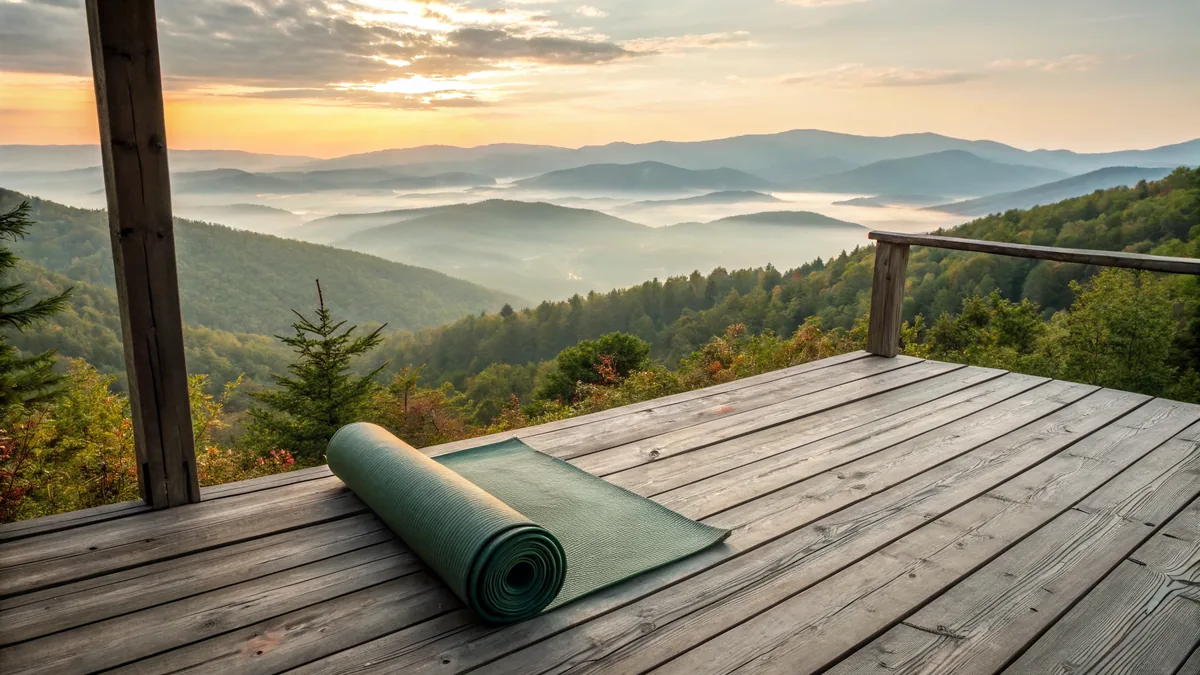
The first time I went on a retreat alone, I spent the drive convincing myself it was a strange thing to do, and the drive home wondering why I had waited thirty-two years. Nobody needed me for three days. Meals appeared, a bell rang for optional yoga, and my phone lived in a drawer. I have been quietly recommending solo retreats to every overwhelmed woman I know ever since.
This guide is the list I send them, finally written down properly. Nine retreats across the United States, every one of them real, currently operating, and taking bookings as I write this in June 2026. I verified each one against its own website, because retreat listicles are notorious for recommending places that closed years ago. One famous ashram almost made this list before I discovered it is currently closed to the public, which tells you everything about how these articles usually get made.
A note on honesty before we begin. I have not stayed at all nine; nobody who claims to have done so is telling the truth. I have visited some, researched all of them the slow way, and chosen places whose formats, shared rooms, self-guided stays, communal tables, are genuinely friendly to a woman arriving alone. Prices are mid-2026 ballparks and they move, so always confirm on the official site before you fall in love.
| Retreat | Where | The vibe | Price tier | Solo notes |
|---|---|---|---|---|
| Kripalu Center | Stockbridge, MA | Yoga and rest, big warm nonprofit campus | $ to $$, dorms from about $109 a night plus tuition | The classic first solo retreat; self-guided R&R stays |
| Omega Institute | Rhinebeck, NY | Workshops and quiet lakeside rest, seasonal | $ to $$, camping to private cabins | Singles-only rooms and a self-guided option |
| 1440 Multiversity | Scotts Valley, CA | Polished learning campus in the redwoods | $$ to $$$, rates quoted at booking | Budget solo pods with privacy screens |
| Art of Living Retreat Center | Boone, NC | Ayurveda and meditation on a Blue Ridge mountaintop | $$, packages roughly $640 to $1,315 | Weekly R&R arrivals, very used to solo women |
| Esalen Institute | Big Sur, CA | Cliffside hot springs and human-potential workshops | $$$, two nights from about $560 to $958 shared | Bunk rooms bookable solo; check Highway 1 access |
| Drala Mountain Center | Red Feather Lakes, CO | Buddhist meditation land, formerly Shambhala | $ to $$, tents and dorms to lodge rooms | Gentle, unpolished, deeply quiet |
| Civana | Carefree, AZ | Approachable desert spa resort, classes included | $$ to $$$, rooms from about $295 | Hotel-style, easiest entry into resort wellness |
| Miraval Arizona | near Tucson, AZ | Adults-only, all-inclusive desert luxury | $$$, roughly $1,450+ a night all-in | Famous for solo female guests; no devices in shared spaces |
| Canyon Ranch | Lenox, MA | Structured all-inclusive wellness estate | $$$, from about $950 a night | Communal dining makes eating alone effortless |
How I chose and verified these nine
The filter: Every retreat here has a working official website, 2026 bookings open, solo-friendly room formats, and a culture where a woman alone is normal, not novel.
My criteria were unglamorous on purpose. First, existence: each center's own website, current calendar, and open 2026 bookings, checked this month. Second, solo-friendliness in the structural sense: shared rooms or fair single rates, communal meals where eating alone is unremarkable, and self-guided options so you are never forced into a program to justify your presence. Third, spread: price tiers from backpacker to splurge, and geography from the Berkshires to Big Sur.
I also looked for what I think of as the bell test. The best solo retreats run on gentle, optional structure, a bell rings, a class happens, you go or you do not, and nobody comments either way. That rhythm is what makes traveling alone feel held instead of lonely, and it is the single biggest difference between a retreat center and a hotel with a yoga room.
One disclosure, because this site runs on honesty: none of these places paid to be here, none know they are listed, and there are no affiliate links in this article. The recommendations are worth exactly what my research and judgment are worth, no more. This is the same slow, verify-everything approach I bring to all my slow travel writing, applied to the retreat world, which badly needs it.
The big-hearted classics
Start here: Kripalu, Omega, 1440 Multiversity, and Art of Living Boone are the established campuses where a first-time solo guest is the most common guest there is.

Kripalu Center for Yoga & Health, Stockbridge, Massachusetts
If American solo retreats have a front door, it is Kripalu. The huge nonprofit campus in the Berkshires runs on exactly the optional-bell rhythm I described: yoga at several levels, walks down to the lake, enormous healthy buffets where half the tables are women eating contentedly alone with a book. The Retreat & Renewal stays are self-guided, dorm beds start around $109 a night plus daily tuition, and summer 2026 midweek promos bring that tuition down further. Roughly half the guests seem to be solo women. You will not be the brave exception; you will be the demographic.
Omega Institute, Rhinebeck, New York
Two hours up the Hudson from the city, Omega is the gentle learning campus, hundreds of workshops a season on everything from writing to grief to herbalism, plus a Rest & Rejuvenation option if you want the lake, the sanctuary, and zero curriculum. The campus is seasonal, roughly spring through late October, and the accommodation ladder is wonderfully democratic: camping from about $230 for a weekend up through cabins, with singles-only rooms that remove the shared-room gamble. The evening sample classes are a low-stakes way to meet people exactly as much as you want to, which for me is about forty percent.
1440 Multiversity, Scotts Valley, California
Set in the redwoods near Santa Cruz, 1440 Multiversity is the newest and most polished of the campuses, all warm timber, infinity tubs, and teaching kitchens. Its budget solo option is clever: pod-style shared rooms with privacy screens, a grown-up hostel done beautifully. One caveat from my verification pass: 1440 quotes exact rates at booking rather than publishing them, so treat any number you read online, including mine, as a rumor. Expect mid to upper tier, packages including meals, and a calendar full through summer 2026.
Art of Living Retreat Center, Boone, North Carolina
On a mountaintop in the Blue Ridge, the Art of Living Retreat Center is the South's answer to Kripalu, with an Ayurvedic spa attached. The signature solo move is their weekly R&R packages, arrivals midweek through Friday, roughly $640 to $1,315 depending on room, meals and classes folded in. The mountain setting does half the work; my notes from the region during my fall road trip research insist that Appalachian fog at sunrise is a wellness treatment in itself. Solo women are a fixture here, and the midweek stay-three-pay-two promos make it one of the better values on this list.
The soulful and remote
For the second trip: Esalen and Drala Mountain Center trade polish for depth, cliffside hot springs in Big Sur and high-country Buddhist quiet in Colorado.

Esalen Institute, Big Sur, California
Esalen is the legend: cliffside hot springs over the Pacific, the birthplace of half the human-potential movement, workshops on everything the soul can name. Solo logistics are honest and communal, bunk rooms and same-gender shared rooms bookable alone, two-night workshop stays from about $560 in sleeping-bag spaces to $958 in standard shared rooms, with scholarships covering up to ninety percent for those who qualify. One real caveat my verification turned up: Highway 1 south of Esalen remains closed, and access from the south runs on twice-daily escorted convoys. Come from the north, plan the drive in daylight, and treat the journey as part of the retreat, because in Big Sur it always was.
Drala Mountain Center, Red Feather Lakes, Colorado
Formerly Shambhala Mountain Center, Drala sits at eight thousand feet of Colorado high country, six hundred acres of pine, silence, and the Great Stupa rising improbably out of the trees. It is the least polished place on this list and the one I would choose for grief, burnout, or any season when you need quiet that goes all the way down. Accommodations run from tents and dorms to simple lodge rooms, and their Retreat & Renewal weekends are startlingly affordable; a June 2026 offer pairs free tuition with modest lodging rates. The center weathered hard financial years recently and is operating and booking normally under the Drala name, which my checks confirmed directly.
The polished resorts
The splurge tier: Civana is the approachable entry, Miraval and Canyon Ranch are the full luxury immersion, and all three handle solo guests like the regulars they are.
Civana, Carefree, Arizona
If retreat campuses feel too granola and luxury resorts too intimidating, Civana is the bridge. It runs like a relaxed desert hotel, rooms from roughly $295 a night, with a serious spa and more than ten included classes daily, sound baths, aerial yoga, desert meditation. There are no shared rooms because it is a resort, but the class-based rhythm gives a woman alone the same gentle social scaffolding a campus does. It is the one I suggest to friends who want wellness with a pool and a margarita policy.
Miraval Arizona, near Tucson
Miraval is the famous one, adults-only, all-inclusive, devices banned from shared spaces, equine therapy in the Sonoran Desert. It is also seriously expensive: solo rates run roughly $1,450 a night and up before the resort fee, with meals, classes, and a spa credit folded in. I include it anyway for two reasons. Pricing is per person, so solo travelers are not punished with supplements, and the resort's culture is so famously solo-female-friendly that dining alone there is closer to a norm than an exception. August and January run cheapest, for the brave and the heat-tolerant respectively.
Canyon Ranch, Lenox, Massachusetts
The Berkshires again, this time in an 1890s mansion estate. Canyon Ranch is the structured one, all-inclusive from about $950 a night with meals, classes, and generous spa and wellness credits, plus actual health professionals on staff. The detail that earns its place on a solo list is the communal dining culture: shared tables are the default, conversation is easy and entirely optional, and the no-tipping policy removes a dozen tiny social frictions. If your nervous system relaxes inside structure rather than away from it, this is your tier.
Black-owned wellness retreats in the USA
Three to know: The Jenesis House in Sedona, OMNoire's retreat collective, and Ujima Retreat Center in Illinois, all verified, active, and built around rest as a right.
This section exists because the search exists, and the search exists because mainstream wellness spaces have not always felt equally restful for Black women. Rest in community, without explaining yourself, is its own category of restoration, and a growing set of Black-owned retreats is built precisely around it. These three are real, verified through their own sites and press coverage, and active in 2026.
The Jenesis House, Sedona, Arizona
A ten-suite luxury estate on four acres of red-rock country, The Jenesis House is widely covered as Arizona's first Black woman-owned resort, founded by Jenesis Laforcarde. Stays are intimate and all-inclusive in spirit, Reiki, sound baths, guided hikes, private chefs for retreat weeks, and the property is overnight-guests-only, which keeps the energy unhurried. It sits firmly in the luxury tier with rates on request, and it books out, so plan ahead rather than spontaneously. If a full retreat feels like more than you need right now, the same red-rock country makes a wonderful lighter trip, and I rounded up the simpler options in my guide to weekend getaways in Arizona.
OMNoire, retreats across the US
OMNoire is not a single property but a retreat company founded in 2017 by Christina M. Rice, organizing wellness gatherings for Black women and women of color at venues across the country and abroad. The 2026 US calendar includes The Aligned Life Retreat at a Scottsdale resort in June, and payment plans make the multi-day packages more reachable than their tier suggests. For a first solo retreat, arriving alone into a community designed for you is a very different proposition from arriving alone into a crowd, and that is exactly OMNoire's offer.
Ujima Retreat Center, Urbana, Illinois
On the opposite end of the scale from Sedona luxury, Ujima is a Black family-owned seven-acre nature retreat founded in 2022, a sleeping cabin, a spring-fed pond, a barrel sauna, kayaks, and a fire pit. It is intimate, budget-tier, and personal rather than programmed, closer to borrowing a wise friend's land than checking into a campus. For Midwestern readers especially, it is proof that a real reset does not require a flight or a four-figure invoice.
My first solo retreat, hour by hour
For everyone hovering over a booking page wondering what it actually feels like, here is my first one, a Friday-to-Sunday in the Berkshires, reconstructed from the notes I took because I was nervous enough to need a journal as a security blanket.
Friday, 4 p.m.: arrived, checked in, immediately considered leaving. The dining hall at first glance looked like a school cafeteria where I knew nobody, which is exactly what it was. By 6:30 I had eaten an excellent dinner alone at a window table and realized that of the eleven women near me, at least seven were also alone, also reading, also fine. The fear had a half-life of one meal.
Saturday: woke without an alarm for the first time in months. Gentle yoga at 8, where the instructor said "if you would rather lie still the whole hour, that is also the practice," a sentence I have thought about weekly since. Walked to the lake. Napped at 2 p.m. like a Victorian. Skipped the afternoon workshop I had been sure I wanted, sat on the porch instead, and watched fog do things to a hillside for forty-five minutes. Cried a little at dinner, not from sadness, from decompression, the way a held breath shakes on the way out. Nobody stared. I suspect the staff have seen the Saturday cry a thousand times.
Sunday: one more class, one more enormous breakfast, a slow drive home with the radio off, which has never happened before or since. I walked back into my apartment and it looked different, smaller and kinder, the way home looks after any real trip. The whole thing cost less than a weekend of city brunches and rearranged my year. That is the honest product these nine places are selling, and it is the reason this article exists.
Solo female safety, honestly
The honest frame: Retreat centers are among the safest ways for a woman to travel alone; the practical risks are rural logistics, not the retreats themselves.
Let me say the reassuring part plainly, because fear keeps too many women home: a structured retreat center is one of the lowest-risk solo trips that exists. Staffed campuses, no alcohol culture, communal meals, locked rooms, and a population that skews heavily toward women traveling exactly like you. My first solo trip was a retreat precisely because it was the training-wheels version of the solo weekends I took afterward.
The real-world cautions are logistical. Most of these places are rural, so the genuinely riskiest part of the trip is a winding unfamiliar road after dark, which is solved by daytime arrivals, downloaded offline maps, and a gas tank filled before the last town. Phone signal dies on several of these campuses, wonderfully and inconveniently, so send someone your itinerary and the center's front-desk number before you go quiet. And Esalen's convoy schedule is a hard constraint, not a suggestion; missing the evening convoy means a long detour, not a longer wait.
The subtler safety skill is social. Retreats are warm places and most fellow guests are lovely, but you owe nobody your story, your room number, or your evening. "I'm here for quiet" is a complete sentence, used often, by everyone, and staff at these centers are practiced allies if anyone fails to hear it. In two years of recommending these places I have collected exactly zero bad-incident stories and an embarrassment of women who cried at checkout because they did not want to re-enter their group chats.
Honest budgets, tier by tier
The real math: A budget retreat weekend runs $300 to $600 all-in, mid-range $700 to $1,500, and the luxury resorts $3,000 and up, before travel.

Budget tier, roughly $300 to $600 for a two-night weekend: a Kripalu dorm with promo tuition, Drala's tents and dorms, Omega camping, Ujima's cabin. You share a bathroom and skip nothing that matters, the same classes, the same food, the same view. This tier is criminally underrated, and it is where I tell every first-timer to start, partly so the experiment costs less than the conclusions it produces.
Mid tier, roughly $700 to $1,500 for two to three nights: private rooms at Kripalu or Omega, Art of Living's R&R packages, Civana with restraint, 1440's pods plus meals. You are paying for a door that closes and a bed nobody else breathes near, which, depending on your week, is either a luxury or a medical necessity. Most of the retreat market lives here, and so do most of the best value-per-calm ratios.
Luxury tier, $3,000 and up before flights: Miraval, Canyon Ranch, The Jenesis House, a full OMNoire package. My honest take: the luxury tier buys you service and seamlessness, not more transformation. The dorm-bed crier and the suite crier do the same crying at the same sunrise. Go luxury when you want to be completely carried, and budget without apology when you do not; I plan retreat savings inside the same gentle system as everything else, the one from my stress budget planning, a little each month into a line item named quiet.
Common mistakes
The big four: Overscheduling the days, booking luxury for a first experiment, ignoring cancellation terms, and expecting a retreat to fix what it can only pause.
The first mistake is packing the schedule. Booking a workshop for every slot turns the retreat into a conference about relaxation, which is a genre of irony your nervous system will notice. Two scheduled things a day is plenty. The empty hours between them, the nap, the long lunch, the staring at trees, are not the gaps in the retreat. They are the retreat.
The second is splurging on the first try. If you have never traveled alone, do not discover at Miraval prices that you hate group dining or miss your own pillow. Run the experiment at Kripalu-dorm or Drala-weekend prices, learn your preferences, then upgrade with confidence. The luxury tier rewards people who already know what they want from it.
The third is skimming the fine print. Retreat bookings are not hotel bookings: deposits, program cancellation windows, seasonal campus closures, and in Esalen's case a literal highway convoy schedule all live in the details. Ten minutes of reading prevents the only genuinely bad retreat stories I have ever heard, and every one of those stories starts with somebody who did not.
The fourth is the heaviest. A retreat is a pause, not a cure. Three days of quiet will show you, with sometimes uncomfortable clarity, what needs changing at home, but the changing still happens at home, in ordinary weeks, through small routines. The women who get the most from these places treat them as punctuation in a sentence they are already writing, not as the sentence itself.
When this won't fit your life
Sometimes the obstacle is money, and I refuse to pretend otherwise: even the budget tier plus travel is real spending, and no amount of dorm-bed enthusiasm changes a month where the math says no. The home version is not a consolation prize. A digital sabbath weekend, a borrowed quiet house, a state park cabin, or one fiercely protected solo Saturday delivers a meaningful fraction of the same reset for almost nothing, and I have written about building those weeks from scratch in my gentle wellness guide.
Sometimes the obstacle is care: babies, elders, a body or a budget of hours that cannot leave for three days. Shrink the format, not the intention, an overnight within an hour of home, even a single hotel night, holds more of the retreat effect than it should. And sometimes the obstacle is heavier than logistics. If what you are carrying is acute grief, trauma, or a mental health crisis, a silent campus can amplify exactly what hurts; that season calls for professional support first, and the retreat will keep. These places reward you most when you arrive needing rest, not rescue.
Helpful sources and next reads
Reliable external sources
- Kripalu Center for Yoga & Health, official site
- Omega Institute, official site
- Esalen Institute, official site and access updates
- Drala Mountain Center, official site
- OMNoire, retreat calendar
More from Sabrina Saturno
You may also love

FAQ
What is the best solo wellness retreat in the USA for a first-timer?
Kripalu in Stockbridge, Massachusetts is the gentlest entry: self-guided stays, optional classes, communal meals where solo women are the norm, and dorm beds that keep a first experiment affordable.
Are wellness retreats safe for women traveling alone?
Yes, notably so. Staffed campuses, communal dining, little to no alcohol, and a guest population full of solo women make retreat centers one of the lowest-risk forms of solo travel. The practical risks are rural roads and dead phone zones, both manageable with daylight arrivals and a shared itinerary.
How much does a solo wellness retreat cost in the USA?
Budget weekends run about $300 to $600 all-in at places like Kripalu dorms or Drala Mountain Center. Mid-range private-room stays run $700 to $1,500. Luxury all-inclusives like Miraval or Canyon Ranch start around $3,000 for a few nights.
What is the most affordable wellness retreat on this list?
Drala Mountain Center in Colorado and Kripalu's dorm-plus-promo-tuition combination compete for the title, with Omega camping close behind. Ujima Retreat Center in Illinois is the budget pick for Midwesterners who want intimate rather than institutional.
Are there black-owned wellness retreats in the USA?
Yes. The Jenesis House in Sedona is a Black woman-owned luxury wellness estate, OMNoire organizes retreats for Black women and women of color at US venues with 2026 dates open, and Ujima Retreat Center in Illinois is a Black family-owned nature retreat.
Do I need to be good at yoga or meditation to go?
No. Every center on this list runs true beginner classes, and all of them allow you to skip everything. A surprising share of guests attend almost nothing and simply sleep, walk, and eat for three days, which the staff consider a complete success.
Will I be the only person there alone?
Almost certainly not. At campuses like Kripalu and Omega, solo guests, mostly women, are often the majority. Even at luxury resorts like Miraval, solo female travelers are such a core audience that the operations are designed around them.
How long should a first solo retreat be?
Two to three nights. One night barely clears the mental static, and a full week is a big bet on an unfamiliar format. The standard Friday-to-Sunday or midweek R&R package is standard for good reason.
What should I pack for a wellness retreat?
Layers, comfortable walking shoes, a swimsuit for hot tubs and springs, a water bottle, a book, and earplugs if you choose a shared room. Most centers are casual to the point of pajama-adjacent, and nobody is evaluating your outfit.
Can I just rest instead of joining programs?
Yes, and there is a name for it: most centers offer rest-and-renewal or self-guided stays, Kripalu, Omega, Art of Living, and Drala all do, where you book lodging and meals and treat every class as optional.
When is the cheapest time to book a US wellness retreat?
Midweek beats weekends almost everywhere, and shoulder seasons beat summer. Specific patterns from my verification: Kripalu runs summer midweek tuition promos, Art of Living offers stay-three-pay-two midweeks, and Miraval prices lowest in August and January.
Is Esalen currently reachable by car?
Yes, with planning. As of mid-2026, Highway 1 south of Esalen remains closed, so arrive from the north, or use the twice-daily escorted convoys from the south. Check Esalen's site and Caltrans before the drive, and aim to arrive in daylight.
The version that lasts
Here is what I actually believe about retreats, after the research and the bookings and the one I cried at. The magic ingredient was never the campus. It was the permission, three days where nobody needed me, where rest was the agenda instead of the reward, where my own company turned out to be better than I had been told. The nine places above are simply the most reliable permission slips I can point you to, at every price a real budget might hold.
If one of them is possible this year, book the modest version of it, midweek, dorm bed, shoulder season, and guard it like a medical appointment, because it is closer to one than the price suggests. If none of them is possible this year, build the home version without shame: a quiet weekend, a silenced phone, meals you did not have to negotiate. The permission is the product. The mountains are scenery.
And when you do go, send the itinerary to someone who loves you, arrive while the sun is up, skip at least one class on purpose, and let yourself be the woman eating alone with a book, completely unbothered. She is not the sad one in the room. She is the one the rest of the dining hall is quietly planning to become. Nine doors are open across this country, at every price, in every kind of landscape. Pick the one your year can hold, and go meet her.