
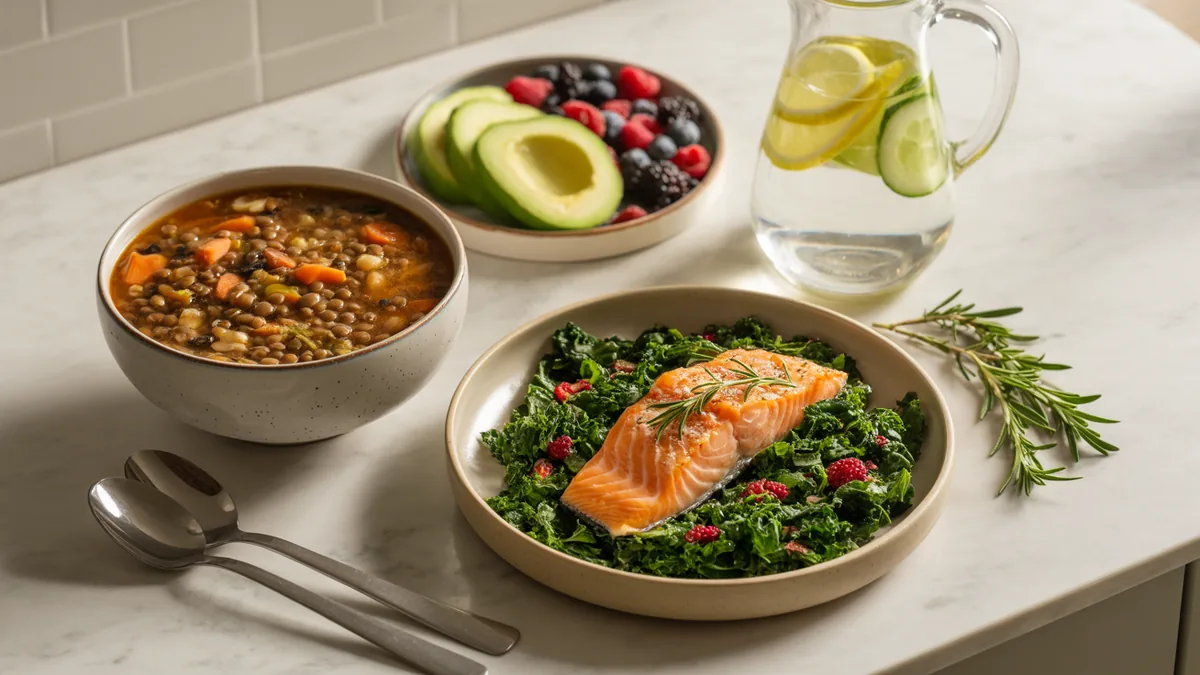
I want to be straight with you before you read another line. Your liver and your kidneys do the work of clearing things from your body, continuously, without any help from a plan. No food removes toxins, no tea speeds that process up, and any programme that promises to do so is selling you something. Nothing in this article claims otherwise, and if you were looking for that, this will disappoint you.
What a ten day plan can honestly offer is much smaller and, in my experience, much more useful. It is ten days of eating mostly whole food, with the decisions already made. That is all. For me the value was never a cleanse. It was ten days where I did not have to think about dinner at six in the evening, ate a lot more vegetables than usual, and got a clear look at what my ordinary eating had drifted into.
So this is the plan written out properly, every meal for all ten days, with two grocery lists, two prep sessions and swaps for the things you will not have. There is no weight loss claim here, no supplement, no juice-only stretch, and no fasting. If you want the food categories rather than the day-by-day plan, my detox diet food list covers what to build from and what to reduce.
| Days | What the meals look like | Prep behind them |
|---|---|---|
| Day 1 to 2 | Simple, familiar meals. Oats, a big salad with beans, a tray dinner | Prep session one, about 75 minutes |
| Day 3 to 4 | Same components, different sauces. Soup appears at lunch | Nothing, assembly only |
| Day 5 | Use-it-up day. Whatever is left becomes a bowl or an omelette | Fridge triage, 10 minutes |
| Day 6 to 7 | The second half opens with fish and a new set of vegetables | Prep session two, about 60 minutes |
| Day 8 to 9 | Lentils and grains carry the meals. Batch soup at lunch | Nothing, assembly only |
| Day 10 | A cooked dinner you actually sit down for, and a plan for day 11 | 20 minutes, mostly cooking |
| Every day | Water, one piece of fruit, a handful of nuts, plenty of vegetables | None |
| Every day | No supplements, no juice-only stretches, no skipped meals | None |
What this plan is, and what it is not
The framing: This is a ten day whole foods eating plan with the decisions pre-made. It is not a cleanse, it does not remove toxins, it involves no supplements or fasting, and it makes no weight loss claim.
The word detox has been attached to so many products that it has stopped meaning anything useful. In medicine it refers to something specific and clinical. In marketing it refers to a tea, a powder, or ten days of juice. The National Center for Complementary and Integrative Health is blunt about this, noting there is little rigorous evidence that detox programmes remove toxins or produce lasting benefits.
Cleveland Clinic makes a similar point in its overview of detoxes and cleanses, which is worth reading before you start anything. I keep the word in the title of this article because it is what people search for, and I would rather someone looking for a ten day cleanse found a page that tells them the truth and hands them a decent plan.
What is actually going on when people feel better on plans like this is not mysterious. You eat more vegetables and fibre, you drink more water, you eat less ultra-processed food and less alcohol, and you eat at more regular times. Those are ordinary changes with ordinary explanations, and they are worth making. They just do not need a story about toxins attached to them.
One clear disclaimer, and I mean it. I am not a doctor or a registered dietitian, and nothing here is medical or dietary advice. If you are pregnant or breastfeeding, managing diabetes, kidney or liver disease, taking medication that interacts with food, or have any history of disordered eating, talk to your doctor before changing how you eat. For some people a structured plan like this is genuinely unsuitable.
How the ten days are structured
The structure: Two five-day halves, each opened by a grocery shop and a prep session, with three meals and one or two snacks daily. Nothing is skipped, nothing is liquid-only, and day five and day ten are deliberately loose.
Ten days splits into two halves for a practical reason rather than a philosophical one. Fresh food does not keep for ten days, and a single enormous shop at the start means the second half is eaten from tired produce. Two shops, two prep sessions, and the back half tastes as good as the front half, which is most of why people finish rather than quit on day six.
Each day has breakfast, lunch, dinner and one or two snacks. There is no fasting window, no meal replacement and no calorie target, because this plan is about the composition of what you eat rather than the amount. If you are hungry, eat more of the vegetables, the protein or the whole grains. Being hungry is not the goal and it is not a sign it is working.
The rough shape of every plate follows the Harvard Healthy Eating Plate: about half vegetables and fruit, a quarter whole grains, a quarter protein, with olive oil or another healthy fat, and water as the drink. I did not invent this shape. I just applied it to ten specific days so nobody has to decide anything at six in the evening.
Day five and day ten are intentionally unstructured. Day five is a use-it-up day, which handles the produce that would otherwise be thrown away, and day ten is a real cooked dinner you sit down for, because ending a plan with a container of leftovers makes the whole thing feel like a punishment that has finally stopped.
Grocery list one, for days 1 to 5
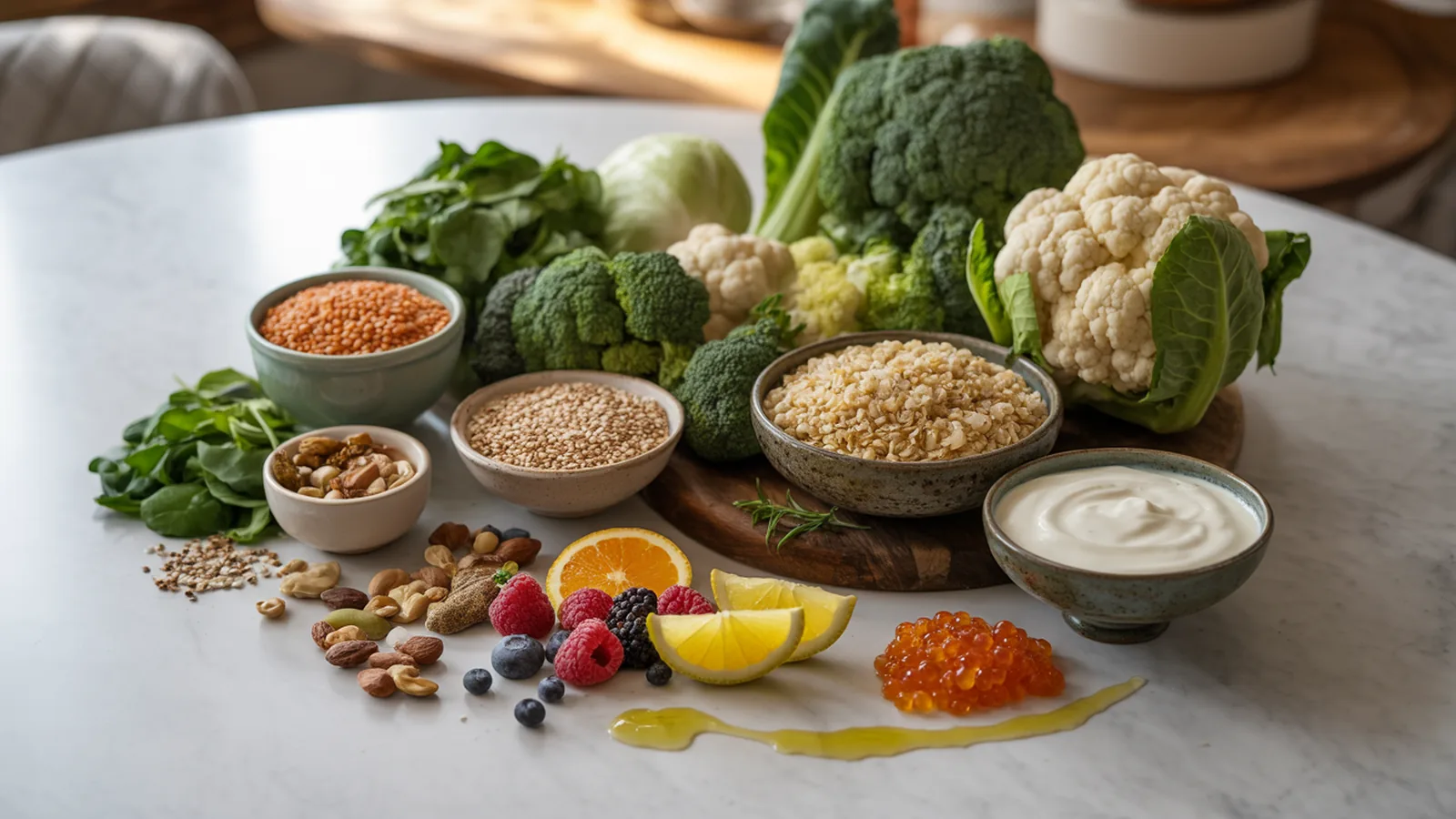
First shop: One shop covering five days, built around oats, eggs, chicken or tofu, two tins of beans, a bag of lentils, brown rice, and roughly nine different vegetables plus three fruits.
Quantities below assume one person eating all three meals from the plan. Double the proteins and vegetables for two people, and add roughly half again for a third. The list is deliberately short on specialty items, because the fastest way to abandon a plan is to spend an hour hunting for an ingredient you will use once.
- Produce: spinach or kale, romaine or mixed leaves, broccoli, carrots, sweet potatoes, red onions, bell peppers, courgettes, cucumber, tomatoes, garlic, lemons, one avocado, bananas, apples, a punnet of berries, fresh parsley.
- Protein: a dozen eggs, about 700g chicken thighs or a block of firm tofu, one tin of chickpeas, one tin of black beans, 250g dried green or brown lentils.
- Grains and pantry: rolled oats, brown rice, wholegrain bread, olive oil, tahini, cumin, smoked paprika, dried oregano, apple cider or red wine vinegar, low-sodium vegetable stock.
- Dairy and other: plain unsweetened yogurt, unsalted almonds or walnuts, chia or pumpkin seeds.
A note on tinned versus dried. Tinned beans are perfectly good, and the sodium difference largely disappears if you rinse them. Dried lentils are cheap and cook in twenty-five minutes without soaking, which makes them the one dried legume I would push you toward even in a short plan.
Fibre is doing quite a lot of the work in this plan, and most adults in the United States fall short of recommended intakes. Harvard's summary of dietary fibre is a clear read on why. If you currently eat very little fibre, increase gradually and drink more water, because a sudden jump is genuinely uncomfortable and is the most common reason people feel worse on day two.
Days 1 to 5, meal by meal
The first half: Familiar meals built from the first prep session. Oats or eggs at breakfast, a grain and bean bowl or soup at lunch, a tray dinner or stir fry in the evening, with fruit and nuts between.
Everything below assumes prep session one has happened, which means cooked rice, cooked lentils, a tray of roasted vegetables, cooked chicken or tofu, and a jar of dressing are already in the fridge. If they are not, the first two days become considerably more work.
Day 1
- Breakfast: Oats cooked with water or milk, topped with berries, chia seeds and a spoon of yogurt.
- Lunch: Brown rice, black beans, roasted peppers and courgette, spinach, tahini lemon dressing.
- Dinner: Chicken thighs or tofu roasted with sweet potato and broccoli, olive oil, lemon.
- Snacks: An apple, a small handful of almonds.
Day 2
- Breakfast: Two eggs scrambled with spinach, one slice of wholegrain toast, half an avocado.
- Lunch: Lentil salad with cucumber, tomato, red onion, parsley and vinegar dressing.
- Dinner: Stir fry of the remaining chicken or tofu with broccoli, carrots and garlic over brown rice.
- Snacks: Plain yogurt with berries, a few walnuts.
Day 3
- Breakfast: Oats again, this time with grated apple, cinnamon and pumpkin seeds.
- Lunch: Lentil and vegetable soup made from stock, the last roasted vegetables and half the lentils.
- Dinner: Chickpeas roasted with smoked paprika and cumin, over leaves, with sweet potato and tahini.
- Snacks: A banana, a small handful of almonds.
Day 4
- Breakfast: Yogurt bowl with berries, oats stirred in raw, chia seeds and a drizzle of tahini.
- Lunch: The rest of the soup, with a slice of wholegrain toast and half an avocado.
- Dinner: Eggs baked into a pan of tomatoes, peppers and onion, with rice or toast alongside.
- Snacks: An apple, a spoon of nut butter if you have it.
Day 5, the use-it-up day
- Breakfast: Whatever fruit is left, with yogurt and seeds.
- Lunch: A bowl of everything remaining: grain, beans, vegetables, leaves, dressing.
- Dinner: An omelette with the last vegetables, plus a large salad.
- Snacks: Nuts, and any fruit that will not survive until the second shop.
Grocery list two, for days 6 to 10
Second shop: A deliberately different list for the back half, built around salmon or white fish, more lentils, quinoa, and a new set of vegetables so the second five days do not taste like a repeat.
The whole point of shopping twice is that the second list looks different. Same structure, different specifics, which is why day seven does not feel like day two. Do this shop on the evening of day five or the morning of day six, and do prep session two straight after unpacking while you are already in the kitchen.
- Produce: green beans, cauliflower, butternut squash or more sweet potato, red cabbage, celery, spring onions, rocket or watercress, mushrooms, fresh ginger, lemons and limes, oranges, pears, a second punnet of berries, fresh coriander or dill.
- Protein: two salmon fillets or 400g white fish, six more eggs, one tin of cannellini or butter beans, the remaining dried lentils, a small block of feta if you eat dairy.
- Grains and pantry: quinoa, more brown rice if needed, wholegrain crackers or oatcakes, more olive oil if running low, mustard, sesame seeds.
- Extras: plain yogurt, unsalted mixed nuts, one bag of frozen peas as insurance.
Frozen fish is entirely fine here and often better value and better quality than what is sitting at the counter. It thaws overnight in the fridge and cooks in the same time. Tinned sardines or mackerel work too if fresh fish is not practical, and they are excellent value for what they contain.
If you do not eat fish, the substitution is straightforward: another tin of beans plus eggs, or tempeh, or more lentils with a stronger sauce. Nothing in this plan depends on a single food, which is deliberate, because plans that hinge on one ingredient fall apart the moment your shop does not have it.
Days 6 to 10, meal by meal
The second half: Fish, quinoa and a new set of vegetables carry days six and seven, lentils and grains carry eight and nine, and day ten is a proper cooked dinner rather than a container.
Prep session two should be done before day six starts, which means cooked quinoa, a tray of roasted squash and cauliflower, a pot of lentils and a fresh jar of dressing waiting in the fridge. That session runs about an hour and it covers the entire back half.
Day 6
- Breakfast: Two eggs, wholegrain toast, sliced tomato, a handful of rocket.
- Lunch: Quinoa with roasted squash, cannellini beans, rocket, lemon and olive oil, feta if using.
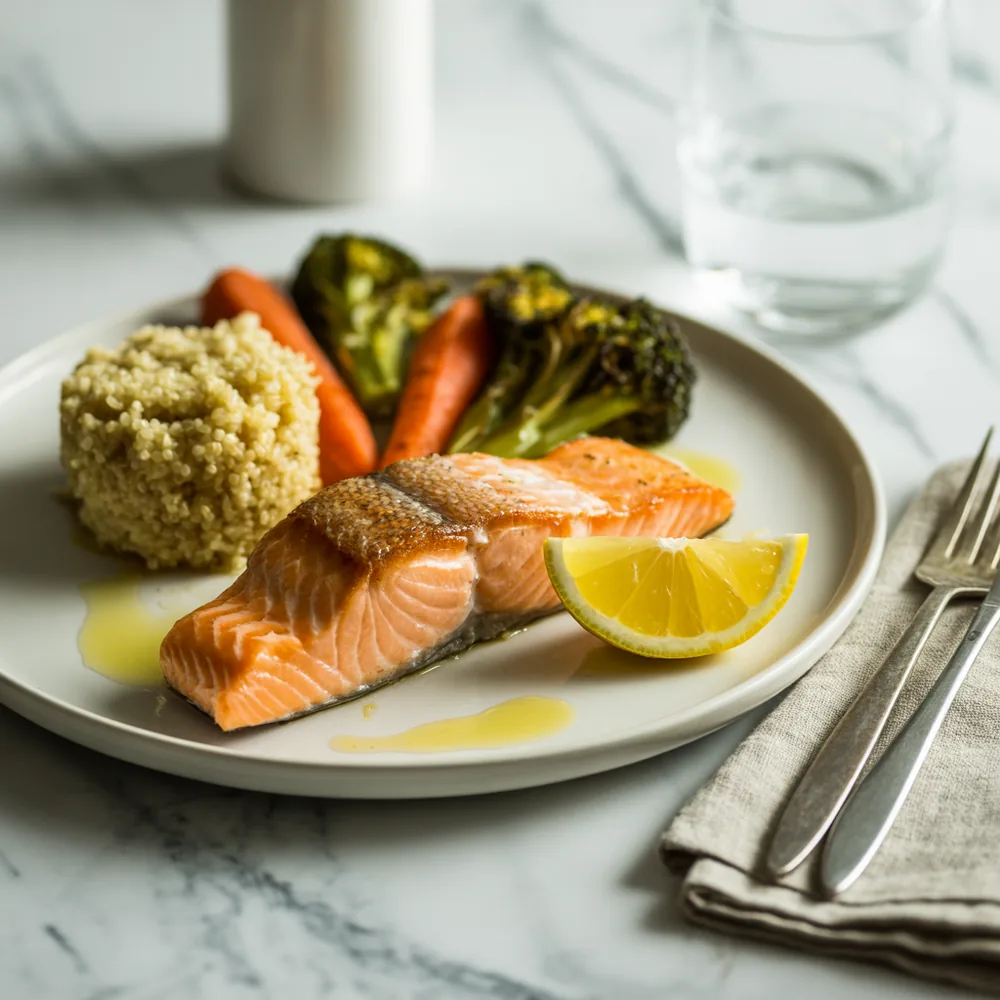
- Dinner: Salmon baked with lemon and dill, green beans, and a small portion of quinoa.
- Snacks: An orange, a handful of mixed nuts.
Day 7
- Breakfast: Oats with pear, cinnamon and sesame or pumpkin seeds.
- Lunch: The second salmon fillet flaked over leaves with cucumber, red cabbage and mustard dressing.
- Dinner: Lentils braised with mushrooms, celery, garlic and stock, over brown rice.
- Snacks: Yogurt with berries, wholegrain crackers.
Day 8
- Breakfast: Yogurt, berries, oats stirred in raw, chia seeds.
- Lunch: The rest of the braised lentils, reheated, with a large side salad.
- Dinner: Cauliflower and chickpea traybake with cumin and smoked paprika, over quinoa, tahini on top.
- Snacks: A pear, a small handful of nuts.
Day 9
- Breakfast: Eggs scrambled with spring onion and mushrooms, one slice of toast.
- Lunch: Soup made from the remaining roasted vegetables, stock and a tin of beans, blended.
- Dinner: Rice bowl with frozen peas, egg, sesame seeds, ginger and whatever vegetables remain.
- Snacks: An orange, yogurt.
Day 10, a dinner you sit down for
- Breakfast: Oats or eggs, whichever you have missed more this week.
- Lunch: The last of the soup, or a bowl from the remaining components.
- Dinner: Something cooked properly and eaten at a table: roasted fish or a vegetable gratin, potatoes, greens, a glass of something you like.
- Snacks: Fruit, and anything left that would otherwise be wasted.
The two prep sessions that make it work
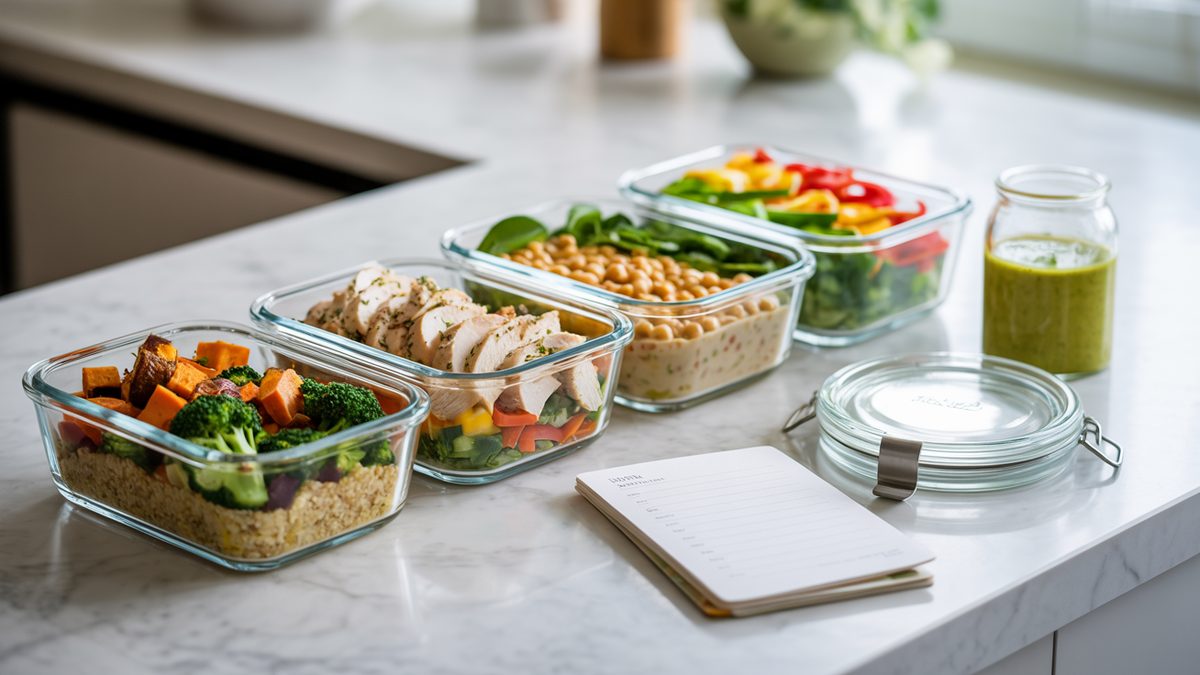
Prep sessions: Session one runs about seventy-five minutes before day one, session two about sixty minutes before day six. Each produces a grain, a legume, a tray of roasted vegetables, a protein and a jar of dressing.
Without these two sessions the plan becomes ten days of cooking from scratch, which nobody sustains alongside a job. With them, six of the ten days require almost no cooking at all, just heating and assembling. The sessions are the load-bearing part, and if you only have time for one of them, do session one.
- Oven on, vegetables in. Chop everything hardy, oil and salt, two trays, forty minutes at 425F.
- Grain on the hob. Brown rice in session one, quinoa in session two, cooked and spread out to cool.
- Legumes. Lentils simmered twenty-five minutes, or beans rinsed from the tin, whichever the half calls for.
- Protein. Chicken or tofu roasted alongside the vegetables, or fish left raw and cooked fresh, since it takes ten minutes anyway.
- Dressing. Olive oil, lemon or vinegar, mustard or tahini, salt, shaken in a jar. It keeps the whole five days.
- Cool and store. Everything refrigerated within two hours, in labelled containers, dated.
Cooked components keep three to four days refrigerated, which is exactly why the plan splits into two halves rather than running one shop across ten days. Nothing in this plan asks you to eat food cooked six days earlier, and if a day slips, freeze the component rather than pushing it another day.
Wash and dry salad leaves during the session and store them with a piece of kitchen paper in the container. This is the single step that most determines whether you actually eat the salad portion of the plan, since leaves that need washing at seven in the evening tend not to get eaten.
Swaps, so the plan fits your kitchen
Swaps: Every component has an equivalent. Any whole grain for the rice or quinoa, any legume for the lentils, any two hardy vegetables for the roasting tray, and eggs, fish, poultry, tofu or beans for the protein.
The plan is written with specific foods so it is usable, not because those foods are special. Nothing here is a superfood and I would be suspicious of anyone telling you otherwise. If you have barley and not quinoa, use barley. If you hate sweet potato, use butternut squash or ordinary potatoes. The structure survives every one of these substitutions.
For allergies and intolerances the swaps are straightforward. Without dairy, use a plant yogurt with no added sugar and skip the feta. Without gluten, use rice, quinoa, oats labelled gluten free, and rice cakes rather than bread. Without nuts, use pumpkin and sunflower seeds, which do the same job in the snacks and cost less.
For a fully plant-based version, replace the chicken with tofu or tempeh, the fish with a tin of beans or more lentils, and the eggs with additional legumes plus something like hummus for the fat and protein. This works well, though the protein total drops, so be more generous with the legume portions than the plan suggests.
On budget, this plan is already cheap and can be cheaper. Dried lentils, tinned beans, eggs, oats, brown rice, frozen vegetables and seasonal produce are the least expensive things in any shop. Drop the fish, use frozen vegetables where fresh is expensive, and buy whatever leafy green is on offer rather than the one written down.
What the ten days actually feel like
The experience: Days one and two often feel flat, particularly if you usually drink a lot of coffee or eat a lot of sugar. Days three to six tend to feel steady. The most reported change is energy that does not dip sharply after meals.
My own first attempt at something like this was miserable for two days and I nearly stopped. I had cut caffeine at the same time, which was a mistake, and I had jumped from very little fibre to a great deal of it overnight, which was a bigger one. The second time I kept my coffee and increased the vegetables more gradually, and days one and two were unremarkable.
By around day three my hunger pattern had changed noticeably. Less of the sharp mid-afternoon drop, less of the standing in front of the fridge at nine at night. I attribute that to protein and fibre at every meal rather than anything mystical, and it is the change I would actually promise someone, with the caveat that it is my experience rather than a research finding.
What I do not experience, and want to be clear about, is anything that would count as detoxification. No dramatic clarity, no toxins leaving, no glow that arrives on day seven. What arrives is more ordinary: I have eaten a lot of vegetables for a week and a half, I have drunk more water, and I have not eaten anything from a packet after nine at night.
If you feel genuinely unwell at any point, dizzy, faint, unusually weak, or if you have a headache that does not resolve, stop and eat normally. That is not a detox reaction to push through. It is a signal, and treating discomfort as evidence a plan is working is one of the more harmful ideas in this whole category of content.
Day 11, and what happens next
After the ten days: Keep two or three specific habits rather than the whole plan. The ones that survive best are vegetables at lunch, a prep session on the weekend, and not eating from packets in the evening.
The failure mode of every short plan is the snap back, where day eleven becomes an enormous compensatory meal and by day fourteen nothing has changed. I have done this. The way to avoid it is to decide before day ten which two or three things you are keeping, and to make them specific and small enough to be obvious.
Mine were: vegetables at lunch rather than only at dinner, one prep session at the weekend, and no eating from a packet after nine in the evening. Three things, all of which I could describe in a sentence. Vaguer intentions like eating better or cutting sugar did not survive a single week when I tried them.
Day eleven itself should be a normal day, not a celebration and not a continuation. Eat something you have missed, without ceremony, and then carry on. Making day eleven into a reward frames the previous ten days as deprivation, which they were not, and sets up exactly the cycle this kind of plan should not create.
If you want to keep something structured going, my weekly meal prep schedule is the ongoing version, built to repeat indefinitely rather than for ten days. And if you want to keep eating this way without the plan, the anti-inflammatory foods list and the gut health foods list cover what I restock permanently.
When a 10 day meal plan won't fit your life
Who should skip this: Anyone pregnant or breastfeeding, managing diabetes, kidney or liver disease, taking medication affected by diet, or with any history of disordered eating should not follow a structured plan without medical guidance.
I want this section to be the one people actually read. Structured eating plans are not neutral for everyone. If you have a history of restrictive eating, bingeing, or a fraught relationship with food rules, a ten day plan with lists and days can reactivate patterns that took a long time to settle. That is a real risk and it outweighs any benefit here.
Medically, several situations need a clinician rather than an article. Pregnancy and breastfeeding change nutritional needs substantially. Diabetes management involves carbohydrate timing that a general plan cannot account for. Kidney disease often restricts potassium, phosphorus or protein, and this plan is high in vegetables and legumes. Some medications interact with specific foods, including leafy greens and grapefruit.
Practically, there are also just weeks where this will not work. A holiday, a work trip, a stretch of hosting, a period where you are eating with other people constantly. Ten days requires a fairly ordinary ten days, and starting it in an unusual one guarantees a failure that will feel like a personal one rather than a scheduling one.
And if the honest reason you are looking at this is weight loss, I would gently redirect you. This plan makes no weight loss claim and is not designed for it. Ten days is not long enough for any meaningful body composition change, and a plan that produces a temporary drop and a rebound is worse than no plan. For that conversation, a doctor or a registered dietitian is the right place.
Helpful sources and next reads
Reliable external sources
- National Center for Complementary and Integrative Health: detoxes and cleanses, what the evidence shows
- Cleveland Clinic: what a detox or cleanse does and does not do
- Harvard T.H. Chan School of Public Health: the Healthy Eating Plate
- Harvard T.H. Chan School of Public Health: dietary fibre
More from Sabrina Saturno
You may also love

FAQ
Does a 10 day detox meal plan actually remove toxins?
No. Your liver and kidneys handle that continuously, and no food or plan speeds it up. Federal health sources are clear that there is little rigorous evidence detox programmes remove toxins. What a ten day whole foods plan can offer is more vegetables, more fibre, less ultra-processed food and pre-made decisions.
Will I lose weight on this plan?
This plan makes no weight loss claim and is not designed for it. Ten days is too short for meaningful body composition change, and short plans that produce a temporary drop followed by a rebound tend to leave people worse off. If weight is your goal, that is a conversation for a doctor or a registered dietitian.
Can I drink coffee during the ten days?
Yes, and I would keep it. Cutting caffeine at the same time as changing everything else made my first attempt miserable for two days and nearly ended it. If you want to reduce coffee, do that separately, gradually, and not in the same week you change every meal.
Do I need any supplements or detox teas?
No, and I would actively avoid them. Nothing in this plan requires a supplement, a powder, a tea or a kit, and products marketed as detox aids are not required for any of the benefits described here. Some laxative teas sold this way can cause real harm.
Is this plan safe for everyone?
No. Anyone pregnant or breastfeeding, managing diabetes, kidney or liver disease, taking medication affected by diet, or with a history of disordered eating should speak to a doctor first. I am not a clinician and this article is not medical advice. For some people a structured plan is genuinely unsuitable.
Can I do this plan as a vegetarian or vegan?
Yes, easily. Replace the chicken with tofu or tempeh, the fish with a tin of beans or extra lentils, and the eggs with additional legumes plus something like hummus. Be more generous with legume portions than the plan states, since the protein total drops when animal foods come out.
What if I am hungry on this plan?
Eat more. There is no calorie target here and hunger is not a sign it is working. Add more vegetables, more legumes, more whole grains or another egg. A plan that leaves you hungry is a plan you will abandon on day four, which is worse than a plan you finish having eaten a bit extra.
Can I have alcohol during the ten days?
The plan does not include it, and most people who feel a difference on plans like this are partly feeling the absence of alcohol. If you would rather not cut it entirely, reducing it is still worth doing. It is your decision, and there is no moral weight attached either way.
How much does this plan cost?
Less than most people's ordinary shopping, in my experience. The bulk of it is oats, brown rice, quinoa, lentils, tinned beans, eggs and seasonal vegetables, all of which are inexpensive. Dropping the fish and using frozen vegetables where fresh is expensive brings it down further without changing the structure.
Can I repeat the ten days back to back?
I would not. The point of ten days is that it ends and something ordinary continues afterward. Repeating a structured plan indefinitely turns it into a set of permanent food rules, which is a different thing with different risks. Keep two or three habits and go back to normal eating instead.
What if I miss a day or eat off plan?
Nothing happens. Pick up at the next meal, not the next day and certainly not the next Monday. The all-or-nothing reset is the single biggest reason short plans get abandoned, and one meal that was not on the list has no effect on the other twenty-nine.
Do I have to prep, or can I cook fresh each day?
You can cook fresh, and it will take roughly forty minutes a day instead of about two and a quarter hours total. Most people cannot sustain that alongside work, which is why the plan is built around two sessions. If you enjoy cooking daily, ignore the prep and use the meal list directly.
What should I do on day eleven?
Eat a normal day, without ceremony. Decide before you finish which two or three specific habits you are keeping, and make them concrete: vegetables at lunch, one weekend prep session, nothing from a packet after nine. Vague intentions to eat better do not survive a single week.
The version that lasts
I have run some version of these ten days three times over the years, and the value has never been where the marketing said it would be. Nothing was cleansed. What I got each time was a clear look at what my ordinary eating had quietly become, and about ten days of not having to decide anything at six in the evening, which turned out to be the actual luxury.
What lasted afterward was never the whole plan. It was three habits, and the same three each time: vegetables at lunch, one cooking session at the weekend, and not eating from packets late at night. If I had skipped the ten days and simply started those three habits, I suspect I would have ended up in the same place with less effort.
So that is the part worth carrying out of it. The plan is a scaffold, not the building. Use the ten days to find out which two or three changes are actually worth keeping in your particular life, then keep those and let the plan go. A short structured stretch is only useful if something ordinary survives it.