
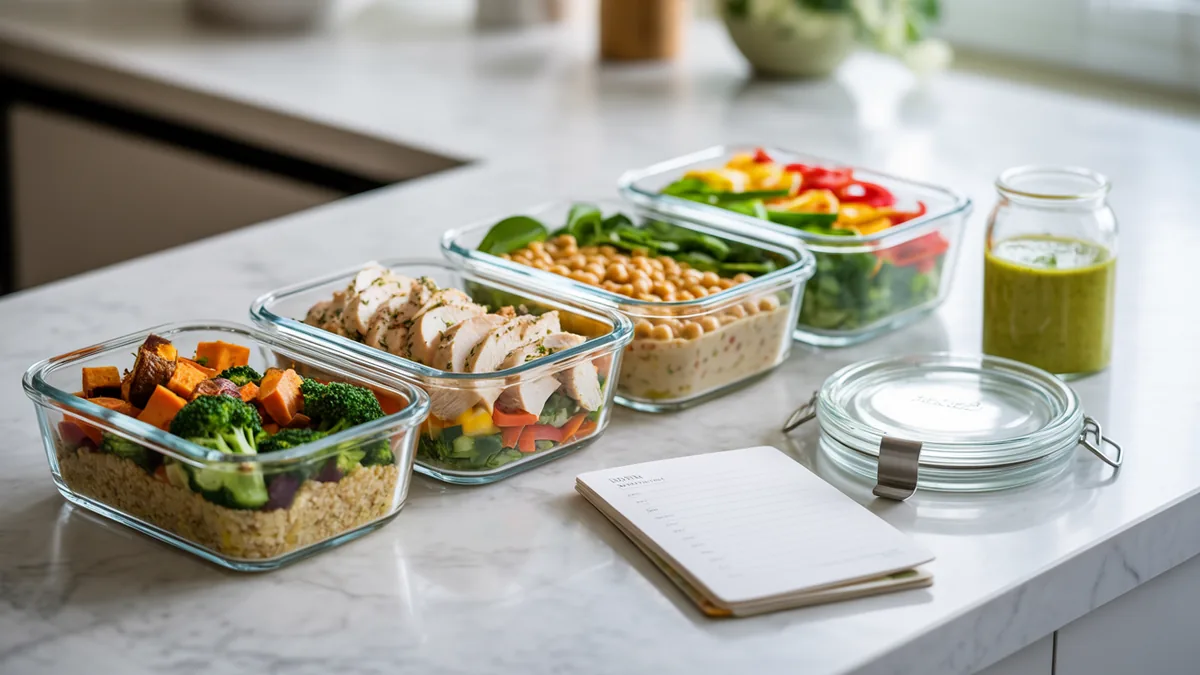
Every meal prep plan I tried in my twenties had the same shape: one enormous Sunday, five identical containers, and a Thursday where I would rather have eaten cereal standing up than face the fourth version of the same chicken and rice. The cooking was never the problem. The calendar was. Everything was concentrated into one day and expected to hold for seven.
What actually works for me now is a schedule rather than a session. Twenty minutes on Saturday, ninety on Sunday, thirty on Wednesday, and five minutes of assembly on the days in between. The total time is roughly the same as one long Sunday and the food is dramatically better by Thursday, because half of it was made on Wednesday and is still perfectly good.
So this is the whole week written out, day by day, with the storage windows that make it safe and a four-week rotation so it does not become monotonous. If you want the cooking method itself, the technique of making components rather than complete meals, that lives in my guide to meal prep for busy women. This piece is the timetable that carries it.
| Day | What happens | Time it takes |
|---|---|---|
| Saturday evening | Fridge audit, menu for five dinners, one written grocery list | 20 minutes |
| Sunday late morning | Shop or receive the delivery, unpack, wash and store produce | 45 minutes |
| Sunday early afternoon | The anchor session: two grains, one protein, one tray of vegetables, one sauce | 90 minutes |
| Monday | Nothing. Assemble from Sunday's components | 5 minutes per meal |
| Tuesday | Nothing. Assemble, and move any freezer item down to thaw | 5 minutes |
| Wednesday evening | The top-up: one fresh protein, one fast vegetable, restock salad greens | 30 minutes |
| Thursday | Assemble from Wednesday's top-up plus what survives from Sunday | 5 minutes |
| Friday | Use-it-up night, whatever is left becomes a bowl, soup or omelette | 20 minutes |
Why one long Sunday session stops working
The core problem: Food cooked on Sunday is at its best on Monday and its worst on Friday, while most single-session plans assume it stays equally good all week. Splitting prep across three points in the week fixes the freshness curve.
There are two separate failures hiding in the one-big-Sunday model and they arrive at different times. The first is boredom, which shows up around Wednesday, when the meal you were pleased with on Monday has become something you are eating out of obligation. The second is quality, which shows up around Thursday, when the greens have gone soft and the roasted vegetables have that particular refrigerated dullness.
The third failure is scheduling. A plan that requires three uninterrupted hours on a Sunday fails the moment a Sunday has something in it, and Sundays regularly have something in them. Three shorter sessions are far more robust, because losing one of them costs you a third of the week rather than all of it.
What changed things for me was noticing that I did not need seven days of food on Sunday. I needed four days of food on Sunday and three days of food on Wednesday. That is the entire insight, and it took me an unreasonable number of years to arrive at, mostly because every article I read framed prep as an event rather than a rhythm.
The other thing worth saying plainly is that meal prep is not a moral activity. It is a logistics tool for making it easier to eat reasonably during a busy week. Cleveland Clinic has a sensible set of meal prep starting points if you want a clinical framing, and none of them require you to build your identity around a set of containers.
The seven-day schedule, explained
The schedule: Saturday is twenty minutes of listing, Sunday is forty-five minutes of shopping plus a ninety-minute cook, Wednesday is a thirty-minute top-up, and the other four days are five minutes of assembly each.
Laid out as a total, that is about three hours of active work spread across a week, plus roughly twenty-five minutes of assembly. Compared to cooking dinner from scratch five nights, it is a large saving. Compared to a single four-hour Sunday, it is roughly break-even on time and considerably better on how the food tastes on Thursday.
- Saturday evening, twenty minutes. Look in the fridge, decide five dinners, write one list in the order of the shop.
- Sunday late morning, forty-five minutes. Shop or unpack the delivery, then wash, dry and store produce before anything else.
- Sunday early afternoon, ninety minutes. Cook two grains, one protein, one tray of vegetables, one sauce. Nothing is a finished meal.
- Wednesday evening, thirty minutes. Cook one fresh protein, roast or steam one fast vegetable, restock washed greens.
- Every other evening, five minutes. Assemble. Grain, protein, vegetable, sauce, something crunchy or acidic on top.
The days without a session are genuinely empty, and that is deliberate. Monday, Tuesday, Thursday and Friday require nothing except opening containers and putting things on a plate. If a schedule asks something of you every single evening, it is not a prep schedule, it is just cooking with extra steps.
You can shift the two cooking sessions to whatever pair of days suits your life, as long as they are three or four days apart. Saturday and Tuesday works. Monday and Thursday works. The gap is what matters, not the names, because the gap is what keeps the second half of the week from eating four-day-old food.
Saturday: twenty minutes that save Sunday
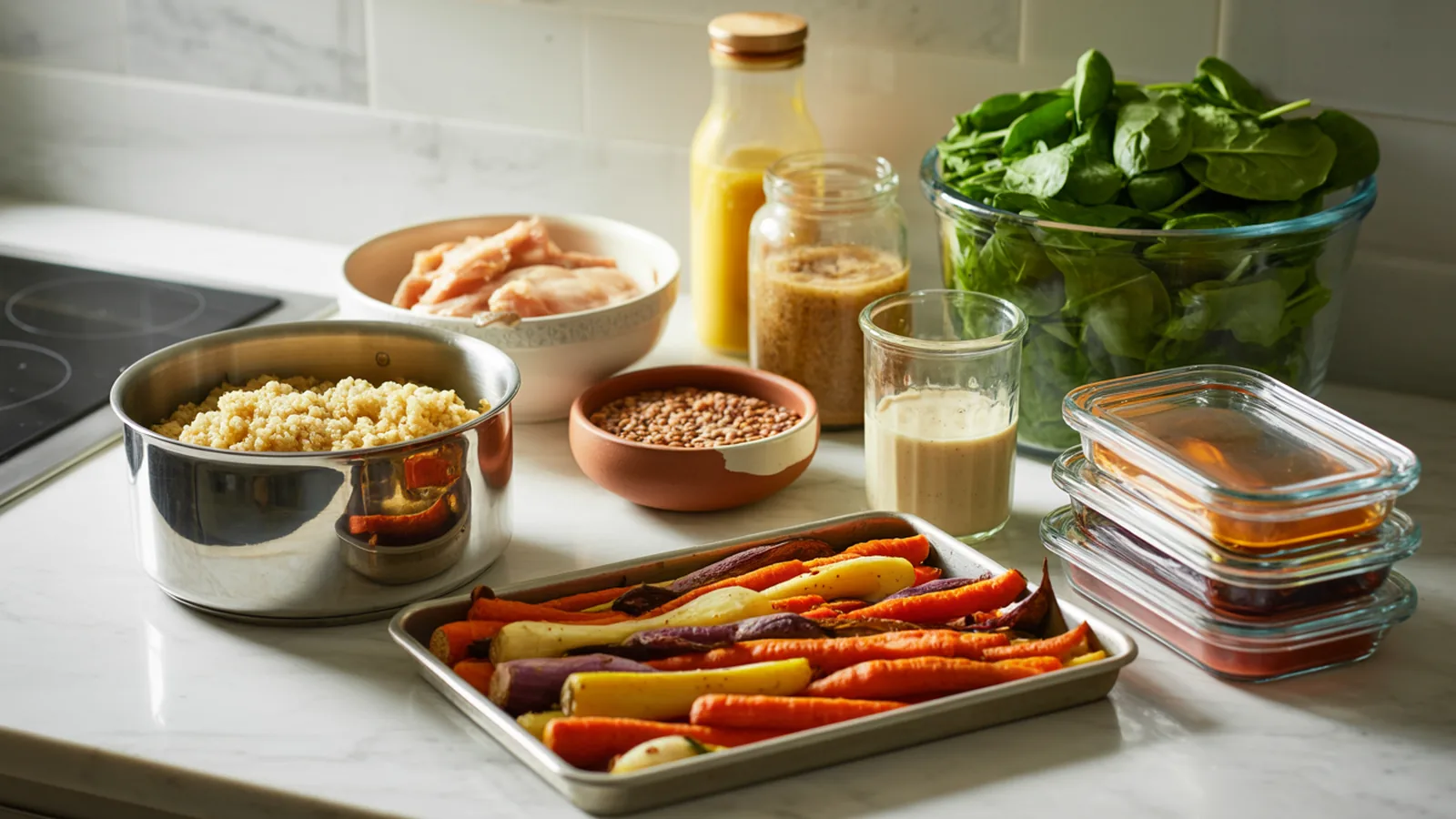
Saturday: Audit what is already in the fridge, freezer and cupboard, choose five dinners around what needs using, then write one list ordered by the layout of the shop so you are not walking in circles.
The audit comes first because the single largest source of food waste in my house was buying things I already owned. Ten minutes with the fridge door open, a look in the freezer, a glance at the cupboard shelf where half-used bags live. Three things always turn up that need using this week, and those three things decide two of the five dinners.
Then the menu, which is five dinners rather than seven because two nights are always going to be leftovers, an omelette, or takeaway, and pretending otherwise is how plans collapse on a Friday. I write them on the back of an envelope. The formal weekly planners I bought are in a drawer, unused, having been beautiful and unsustainable.
The list gets written in the order of the shop, which sounds fussy and saves about ten minutes plus a good deal of irritation. Produce, then dairy, then the cupboard aisles, then frozen, then whatever awkward thing lives at the far end. If you order groceries online this matters less, though the discipline of one list rather than adding things over three days still keeps the total down.
One thing I add to every list regardless: one bag of frozen vegetables and one carton of eggs. Those two items are the reason I have never had a week where there was genuinely nothing to eat, and they cost very little. Frozen vegetables in particular are nutritionally excellent and the food snobbery around them is misplaced.
Sunday: the ninety-minute anchor session
Sunday: Ninety minutes producing four components, not five meals: two cooked grains, one large batch of protein, one tray of roasted vegetables and one sauce. Everything overlaps, so nothing takes its full cooking time.
The order is what keeps it to ninety minutes. Oven on first at a high heat, vegetables chopped and in within the first twelve minutes, because the oven runs unattended for forty. Grains next on the hob, since they also need almost no attention. Protein third, on the stovetop or in the oven alongside. Sauce last, in a jar, in about four minutes.
- Minutes 0 to 12. Oven to 425F. Chop two trays of hardy vegetables, oil, salt, in.
- Minutes 12 to 25. Two pots on: one grain and one pot of beans or lentils if you are not using tinned.
- Minutes 25 to 55. Cook the protein. Chicken thighs, a side of salmon, a pan of ground turkey, or a second tray of tofu.
- Minutes 55 to 70. Sauce or dressing in a jar. Wash and dry salad greens, store with a paper towel.
- Minutes 70 to 90. Cool everything properly, portion into containers, label with the date, clean the kitchen.
The cooling step is the one people skip and it matters for safety. Food should not go into the fridge steaming, because it raises the temperature of everything around it, and it should not sit out on the counter indefinitely either. The general guidance from food safety authorities is to get cooked food refrigerated within two hours, and one hour if the room is very warm.
Two grains rather than one is a small change with a large payoff. A pot of rice and a pot of quinoa, or rice and a tray of roasted potatoes, means Wednesday's plate does not taste like Monday's plate even with the same protein on it. It costs perhaps six extra minutes and it is the single highest-return thing in the session.
Wednesday: the top-up that saves the back half
Wednesday: Thirty minutes to cook one fresh protein and one fast vegetable, restock washed greens, and check what from Sunday needs eating first. This single session is what makes Thursday and Friday food worth eating.
This is the piece almost nobody includes and the piece that changed my week most. By Wednesday evening, Sunday's protein is on day three and the greens are tired. Thirty minutes of fresh cooking resets the whole back half, and because you are only making one protein and one vegetable, it barely feels like cooking.
The protein is the fast kind. Eggs hard-boiled for the week, a tray of sausages, a tin of good tuna turned into something, shrimp that cook in four minutes, or a rotisserie chicken from the shop that requires no cooking at all. I use the rotisserie chicken more often than I would like to admit and it is entirely legitimate.
The vegetable is whatever cooks in under twenty minutes. Broccoli and green beans steamed, courgettes and peppers roasted, a bag of frozen peas warmed with butter and lemon. And greens get restocked, which for me means washing another head of lettuce or opening a new bag, because salad is what keeps the plate from feeling heavy on day five.
While I am there I do a thirty-second triage of Sunday's containers. Anything that needs eating tomorrow goes to the front. Anything that has turned goes in the bin without guilt, because keeping questionable food out of stubbornness is a false economy. This habit cut my waste noticeably, and it takes less time than reading this paragraph.
How long each component actually keeps
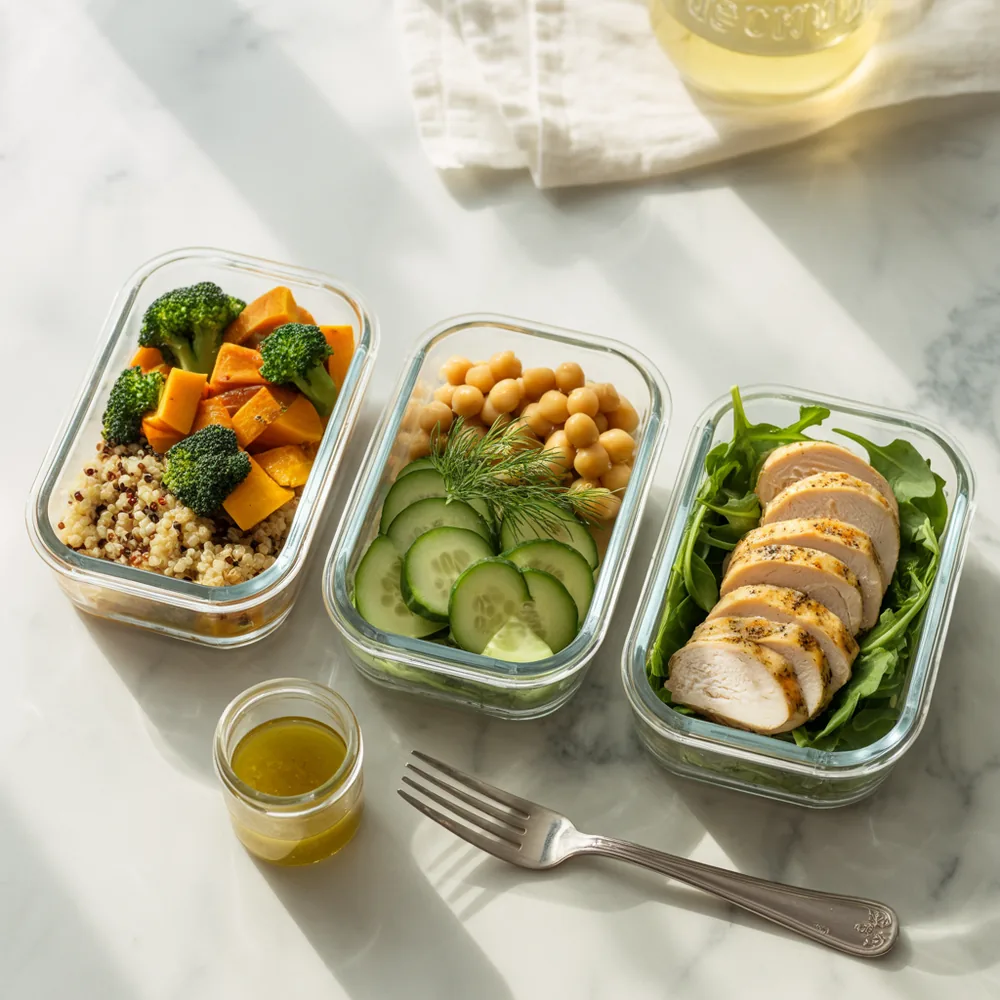
Storage windows: Cooked leftovers keep three to four days refrigerated as a general rule. Hard-boiled eggs keep about a week in the shell. Sauces and dressings often keep longer. When in doubt, freeze on day two rather than gambling on day five.
The federal guidance is refreshingly simple: cooked leftovers should be eaten within three to four days when kept refrigerated at 40F or below, or frozen for longer storage. The FoodSafety.gov cold storage charts are the reference I actually check, and they cover far more items than any blog list.
Within that window, some things hold up better than others in terms of taste rather than safety. Cooked grains, roasted root vegetables and cooked beans are still genuinely good on day four. Cooked chicken breast is dry by day three unless it is in a sauce. Roasted broccoli is unpleasant by day three. Anything dressed goes soft within a day, which is why dressing lives in a jar and goes on at the plate.
- Cooked grains and beans: good for three to four days, best in the first two.
- Cooked poultry, meat and fish: three to four days, and I aim for three.
- Hard-boiled eggs in the shell: about one week refrigerated.
- Roasted hardy vegetables: three to four days, softer ones noticeably less.
- Washed greens, dried, with a paper towel: four to five days.
- Vinaigrettes and most sauces: commonly a week or more, though dairy-based ones are shorter.
The habit that removed most of my uncertainty was labelling with the cook date rather than a use-by guess. A piece of tape and a marker, the date written on it, and no more standing in front of the fridge trying to remember whether that was Sunday's rice or last Sunday's rice. If you are ever genuinely unsure, throw it out. The cost of a portion of rice is not worth the alternative.
Assembling meals from components, five plates
Assembly: Every plate is grain, protein, vegetable, sauce, and something sharp or crunchy on top. Changing only the sauce and the topping makes the same four components read as five different meals.
The formula is deliberately boring because boring formulas survive Wednesdays. What varies is not the structure but the finish, and the finish is where almost all of the perceived difference lives. A bowl with tahini and pickled onion tastes nothing like the same bowl with pesto and toasted almonds, even though the underlying grain, protein and vegetable are identical.
- The grain bowl. Warm grain, protein, roasted vegetables, sauce, a handful of greens folded through at the end.
- The plate. Same components, arranged separately rather than mixed, with lemon and olive oil. It genuinely feels like a different meal.
- The wrap. Protein and vegetables in a tortilla with sauce, greens and something pickled.
- The soup. Stock, whatever grain and vegetables are left, protein added at the end so it does not toughen.
- The eggs. Leftover vegetables and grain in a pan, eggs on top, lid on for three minutes.
Three toppings on rotation carry most of the variety in my kitchen: toasted seeds or nuts, something pickled, and fresh herbs. All three keep well, all three take no preparation at the point of eating, and all three do the thing that four-day-old food most needs, which is contrast in texture and acidity.
For the shape of a balanced plate rather than a prepped one, the Harvard Healthy Eating Plate is the reference I default to. Vegetables take up the largest share, whole grains and a protein split most of what remains, and olive oil does the rest. I pick components so that throwing a bowl together in a hurry lands near that shape without any thinking.
A four-week rotation so you do not get bored
The rotation: Keep the schedule identical and rotate the flavour direction every week. Four weeks of Mediterranean, Mexican, East Asian and a soup-and-roast week covers a month before anything repeats.
Boredom kills more meal prep habits than time does. The fix is not more variety within a week, which multiplies the work, but a different direction each week, which multiplies nothing. The components stay structurally the same. The seasoning, the sauce and the toppings change, and that is enough.
- Week one, Mediterranean. Rice and orzo, chicken thighs with oregano and lemon, roasted peppers and courgette, a lemon tahini sauce, olives and feta on top.
- Week two, Mexican-leaning. Rice and black beans, ground turkey with cumin and smoked paprika, roasted sweet potato, a lime crema, pickled red onion and coriander.
- Week three, East Asian-leaning. Rice and soba, ginger salmon or tofu, roasted broccoli and carrot, a soy-sesame dressing, spring onion and toasted sesame.
- Week four, roast and soup. One large roast chicken or tray of vegetables, its stock turned into two soups, potatoes and lentils, salsa verde.
Week four is the recovery week and it is deliberately the least structured. A roast produces its own leftovers, the stock produces soup, and the whole thing takes less thinking than the other three. After three weeks of components I find I want a meal that arrives whole, and building that into the rotation stopped me from abandoning the system every fourth week.
Within any week I keep the protein consistent, because a single protein cooked well beats three cooked in a hurry. The exception is if a household has genuinely different needs, in which case the vegetarian component is the one that doubles, since beans and lentils reheat better than almost anything else and cost very little.
Where the freezer fits into the schedule
The freezer: Freeze half of the Sunday protein on day two rather than letting it reach day four, and keep three frozen meals in reserve at all times. Move tomorrow's item down to the fridge on Tuesday evening.
The mistake I made for years was treating the freezer as long-term storage for things that had already gone slightly wrong. The better use is proactive: on Tuesday, when Sunday's protein is at its second day and still excellent, half of it goes into the freezer for a week when there was no time to cook at all. Freezing at peak rather than at the edge.
Three meals in reserve is the number that works for me. Below three, the reserve gets used up and never rebuilt. Above five, things get lost and freezer-burned at the back. Three is enough to cover an illness, a very late night and a week where the schedule fell apart entirely, which is roughly how often those happen.
The thawing habit belongs in the schedule, which is why Tuesday has a note attached to it. Moving something from freezer to fridge the night before is a ten-second act that has to happen the day before it is needed, and it is the step that most often gets forgotten. Thawing on the counter is not the answer, and thawing in the fridge is.
Freeze in flat portions rather than blocks. A bag laid flat freezes faster, thaws faster and stacks properly, which sounds like a small optimization until you have tried to prise apart a solid brick of chilli at seven on a Wednesday. Label everything with contents and date, because unlabelled frozen food is functionally a mystery you will not open.
When the schedule slips, and how to restart
Recovering: A missed Sunday is fixed by a thirty-minute Monday, not by an abandoned week. If both cooking sessions are missed, buy pre-cooked components and restart the following Saturday with the list, not the cooking.
The schedule will slip. Mine slips perhaps one week in four, and the difference between a system that survives and one that does not is entirely in what happens next. The failure mode is treating a missed Sunday as a failed week, eating badly for six days out of a vague sense of having blown it, and then trying to start again from scratch.
The actual repair is small. If Sunday goes, do thirty minutes on Monday evening: one grain, one protein, done. That covers Tuesday and Wednesday and gets you to the Wednesday top-up, which was going to happen anyway. You have lost one day, not one week, and the week is entirely salvageable.
If both sessions go, buy your way out without shame. A rotisserie chicken, a bag of pre-cooked grains, a tub of hummus, bagged salad and a jar of good sauce is a perfectly reasonable week of food that requires no cooking at all. It costs more and it is far better than five days of whatever is nearest at eight at night.
The restart point is always Saturday, and always with the list rather than the cooking. Twenty minutes with the fridge door open is a much lower barrier than a ninety-minute session, and once the list exists the rest tends to follow. Every time I have tried to restart by cooking first, I have not restarted.
When a weekly meal prep schedule won't fit your life
When to skip it: Skip the full schedule if you have no fridge space, cook for people with very different needs, are in a season with no spare thirty minutes, or if prepped food genuinely puts you off eating.
Fridge space is the constraint nobody mentions. In a shared house with one shelf, four containers of components is not possible, and the honest adaptation is to prep two things rather than four and shop twice a week. This is less efficient and it is what the space allows, which makes it the right answer for that kitchen.
If your household has genuinely divergent needs, a picky child, someone with an allergy, different eating windows, the component approach can become three parallel systems, which is more work than cooking nightly. In that case prepping only the shared base, usually the grain and the vegetables, and cooking proteins to order is more realistic.
There is also a real group of people for whom prepared food is unappealing in a way that affects whether they eat at all. If opening a container of Sunday's dinner on Wednesday makes you not want dinner, forcing the system will cost you more than it saves. Prep the ingredients rather than the meals: washed and chopped vegetables, cooked grains, and cook fresh each night in fifteen minutes.
And in some seasons the honest answer is that food comes from somewhere else for a while. A newborn, an illness, a period of caring for someone, a stretch of grief. During those, the useful version of this article is one line: keep eggs, frozen vegetables and something you can heat in the house, and let the rest of the schedule wait. None of this is medical or dietary advice, and anyone managing a health condition should take dietary questions to a doctor or a registered dietitian.
Helpful sources and next reads
Reliable external sources
- FoodSafety.gov: cold food storage charts for the fridge and freezer
- Cleveland Clinic: practical meal prep ideas and starting points
- Harvard T.H. Chan School of Public Health: the Healthy Eating Plate
- USDA Food Safety and Inspection Service: leftovers and food safety
More from Sabrina Saturno
You may also love


FAQ
How many days of food should I prep at once?
Three to four days of cooked components rather than seven. Cooked leftovers keep three to four days refrigerated, so a full week prepared on Sunday means Friday's meal is at the outer edge of both safety guidance and palatability. Two shorter sessions a few days apart solves this cleanly.
What day is best for meal prep?
Any two days separated by three or four days. Sunday and Wednesday works for a standard week, Saturday and Tuesday works if your weekend starts earlier, and Monday and Thursday works for shift patterns. The gap matters far more than which days you pick.
How long does meal prep actually take each week?
About three hours of active work in this schedule, split into twenty minutes on Saturday, roughly two hours on Sunday including shopping, and thirty minutes on Wednesday. Assembly on the other days runs about five minutes per meal, which is faster than ordering food.
How long do prepped meals last in the fridge?
Cooked leftovers keep three to four days at 40F or below according to federal food safety guidance. Hard-boiled eggs in the shell keep about a week, and most vinaigrettes keep longer. If something has been in the fridge and you cannot remember when you cooked it, throw it out.
Should I prep breakfast and lunch too?
Breakfast prep gives the best return for the least effort, since overnight oats, hard-boiled eggs and a batch of egg muffins take almost no session time. Lunch usually assembles from the same components as dinner. I would not prep all three meals as separate projects, which is where the workload becomes unreasonable.
What containers work best?
Glass with a proper seal, in two sizes, and enough of them that a full week does not require washing mid-week. Glass does not stain or hold smells, goes from fridge to oven, and lets you see what is inside, which matters more than it sounds when things are stacked.
How do I stop getting bored by Wednesday?
Change the sauce and the topping rather than the components, and rotate the flavour direction weekly rather than daily. Toasted seeds, something pickled and fresh herbs are the three additions that do the most work, because four-day-old food mainly lacks contrast in texture and acidity.
Can I meal prep on a small budget?
Yes, and it usually saves money. Dried beans and lentils, seasonal vegetables, frozen vegetables, eggs and whole grains are the cheapest components and they all store well. The savings come mostly from wasting less produce and buying less food at eight in the evening when nothing is prepared.
Is it safe to reheat rice?
Yes, if it was cooled quickly and refrigerated promptly. The risk with rice comes from leaving it at room temperature for hours after cooking, which allows spores that survive cooking to multiply. Cool it within an hour, refrigerate it, and reheat it thoroughly once rather than repeatedly.
What should I freeze and what should I keep fresh?
Freeze cooked proteins, soups, stews, sauces and cooked grains, all of which hold up well. Keep salad greens, cut fruit, cucumber and anything with a high water content fresh, since freezing destroys their texture. Freeze on day two while things are still at their best rather than at the edge of the window.
What if I miss my Sunday session?
Do thirty minutes on Monday evening: one grain, one protein. That covers you to the Wednesday session, which was scheduled anyway, so you lose one day rather than the week. The most common way meal prep dies is treating a missed session as a failed week.
Do I need to weigh or track anything?
No. This is a logistics schedule, not a diet plan, and nothing here involves counting. If you are tracking for a specific medical or athletic reason, prepping components actually makes that easier, since you are weighing known quantities once rather than estimating five times.
Can I use this schedule if I cook for a family?
Yes, with the proteins scaled up and often one extra component. The main adjustment is that families empty the fridge faster, so the Wednesday top-up becomes more important rather than less. Prepping only the shared base and cooking proteins to order works well when tastes diverge sharply.
The version that lasts
The version that has survived three years in my kitchen is two cooking sessions, one list, and about three hours a week. Nothing in it is impressive. There is no wall of matching containers, no colour-coded week, no photograph worth taking. There is a Saturday envelope with five dinners on it and two evenings where the kitchen is busy for a while.
What made it durable was accepting that Friday would always be a use-it-up night rather than a planned one, and that one week in four the whole thing would slip. Building the recovery into the system, a thirty-minute Monday, a freezer with three meals in it, meant that slipping stopped being the end of the habit and became a normal part of it.
There is one change here I would push harder than the rest, and it is the Wednesday session. Twenty to thirty minutes in the middle of the week does more for how you eat on Thursday and Friday than any amount of extra effort on Sunday, and it is the piece that almost every meal prep guide leaves out.