
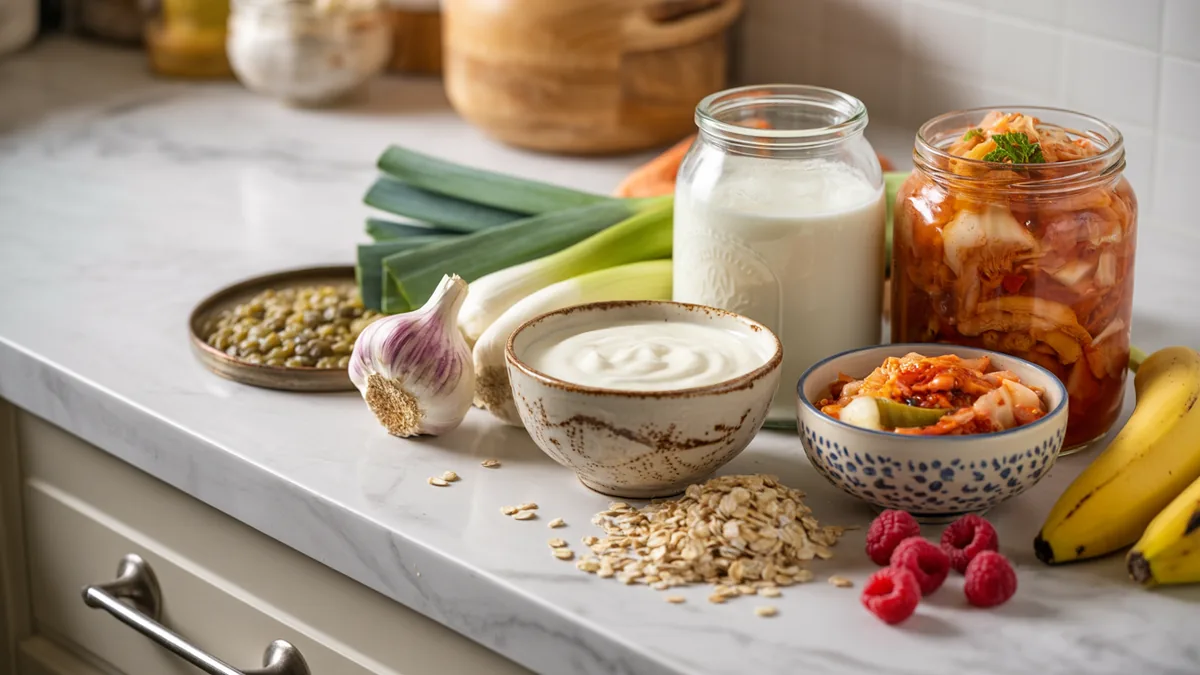
There is one shelf in my fridge that basically contains this entire article. A tub of plain kefir, an open jar of kimchi with a slightly domed lid, half a red cabbage, and a bag of ground flax I keep cold so it does not turn rancid. None of it was a project. It collected over about two years of reading and quietly swapping things in. Strip the marketing off a gut health foods list and you are left with three families: fermented foods carrying live bacteria, plant fibers that feed the bacteria already living in you, and enough total fiber for any of it to matter.
Let me set expectations before the list starts, because this topic attracts more promises than it can keep. Nothing below fixes anything. The research linking specific foods to the gut microbiome is young, built mostly on associations and short studies, and honest scientists say so out loud. What I can offer is which foods keep showing up in the careful sources, roughly what each one contributes, and how they fit into a week where I cook for two people and am usually tired by six in the evening.
So I have organized this by mechanism rather than by meal. Fermented foods come first because they are what people ask about. Then prebiotic fiber, then the plain arithmetic of total fiber, which is where most of us actually fall short. After that come polyphenol foods, the diversity idea, the habits that work against all of it, and a week of eating you could copy without a special shopping trip. If you have a diagnosed digestive condition, read the caution section before you change a thing.
| Food | What it brings | How I use it |
|---|---|---|
| Plain yogurt or kefir | Live cultures plus roughly 8 to 11g protein per cup | Kefir in a small glass, yogurt as a breakfast base |
| Refrigerated sauerkraut or kimchi | Live cultures and about 2g fiber per half cup | A forkful beside eggs or on top of a grain bowl |
| Miso and tempeh | Fermented soy; tempeh carries about 7 to 9g fiber per cup | Miso stirred into broth off the heat, tempeh pan-fried |
| Garlic, onions, leeks | Inulin and fructans that gut bacteria ferment | The base layer of almost everything I cook |
| Cooked lentils and black beans | About 15g fiber per cooked cup | A Sunday pot that lands in soups and bowls all week |
| Oats and barley | Beta-glucan; about 4g fiber per cooked cup of oats | Oats most mornings, barley in soup where rice used to go |
| Raspberries and pears | About 8g per cup of raspberries, 5 to 6g per pear with skin | Frozen raspberries in yogurt, pears eaten over the sink |
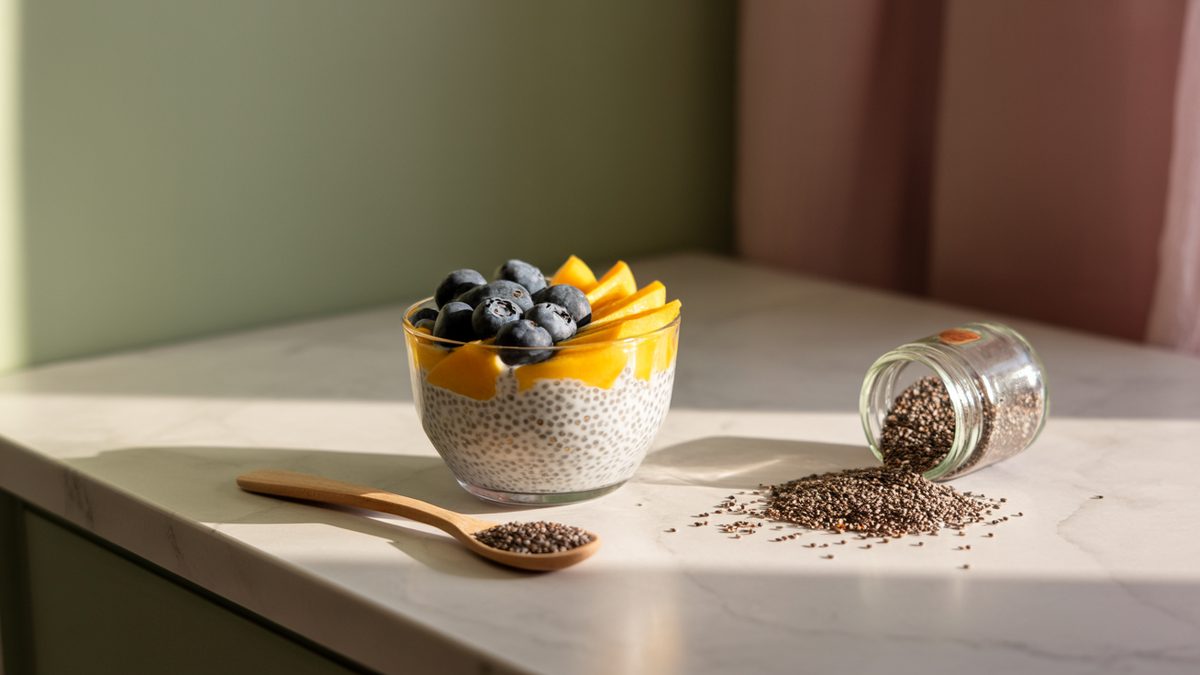
| Chia and ground flax | About 10g fiber per ounce of chia | A tablespoon stirred into yogurt or an overnight oat jar |
What gut health actually means
Plain version: Gut health usually refers to three things at once: the mix of microbes living in your large intestine, the condition of the gut lining, and whether digestion runs comfortably and regularly.
The phrase got popular before it got precise, so it helps to break it into parts. The first part is your microbiome, the trillions of bacteria and other microbes living mostly in the large intestine, which differ from person to person more than almost any other biological feature. The second is the gut lining itself, a single layer of cells doing the work of letting nutrients through while keeping other things out. The third is the everyday experience of digestion: whether you are regular, whether you feel comfortable after eating.
Diversity is the word you will see attached to the first part. In broad terms, researchers observe that people with a wider variety of microbial species tend to look healthier on a range of measures than people with a narrower mix. That is an association drawn from population studies, not a dial you can read at home or a target you can hit by Friday. Harvard's Nutrition Source overview of the microbiome is careful about exactly this distinction, which is why I keep sending people there.
What food can do here is modest and real at the same time. Diet shifts the microbial mix within days, which sounds dramatic until you learn it shifts back just as fast when you go back to eating the way you did before. So the useful frame is not a reset or a protocol. It is what you eat repeatedly, over months, because that is the input your gut bacteria are actually responding to. Everything below is written with that timescale in mind.
Fermented foods that carry live cultures
Live cultures: Plain yogurt, kefir, refrigerated sauerkraut and kimchi, miso, tempeh and natto carry live bacteria. Shelf-stable jars in the pickle aisle are usually pasteurized and carry none.
Yogurt and kefir are the easiest entry point because they are already in every American grocery store. Look for the phrase live active cultures on the label and for a short ingredient list, ideally milk and cultures and nothing else. Kefir is the thinner, drinkable one, and it typically carries a wider range of bacterial strains than yogurt does. I drink about half a cup most mornings from a small glass, which took some getting used to because it is genuinely tangy. Plain also means you control the sugar, which flavored tubs quietly do not.
Sauerkraut and kimchi are where most people accidentally buy the wrong thing, so this is the detail worth carrying with you. Live cabbage ferments live in the refrigerated section, usually in a plastic-lidded jar, and the label will say raw or unpasteurized. The shelf-stable jars sitting at room temperature in the pickle aisle have been heat treated for shelf life, which is fine food and often delicious, but the heat ends the live culture story. Vinegar-brined pickles are a different process altogether and were never fermented in the first place.
Then there is the fermented soy family, which is underrated in American kitchens. Miso is a fermented paste that gives you savory depth in seconds, and I stir it into broth after taking the pot off the heat, since boiling it defeats the point. Tempeh is a firm fermented cake of whole soybeans that also brings about 7 to 9g of fiber per cup, which no other fermented food on this list comes close to. Natto is the sticky, strongly flavored Japanese one, and I will admit I have never learned to love it.
Now the hedge, because it matters. Most of the bacteria in fermented foods are transient, meaning they pass through rather than taking up residence, and the research on what that does is still developing. The NIH Office of Dietary Supplements fact sheet on probiotics is refreshingly plain about how much remains unsettled, and Cleveland Clinic's page on probiotics says something similar. I eat these foods because they taste good and are associated with reasonable things, not because I expect a result.
Prebiotic fiber: the food your bacteria eat
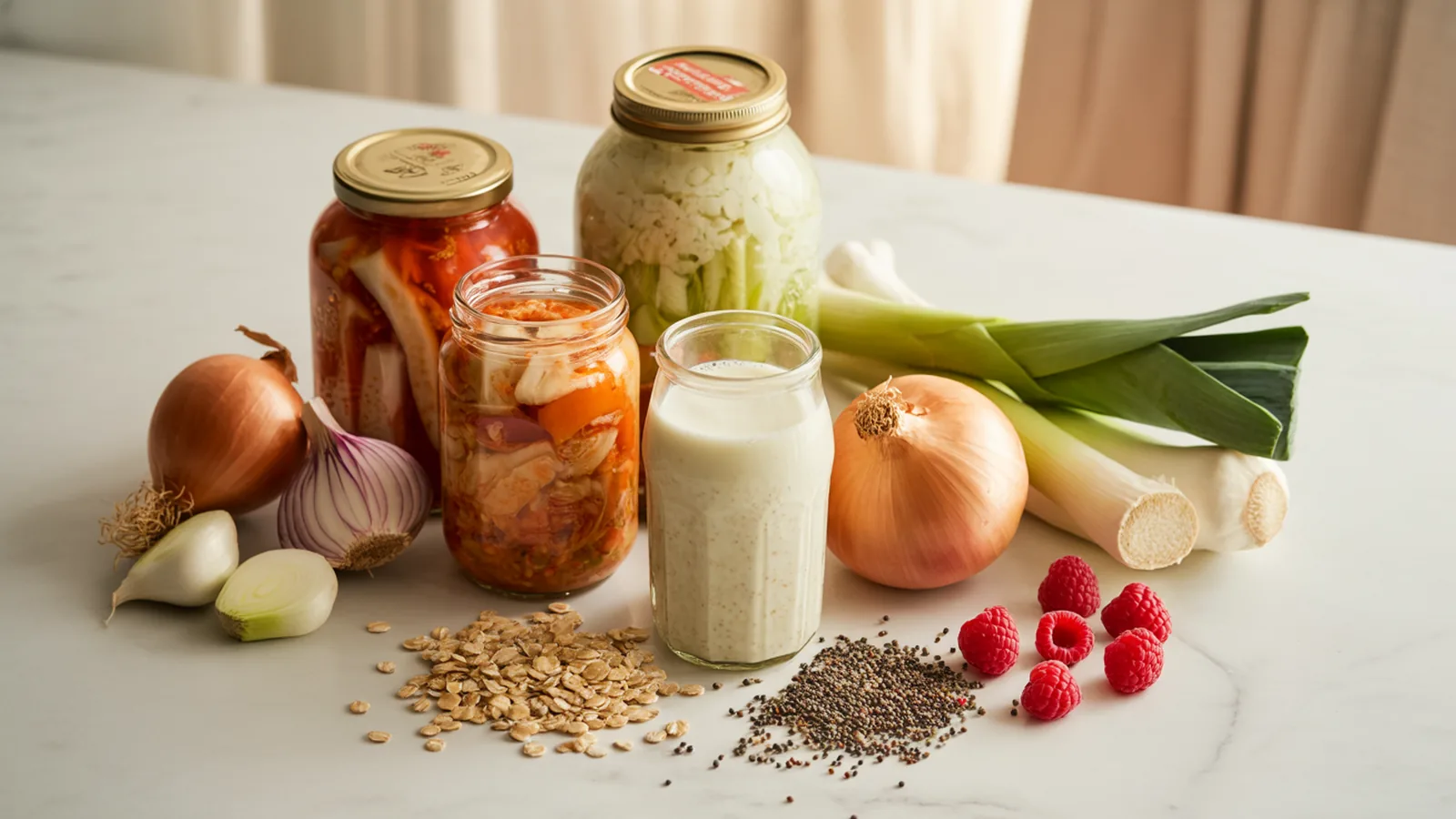
Prebiotics: Garlic, onions, leeks, asparagus, slightly green bananas, oats, barley, apples, chicory root, Jerusalem artichoke and legumes carry fibers that gut bacteria ferment in the colon.
A prebiotic is simply a fiber you cannot digest that your gut bacteria can. You eat it, it travels intact to the large intestine, and the microbes there break it down and produce short-chain fatty acids as a byproduct, which is the part researchers find interesting. The main types you will meet by name are inulin and fructans, found generously in the allium family, and resistant starch, which shows up in certain starchy foods depending on ripeness and temperature.
The allium group does most of this work in an ordinary kitchen without anyone thinking about it. Garlic, yellow onions, shallots, and leeks all carry inulin and fructans, and they are already the base layer of soups, sauces, and roasted trays. Asparagus belongs here too. So does chicory root, which you will more likely encounter as an added ingredient in high-fiber bars and coffee substitutes than as a vegetable, and Jerusalem artichoke, a knobby tuber so concentrated in inulin that a big serving will make its presence known.
Resistant starch is the quieter one and has a couple of useful quirks. A banana that is still slightly green carries considerably more of it than a spotted ripe one, and the amount drops as the fruit sweetens. Cooked potatoes, rice, and pasta that have been chilled overnight form more resistant starch than they had when hot, and reheating does not undo all of it, so leftover rice is doing something the fresh pot was not. Oats and barley add beta-glucan, a different fermentable fiber that also thickens porridge.
Apples belong on the prebiotic side of this list because of pectin, which sits mostly in and just under the skin, so I stopped peeling them years ago. Legumes deserve their own mention: lentils, chickpeas, black beans and split peas carry both fermentable fiber and a real amount of total fiber, which is a rare combination. If a food shows up in this section and the next one, that is not sloppiness. It is the reason those foods are worth building a week around.
High-fiber staples and the real fiber target
The numbers: US guidance lands around 25 to 30g of fiber per day, and most Americans take in closer to 15g. One cup of cooked lentils is roughly 15g on its own.
This is the least glamorous section and the one that changes the most. Federal guidance puts adult fiber intake somewhere in the range of 25 to 30g a day depending on age and sex, and national intake surveys put the actual American average closer to 15g. That gap is the single largest, most fixable thing on this entire page. Harvard's Nutrition Source page on fiber lays out the guidance clearly, and per-food values throughout this section come from USDA FoodData Central.
Here is what those grams look like in ordinary portions, which is what finally made the target feel reachable to me rather than abstract:
- 1 cup cooked lentils: about 15g
- 1 cup cooked black beans: about 15g
- 1 medium avocado: about 10g
- 1 ounce chia seeds, roughly 2 tablespoons: about 10g
- 1 cup raspberries: about 8g
- 1 medium pear with the skin on: about 5 to 6g
- 1 cup cooked oatmeal: about 4g
Look at that list for a second and the arithmetic stops being intimidating. Oats with chia at breakfast is roughly 14g before you have done anything clever. Add a cup of lentil soup at lunch and you are near 29g without a supplement, a powder, or a single food you would not otherwise eat. That was the moment the target stopped feeling like a diet and started feeling like a shopping decision, which is a much easier thing to sustain. Chia earns its place through fiber more than anything else, and I broke down the whole profile in my piece on chia seeds nutrition.
Two honest caveats on the numbers. Values shift with variety, ripeness, and how something is cooked, so treat these as reliable ballparks rather than precise measurements, and do not bother tracking to the gram. And higher is not automatically better. Somewhere past about 40 to 45g a day, most people I know start reporting more bloating than benefit, and there is no prize for the biggest number. Landing consistently in the 25 to 30g range beats spiking to 50g on Sunday and 8g on Thursday.
Polyphenol foods: berries, olive oil, tea, cocoa, coffee
Polyphenols: Most polyphenols in berries, extra virgin olive oil, green tea, cocoa and coffee are not absorbed in the small intestine, so they reach the colon where gut bacteria metabolize them.
The reason polyphenols show up in gut conversations at all is a piece of plumbing rather than nutrition. The majority of the polyphenols you eat are not absorbed high up in the digestive tract. They travel onward to the large intestine still largely intact, and it is the bacteria there that break them apart into smaller compounds. So this is a two-way relationship: the plant compounds arrive as raw material for the microbes, and the microbes determine what those compounds actually become in your body.
In practical terms this puts a specific short list on my counter. Berries, particularly darker ones, are the densest everyday source and happen to carry fiber alongside. Extra virgin olive oil matters here for its unrefined polyphenol content, which is precisely what refining strips out, so the cheap light-colored bottles are a different product. Green tea, unsweetened cocoa powder, and coffee all contribute meaningfully, and coffee in particular is one of the largest polyphenol sources in the average American diet simply because of how much of it people drink.
What research associates with these foods is worth stating carefully. Studies observe shifts in microbial composition in people who eat polyphenol-rich diets, and some short trials find changes in specific bacterial groups after several weeks of cocoa or berry intake. Those are measured associations and small-scale findings, not outcomes anyone should promise you. I include this group because the foods are pleasant and the evidence is suggestive, which is a fair reason to eat something and a poor reason to expect anything.
My actual use of these is completely unremarkable. Frozen raspberries go into yogurt in the morning. Olive oil goes on everything, and I buy the dark bottle in the smaller size so it stays fresh rather than the value jug that goes stale by month four. Cocoa powder gets stirred into oats. Coffee needs no encouragement from me. Several of these overlap with my anti-inflammatory foods list, which reaches the same shelf by a different route.
Plant diversity, and the 30 plants a week idea
The diversity lever: Research from the American Gut Project associated eating 30 or more different plant types weekly with greater microbiome diversity than eating 10 or fewer. It is an association, not a prescription.
If I had to name one lever on this page that matters more than the others, it would be variety rather than any single food. The number people quote comes from the American Gut Project, a large citizen-science study that compared participants by how many distinct plant types they ate in a week. Those reporting 30 or more showed more diverse gut microbial communities than those reporting 10 or fewer. That finding is why the number 30 turns up everywhere now.
Read that carefully, though, because the framing gets mangled constantly. It is an observed association in self-reported data, not a controlled experiment proving that adding plants causes diversity. People eating 30 plant types a week almost certainly differ in other ways too. I treat 30 as a useful mental prompt for grocery shopping, not a target with a scoreboard, and I have never once counted mine to the end.
What makes the number reachable is that plants count generously. Every vegetable, fruit, whole grain, legume, nut, seed, herb, and spice counts as its own entry. A mixed bag of frozen vegetables is three or four. A jar of Italian seasoning is several at once. A handful of mixed nuts is four in one grab. Once you know herbs and spices count, thirty stops being a challenge and starts being a description of a normal cook's week.
The practical version I actually use is smaller and easier to remember. When I shop, I try to buy one plant I did not buy last week. Some weeks that is a bunch of dill, some weeks it is a squash I have to look up, some weeks I forget entirely. Over a couple of months that single habit widened what is in my kitchen more than any list I ever wrote down and stuck to the fridge.
What tends to pull in the other direction
The other side: Very low fiber stretches, heavy alcohol intake, and diets built mostly on ultra-processed foods are the patterns research associates with narrower microbial diversity.
I am not going to write a naughty list, partly because it is tedious and partly because that framing has never once helped me eat better. But it would be incomplete to describe what supports this picture without describing what works against it. Three patterns come up repeatedly in the research, and all three are about sustained habits rather than individual meals, which is worth holding onto before you feel bad about anything you ate this week.
The first is simply not eating much fiber for a long stretch. When there is little fermentable material arriving, the bacteria that specialize in it have less to work with. This is not about a travel week or a stretch of takeout. It is about months of eating in a way that rarely includes plants, which is closer to the American default than most of us like to admit. The fix is the same as the whole rest of this article.
The second is heavy alcohol intake, which research associates with changes in both the microbial mix and the gut lining. The word doing the work there is heavy. Moderate drinking sits in murkier territory in the evidence, and I am not going to pretend otherwise or tell anyone what their glass of wine means. The third is a diet built mostly on ultra-processed foods, which tends to be low in fiber and high in additives, and the association shows up consistently in population data.
The reason I present these without a lecture is that guilt is a terrible motivator and a worse habit. I eat chips. I drink wine. I have weeks where dinner is whatever survives the day. None of that undoes anything, because the timescale that matters here is months rather than meals. Knowing which direction each habit pulls is enough information to make small choices with, and small choices repeated are the only mechanism that has ever worked for me. That same low-pressure thinking runs through my anti-inflammatory eating complete guide if you want it at length.
Adding fiber without wrecking your week
Go slow: Increase fiber by roughly 5g per day each week rather than all at once, drink noticeably more water alongside it, and expect two to three weeks of adjustment.
This is the part most gut health lists skip, and skipping it is how people quit in four days. If you go from 15g of fiber to 30g overnight, you will very likely feel bloated and gassy and conclude that fiber does not agree with you. It is not an intolerance. It is a population of bacteria suddenly handed far more material than they were set up to process, and the byproduct of that processing is gas. The discomfort is real, and it is also temporary.
The approach that works is boring: add roughly 5g a day and hold there for a week before adding more. That might look like a tablespoon of chia in your breakfast for week one, half a cup of beans at lunch in week two, swapping white rice for barley in week three. Four weeks of that and you have moved from 15g to 30g without a single miserable afternoon, which is a considerably better outcome than doing it in one Sunday.
Water is not an optional footnote here. Fiber, especially the soluble kind in oats, chia, and beans, works by absorbing water and forming a gel, and without enough fluid it can make things distinctly less comfortable rather than more. I do not have a number to give you because everyone's need differs. What I can say is that when I increased fiber and did not increase water, I noticed within about two days, and it was not subtle.
Expect an adjustment period of roughly two to three weeks even when you do it patiently. Beans in particular tend to settle down with regular eating, which is one argument for eating them more often rather than less. Rinsing canned beans well helps some people. Starting with lentils, which many find gentler than black beans or chickpeas, helps others. If discomfort is severe or lasts well beyond a month, that is worth a conversation with a doctor rather than more stubbornness.
A realistic week that hits most of this list
A real week: Oats with chia and berries most mornings, a pot of lentils cooked once, refrigerated kraut beside dinner, and one new plant added to the cart. No special shopping trip required.
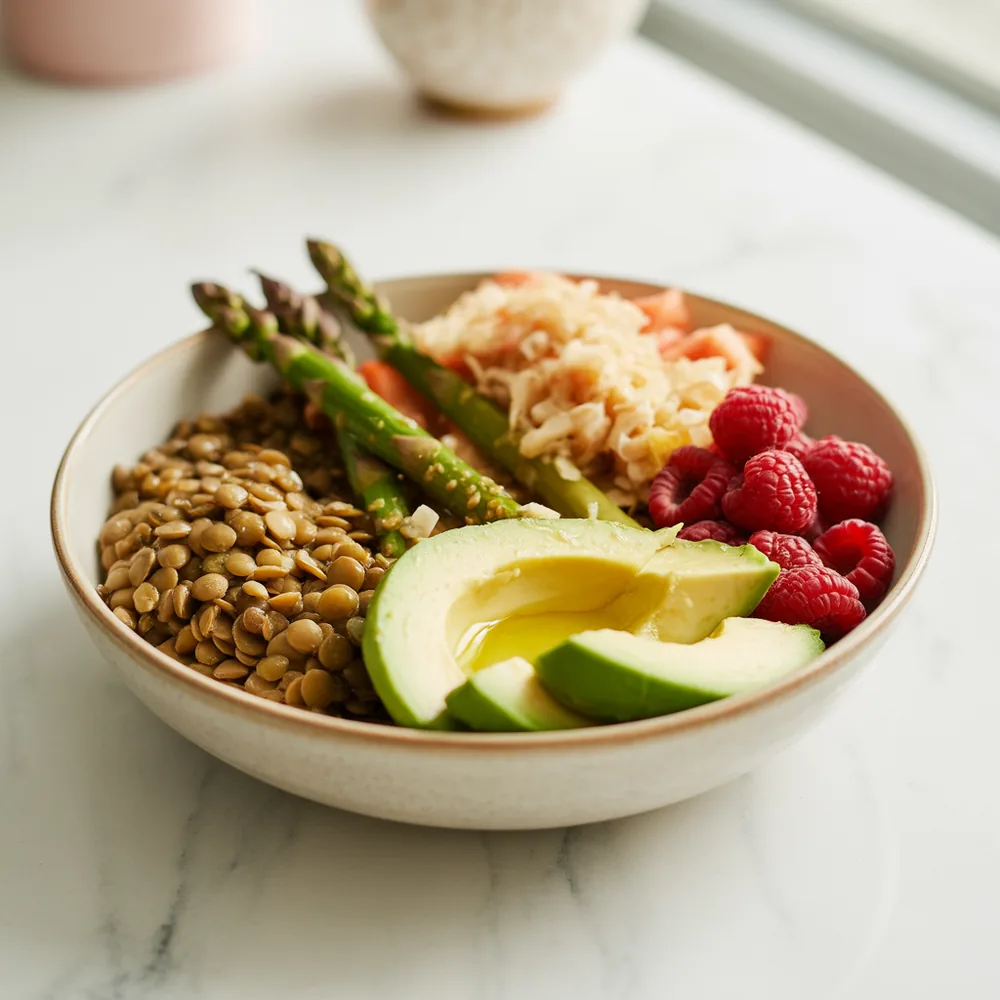
Here is a week that requires nothing from a specialty store. Sunday, I cook one pot of lentils and roast a tray of whatever vegetables are getting soft. That takes about forty minutes of mostly waiting, and it is the only cooking that could be described as planning. Everything else in the week is assembly, which is the only reason it has survived years of ordinary tiredness rather than becoming a phase I look back on fondly.
Mornings are oats with a tablespoon of chia and a handful of frozen raspberries, plus a small glass of kefir on the side. That combination is roughly 14 to 16g of fiber and takes under five minutes, most of which is waiting for the kettle. On days I want savory instead, it is eggs with a forkful of kimchi and a piece of whole grain toast, which is less fiber but keeps the fermented food in play without any effort at all.
Lunch is the lentils, either as soup with garlic and onion cooked into the base or spooned over the roasted vegetables with olive oil and lemon. Dinner is genuinely whatever, but with two small defaults: something from the allium family goes in the pan first, and if there is a starch, I make extra so there is chilled rice or potato in the fridge tomorrow. Neither of those requires a decision once they become how you cook.
Across that week I land somewhere around 25 to 30g of fiber most days, at least one fermented food daily, prebiotic vegetables at nearly every dinner, and somewhere between twenty and thirty plant types counting herbs. I do not measure any of it. The structure does the work, and the only active thought I give it is one line on the shopping list for a plant I did not buy last time. If you want the cart version of a week like this, my anti-inflammatory grocery list overlaps heavily with what I am describing here.
Who should be careful with this list
Caution: People with IBS or FODMAP sensitivity, anyone recovering from GI surgery, and people on prescribed medical diets should talk to a clinician before adding high-fiber or fermented foods.
There is a real group of people for whom parts of this list are actively unhelpful, and they deserve more than a footnote. If you have irritable bowel syndrome, several of the best prebiotic foods on this page are high in FODMAPs, the fermentable carbohydrates that trigger symptoms for a meaningful share of people with IBS. Garlic, onions, Jerusalem artichoke, and legumes are among the most common culprits. That is not a reason to avoid them permanently, but it is a reason to work with a dietitian rather than a blog post.
Recent gastrointestinal surgery is its own category. After many abdominal and bowel procedures, patients are put on low-residue or low-fiber diets for a defined recovery period, and adding beans and raw cabbage during that window is genuinely the wrong move. The same applies if you are managing an active inflammatory bowel disease flare, where fiber tolerance can change substantially from one month to the next.
A few other situations call for a conversation first. Some people with weakened immune systems are advised to be cautious with live-culture foods and probiotic supplements. Kidney conditions can come with potassium and phosphorus limits that reshape which plants make sense. Anyone on a prescribed therapeutic diet already has a plan that this article does not know about, and that plan wins.
So here is the plain version I would say to a friend. I am not a doctor or a registered dietitian, and nothing here is medical advice. If you have a digestive condition, take regular medication, are pregnant, or are recovering from surgery, talk with your doctor or a registered dietitian before making meaningful changes to how you eat. That is not a legal disclaimer bolted on at the end. It is the actual right answer for a genuinely individual system.
When a gut health food list won't fit your life
Honest fit: This list assumes a kitchen, a working stomach, and time to cook once a week. Remove any of those and the useful version of it is much smaller.
The version of this list I have written assumes a few things I should name. It assumes you have a fridge with room for a jar of something fermented, a stove you can use, and forty minutes somewhere in a week to cook a pot of beans. Plenty of people do not have all three. If you are in a dorm, a shared kitchen with no storage, temporary housing, or a stretch of life where cooking is not happening, most of this page is written for someone else's circumstances.
The good news is that the shrunk-down version still holds. Canned beans rinsed and eaten cold, a pear, a tub of plain yogurt, frozen vegetables microwaved in the bag, and whole grain bread will get you most of the way without a single pan. Nothing about fiber or live cultures requires cooking skill or nice equipment. It requires the foods, and the cheapest foods on this entire page happen to be the highest-fiber ones, which is not true of most wellness lists.
There are also seasons where this should not be your focus at all. If you are in the middle of grief, a newborn, a job that eats your evenings, or an eating disorder history that makes food rules dangerous, adding a fiber target is not the help you need. Food-tracking frameworks can do real harm to some people, and if counting plant types would tip you toward restriction or anxiety, please close this tab and skip it entirely.
And if none of it fits right now, the honest fallback is one thing rather than eleven. Pick the single easiest item on this page and let the rest go. For me that would be adding beans to something you already eat. For someone else it is a tub of plain yogurt or keeping the skins on fruit. One habit held for a year is worth more than a full list held for nine days, and I would rather you have the year.
Helpful sources and next reads
Reliable external sources
- Harvard T.H. Chan Nutrition Source: The Microbiome
- Harvard T.H. Chan Nutrition Source: Fiber
- NIH Office of Dietary Supplements: Probiotics
- USDA FoodData Central
More from Sabrina Saturno
You may also love

FAQ
What foods are best for gut health?
The reliable groups are fermented foods with live cultures like plain yogurt, kefir, and refrigerated kimchi; prebiotic fiber foods like garlic, onions, oats, and legumes; and high-fiber staples like lentils, beans, berries, and chia. No single food carries the whole thing, and variety across all three groups is what research keeps pointing to.
How much fiber should I actually eat per day?
US guidance falls roughly in the 25 to 30g a day range for adults, varying by age and sex, while average American intake sits closer to 15g. Closing that gap is the most concrete change on this list. One cup of cooked lentils alone is about 15g.
Do shelf-stable sauerkraut and pickles have probiotics?
Usually not. Jars sold at room temperature in the pickle aisle have generally been heat treated for shelf stability, which ends the live culture. Look in the refrigerated section for jars labeled raw or unpasteurized. Vinegar-brined pickles were never fermented at all, whatever the label suggests.
What is the difference between prebiotics and probiotics?
Probiotics are the live bacteria themselves, found in yogurt, kefir, and live ferments. Prebiotics are the fibers those bacteria eat, found in garlic, onions, oats, bananas, and legumes. Prebiotics feed the bacteria you already have, which is why they matter even if you eat no fermented food at all.
Is the 30 plants a week rule real?
It comes from the American Gut Project, which observed that people reporting 30 or more plant types a week had more diverse gut microbiomes than those reporting 10 or fewer. It is an association from self-reported data, not a proven prescription. I use it as a shopping prompt rather than a target.
Do herbs and spices count toward plant diversity?
Yes, and that is what makes 30 reachable. Every herb, spice, nut, seed, whole grain, legume, fruit, and vegetable counts as its own plant type. A jar of mixed Italian seasoning is several at once, and a handful of mixed nuts can be four.
Why does fiber make me bloated?
Usually because the increase was too fast. Gut bacteria ferment fiber and produce gas as a byproduct, and a sudden jump gives them far more to work with than they are set up for. Adding about 5g a day per week, with more water, avoids most of it. Persistent discomfort deserves a doctor's opinion.
Does yogurt need to be plain?
Plain is easier to control, because flavored tubs can carry a surprising amount of added sugar. What matters more is the phrase live active cultures on the label and a short ingredient list. If you need sweetness, adding your own fruit at home usually lands lower in sugar than the flavored version.
Are green bananas really better than ripe ones for gut health?
Slightly green bananas carry more resistant starch, a fermentable fiber, and the amount drops as the fruit ripens and sweetens. That does not make ripe bananas a bad food. It just means the greener ones contribute more to this particular mechanism, along with cooled cooked potatoes, rice, and pasta.
Can I skip all this and take a probiotic supplement instead?
Supplements are a different question with genuinely mixed evidence, and strain and dose matter enormously. Food gives you fiber, protein, and polyphenols alongside any bacteria, which a capsule does not. If you want to try a supplement, talk with your doctor, especially if your immune system is compromised.
What is the cheapest gut health food?
Dried lentils and canned beans, by a wide margin. Both land near 15g of fiber per cooked cup for well under a dollar a serving, and neither requires anything but a pot. Oats, cabbage, and frozen vegetables sit close behind on the same value logic.
How long before a change in diet affects the gut microbiome?
Studies show measurable shifts in microbial composition within days of a dietary change, and shifts back just as quickly when the old pattern returns. That is why the useful frame is months of repeated eating rather than a short reset. What you eat consistently matters more than any single week.
Should I try this if I have IBS?
Talk with a dietitian first. Several of the strongest prebiotic foods here, including garlic, onions, and legumes, are high in FODMAPs and commonly trigger symptoms in people with IBS. A structured low-FODMAP approach with professional guidance works far better than experimenting from an article.
The version that lasts
What has actually stayed with me from all of this is smaller than the list above suggests. I buy plain kefir. I keep a jar of live kraut open. I cook lentils on Sunday more weeks than not. I leave the skins on fruit and put chia in my oats. That is five habits, none of which required a decision after the first month, and together they cover most of what this page describes without me thinking about mechanisms at all.
The framing that survived is that I am feeding something rather than fixing something. That distinction changed how the whole subject felt. Fixing implies a broken thing, a protocol, an end date, and a way to fail. Feeding is just a thing you do on a Tuesday, repeatedly, without a scoreboard. It also fits the science better, since the microbes respond to what shows up regularly rather than to any single impressive meal.
If one sentence outlasts the rest of this article, let it be that fiber is the part most people are missing and the part most within reach. Fermented foods are a nice addition and polyphenols are a pleasure, but the 15g to 30g gap is where the real change sits, and closing it costs a bag of lentils and a couple of weeks of patience. Start there, go slowly, and bring anything that concerns you to a clinician who knows your history.