
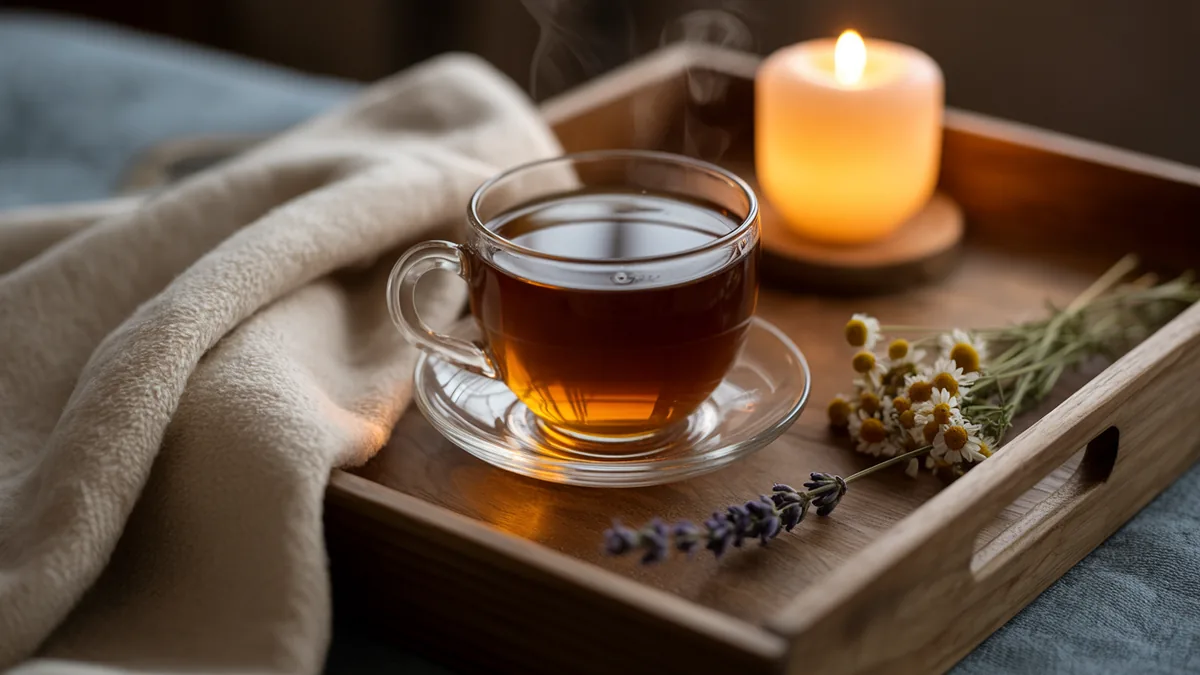
If you want a calming evening tea ritual, here is the heart of it in one line: pick a caffeine-free tea, brew it sixty to ninety minutes before bed, dim the lights, put the screens away, and drink it slowly while you let the day end. The tea matters, but the ritual around it matters more.
I started doing this on the nights I could not switch my brain off. The act of boiling water, warming a mug, and sitting with something warm turned out to be a surprisingly strong cue that the working part of my day was over. It is not magic. It is a small, repeatable signal, and over time my body learned to read it.
This is a guide to the whole wind-down, plus one signature caffeine-free blend I come back to. It sits beside my cortisol tea and my moon milk, but where those are single drinks, this is the ritual that holds them, the frame around the cup rather than just the cup.
| Part of the ritual | What I do | Why it helps |
|---|---|---|
| Timing | Sip 60 to 90 minutes before bed | Gives the warm-drink cue time to land before sleep |
| The drink | Caffeine-free herbal blend, no black or green tea | Keeps caffeine out of your evening entirely |
| The light | Dim the lamps, light one candle | Bright light tells your brain it is still daytime |
| Screens | Phone in another room while I sip | Removes the scroll that keeps the day going |
| The mug | A heavy mug I like holding | The warmth in your hands is part of the calm |
| The steep | Cover and steep 5 to 10 minutes | Pulls more flavor and oils from the dried herbs |
Why an evening tea ritual actually helps
The honest version: a warm caffeine-free drink and a calm routine are a gentle cue for rest, not a cure for sleep problems.
I want to start with the part most blogs skip, because I think it is the most important. A cup of herbal tea is not going to fix insomnia. It is not a sleeping pill in a mug, and anyone who tells you a single drink will knock you out is selling something. What a calming evening tea ritual actually does is quieter and, in my experience, more useful than that. It gives your body a repeated, reliable signal that the day is ending and it is allowed to slow down.
Our bodies love a pattern. When you do the same small set of things every night, warm a mug, dim the lights, sit down, sip something that is not coffee, your brain starts to link those cues with winding down. It is a bit like how a particular song can drop your shoulders. The tea is not magic. The repetition is the point. After a couple of weeks of doing it, I noticed I started to feel sleepy just from filling the kettle, which is exactly the kind of trained-in calm you are going for.
There is also a simple physical comfort to it. Holding something warm, breathing in the steam, slowing your sips so you are not gulping, all of that nudges you toward a calmer state. The relaxation part is well documented, and if you want a grounded overview, the NIH NCCIH guide to relaxation techniques is a calm, no-hype read on why slowing your body down before bed can genuinely help. The Sleep Foundation page on tea and sleep is also even-handed about what the evidence does and does not say.
So that is the frame for this whole article. We are building a soft, repeatable cue for rest using a drink you will look forward to. If you have ongoing trouble sleeping, the kind that wears you down week after week, please talk to a doctor rather than relying on chamomile. A ritual like this works best as the cherry on a sane sleep routine, not as a patch over a real problem.
One more thing I love about it. This is one of the few wellness habits that costs almost nothing and asks almost nothing of you. No app, no subscription, no equipment beyond a kettle and a mug you already own. That low bar is exactly why I have actually kept it, long after fancier routines fell off my radar.
When to have it, and how long it takes
The sweet spot: 60 to 90 minutes before you want to be asleep, so the mug doesn't wake your bladder at 2 a.m.
Timing is the part people get wrong, and it is easy to fix. I aim to make my tea about 60 to 90 minutes before I actually want to be asleep. Sip it too late, right as you are crawling into bed, and you are basically signing up for a 2 a.m. trip to the bathroom, which undoes the whole point. Give it a window and your body has time to process the liquid before you lie down.
That hour or so also doubles as a buffer between the busy part of the evening and sleep. For me the tea marks a line. Once the kettle is on, the work is done for the day. No more emails, no more starting a new task I will not finish. The drink becomes a small ceremony that closes the office, even though I work from my kitchen table half the time.
The making itself takes maybe two minutes of active effort. Boil water, add herbs, pour. Then there is a 5 to 10 minute steep where you do nothing, which is honestly part of the gift. I use those minutes to dim the lights or put my phone on its charger in another room. The sipping is unhurried on purpose, ten or fifteen minutes of slow drinking rather than chugging. So the whole ritual, from kettle to empty mug, is around twenty minutes. That is the whole ask. Twenty quiet minutes to tell your nervous system the day is over.
If twenty minutes feels like a lot on a chaotic night, shrink it. A five-minute version, just the warm mug and one deep breath, still counts. The ritual is supposed to serve you, not become another item on the to-do list you feel guilty about skipping.
The caffeine-free herbs that suit evening
Stick to caffeine-free: chamomile, lemon balm, lavender, rooibos, and peppermint. No black, green, white, or oolong tea after lunch.
The first rule of an evening tea ritual is the easiest one to forget. Skip actual tea. Black, green, white, and oolong all come from the same plant and all carry caffeine, which is the last thing you want near bedtime. Even a cup of green tea at night can keep a sensitive person staring at the ceiling. So everything here is herbal, meaning it comes from flowers, leaves, and roots that never had caffeine to begin with. Here are the ones I actually reach for at night:
- Chamomile. The classic for a reason. It is soft, faintly apple-like, and the one most people associate with bedtime. It is the base of my blend.
- Lemon balm. A lemony, gentle herb in the mint family. It lifts the flavor of chamomile so the cup does not taste like flat hay, and it has a long folk reputation for taking the edge off.
- Lavender. A little goes a very long way. Used culinary-style and in tiny amounts, it adds a floral, soothing note. Too much and your tea tastes like soap, so I treat it like a pinch of salt.
- Rooibos. A naturally caffeine-free red bush tea from South Africa. It is mild, slightly sweet and woody, and gives a cup more body so it feels like a real drink, not just hot flower water.
- Peppermint. Refreshing, settling on the stomach, and a nice option if you find floral teas a bit much. Some people find mint a touch too brightening at night, so I use it more in winter when I want something clear and clean.
You do not need all five. Pick two or three you genuinely like the smell of, because if you do not like the taste you will quit, and a ritual you quit is no ritual at all. Honestly, smell the loose herbs in the shop or open the box at home. The aroma is half of why this works.
Now the safety note, because it matters and it is short. Chamomile is in the same plant family as ragweed and daisies, so if you have a ragweed or daisy allergy, be cautious or skip it entirely. Lavender should be culinary grade, the kind sold for food and tea, never the essential oil or potpourri kind. And if you are pregnant, nursing, or taking medication, some herbs can interact in ways you would not expect, so check with your doctor or pharmacist before making any herb a nightly habit. None of this is meant to scare you off a cup of chamomile. It is just the grown-up version of reading the label.
My signature calming evening tea blend
The one I make most: chamomile, lemon balm, a pinch of lavender, and a little rooibos for body. Soft, floral, faintly sweet.

After a lot of cups, this is the blend I keep coming back to, and it is the one in the recipe card below. It is built around chamomile for softness, lemon balm to keep it from tasting flat, a tiny bit of lavender for that floral hush, and a little rooibos to give the cup some body so it drinks like a proper drink. For one big mug, here is exactly what goes in.
- 1 teaspoon dried chamomile flowers. The base. This is most of the cup's character.
- 1 teaspoon dried lemon balm. Brightens the chamomile so it does not taste like hay.
- 1/2 teaspoon dried rooibos. Adds body and a gentle, woody sweetness.
- A small pinch of culinary dried lavender. Maybe ten or fifteen buds. More than that and it goes soapy.
- Hot water just off the boil, about one and a half cups, and honey or a slice of lemon to finish if you like.
You combine the dried herbs in an infuser or a teapot, pour the just-boiled water over them, then cover and steep. I cannot stress the covering enough, and I get into why in the next section. The result is a pale gold cup that smells like a meadow at dusk, soft and a little sweet, with the lemon balm keeping it from being cloying. It is gentle. It is supposed to be. This is not a punchy, in-your-face tea, it is the liquid equivalent of someone turning the lights down.
If you want to make this easy on your weeknights, mix a big batch of the dry blend ahead. I scale the same ratio up, three parts chamomile, three parts lemon balm, a bit more than one part rooibos, and a careful pinch of lavender, then keep it in a sealed jar away from light. Then a single nightly mug is just a scoop and a pour. The pre-mixing is the trick that turned this from a nice idea into something I actually do on a Tuesday.
This blend is deliberately its own thing, separate from a few other calming drinks I make. It is not my cortisol tea, which is a specific tart, adaptogen-leaning brew. It is not moon milk, which is a warm spiced milk drink, or my chamomile latte, which is chamomile steeped into frothy milk like a cozy bedtime cup. This one is the simple steeped-herb-in-water ritual blend. If you want the milky or the tart versions, follow those links. Here we are keeping it light and pure.
How to steep it so it actually tastes good
The whole trick: just-off-boil water, cover the cup, and steep 5 to 10 minutes. Covering keeps the calming oils in the mug, not the air.
Herbal tea is forgiving, but a few small moves make the difference between a flavorful cup and sad warm water. Here is exactly how I do it.
Use water just off the boil. Unlike green tea, which scorches in boiling water, dried flowers and roots actually want it hot, right around the boil. Bring your kettle up, let it settle for just a few seconds, then pour. Hot water pulls more flavor and more of the aromatic oils out of the herbs.
Use enough herb. The most common reason a homemade herbal cup tastes weak is simply not enough plant in the cup. My blend uses a generous couple of teaspoons of dried herb for a big mug, and that is on purpose. If yours is watery, add more next time before you blame the herbs.
Cover the cup while it steeps. This is the step almost everyone skips, and it is the one that matters most. Those calming aromatic oils are volatile, which means they float off in the steam. If you leave the mug open, a lot of the good stuff literally evaporates into your kitchen instead of staying in your tea. Put a small saucer or lid over the cup or teapot while it steeps. You trap the steam, it drips back in, and the cup is noticeably more flavorful and aromatic.
Steep 5 to 10 minutes. Longer than you would steep black tea. Five minutes gives you a light cup, ten gives you a stronger, more soothing one. I usually go the full ten because I am not in a rush at that point in the night. Herbal teas do not turn bitter the way real tea does if you over-steep, so you have a lot of room to play.
Strain and finish. Lift out the infuser or pour through a small strainer. Add a little honey if you want, or a thin slice of lemon, which plays beautifully with the lemon balm. Then stop fussing and go sit down.
If you are using tea bags instead of loose herbs, all of this still applies. Cover the mug, give it the full steep, and maybe use two bags if the cup tastes thin. The covering trick alone will upgrade a basic store-bought sleepytime bag more than you would expect.
The mug, the light, and the little details
The sensory part: a mug you like holding, lamps instead of overheads, no screens. These details do more work than the tea itself.
Here is the thing I did not expect when I started. The tea is maybe half of why this ritual works. The other half is everything around it, the sensory setup that tells your nervous system you are safe to power down. None of it is fancy, but it all matters.
The mug. Pick one you actually like holding. For me it is a heavy stoneware mug that keeps the heat and feels solid in two hands. The weight and warmth are part of the calm. A thin, rattly cup just does not give the same comfort. This sounds precious and it is, a little, but it works, so I have made my peace with it.
The light. This is the big one. Bright overhead light tells your brain it is still daytime, full stop. So I turn the overheads off and switch to a single warm lamp, and most nights I light one candle. The room goes amber and soft, and my body reads that as evening. If you do one thing from this whole article besides the tea, dim your lights an hour before bed. Harvard Health makes this same point in its rundown of better-sleep habits, and it is the change that gave me the most.
The screens. I put my phone on its charger in another room before I sit down with the tea. Not in my pocket, not face-down on the table, in another room. The drink is supposed to end the day's input, and you cannot do that with a glowing rectangle in your hand pulling you back into everyone else's evening. This is the hardest part for most people, me included. It is also the part that changes the ritual from nice to genuinely restful.
You do not need all of it every night. But a warm mug, one soft light, and your phone out of reach is a tiny, repeatable setup that does an enormous amount of quiet work.
How I actually do the ritual, start to finish
My real routine: kettle on, phone away, lights low, steep covered, then sit and sip slowly with a book until the mug is empty.

Let me walk you through a normal night, because the play-by-play is more useful than a list of principles. This is roughly what it looks like at my house, give or take.
About an hour and a half before bed, I fill the kettle and flip it on. That sound has become my signal that the workday is over, even on the nights I worked too late. While it heats, I scoop my pre-mixed blend into the infuser and set it in my heavy mug. I also use this minute to walk my phone to its charger in the bedroom, so by the time I sit down it is genuinely out of reach.
I pour the just-boiled water over the herbs, slide a small saucer on top of the mug to trap the steam, and let it steep while I turn off the overhead lights and switch on the one lamp by the sofa. Some nights I light a candle. The room goes warm and dim, and honestly my shoulders drop right about here, before I have even taken a sip.
After eight or ten minutes I lift out the infuser, sometimes stir in a little honey, and finally sit down. Then the actual point of the whole thing: I drink it slowly. No multitasking, no scrolling, usually a few pages of whatever book is on the side table. I am not trying to finish the book. I am just giving my hands and eyes something gentle to do while the warm drink does its quiet work. By the time the mug is empty, fifteen or so minutes later, I am usually yawning, and that is my cue to go brush my teeth and get in bed.
If you want company at the other end of the day, my bright morning counterpart to this is my 10-minute calm morning tea, same slow-and-intentional spirit, opposite end of the clock. And if you are the kind of person who likes to set the whole week up gently, this evening ritual slots right into my Sunday reset checklist, which is where a lot of my calmer habits started.
The exact steps are not sacred. Some nights I skip the candle, or read on the couch with the cat instead. What stays the same is the shape: warm drink, low light, no phone, slow sips. Keep that shape and the details can flex around your actual life.
When this won't fit your life
Honest caveat: a tea ritual is a gentle cue, not a treatment. If sleep is a real, ongoing struggle, see a professional.
I am not going to pretend this works for everyone or every night, because that would be dishonest, and dishonest wellness advice is exactly what I try not to write.
First and most important: if you have real, ongoing trouble sleeping, the kind that drags on for weeks and leaves you exhausted, a mug of chamomile is not the answer and I would be doing you a disservice to suggest it is. That is a conversation for a doctor, who can look at what is actually going on. A tea ritual can be a lovely part of a sleep routine, but it cannot treat insomnia, sleep apnea, anxiety, or any of the bigger reasons sleep goes sideways. Please do not let a nice nighttime habit talk you out of getting real help.
Second, some practical mismatches. If you have a ragweed or daisy allergy, chamomile may not be for you, so build your blend from other herbs or check with your doctor first. If you are pregnant, nursing, or on medication, run your herb choices past a professional before making them a nightly thing. If a warm drink right before bed reliably wakes you for a bathroom trip, move it earlier or use a smaller mug. And if the whole idea of a twenty-minute ritual feels like one more obligation on an already overloaded night, scrap the production and just hold a warm mug for five minutes. The ritual is here to lower your load, not add to it.
Make it on the nights it feels good. Skip it on the nights it does not. There is no streak to protect and no medal for consistency. It is a small, warm, optional kindness at the end of the day, and that is exactly enough.
Helpful sources and next reads
Reliable external sources
More from Sabrina Saturno
You may also love

FAQ
What is a calming evening tea ritual?
It is a small nightly routine: a warm, caffeine-free mug sipped slowly 60 to 90 minutes before bed, in dim light and away from screens, to signal that the day is ending.
Does evening tea really help you sleep?
It is a gentle cue, not a cure. The warm drink and repeated routine help your body wind down, but tea will not treat insomnia. For ongoing sleep trouble, see a doctor.
When should I drink my evening tea?
About 60 to 90 minutes before you want to be asleep. That gives your body time to process the liquid so you are less likely to wake for a bathroom trip.
Which herbs are best for an evening tea?
Caffeine-free ones: chamomile, lemon balm, lavender, rooibos, and peppermint. Avoid black, green, white, and oolong tea at night, since they all contain caffeine.
Is chamomile safe for everyone?
Chamomile is in the ragweed and daisy family, so people with those allergies should be cautious or skip it. If pregnant, nursing, or on medication, check with a doctor first.
Can I use lavender from anywhere?
Use culinary-grade dried lavender sold for food and tea, never essential oil or potpourri. Use a tiny pinch, because too much lavender makes tea taste soapy.
How long should I steep herbal tea?
Five to ten minutes, longer than black tea. Cover the mug while it steeps to trap the aromatic oils, and herbal teas will not turn bitter if you steep them longer.
Why should I cover the cup while it steeps?
The calming aromatic oils are volatile and float off in the steam. Covering the mug traps that steam so it drips back in, leaving you a more flavorful, aromatic cup.
What water temperature should I use?
Just off the boil. Unlike green tea, dried flowers and roots want hot water near boiling to pull out their full flavor and oils.
Is this the same as your cortisol tea or moon milk?
No. This is a simple steeped-herb blend. My cortisol tea is a specific tart brew, and moon milk is a warm spiced milk drink. They are linked above if you want those instead.
Can I make the blend ahead of time?
Yes. Mix the dry herbs in the same ratio in a sealed jar away from light, then scoop a single mug's worth each night. Pre-mixing makes the ritual realistic on busy nights.
What if I don't like floral teas?
Lean on rooibos and peppermint instead of chamomile and lavender. Rooibos gives body and gentle sweetness, and peppermint is clean and refreshing without any floral note.
Will a tea ritual fix my insomnia?
No, and please do not rely on it for that. Ongoing sleep problems deserve a professional's attention. A tea ritual is a small, pleasant support, not a treatment.
The version that lasts
The version of this ritual that lasts, for me, is the stripped-down one. Not the candle-lit, perfectly-steeped, photogenic version, though that is lovely when I have it in me. The version that survives a hard week is just a warm mug and my phone in another room. Keep the bar that low and you will actually do it, which beats a beautiful routine you only manage twice a month.
I also had to let go of treating it like a streak. Some nights I skip it entirely and sleep fine. Some nights I am too wired and the tea does not touch it, and that is information, not a failure. The ritual is a gentle nudge toward rest, not a switch that works on command. Holding it loosely is what kept it in my life.
So take the bones of this, the caffeine-free blend, the covered steep, the dim light, the slow sips, and shape it around your actual evenings. Make it shorter, make it earlier, swap the herbs for ones you love the smell of. Once the shape is yours, the tea stops being a thing you try and becomes the soft signal that the day, finally, is done.