
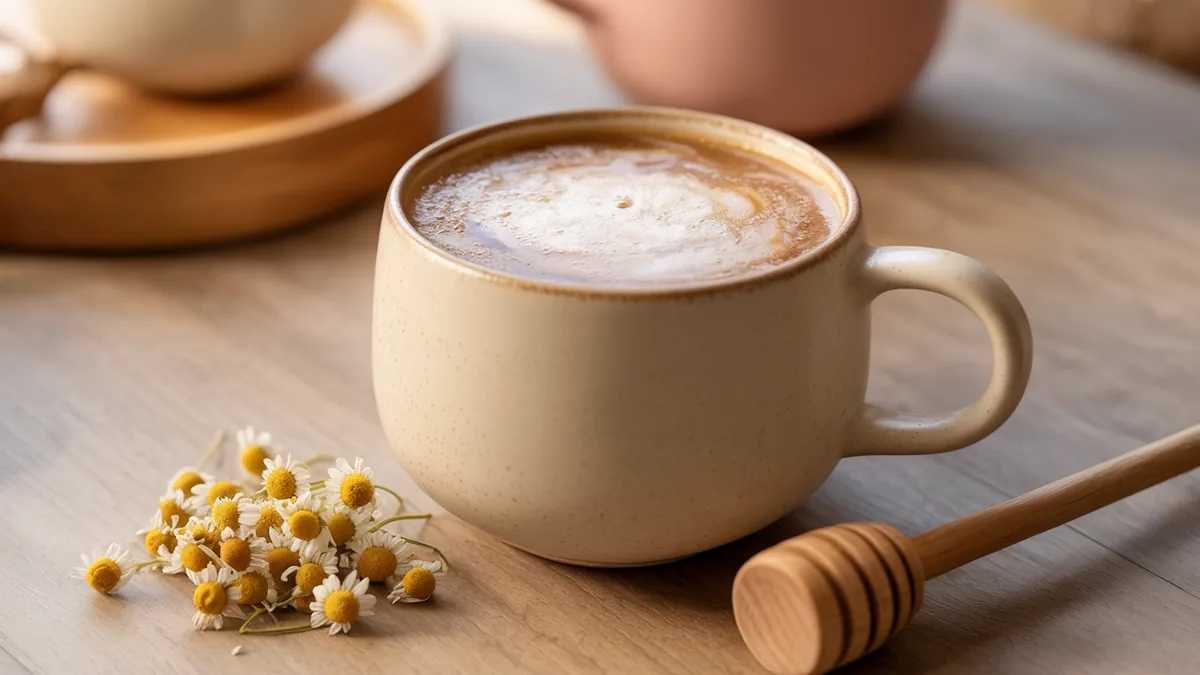
If you came here for a chamomile latte recipe, here is the short version: steep chamomile strong in a splash of hot water, froth it with warm milk and a little honey, and pour it into your favorite mug. It is caffeine-free, it takes about five minutes, and it has become my quiet signal that the day is finally winding down.
A chamomile latte is gentler than it sounds. You are basically making a creamy, lightly sweet cup of chamomile tea with the body of a latte. The flowers give it a soft apple-honey flavor, the steamed milk turns it into a treat, and because there is no coffee in it, I can drink one at nine at night without lying awake regretting it.
I keep this honest: a warm caffeine-free latte is a lovely bedtime ritual, not a sleeping pill. If you love the sleepy-drink family, this sits beside my cortisol tea and my moon milk, but it is its own simple thing, just strong chamomile and milk, no ashwagandha and no long herb list.
| Element | What I use | Why it matters |
|---|---|---|
| Chamomile base | 2 tea bags or 2 tsp loose buds in 1/2 cup water | Strong steep keeps the flavor from getting drowned by milk |
| Steep time | 7 to 10 minutes, covered | Longer steep pulls more of that soft apple-honey taste |
| Milk | 2/3 cup, steamed and frothed | Creates the creamy latte body and the foam cap |
| Sweetener | 1 tsp honey or maple, optional | Rounds out chamomile's faint bitterness |
| Flavor add | 1/4 tsp vanilla or a pinch of cinnamon | Makes it taste like a treat, not just tea with milk |
| Caffeine | Zero | Why it works as a bedtime drink |
What a chamomile latte actually is
The short version: it's chamomile tea steeped strong, then frothed together with warm milk and a little sweetener into a creamy, caffeine-free latte.
A chamomile latte is exactly what it sounds like once you stop overthinking it. You steep chamomile until it's properly strong, almost too strong to drink on its own, then you fold in steamed, frothy milk and maybe a teaspoon of honey. That's it. The milk softens the slight herbal bitterness and gives you that latte texture, the foam cap, the warmth you can wrap both hands around. There's no coffee, no caffeine, nothing keeping you up.
I started making these because I wanted a bedtime drink that felt like a real treat and not like medicine. Plain chamomile tea is lovely, but some nights it feels a little thin, a little austere. Adding milk turns it into something cozier. It tastes faintly of apples and honey, a touch floral, and it goes down warm and round instead of watery.
People sometimes lump this in with two other evening drinks I make, so let me draw the line clearly. My moon milk recipe is warm milk built around ashwagandha, an ayurvedic adaptogen, with spices stirred in. My cortisol tea recipe is a multi-herb evening blend, several botanicals working together in one brew. This is neither. This is just chamomile, steeped strong, made creamy. No ashwagandha, no herb stack. One simple plant turned into a latte.
That simplicity is the whole appeal. You don't need a cabinet of powders. If you have chamomile tea bags and any kind of milk, you can make this tonight. And because there's nothing exotic in it, it's an easy ritual to actually keep, which to me matters more than any single fancy ingredient.
I should also say what a chamomile latte is not. It's not a cure, it's not a supplement, and it's not going to fix a sleep problem on its own. It's a warm, pretty, comforting drink that happens to be caffeine-free, which makes it a smart pick for the evening. I make it the way some people pour a glass of wine to mark the end of the day, except this one lets me actually fall asleep. That framing keeps me honest about what it can and can't do.
What you need
Pantry check: chamomile (bags or loose buds), milk of any kind, and a little honey or vanilla. Nothing rare.
This is a short list on purpose. The point of a chamomile latte is that you can make it with what's already in your kitchen, not a special order. Here's what I reach for, with rough amounts for one mug.
- Chamomile: 2 tea bags, or 2 teaspoons loose chamomile buds. Two is not a typo. One bag gets lost under the milk.
- Water: about 1/2 cup, just off the boil. You want a concentrated steep, not a full mug of tea.
- Milk: about 2/3 cup. Dairy whole milk froths beautifully, but oat and soy work great too. More on that below.
- Sweetener (optional): 1 teaspoon honey or maple syrup. Chamomile has a faint bitterness, and a little sweetness rounds it off.
- Vanilla (optional): 1/4 teaspoon vanilla extract, or a tiny pinch of cinnamon. This is what pushes it from tea-with-milk into something that tastes like dessert.
That's the core kit. If you want to get fancy you can add a single crushed cardamom pod or a drop of almond extract, but honestly I make the plain version most nights. You also need a way to froth the milk. A handheld milk frother is ideal and costs almost nothing. No frother? A small whisk, a French press pump, or a jar you shake hard all work. I cover the tools in the method.
One small note on the honey. If you're making this for a child under one year old, skip honey entirely and use maple syrup instead, for the usual infant safety reason. For everyone else, honey and chamomile are a classic pairing for a reason.
If you want to stock up so this is always an option, I'd buy one box of decent chamomile tea bags and one small bag of loose buds, and keep whatever milk you already drink. That's the entire investment. You don't need a special mug, a fancy frother, or a barista setup, though a five-dollar handheld frother does make life easier. I resisted buying one for ages and regretted the wait, because the foam really is what turns this from tea-with-milk into something that feels like a treat.
How I make my chamomile latte
The method: steep chamomile strong in a little water, froth your milk separately, combine, then sweeten to taste.

Here is exactly how I build one, start to finish, in about five minutes. The trick that makes or breaks it is the strong steep. If you steep chamomile in a full mug of water and then add milk, the flavor vanishes. So I steep it concentrated first.
Start by boiling your water and pouring just half a cup over your two tea bags or two teaspoons of loose buds. Cover the cup with a small saucer right away. That cover keeps the aromatic oils from escaping as steam, and it genuinely changes the flavor. Let it sit a full 7 to 10 minutes. This is longer than the box tells you, and that's the point. You want it deep golden and almost too herbal on its own.
While it steeps, warm your milk. I pour about two-thirds of a cup into a small saucepan over medium-low heat until it's steaming but not boiling, then froth it. If you have a handheld frother, hold it just under the surface and let it spin until you've got a soft foam, maybe 20 seconds. No frother? Heat the milk, pour it into a jar with a tight lid, and shake hard for 30 seconds, then microwave 20 seconds more to firm the foam.
Now combine. Squeeze and remove the tea bags, or strain out the loose buds through a fine sieve. Pour the frothed milk slowly into the strong chamomile, holding back the foam with a spoon, then spoon the foam on top last. Stir in your honey while everything is still hot so it dissolves, add the vanilla, and that's your latte. Taste it. If the chamomile feels shy, you steeped too gently or used too much milk. Next time, steep longer or pour less milk. It's very forgiving.
A couple of small things I learned the hard way. Don't skip squeezing the tea bags, because a real squeeze pushes the last of the strong, concentrated tea out and it makes a noticeable difference. Do strain loose buds well, because a stray clump of soggy chamomile in your mouth is not the cozy moment you were after. And if you're sweetening, add it to the hot tea before the foam goes on, not after. Honey stirred into foam just sits there in a sad lump. Hot tea dissolves it cleanly so the sweetness spreads through the whole drink.
Variations I actually make
Mix it up: a vanilla-honey version, an iced summer one, a lavender-chamomile twist, and a dairy-free oat build.
The plain version is my default, but I rotate through a few depending on the season and my mood. None of these are complicated. They're just small swaps.
Vanilla honey chamomile. My most-made variation. I add a slightly generous 1/4 teaspoon of vanilla and a full teaspoon of honey. It tastes like a warm vanilla steamer with a soft floral edge. This is the one I make when I want comfort more than anything.
Iced chamomile latte. In summer I steep the chamomile strong, let it cool, then pour it over ice and top with cold frothed milk. A little maple syrup dissolves better than honey in cold drinks, so I use that. It's genuinely refreshing on a hot evening when a hot drink feels like too much.
Lavender chamomile. If I'm in the mood for something more floral, I add a tiny pinch of culinary lavender to the steep, just a pinch, because lavender bullies everything fast. It pairs beautifully with chamomile. If you love that direction, my full lavender latte recipe goes deeper on doing lavender right.
Spiced chamomile. A pinch of cinnamon and the tiniest grate of nutmeg make it taste almost like a chai cousin, minus the caffeine and the heat. Cozy autumn energy. If you like warming spices in milk, you'll probably also like my golden milk recipe, which leans into turmeric and ginger instead.
Dairy-free. I make this with oat milk constantly. Barista-style oat milk froths almost as well as whole dairy and adds its own gentle sweetness, so I often skip the honey entirely with oat.
One more I make when I want it to feel like a real dessert: a honey-vanilla chamomile with a tiny pinch of salt. The salt sounds odd but it sharpens the sweetness and makes the whole thing taste fuller, the same trick that makes salted caramel work. Just a few grains, not a pinch you'd notice. I stumbled onto it by accident one night and now I do it whenever I want the latte to feel a little more indulgent than usual. Small change, surprisingly big difference.
Choosing your milk and your chamomile
Quality matters: use the freshest chamomile you can find and a milk that froths well; both decide whether this tastes special or flat.
Two ingredients carry this whole drink, so they're worth a few honest words. First, the chamomile. Tea bags are perfectly good and what I use on a Tuesday, but they vary a lot in strength. Cheap bags can taste like warm straw. If you can find a brand with whole or coarsely broken buds rather than fine dust, you'll taste the difference, more honey, more apple, less hay. Loose chamomile buds from a good source are even better, and you only need two teaspoons, so a bag lasts ages.
Freshness matters more than people expect with herbs. Chamomile that's been open in your cupboard for two years has lost most of its aromatic oils. If yours smells faint, it probably tastes faint, and no amount of milk will fix that. I buy small amounts and use them up.
Now the milk. For the creamiest, foamiest latte, whole dairy milk is hard to beat because its fat and protein build a sturdy foam. If you want plant milk, reach for a barista-style oat or soy. Those are formulated to froth and they hold up. Standard almond milk and coconut milk can froth, but the foam is thinner and collapses faster, so I steam those more and froth them less, leaning into a creamy body instead of a tall foam cap.
Temperature is the quiet variable. Milk frothed too hot, past a scald, goes flat and tastes slightly burnt. I aim for steaming, around the point where I can't hold a finger against the pan but it isn't bubbling. If you've ever wondered why a cafe latte tastes better than your home version, scorched milk is usually the culprit.
If you're buying chamomile and feel overwhelmed by the options, here's my simple rule. Skip anything labeled just generic herbal blend, since chamomile often plays a bit part in those. Look for a tea that lists chamomile as the only or main ingredient, ideally calling out whole flowers. German chamomile is the most common type for tea and the one most people mean when they say chamomile. Roman chamomile exists too and is a touch more bitter. Either works for a latte, so don't agonize. Buy small, smell it when it arrives, and trust your nose.
The one note that matters
Read this first: chamomile is in the ragweed and daisy family, so allergy sufferers can react, and pregnancy is a check-with-your-doctor situation.
I love this drink, but I'm not going to pretend a tea has no caveats. The one that genuinely matters is allergies. Chamomile belongs to the Asteraceae family, the same plant family as ragweed, daisies, marigolds, and chrysanthemums. If you have a known allergy to any of those, especially ragweed, you can react to chamomile too, and reactions range from mild mouth itchiness to, rarely, something more serious. If that's you, talk to your doctor before trying it, and don't make a big mug your first experiment.
Pregnancy and breastfeeding are a check-with-your-provider situation. Chamomile is a traditional remedy, but the evidence around it during pregnancy is limited, and some sources advise caution. I'm not qualified to clear you, so please ask the person who knows your history. The same goes if you take blood thinners, since chamomile may interact, or if you're scheduled for surgery soon.
Beyond that, keep your expectations honest. Chamomile has a long traditional reputation as a calming, wind-down herb, and many people, me included, find a warm cup genuinely soothing as part of a bedtime routine. But a creamy latte is a comforting ritual, not a cure for insomnia or anxiety. You can read what the NIH NCCIH on chamomile actually says about the evidence, and Cleveland Clinic on chamomile tea gives a balanced rundown of the realistic benefits. The Sleep Foundation on tea and sleep is also worth a read if you're chasing better nights. If sleep is a real ongoing struggle for you, a warm latte is a nice supporting act, not the main treatment, and a doctor should be.
How I actually drink it
My ritual: I make it about an hour before bed, screens off, and treat the whole thing as the cue that the day is closing.

The drink is half of it. The ritual is the other half, and honestly the ritual is why it works for me at all. I make my chamomile latte about an hour before I want to be asleep, not right as my head hits the pillow. That hour gives my body time to settle, and it stops me from drinking something warm and then immediately lying down, which never goes well for me.
I make it the same way most nights, almost on autopilot now, which is the point. The act of boiling the water, covering the cup, frothing the milk, it's a small sequence that tells my brain the day is done. I turn the bright kitchen light off and leave just the under-cabinet glow. Phone goes face down on the counter, not in my hand. Then I carry the mug to the couch and actually sit with it instead of multitasking.
I drink it slowly. A chamomile latte is not a chug. It's a sipping drink, and rushing it kind of defeats the purpose. By the time the mug is empty I'm usually a little drowsy and a lot calmer, and that's my signal to brush my teeth and go up. If I want company for it, I'll keep a book nearby, never a screen.
This pairs naturally with a broader wind-down, and if you want to build one out, my calming evening tea ritual walks through the whole routine I've settled into. The latte is the warm anchor in the middle of it. Some nights I swap it for plain chamomile, some nights for one of my other evening sips, but the shape of the ritual stays the same, and that consistency is what actually helps.
I'll be honest about the messy reality too, because no routine survives contact with real life perfectly. There are nights I'm out, or I forget, or I just want to go straight to bed, and I skip it entirely. The ritual still works because I don't treat it as a rule I have to obey. It's an offer I make to myself most nights, not a streak to protect. The pressure to never miss a wellness habit is its own kind of stress, and I'd rather have a loose, kind ritual I keep for years than a strict one I quit in a month.
When this won't fit your life
Honest take: it won't fix real sleep problems, the allergy risk is real for some, and on busy nights even five minutes is too much.
I want to be straight with you, because I think wellness writing skips this part too often. A chamomile latte is a lovely habit, but it isn't right for everyone or every night, and pretending otherwise helps no one.
If you have a ragweed or daisy allergy, this might simply be off the table for you, and that's okay. There are plenty of caffeine-free, comforting bedtime drinks that don't involve the Asteraceae family. Don't force it just because it's trendy. If you have insomnia or anxiety that's affecting your real life, please don't let a warm latte stand in for actual care. It can sit alongside treatment, but it is not the treatment, and I'd be doing you a disservice to suggest it could be.
Then there's the practical reality. Some nights you are exhausted and the idea of frothing milk and washing a saucepan is one task too many. On those nights I drink a plain chamomile tea bag in hot water, or nothing at all, and I don't feel guilty about it. A ritual you resent isn't a ritual, it's a chore. The dishes are real too. A latte means a pan, a frother, and a mug to clean, and if that friction means you'll skip it entirely, simplify down to tea.
And if you just don't like the taste of chamomile, that's allowed. Some people find it faintly medicinal even with milk and honey. If that's you, no recipe tweak is going to convert you, and a warm vanilla milk or a different herbal will serve you better. The best bedtime drink is the one you genuinely look forward to.
So who is this actually for? Someone who likes a warm, slightly sweet, caffeine-free drink in the evening, has no daisy-family allergy, and wants a small five-minute ritual to close the day. If that's you, I think you'll love it, and I hope it becomes as steady a part of your nights as it has mine. If it's not, no hard feelings. I'd rather you find the version of a wind-down that fits your real life than force mine onto it. Take what's useful here and leave the rest.
Helpful sources and next reads
Reliable external sources
More from Sabrina Saturno
You may also love


FAQ
What is a chamomile latte?
It's chamomile tea steeped strong, then combined with steamed, frothed milk and usually a little honey or vanilla. The result is a creamy, caffeine-free latte.
Does a chamomile latte have caffeine?
No. Chamomile is a herbal tea with zero caffeine, which is exactly why it works as a bedtime or evening drink.
How do I make a chamomile latte without a frother?
Heat your milk, pour it into a jar with a tight lid, and shake hard for about 30 seconds. Microwave 20 seconds more to firm up the foam, then pour.
Why does my chamomile latte taste weak?
You probably steeped too gently or used too much milk. Steep two tea bags in just half a cup of water for 7 to 10 minutes so the chamomile stays strong under the milk.
What milk is best for a chamomile latte?
Whole dairy milk froths best. For plant milk, barista-style oat or soy work great. Almond and coconut froth thinner, so steam them more and froth less.
Can I make an iced chamomile latte?
Yes. Steep the chamomile strong, let it cool, pour over ice, and top with cold frothed milk. Use maple syrup since it dissolves better in cold drinks than honey.
Is chamomile latte good for sleep?
Chamomile is a traditional calming herb and a warm latte is a soothing bedtime ritual, but it is not a cure for insomnia. Treat it as a supporting habit, not a treatment.
Can I drink a chamomile latte if I have a ragweed allergy?
Be cautious. Chamomile is in the same Asteraceae family as ragweed and daisies, so allergy sufferers can react. Check with your doctor before trying it.
Is a chamomile latte safe during pregnancy?
It is a check-with-your-provider situation. Evidence on chamomile in pregnancy is limited and some sources advise caution, so ask the person who knows your history.
How is this different from moon milk or cortisol tea?
My moon milk is warm milk built around ashwagandha, and my cortisol tea is a multi-herb blend. This is just chamomile steeped strong and made creamy, with no adaptogens or herb stack.
Can I sweeten a chamomile latte without honey?
Yes. Maple syrup, a date syrup, or a little vanilla all work. For kids under one year, skip honey and use maple syrup instead.
How long does it take to make?
About five minutes. Most of that is the steep, which you can do while you warm and froth the milk.
Can I add other flavors?
Absolutely. A pinch of cinnamon, a tiny bit of culinary lavender, or a drop of almond extract all pair well with chamomile. Add them sparingly so they don't overwhelm it.
The version that lasts
The version of this that lasts isn't the prettiest one. It's the one you'll still make on a tired Tuesday in February when you don't feel like fussing. For me that's two tea bags, oat milk, a quick froth, and honestly no sweetener half the time. It takes five minutes and I could do it half asleep, which is the whole idea.
I've made the fancy versions, the lavender swirls and the careful latte art, and they're fun on a slow weekend. But the habit that actually stuck is the plain, slightly boring one, because it asks almost nothing of me. That's the thing about a bedtime ritual. It only helps if you keep it, and you only keep what's easy. So build your chamomile latte around what you'll realistically reach for, not around what photographs well.
If it becomes the small signal that closes your day, screens down, lights low, mug warm in your hands, then it's doing its job. Not curing anything, not promising the moon, just gently telling you the day is over and you're allowed to stop now. That's enough. Some nights it's the kindest thing I do for myself, and it started with nothing more than tea and milk.