
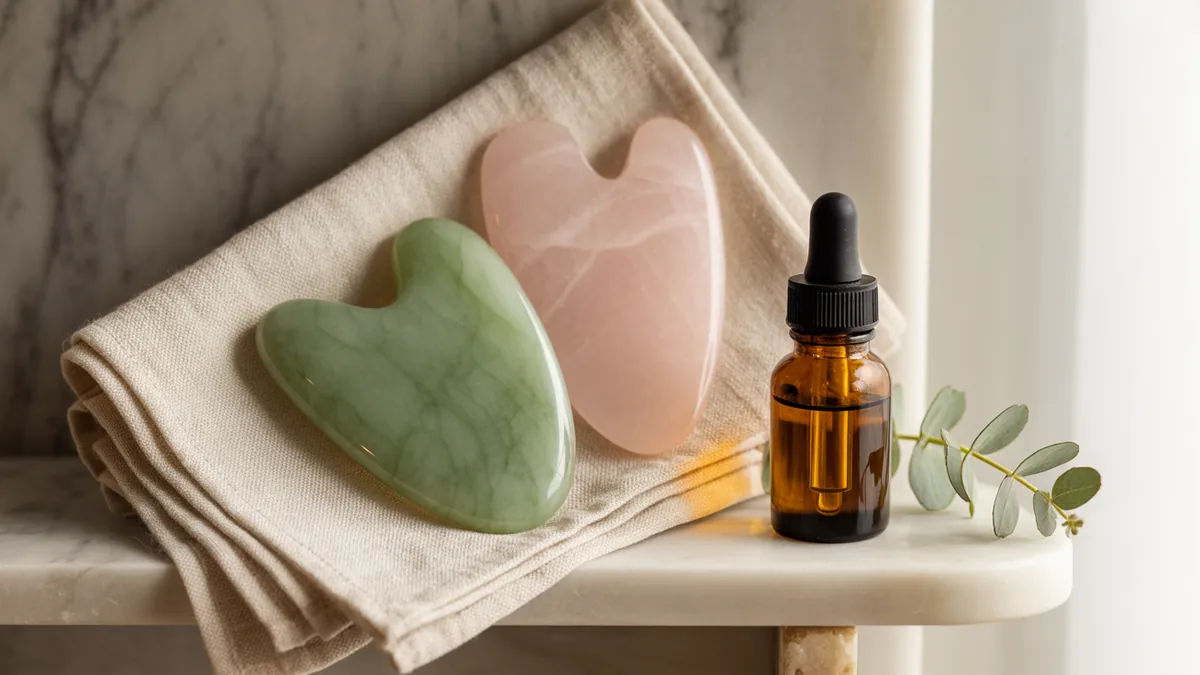
I bought my first gua sha stone three years ago because it was pretty and on sale, then let it sit in a drawer for four months because I had no idea what I was doing. The internet showed me dozens of people scraping their faces at high speed with no oil, and it looked like a recipe for irritation rather than the calm thing it is supposed to be. So I want to start where I wish someone had started with me: this is a flat stone you glide over slippery skin, slowly, to move fluid. That is the whole job.
Learning how to use gua sha properly took me about two weeks of fumbling, and most of what I got wrong was simple. Too little oil, too much speed, pressing like I was trying to sand something. Once I slowed down and learned the stroke directions, it became the five minutes of my evening I actually look forward to. My jaw feels less clenched. My face looks less puffy in the morning. Nothing dramatic, nothing that will reshape your bones, just a quietly nice ritual.
One thing up front, because the search results blur these together: this guide is about the gua sha stone tool and lymphatic drainage strokes. It is not facial exercise. If you want the muscle-engaging stuff, I keep that separate in my morning face yoga routine, and the two practices actually pair beautifully. Here we are talking purely about the tool, the oil, the strokes, the cleaning, and how often to do it.
| Face zone | Stroke direction | Passes | Why this direction |
|---|---|---|---|
| Neck | Straight down the sides, collarbone-ward | 3-5 per side | Opens the drainage path everything else empties into. Always first. |
| Jaw | Chin out to earlobe, hugging the jawbone | 3-5 per side | Defines the jawline edge and clears fluid toward the ear. |
| Cheeks | Side of nose outward to the ear, then down the neck | 3-5 per side | Carries puffiness off the face and down the neck route. |
| Under-eye and brow | Under-eye gently outward to temple, brow up to hairline | 2-3 per area | Lightest pressure here; eases morning puffiness and tension. |
What a gua sha tool actually is
Plain definition: A gua sha is a smooth, flat stone with curved and notched edges that you glide across the face to move lymphatic fluid and release muscle tension.
Strip away the marketing and a gua sha is a contoured piece of polished stone, usually jade or rose quartz, sized to sit in your palm. The traditional body version is firmer and used with real pressure on muscles, often leaving redness on purpose. The facial version you see online is the gentle cousin. You are not bruising anything. You are coaxing fluid toward your lymph nodes, which is why the strokes head down and out, never randomly.
The shape does the thinking for you once you understand it. The long flat edge is for sweeping broad areas like the cheeks and neck. The deep curve, the part that looks like a heart dip, hooks around the jawline. The small notch at one end is for tight detail spots, like the brow or the side of the nose. You do not need to memorize fancy names. You just need to match the right edge to the right zone, which I will walk through.
Jade or rose quartz is mostly a vibe and budget question. Jade tends to stay a touch cooler, rose quartz looks like candy and holds cold from the fridge a little longer. Neither one has special powers, and a cheap stainless steel one works identically if you do not care about the aesthetic. The stone is just a comfortable handle for your hand. The technique is what matters, and that is gloriously free.
What it will and won't do
Realistic expectations save you from disappointment. A gua sha session can reduce that morning puffiness, ease the tension knot most of us carry in the jaw, and give your skincare a few minutes of focused contact. It is genuinely relaxing, which is not nothing. What it will not do is permanently lift your face, sculpt new bone structure, or replace anything a dermatologist offers. The before-and-after photos online are usually decongested puffiness and good lighting, not magic.
What oil to use with gua sha
The oil rule: Use enough facial oil or a rich serum that the stone glides with zero drag. Dry skin plus a stone equals tugging, and tugging is the one thing you must avoid.
This is the question I get most, and the answer is simpler than people expect. You want slip. The stone has to slide, not catch. Any facial oil works: jojoba, squalane, rosehip, marula, a basic grapeseed from the kitchen if that is what you have. I keep a small bottle of squalane by my sink purely for this because it is light, cheap, and does not clog my pores. The fancy oil is optional. The slip is mandatory.
If your skin runs oily and a full facial oil feels like too much, a thick, slippery serum can do the job instead. The same hydrating layers I describe in my skin flooding guide give plenty of glide. A hyaluronic serum topped with a couple of drops of oil is a lovely combination, hydrating and slick at once. What you cannot do is run the stone over bare, dry skin. That drags the skin sideways, and over time that is exactly the kind of pulling we are trying to avoid.
How much oil? More than you think. Three or four drops pressed across the whole face and neck, reapplied if you feel any catch mid-routine. When I am layering a serum first, I treat it like the application steps I cover in how to apply face serum: press it in, let it sink for a moment, then add the oil on top so the stone has a real cushion to ride on. If you have sensitive or reactive skin, my natural skincare for sensitive skin notes cover gentle oils that play nicely with a stone.
When to gua sha in your skincare routine
The timing: Gua sha goes after cleansing and after your serum or oil, never on dry skin and never before you have applied your slip layer.
The order trips up a lot of beginners, so let me be exact. Cleanse first, always, because dragging a stone over the day's dirt and sunscreen is asking for clogged pores. Then your watery steps if you use them, toner or essence. Then the serum or oil that gives you slip. The stone goes on top of that layer. So the honest answer to gua sha before or after skincare is: after cleansing, and after the hydrating layer, with the oil acting as both treatment and lubricant.
I do mine at night nine times out of ten, and the reason is mood, not science. Evening is when my jaw is tightest and when I have five unhurried minutes. The relaxation reads as part of winding down. That said, a quick morning session is the better choice if puffiness is your main concern, because you are clearing the fluid that pooled overnight before you walk out the door. Some people do a fast morning drain and a longer evening ritual. Both are fine.
One placement question people ask: where does it sit relative to a fragrance-free routine or a barrier-focused one? It slots in the same spot regardless. If you are following something like my fragrance-free beauty routine or a barrier-rebuilding plan, the gua sha is simply the massage step layered over your usual serum, not a replacement for any product. It adds five minutes, not a new shelf of bottles.
The full gua sha facial routine, zone by zone
The core sequence: Neck first, then jaw, then cheeks, then under-eye and brow, holding the stone almost flat and moving slowly outward and down.

Here is the movement map, described the way I wish someone had described it to me, in plain directions instead of diagrams. The golden rule across every zone: hold the stone at a shallow angle, almost flat against the skin, around fifteen degrees. Steep angles mean edges digging in. Flat means a broad, gentle sweep. Pressure should be light, the kind you would use to spread butter on soft bread, never scraping.
Step one: the neck, always first
This is the step beginners skip and the one that matters most. Your lymph drains down the neck toward the collarbone, so you open that path before you push anything toward it. Hold the flat edge against the side of your neck, just below the ear, and sweep straight down to the collarbone. Three to five passes on each side. Then do the back of the neck if you carry tension there. You are opening the drain before filling the sink.
Step two: the jaw, chin to ear
Now the part everyone wants, the gua sha for jawline work. Hook the curved dip of the stone under your jawbone at the center of your chin. Glide along the bone out to your earlobe, following the jaw's edge, three to five times per side. Keep it slow. This is where you can use a touch more pressure since you are tracing bone, but still nothing that hurts. Finish each pass by carrying the stroke down the neck so the fluid keeps moving toward the drain you opened.
Step three: the cheeks, inside out
Lay the flat edge under your cheekbone, starting beside the nose. Sweep outward toward the top of your ear, letting the stone ride just under the cheekbone. Three to five passes. Then a second set lower on the cheek, same outward direction. Every cheek stroke should end by traveling down the neck. Out, then down. That is the rhythm of the whole face: collect from the center, carry it to the side, send it down. Repeat it and your hands learn it within a week.
Gua sha for puffy eyes
Under-eye rule: This is the most delicate zone. Use the lightest pressure and the small notched end, moving outward toward the temple, never back and forth.
The under-eye is where caution matters most, because the skin there is thin and the area puffs easily. For gua sha for puffy eyes, switch to the small notched end of the stone and barely touch the skin. Start at the inner corner, just below the lash line, and glide outward to the temple. Two or three feather-light passes. Then continue the stroke down past the ear and into the neck, because that puffiness has to go somewhere, and the somewhere is always down.
A cold stone helps here more than anywhere else. I keep my rose quartz in a clean pouch in the fridge, and on mornings when I have clearly slept badly, that chilled glide under the eyes genuinely takes the swelling down. It is the one place where the result is immediate and visible. Just resist the urge to press or to drag inward toward the nose. Outward and gentle, every time, and stop the moment anything feels tender.
For the brow and forehead, switch back to the flat edge. Sweep upward from the brow toward the hairline, working across the forehead in vertical strokes. This is where I feel tension release the most, especially if I have spent the day frowning at a screen. Three or four upward passes across the whole forehead, then one final sweep out to the temples and down the neck to close the loop.
Neck and scalp gua sha
Beyond the face: The neck deserves its own attention, and a few minutes of scalp gua sha is the relaxing bonus almost nobody talks about.

Neck gua sha is worth doing as its own thing, not just as the opening drain. We hold an astonishing amount of tension in the neck and the soft area under the chin. Tilt your head back slightly, use the flat edge, and sweep from under the chin down the front of the throat with very light pressure, then down each side. This area looks better when it is decongested, and it is the part of the face people forget to care for until it starts to bother them.
Scalp gua sha is the underrated finale. Most stones have a comb-like edge or a broad curve that works on a dry scalp, no oil needed. Press the edge against your scalp and draw it slowly from your hairline back toward the crown, section by section. It feels like the best part of a haircut, that head massage moment, except you can have it any night. It is purely for relaxation and the lovely tingle, and it is the step that turns this from a chore into something I genuinely want to do.
If you want to layer this into a broader wind-down, the gua sha sits naturally inside an evening ritual the way I describe my whole approach in the soft beauty routines guide. Five minutes of slow strokes, dim light, and a stone that has been chilling in the fridge is a small kindness that costs nothing and asks for nothing back.
How often should you gua sha
Frequency: Two to four times a week is plenty for most people, and daily is fine if your skin tolerates it and you keep the pressure gentle.
How often should you gua sha is the question with the most anxious energy behind it, and the answer is relaxed. There is no dose you are missing. Two to four sessions a week gives you all the puffiness relief and tension release the practice offers. I personally do a proper routine three evenings a week and a quick morning under-eye drain whenever I look swollen, and that rhythm has held for years without me thinking about it.
Daily is fine too, as long as you are gentle and your skin is happy. The risk of overdoing it is not frequency, it is force. Someone pressing hard every single day can irritate their skin or trigger breakouts; someone gliding lightly every day will be fine. If you ever see lingering redness, broken capillaries, or new bumps, that is your cue to ease the pressure and cut back, not to push through. Gua sha should never leave a mark on your face.
The trap to avoid is the all-or-nothing spiral, which is my personal weakness with every routine. Missing a week changes nothing. This is not a streak you can break. Treat it like the calm five minutes it is, do it when it serves you, skip it when life is loud, and come back to it without any guilt. The version that lasts is the gentle, occasional one, not the punishing daily one you abandon by month two.
How to clean your gua sha
Cleaning: Wash the stone with mild soap and warm water after every use, dry it fully, and disinfect it weekly. A dirty stone spreads oil and bacteria back onto your skin.
Nobody talks about how to clean your gua sha, and then they wonder why they break out. The stone collects oil, dead skin, and product every single session. Run it under warm water with a drop of mild soap or a gentle facial cleanser after each use, rubbing it with your fingers, then rinse and pat it dry with a clean towel. Drying matters, because a stone left wet in a humid bathroom can grow grime in the little curves you cannot see.
Once a week I give mine a deeper clean. A wipe with a cotton pad dampened with rubbing alcohol disinfects it without harming the stone, and then I rinse and dry it again. If you have been breaking out, clean it before and after every use until your skin settles. Store it somewhere dry, not sitting in a puddle by the tap. A small cloth pouch keeps it from chipping and from collecting dust between uses.
One care note for the stone itself: avoid dropping it, obviously, since jade and rose quartz chip, and avoid extreme heat, which can crack some stones. Cold is friendly, which is why the fridge works so well. Hot water for cleaning is fine, boiling is not necessary and not worth the risk. Treat it like a nice glass and it will outlast every serum you own.
What the evidence honestly says
The honest summary: Facial gua sha can temporarily reduce puffiness and feels relaxing, but it does not lift, sculpt, or change your skin permanently.
Time for the part the sculpting videos skip. Most rigorous gua sha research studies the firmer body therapy used by practitioners, not the gentle facial version, and the facial evidence is thin. What is well established is more modest and more believable: facial massage in general can briefly improve local circulation and move lymphatic fluid, which is exactly why your face looks less puffy right after. That puffiness reduction is real. It is also temporary, returning as fluid naturally redistributes.
Dermatologists tend to land in a sensible middle. The American Academy of Dermatology is clear that facial massage techniques can feel good and aid relaxation, while cautioning against aggressive tools on irritated skin, which you can read in their general skin care basics. The Cleveland Clinic's overview of gua sha says much the same: pleasant, low-risk when done gently, but not a substitute for medical treatment and not a face-lift.
So why do so many of us swear by it? A few honest reasons. The lymphatic decongestion genuinely reduces morning puffiness, which photographs as a slimmer face. The massage relaxes clenched jaw and brow muscles, which softens how tension shows up. And the ritual itself, five slow minutes of paying attention to your own face, does something for the nervous system that no product can. I keep doing it because it feels good and my face looks fresher, not because I believe it rearranges my anatomy. If you would rather skip the stone, I cover the hands-only version in my lymphatic drainage face massage guide.
Beginner mistakes I made
The big four: Too little oil, too much speed, too much pressure, and skipping the neck. Fix those and you have fixed almost everything.
My first mistake was not enough slip. I was timid with the oil, the stone caught and dragged, and I assumed gua sha just felt uncomfortable. It does not. If you feel any pull, stop and add more oil. The stone should feel like it is floating. This is the single most common gua sha for beginners error, and it is a thirty-second fix.
The second was speed. The videos that get views move fast and dramatically, but fast does nothing for lymphatic drainage, which responds to slow, deliberate strokes. I now count to three across each pass. Slower genuinely works better and feels far more relaxing, which is half the point.
The third was pressure, the belief that pressing harder would sculpt faster. It only reddened my skin and once gave me a little broken capillary on my cheek that took ages to fade. Light pressure, especially near the eyes, is non-negotiable. You are moving fluid that sits just under the surface, not massaging deep muscle.
The fourth was skipping the neck because it felt unglamorous. Without opening the neck drain first, you are just pushing fluid around the face with nowhere for it to go. Three to five neck sweeps before anything else changed my results more than any expensive stone ever could. Start at the neck, end at the neck, and let everything in between flow downhill.
When this won't fit your life
Gua sha is gentle, but it is not for everyone or every moment. If you have active acne, especially inflamed or pustular breakouts, dragging a stone across them can spread bacteria and worsen things, so skip the affected areas entirely. The same goes for rosacea and easily flushed skin, where the friction and circulation boost can trigger more redness. If you have any broken skin, open blemishes, cuts, sunburn, or an active flare, put the stone down until your skin has healed.
There are also timing rules that matter. If you have had recent injectable fillers, Botox, or any in-office treatment, do not gua sha over those areas until your provider clears you, because pressure can theoretically shift product or interfere with healing. People on blood thinners or with conditions that bruise easily should be especially cautious. And if you are working on a compromised barrier, the slow rebuild I describe in my skin barrier repair routine comes first; add the stone back only once your skin is calm. When in doubt, a dermatologist is the right person to ask, not a tutorial.
Helpful sources and next reads
Reliable external sources
- Cleveland Clinic: what gua sha is and what it can do
- American Academy of Dermatology: skin care basics
- American Academy of Dermatology: facial care guidance
- Harvard Health: the benefits of massage
- Cleveland Clinic: lymphatic drainage massage
More from Sabrina Saturno
You may also love

FAQ
How do you use a gua sha for beginners?
Cleanse your face, apply a facial oil or slippery serum so the stone glides, then sweep the stone slowly outward and downward across each zone, three to five passes. Always start by draining the neck, then work the jaw, cheeks, under-eye, and forehead, ending back down the neck.
What oil should I use with a gua sha?
Any facial oil that gives good slip works, such as squalane, jojoba, or rosehip. The only requirement is enough oil that the stone slides without dragging your skin. If you prefer not to use oil, a thick hydrating serum can provide enough glide.
Do you gua sha before or after skincare?
After cleansing and after your hydrating serum or oil. The oil layer doubles as the lubricant the stone needs. Never use a gua sha on bare, dry skin, because that drags and pulls instead of gliding.
How often should you gua sha?
Two to four times a week is plenty for puffiness and tension relief. Daily is fine if you keep the pressure gentle and your skin tolerates it. The thing to avoid is pressing too hard, not doing it too often.
Which direction do you move a gua sha?
Outward from the center of your face toward the ears, and downward toward the neck and collarbone. Lymph drains down the neck, so you open that path first and send every stroke in that direction. Never scrape back and forth.
Does gua sha really help with puffiness?
Yes, temporarily. Gently moving lymphatic fluid reduces the puffiness that pools overnight, which is why faces look fresher right after a session. The effect is real but short-lived, and a cold stone enhances it, especially under the eyes.
Can gua sha define my jawline permanently?
No. It can reduce fluid retention along the jaw so the edge looks cleaner for a while, but it cannot reshape bone or muscle permanently. The sharper-jaw photos online are decongested puffiness and lighting, not a structural change.
How do I clean my gua sha stone?
Wash it with warm water and a drop of mild soap after every use, then dry it fully with a clean towel. Once a week, wipe it with rubbing alcohol to disinfect, rinse, and dry. A clean stone prevents the breakouts a dirty one can cause.
Can I do scalp gua sha?
Yes, and it is wonderfully relaxing. Use the broad or combed edge on a dry scalp, no oil needed, drawing it slowly from your hairline back toward the crown. It is purely for tension relief and the pleasant tingle, not for the lymphatic drainage your face gets.
Is jade or rose quartz better for gua sha?
Neither is better at the actual job; it is preference and budget. Jade tends to stay slightly cooler, rose quartz holds fridge-cold a touch longer and looks pretty. The technique matters far more than the stone, and even a stainless steel tool works identically.
Can gua sha cause broken capillaries?
It can if you press too hard, especially on delicate or reactive skin. Use light pressure, plenty of slip, and stop if you see lingering redness. Done gently, gua sha should never leave a mark or break a vessel.
Is gua sha the same as face yoga?
No. Gua sha uses a stone tool to move fluid and release tension, while face yoga uses facial movements to engage muscles. They are different practices that pair well. I cover the muscle-based one separately in my morning face yoga routine.
The version that lasts
Three years in, my gua sha lives on the bathroom shelf, not in a drawer. What changed was not the stone, it was understanding that this is a slow, gentle, slightly indulgent five minutes, not a workout for my face. I stopped expecting it to sculpt me and started enjoying it for what it actually delivers: less puffiness, a softer jaw, and a quiet pause at the end of the day.
If you remember only a handful of things, remember these. Use enough oil that the stone floats. Start at the neck and send everything downhill. Press lightly, move slowly, and clean the stone afterward. Two to four times a week is plenty. And if your skin is irritated or broken out, give it a rest. None of this is precision medicine, and that is exactly why it survives a real, busy life.
So pick a stone you find pretty, keep it by the sink, chill it in the fridge if you like a cold finish, and let it become the small ritual that bookends a hard day. Pair it with a few face yoga movements if you want to engage the muscles too. Hold it all loosely. The version that lasts is the one that feels like a treat rather than a task, and that version is allowed to be enough.