

If you searched for a lymphatic drainage face massage, here is the short version before anything else: with clean hands and a little oil, you make light downward strokes that nudge fluid from your face toward your neck, starting at the neck itself. No roller, no stone, no gadget. Just your fingers and a few quiet minutes. That is the whole thing, and everything below is the detail I wish someone had handed me the first puffy morning I tried it and pressed way too hard.
I want to be honest from the first line, because the internet has turned this into a miracle. A manual lymphatic drainage face massage is a lovely, gentle way to move morning puffiness off your face. It is not a facelift, it does not change your bone structure, and the result is temporary. What it does do is help a swollen, sleep-creased face look less puffy for a few hours, and give you a small calming ritual to start the day. I am not a doctor, and this is not medical advice. It is just the routine I actually use.
I reach for it most on the mornings when I wake up looking like I cried in my sleep, even when I did not: a puffy face, heavy under-eyes, that slightly inflated feeling around the cheeks. Maybe I ate salty takeout, maybe I slept badly, maybe it is just the day. Five minutes of soft strokes, and my face looks more like mine again. Here is exactly how I do it, plus where puffiness comes from and how to make it stick.
| Area | Stroke | What it helps |
|---|---|---|
| Neck | Flat fingers sweeping straight down the sides toward the collarbones | Opens the drainage path everything else empties into; always go first. |
| Jaw | Glide from the chin out to the ear, then down the neck | Eases a heavy, swollen lower face and a tight jaw. |
| Cheeks | Sweep from beside the nose outward to the ears, then down | Lifts general face puffiness and that inflated cheek feeling. |
| Under-eyes | One light fingertip from inner corner out to the temple | Softens under-eye bags and morning eye puffiness. |
| Forehead | Sweep up from the brows, then out and down past the ears | Releases tension and helps the whole face feel less heavy. |
What lymphatic drainage face massage is
Plain definition: It is a light, hands-only facial massage that uses slow downward strokes to encourage built-up fluid to move out of your face and drain toward your neck.
Your lymphatic system is a quiet network of vessels and nodes that carries fluid, waste, and immune cells around your body. Unlike blood, which your heart pumps, lymph has no pump of its own. It relies on movement, muscle, and gentle pressure to keep flowing. When you sleep flat for eight hours, some of that fluid pools in your face, which is a big part of why you wake up puffy. A lymphatic drainage face massage is simply you, by hand, giving that fluid a gentle push toward the exit.
The key word is gentle. The vessels that carry lymph sit very close to the surface of your skin, much shallower than you would guess. So this is nothing like a deep tissue massage. You are not kneading muscle or pressing hard into your cheeks. You are barely moving the skin, with the weight of a feather, in the direction the fluid naturally wants to drain. If your fingers are dragging or your skin is turning red, you are pressing far too hard.
Everything drains downward and toward the neck, because that is where the larger lymph nodes sit and where the fluid leaves the face. That is why every good routine, including mine, starts at the neck rather than the eyes. You open the door first, then you sweep things toward it. Do it in the wrong order and you are pushing fluid against a closed gate.
Hands only, on purpose
This whole guide is about doing it with your fingers and palms, nothing else. No roller, no stone, no chilled metal wand. I love that the hands-only version costs nothing, travels everywhere, and lets you feel exactly how much pressure you are using, which is the part beginners get wrong with tools. If you would rather use a tool, I will point you to the right guide near the end so I am not repeating a method that already lives elsewhere on this site.
Why your face puffs up
The short reason: Overnight, fluid pools in your face because you have been lying flat and still, and salt, sleep, alcohol, hormones, and crying all make it worse.
Morning puffiness is mostly fluid, not fat and not a problem with your face. When you lie down to sleep, gravity stops helping your lymph drain the way it does when you are upright and moving. Fluid that would normally trickle down through the day settles in the softest, loosest tissue you have, which happens to be your eyelids, under-eyes, and cheeks. That is why the puffiness is worst in the first hour after you wake and tends to ease on its own as the day goes on.
Salt is the usual suspect when the puffiness is dramatic. A salty dinner makes your body hold onto more water, and a lot of that shows up in your face by morning. Alcohol does it too, partly through dehydration and the rebound water retention that follows. A short or restless night, a good cry the evening before, allergies, your menstrual cycle, and simply getting older all tip the scale toward a puffier morning face. None of it means anything is wrong.
I find it genuinely calming to know this. The puffy face staring back at me is not a flaw to fix forever, it is fluid that will move. A lymphatic drainage face massage just speeds up what your body was going to do anyway over the next couple of hours. It is the difference between waiting for the swelling to drift off on its own and giving it a polite nudge toward the door before a meeting or a photo.
Before you start
The setup in short: Wash your hands, work on clean skin, add a little slip from oil or moisturizer, and commit to feather-light pressure the whole way through.
The prep here is almost nothing, which is why I have actually kept this habit. Start with clean hands, because you will be touching your face for several minutes and you do not want to drag the morning's grime around. I do this on freshly cleansed skin most days, right after I rinse my face. If you want a gentle cleanser routine to pair it with, this sits beautifully on top of my sensitive skin routine, which keeps the whole thing low-irritation.
Next, you need slip. Dry fingers on dry skin will tug, and tugging is the opposite of what you want here, especially near the eyes. A few drops of a light facial oil is my favorite, warmed between my fingertips first so it glides. A dab of your morning moisturizer works just as well. You want enough that your fingers move smoothly across the skin without sliding off the edge of control. Not greasy, just enough to float.
Then the single most important rule: pressure so light it almost feels like nothing. Imagine you are moving the surface of still water, or petting a cat that does not want to be petted hard. The lymph vessels are shallow, and heavy pressure actually flattens them and slows drainage instead of helping. If you remember only one thing from this whole article, make it this. Light. Slow. Downward. Toward the neck. Repeat each stroke a handful of times rather than pressing harder.
My 6-step manual routine
The routine in short: Neck first, then jaw, cheeks, under-eyes, forehead, and finish at the neck again, all with light downward sweeps of your fingers, no tools.

This is the full sequence I run most mornings, and it takes about five minutes once you know it. Do every stroke slowly, repeat each one five or six times, and keep the pressure feather-light. The order matters more than anything, because you are always clearing the path before you sweep toward it. Here it is, start to finish.
- Clean hands and a little slip. Wash your hands, then warm two or three drops of facial oil or a dab of moisturizer between your fingertips so they glide. Take one slow breath before you start; this is meant to feel calm, not rushed.
- Drain the neck first. With flat, soft fingers, sweep straight down the sides of your neck, from just below your ears down toward your collarbones. Repeat five or six times on each side. This opens the path everything else will drain into, so never skip it.
- Sweep the jaw out to the ear. Place your fingers at the center of your chin and glide along the jawline out toward each ear, then carry the stroke down the side of the neck you just cleared. This eases that heavy, swollen lower-face feeling.
- Cheeks outward to the ear, then down. Starting beside your nose, sweep across each cheek out toward the ear, following the cheekbone, then bring the stroke down the neck. This is the move that lifts the puffy, inflated look across the middle of the face.
- Gentle under-eyes out to the temple. Using just one fingertip and almost no pressure, trace under each eye from the inner corner out toward the temple. This is the most delicate area, so go even lighter here. More on the eyes in the next section.
- Forehead up and out, then finish at the neck. Sweep your forehead from the brows upward, then fan the strokes out toward the temples and down in front of the ears. To finish, return to step two and do a few more downward neck sweeps so everything you moved has somewhere to go.
That final return to the neck is the part people forget, and it is the part that actually empties the face. Think of the whole routine as filling a sink and then opening the drain. If you only sweep the cheeks and eyes without clearing and re-clearing the neck, you are just moving fluid in a circle. This pairs well with my morning face yoga if you want a few minutes of gentle movement to go with the drainage.
Lymphatic drainage for puffy eyes and under-eyes
For the eyes: Use one fingertip, the lightest touch you can manage, and sweep from the inner corner out to the temple, then down the side of the face toward the neck.

The under-eyes are where most of us want the magic, and they are also where you have to be the most careful. The skin here is the thinnest on your whole face, and it bruises and stretches easily, so this is a place to be almost absurdly gentle. I use a single fingertip, usually my ring finger because it is the weakest and naturally presses the least, and I tell myself to use half the pressure I think I need.
The stroke is simple. Start at the inner corner of the eye, just beside the nose, and glide outward along the bone under the eye toward the temple. Do not press into the eyeball, do not drag the loose skin, and stay on the bony rim rather than the soft pad itself. At the temple, carry the motion down in front of the ear and toward the neck, so the fluid keeps moving to the exit. Three or four passes per eye is plenty.
Lymphatic drainage for puffy eyes works best when the rest of the face is already cleared, which is why the eyes come after the neck, jaw, and cheeks in my routine, never first. If you go straight for the under-eyes on a puffy morning, you are trying to drain fluid into an area that is still backed up. Clear the path below, then move the eye puffiness down into it. A cool room or briefly cool hands can make the under-eye area feel even less swollen.
Honesty check on under-eye bags: real, structural under-eye bags, the kind that are there even when you are not puffy, are often fat or skin changes that a massage will not erase. What this helps is the fluid component, the morning swelling that comes and goes. So expect softer, fresher under-eyes for a few hours, not a permanent change to a feature you have had for years.
Face and neck together
The whole picture: The face and neck are one drainage system, so treating them together, neck first and neck last, works far better than massaging the face alone.
It took me a while to really understand that the face and neck are not two separate projects. They are one drainage path, and the neck is the bottleneck. All the lovely sweeping you do on the cheeks and under-eyes only pays off if the neck below them is clear, because that is the route the fluid takes to leave. This is why a lymphatic drainage face and neck routine beats a face-only one almost every time.
In practice that means I bookend everything with neck work. Neck sweeps to start, opening the path, and neck sweeps to finish, emptying everything I moved down into it. In between, every face stroke ends by traveling down the neck rather than stopping at the jaw. You are always pointing the fluid the same direction, toward the collarbones, and giving it a clear runway to get there. Nothing should ever sweep up and away from the neck and just stop.
The neck is also where a lot of us hold tension, so this part feels good in its own right. Soft downward strokes along the sides of the neck, behind the ears, and toward the collarbones release some of that gripped, hunched feeling from sleeping or staring at a screen. On a calmer evening I do a shorter version of this as part of my evening reset routine, less about depuffing and more about unwinding before bed.
Before and after, honestly
What to expect: A visibly less puffy, fresher face for a few hours. The change is real but temporary, and it is not a substitute for medical care.
Let me set the lymphatic drainage face before and after expectation clearly, because the before-and-after photos online oversell it. After a good five-minute session on a puffy morning, my face genuinely looks less swollen. The cheeks look a touch more defined, the under-eyes look fresher, and the whole face looks more awake. It is a real, visible change, and on my puffiest mornings it is the difference between looking tired and looking like I slept fine.
Here is the honest part. The effect is temporary, usually a few hours, sometimes most of a day if you keep moving and drinking water. You are speeding up a natural process, not changing the underlying structure of your face. It will not slim your jaw permanently, it will not remove fat, and it will not erase fine lines. Anyone selling it as a non-surgical facelift is stretching the truth well past where it goes. Manage your expectations and you will be pleasantly surprised rather than let down.
I am not a doctor, and this is not medical advice. A lymphatic drainage face massage is a gentle cosmetic and feel-good practice for ordinary morning puffiness. It is not a treatment for any medical condition, and it cannot diagnose or cure anything. If your swelling is sudden, one-sided, painful, or does not settle, that is not a job for a face massage, it is a reason to see a clinician, which I will come back to below.
For the kind of puffiness most of us are dealing with, though, the payoff is lovely for how little it costs. Five minutes, no equipment, a face that looks more like itself. I think of it the same way I think about a glass of water and a calm morning, like my cortisol tea: small, repeatable, kind, and genuinely helpful without pretending to be more.
How often and when
The honest schedule: Daily is fine if it feels good, mornings are best for depuffing, and a few minutes is plenty. More is not better here.
You can do this every day, and on puffy stretches I do. Because the pressure is so light, there is no real risk in a gentle daily routine for most healthy people, and the morning is the natural time since that is when puffiness peaks. I fold it into the few minutes between cleansing and the rest of my skincare, so it does not feel like an extra chore I have to find time for.
That said, more is not better. This is not a case where pressing harder or going longer gets you a bigger result. Five gentle minutes does the job; ten minutes of grinding into your face just irritates the skin and can leave it red. If you only have two minutes, do the neck, the cheeks, and a few light under-eye sweeps and call it done. The consistency of a short daily habit beats an occasional marathon session by a mile.
I time it to whatever else I am doing to wake up. Some mornings that is right after I splash my face, some mornings it is while a kettle heats. Tying it to an anchor you already have makes it stick far better than promising yourself a separate self-care block you will skip when you are busy. The whole point is that it is small enough to actually keep doing.
Prefer a tool?
Quick note: Everything here is hands-only, but a stone can do similar work if you would rather hold something.
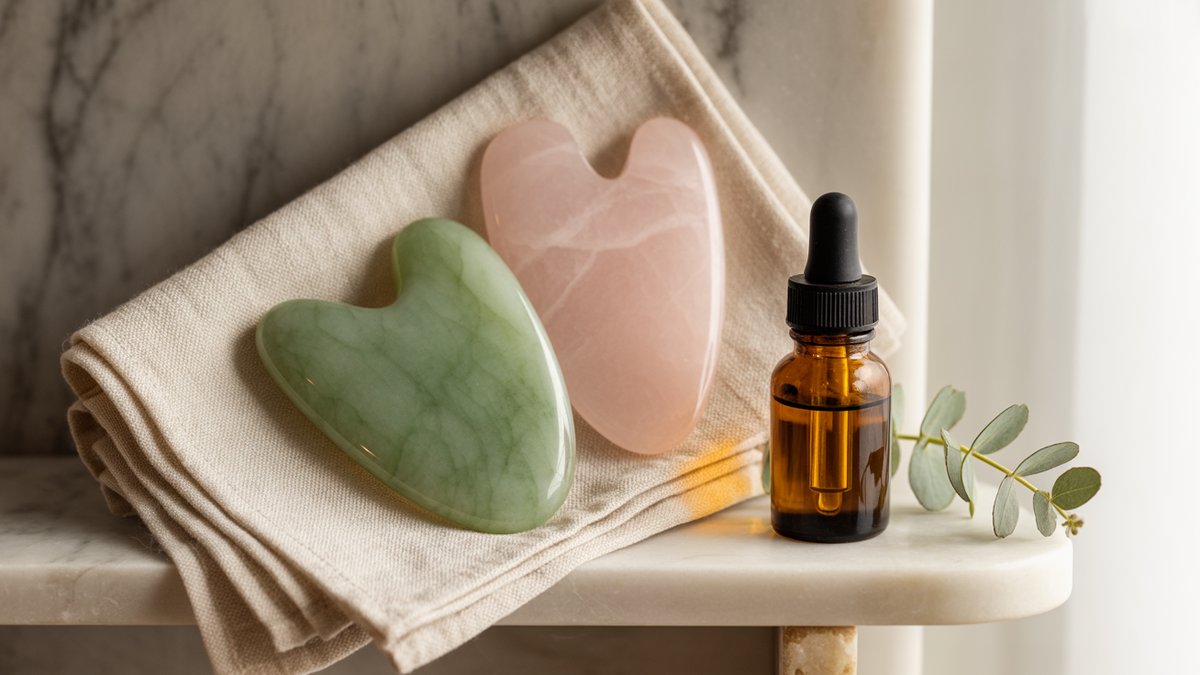
I love the hands-only version because it costs nothing and you can feel exactly how light you are being, which is the hardest part to get right. But some people simply prefer the cool, smooth feel of a tool gliding over the skin, and that is completely valid. If you would rather use a tool, my gua sha guide walks through it, with the angles, the strokes, and the care that particular stone needs.
I am keeping it to a single pointer on purpose, because the tool method is its own thing and deserves its own full walkthrough rather than a rushed paragraph here. If you are happy with your hands, you genuinely lose nothing by skipping a tool entirely. The fluid does not know whether it is being moved by a stone or a fingertip. It only cares about the direction, the lightness, and the patience, all of which your hands do just fine.
When this won't fit your life
A lymphatic drainage face massage is a gentle cosmetic ritual, not a medical treatment, and there are times to skip it and call a professional instead. I am not a doctor, and this is not medical advice. See a doctor for swelling that comes on suddenly, swelling that is only on one side, or puffiness that is painful, hot, red, or simply will not go away. Those can point to an infection, an allergic reaction, a thyroid issue, or other things that a face massage cannot touch and should not delay you from getting checked.
If you have lymphedema, a known lymphatic disorder, or you have had lymph nodes removed or treated, do not freelance from a blog. Medical lymphatic drainage for those conditions is a specific clinical therapy done or guided by a trained professional, and it is not the same as the casual depuffing routine on this page. Talk to your own clinician about what is safe for you. The same goes if you are mid-flare with an active skin infection, a fresh injury, or a rash on your face; let the skin settle and heal first.
And honestly, some mornings this just will not fit, and that is fine too. If you are rushing out the door, skip it without guilt; a puffy face is not an emergency and it settles on its own within a couple of hours. This habit is meant to be a small kindness, not another box to check or another standard to fail. Use it on the mornings it helps, leave it on the mornings it does not, and never let a five-minute face massage become a source of stress.
Helpful sources and next reads
Reliable external sources
- Cleveland Clinic: lymphatic drainage massage
- NIH/NCBI: anatomy of the lymphatic system
- American Academy of Dermatology: skin care basics
More from Sabrina Saturno
You may also love


FAQ
What is a lymphatic drainage face massage?
It is a light, hands-only facial massage that uses slow downward strokes to nudge pooled fluid out of your face and toward your neck, where it drains away. There are no tools involved, just your fingers and a little slip from oil, and it is mainly used to ease morning puffiness.
Does lymphatic drainage face massage really work?
For temporary puffiness, yes, it genuinely helps. A few minutes of gentle strokes moves fluid off your face and leaves it looking less swollen and fresher for a few hours. It does not change your bone structure or remove fat, and the effect is short-lived, so think depuff, not facelift.
How do I do lymphatic drainage on my face at home?
Start with clean hands and a little oil for slip, then work in order: neck first, then jaw, cheeks, under-eyes, and forehead, finishing back at the neck. Keep every stroke feather-light and aimed downward toward your collarbones, and repeat each move five or six times. It takes about five minutes.
Does it help puffy eyes?
It helps the fluid kind of eye puffiness, the morning swelling that comes and goes. Use one fingertip with almost no pressure and sweep from the inner corner out to the temple, then down toward the neck. Clear the neck and cheeks first so the eye puffiness has somewhere to drain.
Can it get rid of under-eye bags?
It softens the puffy, fluid-related part of under-eyes, so they look fresher for a few hours. Structural bags that are there even when you are not puffy are usually fat or skin changes, and a massage will not erase those. Expect temporary freshness, not a permanent fix for long-standing bags.
Should I massage the face and neck together?
Yes, always. The neck is where the fluid actually exits, so it is the bottleneck for everything you do on the face. Begin and end at the neck, and let every face stroke travel down the neck rather than stopping at the jaw. Face-and-neck together works far better than face alone.
How long does a lymphatic drainage face massage take?
About five minutes for the full routine, or two minutes for a quick version of neck, cheeks, and a few under-eye sweeps. It is short on purpose. More time and harder pressure do not give a bigger result, and they can irritate the skin, so gentle and brief wins.
How often should I do it?
Daily is fine for most healthy people because the pressure is so light. Mornings are best since that is when puffiness peaks. Tie it to something you already do, like right after cleansing, so it sticks. A short consistent habit beats an occasional long session every time.
Can you overdo it?
You can, mostly by pressing too hard or going too long. Heavy pressure flattens the shallow lymph vessels and can leave skin red and irritated, especially under the eyes. The fix is simple: lighter and shorter. If your skin looks flushed or feels sore afterward, you were not being gentle enough.
What should I expect from before and after?
A visibly less puffy, more awake face for a few hours. Cheeks look a touch more defined and under-eyes look fresher. The change is real but temporary, and it does not alter your underlying face shape. Anyone calling it a non-surgical facelift is overpromising, so keep expectations grounded.
Do I need oil to do it?
You need some kind of slip so your fingers glide instead of dragging, which matters most near the delicate eye area. A few drops of light facial oil is ideal, but a dab of your usual moisturizer works just as well. You only need enough to float across the skin, not a greasy layer.
Who should avoid it?
Skip it and see a doctor for sudden, one-sided, painful, hot, or persistent swelling, or an active infection, rash, or allergic reaction. If you have lymphedema, a lymphatic disorder, or have had lymph nodes treated or removed, get personalized guidance from a clinician. I am not a doctor, and this is not medical advice.
The version that lasts
Here is where I have landed after a lot of puffy mornings. The routine at the top of this page is real, gentle, and worth trying tomorrow if your face tends to wake up swollen. Neck first, light hands, everything sweeping down and out, neck again to finish. It is almost too simple to believe it does anything, and then you look in the mirror and your face looks like yours again.
What keeps me doing it is not a promise of permanent change, because there is not one. It is the small calm of five quiet minutes, the cool of my fingers on my face, the way a swollen morning softens before the day even starts. The depuffing is lovely, and the little pause that comes with it is the part I would not give up. I am not a doctor, and this is not medical advice; it is just a kind habit that fits a real morning.
So keep your hands clean, keep them light, and keep pointing everything toward your neck. If five minutes is too much on a rushed day, do two. If your puffiness is sudden, painful, or stubborn, see a professional instead. The version that lasts is the one that feels like care rather than a task, and that gentle, hands-only version is allowed to be enough.