
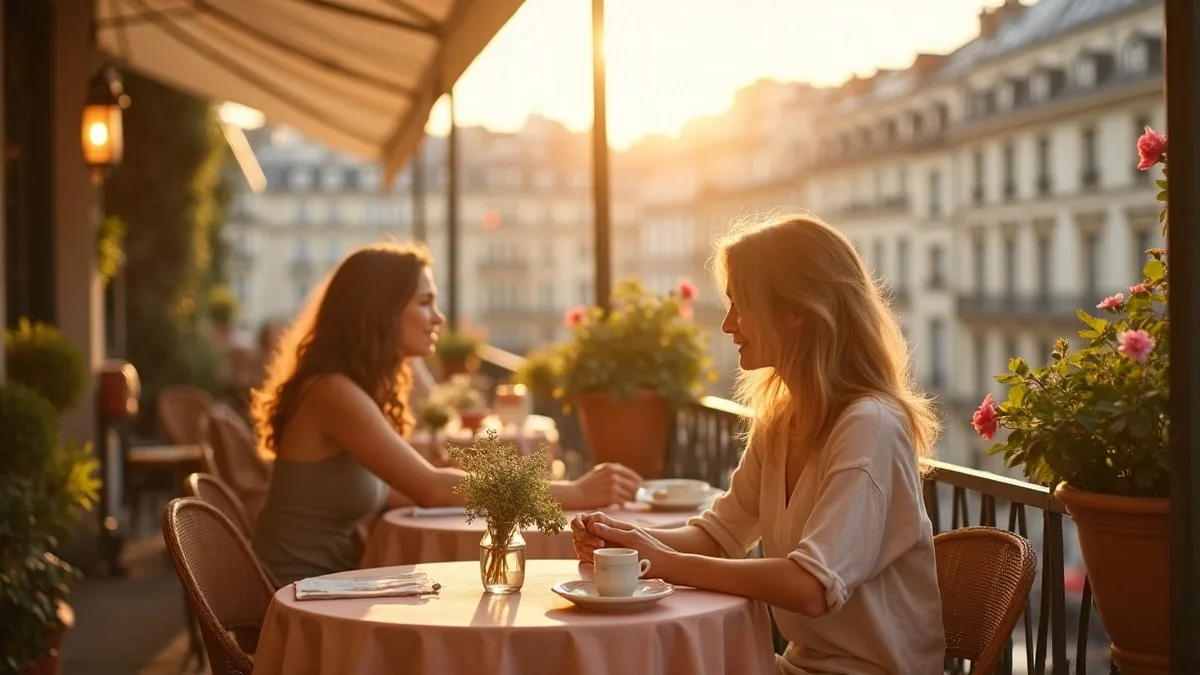
My answer for a soft Paris itinerary is to plan one or two neighborhoods per day, book the two or three museums that matter to you, leave evenings unscheduled, and walk slowly enough to actually see the city. Four days is enough to fall in love with Paris without exhausting yourself. The trick is choosing pacing over pageantry.
I wrote this for women who want Paris to feel like a long exhale, not a bucket-list sprint. I am not a tour guide. I am a traveler who used to over-plan trips into resentment and slowly learned that the best Paris days happen when you leave room for the city to surprise you. Four days, three meals, two coffees, one museum, one walk. That is usually plenty.
Paris opened up for me when I stopped trying to win the city. The cobblestones, the bakeries, the late lunches, the small bookshops, the gardens you stumble into by accident, all of it asks for time, not for a checklist. I want to share the itinerary I now keep returning to, and the small choices that made it feel like rest instead of work.
Why it matters
A soft Paris itinerary matters because Paris rewards slowness in ways few cities do. Pacing protects ankles, knees, patience, and the rhythm of long café lunches that become the memories. A trip that crams ten landmarks per day delivers photographs. A trip that lingers delivers experience.
Paris rewards slowness in a way few cities do. The flavor of a fresh croissant, the light on the Seine at 6 p.m., the quiet of an early-morning museum, the rhythm of a long café lunch. These are not things you can rush. A trip that crams ten landmarks per day delivers photographs. A trip that lingers delivers memories.
A soft itinerary is also kinder to your body. Paris is a walking city. Most travelers underestimate how many miles their day quietly accumulates. Pacing protects ankles, knees, and patience. It also creates space for the better version of you to show up at dinner instead of the exhausted one.
For searchers who want a direct line, the move is simple. Pick fewer neighborhoods. Book the museums you genuinely care about. Walk between sights instead of taking the métro every time. Leave evenings unplanned. The city will fill the gaps better than your spreadsheet ever could.
How I approach it
I plan Paris around three questions. What do I want to remember when I am 80? Which neighborhood do I want to know well enough to recognize a second time? What kind of evening do I want to come back to? Those three questions usually replace twenty Google searches and produce a much warmer trip.
I also build for rhythm, not coverage. Two slow sights per day, one good meal, one walk, one café pause. That structure leaves room for spontaneity, weather changes, or the museum room that holds you for an extra hour without warning. The structure is the freedom.
My third filter is honesty about energy. I am not the version of myself who can walk 18,000 steps and then have a 3-hour dinner. I am the version who needs an afternoon coffee or a 20-minute sit-down in a park to keep enjoying the day. Paris welcomes both versions. The soft itinerary plans for the second one.
Day-by-day: my 4-day soft itinerary
This 4-day soft Paris itinerary covers (1) Le Marais and Île Saint-Louis on arrival day, (2) Saint-Germain and the Latin Quarter on day two, (3) Montmartre and Pigalle on day three, and (4) Canal Saint-Martin and République on day four, with long lunches and unhurried evenings.
This itinerary assumes you land mid-morning on Day 1 and fly out evening of Day 4. It is paced for one or two travelers, not for a family with young children. Each day covers two adjacent neighborhoods that you can walk between, with a long lunch in the middle and an unhurried evening.
Day 1: Le Marais and Île Saint-Louis
I start in Le Marais because it gives you a soft introduction to Paris without overwhelming you. Drop bags, take a slow coffee, then walk to Place des Vosges, sit on a bench, and let the jetlag dissolve in the morning sun. From there, wander into the smaller streets around the Picasso Museum, even if you do not enter. The neighborhood is the experience.
For lunch I cross to Île Saint-Louis and pick up a long sandwich or a salad to eat on the quai, looking at the back of Notre-Dame. Afterwards, the only required stop on this day is Berthillon for ice cream. It has been making frozen desserts on Île Saint-Louis since 1954, and the lavender or salted caramel cone is worth the small wait.
The afternoon belongs to slow walking. Cross to the Latin Quarter side, find Shakespeare and Company, and let yourself disappear into the bookshop for an hour. Walk along the Seine, watch the booksellers' green stalls, and let the day taper into a simple bistro dinner back in Le Marais. Sleep early. The city will wait.
Day 2: Saint-Germain and the Latin Quarter
Day 2 begins with a morning coffee at Café de Flore, which has anchored the Saint-Germain literary scene since 1887. Order a café crème, watch the regulars, and let the place feel familiar rather than touristic. From there, walk to the Musée d'Orsay for the second half of the morning. Book the 11 a.m. timed entry. The Impressionist galleries at that hour are still calm.
For lunch, pick up a tarte from Poilâne on rue du Cherche-Midi, where the bakery has worked the same sourdough method since 1932. Eat in the small Square Récamier or in the Jardin du Luxembourg if the weather agrees. The Luxembourg garden is the gift of Saint-Germain. A long bench, a slow lunch, the chestnut trees doing their work.
The afternoon stays in the 6e: a slow loop through the cobbled streets, a stop at Les Deux Magots if Café de Flore was too crowded earlier, and a return to Shakespeare and Company if you missed it. Dinner can be a bistro classic at Le Procope, the oldest café-restaurant in Paris (1686), or a simpler crêperie in the Quartier Latin.
Day 3: Montmartre and Pigalle
Day 3 climbs. Begin early at the foot of Montmartre to avoid both heat and crowds. Walk up through the back streets rather than the main staircase. Stop at La Maison Rose for a photo if you want, or head straight for Sacré-Cœur. Sit on the steps facing south. The view of Paris in morning light is the kind of thing you remember for years.
After Sacré-Cœur, wander to Place du Tertre, observe the painters at work, then descend to rue des Abbesses for a lunch that does not require reservations. Pigalle below Montmartre has changed a great deal over the last two decades and now holds some of the warmest neighborhood restaurants in the city. Stay in the daylight part of the area.
The afternoon is unscheduled by design. You will be tired from the climb. Find a small café, write postcards, or take the métro back to your neighborhood for a long rest at the hotel. The evening can be a simple wine bar in the 9e arrondissement or an unplanned walk back through South Pigalle.
Day 4: Canal Saint-Martin and République
Day 4 belongs to the part of Paris that feels least like a postcard and most like a lived-in city. Start with breakfast at Holybelly on rue Lucien Sampaix, which has anchored the canal brunch scene since 2013. Eggs, pancakes, real coffee, no rush. After breakfast, walk the canal northward. Sit on the iron footbridges.
Around lunchtime, stop at Du Pain et des Idées on rue Yves Toudic, the bakery operating since 2002 with the same wood-fired oven. Order the pistachio escargot pastry and the pain des amis. Eat them outside on a bench by the canal. This is one of the small experiences that justified the whole trip the first time I did it.
The afternoon weaves through République into the 10e and 11e. Pause at Le Comptoir Général if it interests you, a sprawling Afro-Caribbean concept space along the canal that has run since 2009. Dinner is your choice of a small neighborhood bistro or a last view-back-toward-central-Paris splurge. Sleep well. The plane is tomorrow.
Where I stay and why

The neighborhood you sleep in shapes your trip more than any individual sight. I have stayed in four areas across different visits, and each fits a different version of a Paris trip. Pick by the kind of evening you want, not by proximity to the Eiffel Tower.
| Neighborhood | Style | Hotel price (USD per night) | Best for |
|---|---|---|---|
| Le Marais (3e and 4e) | Walkable, late cafés, lively, central | $200 to $350 | First-time soft itinerary, evening walkers |
| Saint-Germain (6e) | Elegant, quiet, classic | $250 to $400 | Museum-heavy trips, slower evening pace |
| 9e (Pigalle, Saint-Georges) | Residential, small cafés, cheaper than central | $150 to $250 | Repeat trips, budget-conscious travelers |
| Canal Saint-Martin (10e) | Local, younger residents, slower pace | $120 to $220 | Travelers who want Paris to feel lived-in, not monumental |
My one consistent suggestion across all four neighborhoods is to avoid hotels closer than three blocks to a major monument. The room cost rises sharply and the streets become noisier overnight. A 10-minute walk between your hotel and the Louvre or Notre-Dame is the right trade.
Cafés and bakeries I keep returning to
Some of these have already appeared in the day-by-day itinerary because they shape the rhythm of those neighborhoods. Listing them again here means you can find them later when you want to plan a single morning or afternoon around food rather than sights.
Du Pain et des Idées (10e), open since 2002 and run by Christophe Vasseur, makes the best pain des amis and pistachio escargot pastry I have eaten in Paris. Closed on weekends, which I always forget. Plan accordingly.
Poilâne (6e), the family-owned bakery operating since 1932, sells a sourdough miche that travels well and a small punition cookie that does not. Sit at the small café next door if you want bread and butter eaten properly.
Pierre Hermé (multiple locations) is the macaron destination for me. The Ispahan combination of rose, lychee and raspberry is the one I save room for. Order one of each flavor and walk to a nearby park to eat them slowly.
Berthillon (4e) on Île Saint-Louis has been making ice cream since 1954. The salted caramel and the lavender are the flavors I think about months after I get home. The queue moves faster than it looks.
Café de Flore (6e), founded 1887, and Les Deux Magots (6e), founded 1885, are the two great literary cafés of Saint-Germain. Order an espresso at a sidewalk table, never at the bar, and stay for an hour.
Holybelly (10e), open since 2013 on the Canal Saint-Martin, makes a brunch worth the walk. Coffee is taken seriously here, the pancakes are honest, and the staff is welcoming to non-French speakers.
Angelina (1er), the salon de thé opened in 1903 on rue de Rivoli, serves the chocolat chaud that everyone has photographed and that still earns its reputation. Share one between two people. It is rich.
Shakespeare and Company (5e) is not strictly a café, but the small attached café serves a quiet coffee in front of Notre-Dame. The bookshop itself has stood in this location since 1951.
Step-by-step guide
Planning a soft Paris trip takes five steps: (1) define the real goal of the trip, (2) book only what requires advance reservations like the Louvre, (3) pick the neighborhood before the hotel, (4) pack walking shoes already broken in, and (5) plan meals loosely with one fixed reservation max.
First, define your real goal. Is this a romantic anniversary trip, a first solo trip to Europe, a girls' weekend, a quiet break from work, or a chance to introduce someone you love to a city you already know? The honest goal shapes every other decision. Soft Paris means different things in each case.
Second, book the two or three things that absolutely require advance reservations. The Louvre, the Eiffel Tower summit, and any restaurant you have been dreaming of. Everything else can stay flexible. Over-booking removes the spontaneity that makes Paris feel romantic.
Third, pick your neighborhood before you pick your hotel. The neighborhood determines the rhythm of your trip more than any individual property. A small mid-range hotel in the right area beats a beautiful hotel in a wrong one.
Fourth, pack for walking. Paris is a flat city with cobblestones, and most travelers walk five to ten miles per day without realizing it. Bring shoes that survive that distance comfortably. New shoes are not the moment for Paris. Broken-in ones are.
Fifth, plan your meals loosely. Lunch around 1 p.m., dinner around 8 p.m., a long afternoon coffee somewhere in between. Avoid the temptation to book every meal in advance. Some of the best memories come from a window with handwritten daily specials.
- Define the trip's real goal first.
- Book only what requires advance reservations.
- Pick the neighborhood before the property.
- Pack walking shoes, not new ones.
- Leave meals loose enough for surprise.
Common mistakes
The four biggest mistakes planning a Paris trip are trying to see every arrondissement quickly, booking dinner reservations every night before arrival, underestimating jetlag on Day 1, and assuming you need fluent French. Each turns a soft trip into a sprint and a sprint into a forgettable week.
My first mistake was trying to see all four arrondissements with a quick photo at each. Paris does not work that way. The city is built for slow appreciation, and the time spent rushing between monuments is the time that could have been a long lunch or a calm afternoon.
My second mistake was booking dinner reservations every night before I arrived. Some of the most memorable evenings happened when we wandered and stopped at a small bistro we had not heard of. Reservations are useful for one or two key meals. They become a cage if applied to every night.
My third mistake was underestimating how tired the first day's jetlag would make me. I scheduled the Louvre at 2 p.m. on Day 1 once. I remember almost none of it. Now I keep Day 1 light, walk slowly, eat well, and save museums for Days 2 and 3.
My fourth mistake was thinking I had to speak fluent French to enjoy Paris. Basic politeness in French (bonjour, merci, s'il vous plaît) goes a long way. Most servers in tourist neighborhoods will switch to English the moment they notice you are struggling. Paris is more welcoming than the stereotype suggests.
Museum reservations: the playbook I learned the hard way
Museum reservations changed in Paris after the 2020s, and the system now rewards travelers who book ahead. Walk-ups are still possible at smaller museums, but the big ones (Louvre, Musée d'Orsay, Orangerie, and to a lesser extent Rodin and Marmottan) require timed entry that sells out weeks in advance during peak season.
For the Louvre I book directly through the official Louvre website, never through third-party resellers. The earliest morning slot, around 9 a.m., is the calmest in front of the Mona Lisa. Plan a maximum of three hours. Even the Louvre wears you down after that.
For Musée d'Orsay the 9:30 a.m. slot is consistently quieter than mid-day. The Impressionist galleries on the top floor are the heart of the museum, and they fill up after 11 a.m. Plan two hours. A small café break inside the museum is worth the price for the natural light.
For the Orangerie, the small museum across the Tuileries from the Louvre, time-block 90 minutes and head straight for the Monet Water Lilies rooms. The museum is small enough that you can finish in one visit. Book online to skip the entrance queue, even on rainy weekdays.
For the Rodin Museum, the garden ticket alone is worth it on a sunny day. For Marmottan, off the central tourist paths, walk-up entry is usually possible. The Paris Convention and Visitors Bureau keeps a useful updated list of reservation policies for the main museums, which I check before each trip.
What 4 days in Paris actually costs
Paris is more expensive than most American cities and less expensive than people fear. Based on the Paris Convention and Visitors Bureau most recent published guidance, a mid-range trip for one person currently lands in the range of $200 to $300 per day, including hotel, meals, transit, and one paid attraction. Couples sharing a room land lower per person.
For accommodation, the most reliable mid-range range in 2026 is roughly $180 to $320 per night for a small hotel room in Le Marais, Saint-Germain, or the 9e. Apartment rentals are sometimes cheaper for stays of four nights or more, especially in the 10e or 11e arrondissements.
For meals, a soft itinerary plans on roughly $60 to $90 per person per day. Breakfast is often a coffee and pastry under $10. Lunch in a casual brasserie usually lands $20 to $35. Dinner at a neighborhood bistro is generally $40 to $70 with a glass of wine.
For transit, a weekly Navigo pass on the RATP system is around 30 euros and covers unlimited métro, RER, bus and tram within central Paris. It is the best value in the city. Walking covers most of a soft itinerary, but the métro saves your feet on a rainy afternoon.
For museums and paid attractions, the four to six tickets I usually buy across a trip add up to roughly $80 to $120 total. Many smaller museums offer a free first Sunday of the month from October to March. I avoid the Paris Museum Pass unless I plan to visit more than five museums.
If you only have 2 days, or 7
For 2 days, keep Day 1 and Day 2 from the itinerary above. Le Marais and Île Saint-Louis on the first day, Saint-Germain and the Latin Quarter on the second. Skip the Louvre entirely and pick Musée d'Orsay or the Orangerie. Walk the Seine in the evening. Two days is enough to fall in love with Paris, not enough to know it.
For 7 days, keep all four days as written and add a fifth day for the Right Bank monuments (Champs-Élysées, Tuileries, Place Vendôme), a sixth day as a Versailles or Giverny day trip, and a seventh day deliberately unscheduled. The seventh day is often the one travelers remember most clearly afterward.
For 7-day itineraries I usually recommend resting on Day 4 with a relaxed afternoon at a museum and a long lunch. The temptation in a week-long trip is to keep accelerating. The actual trick is to slow down twice: once in the middle and once at the end. Pace is the whole game.
When this itinerary won't fit your trip
This itinerary assumes specific things that do not match every trip. Two adult travelers, an interest in slow pacing, mid-range budget, no major mobility constraints, willingness to walk, no children. If any of those is different for you, the structure still has value but the adjustments matter.
For families with young children, the soft itinerary works with three changes: Jardin du Luxembourg becomes a daily fixture, the Eiffel Tower replaces one museum, and Montmartre stays optional because of the climb. Berthillon ice cream becomes a non-negotiable. Plan around afternoon naps and earlier dinners.
For travelers with reduced mobility, the walking distances in this itinerary need to be replaced with strategic métro use and one or two longer rest periods per day. The RATP accessibility map shows which stations are wheelchair friendly. Many older métro lines are not.
For business or convention travelers with only one or two evening hours, focus on a single neighborhood within walking distance of your hotel. A slow dinner at a local bistro and a real coffee the next morning will give you more of Paris than a frantic tourist sprint will.
For travelers with allergies or strict dietary restrictions, Paris has improved significantly in the last decade. Vegan, gluten-free, and allergen-aware restaurants exist in every central arrondissement now. The first-time stress around food is rarely warranted in 2026.
For first-time international travelers, the U.S. State Department France travel page is the right source for entry requirements, safety updates, and embassy contact information. Check it within the week before departure, not months ahead.
My personal experience
My first trip to Paris was a sprint. I tried to see every major monument in four days, walked too fast, ate too quickly, and came home with hundreds of photos and very few memories I can actually describe in detail. I went back the following year and decided to do it differently.
The second trip was the soft itinerary. The same number of days, less than half the activities, and twice the joy. I remember the conversations at café tables better than I remember the Louvre rooms. I remember the smell of bread at Du Pain et des Idées more clearly than the inside of any museum. That contrast taught me something I now apply to every city.
I also learned that I prefer Paris in shoulder seasons. May and September deliver the warmest weather and the softest light without the worst crowds or prices. The trip costs roughly 20 percent less than in July or August, the museums are more breathable, and the temperature stays kind. I check Météo France the week before any trip to confirm.
That same pacing logic, choosing fewer things and letting them matter more, now shapes the way I plan every trip. I used the same approach when writing my US travel map and my Argentina itinerary. The principle travels well.

Practical checklist
Use this checklist when you want the shortest version. Keep it on your phone in case you lose your printed copy somewhere between the airport and the hotel. The goal is to make the first day easier so the rest of the trip can be slower.
Book Louvre and Musée d'Orsay in advance. Buy a 7-day Navigo pass at any métro station. Choose your neighborhood before your hotel. Pack walking shoes that are already broken in. Leave at least two evenings unscheduled. Learn five French phrases before you fly. Carry a small folded map. Eat lunch around 1 p.m.
If you have any chronic medical condition, travel insurance you can call from abroad, and a copy of your prescriptions, please keep both accessible. Self-care content cannot replace travel preparation. Pharmacies in Paris are excellent but they will need accurate names of any medications you carry.
For weather, season, and last-minute updates, the night before a major outing I check Météo France and the Paris Convention and Visitors Bureau site. They tend to have more up-to-date strike, opening hour, or weather alerts than most travel blogs.
A softer way to keep going
The part nobody talks about with a Paris itinerary is the day after you come home. The first 48 hours back can feel deflating because the rhythm of the trip was unusual: slow mornings, long lunches, unhurried walks. Building one or two of those habits into your real life is how the trip stays alive.
I make room for low-energy versions of Paris habits at home. A real coffee at the table instead of a paper cup at my desk. A 20-minute walk after dinner. A small bakery purchase on Saturday morning. None of these are Paris. All of them carry a thread of it.
I also believe in seasonal trip editing. A Paris itinerary that fits May will not fit January. Winter Paris asks for indoor activities, shorter walks, and earlier museum visits when the light fades by 5 p.m. The skeleton holds. The skin of the trip changes with the calendar.
Pair the trip with the rest of your routine. I treated my dinners in Paris like a small digital sabbath, leaving my phone in the hotel and ordering at the table without checking reviews. The meals felt longer and the company felt closer. The phone did not miss me.
Many afternoons turned into walking for mental clarity without a plan. I would set out for a single sight and end up wandering for two hours. Those were the afternoons I remember most clearly. The unplanned ones almost always win.
The goal is not to turn Paris into another performance. The goal is to bring back one or two habits that quietly improve your week at home. If a soft trip teaches you to take longer lunches and walk more often, the trip earned its cost twice over.

Helpful sources and next reads
Reliable external sources
- Paris Convention and Visitors Bureau, official tourism guide
- Musée du Louvre, official reservations and visit information
- RATP, Paris transit network and Navigo passes
- U.S. State Department, France travel and safety page
- Météo France, seasonal weather and forecasts
More from Sabrina Saturno
You may also love


FAQ
This FAQ covers the ten most-asked questions about a soft Paris itinerary: how to start, how often to update, the biggest mistake, solo female safety, winter visits, Versailles compatibility, French language needs, total cost, signs the trip is too packed, and the best month to visit Paris.
What is the simplest way to start a soft Paris itinerary?
Pick four days. Choose one or two neighborhoods per day. Book the two museums you most want to see. Leave evenings unscheduled. Walk between sights instead of taking the métro. Eat lunch slowly. Repeat. That is the whole framework.
How often should I revisit my Paris travel plan?
I update it before each trip and again midway through, often after the first long lunch when the city has reminded me what it actually wants. Paris responds well to flexibility. A perfect itinerary is rarely the most memorable one.
What is the biggest mistake people make planning a Paris trip?
Overbooking. Most first-time travelers try to fit six monuments per day, every meal at a famous restaurant, and three museums each afternoon. The trip becomes exhausting by Day 2. Pacing protects both your energy and your memory of the city.
Is Paris safe for solo female travelers?
Mostly yes, with the usual urban awareness. Central neighborhoods (Marais, Saint-Germain, the 9e) are well-lit and busy until late. Avoid empty métro cars at night and stay alert near major tourist sites where pickpocketing is common. The U.S. State Department France page keeps current safety updates.
What about visiting Paris in winter?
Winter Paris is quieter, cheaper, and beautifully atmospheric. The trade-off is shorter daylight and colder evenings. Museums become indoor afternoons rather than morning walks. The Christmas markets and the holiday windows on Boulevard Haussmann are worth the cold. Pack a warm waterproof coat and good boots.
Can I do Versailles in a soft itinerary?
Yes, if you have at least 5 days. Versailles deserves a full day, not an afternoon. Take the RER C in the morning, see the palace and gardens at a leisurely pace, return to Paris by early evening. Day-trip from a 4-day itinerary feels rushed.
Do I need to speak French to enjoy Paris?
No. Basic politeness in French (bonjour, merci, s'il vous plaît, au revoir) makes a noticeable difference, but most servers, hotel staff, and museum employees in central Paris speak enough English to help you. Effort is appreciated. Fluency is not required.
Is a soft Paris itinerary expensive?
It does not have to be. Picking a hotel in the 9e or 10e, eating lunch at brasseries and breakfast at bakeries, walking instead of taking taxis, and limiting museum visits to two or three keeps the daily cost in the mid-range. The Paris CVB publishes useful budget guidance.
How do I know if my Paris itinerary is too packed?
If you are checking the time more than twice per hour, if you eat lunch standing up, if you arrive at each evening exhausted, or if you keep skipping the café pauses, the itinerary is too packed. Soft Paris feels slightly under-scheduled on paper and exactly right in practice.
When is the best month to visit Paris for a soft itinerary?
May and September, in my experience. The weather is reliably mild, the daylight is long, the museums are less crowded than in summer, and hotel prices ease from peak rates. June and October are close seconds. Avoid August unless heat does not bother you.
The version that lasts
A soft Paris itinerary asks for less than most guidebooks will recommend. Four days, two neighborhoods at a time, two museums, slow lunches, unplanned evenings, and the discipline to choose pacing over pageantry. The city becomes more beautiful when you stop trying to consume it.
The version that lasts is the one your tired self can actually walk through on Day 3. Pick fewer sights. Linger longer. Eat at the table. Leave time for the bookshop you did not plan to visit. The cobblestones, the bakeries, the light on the Seine, all of it will still be there. Paris rewards the travelers who let it.