
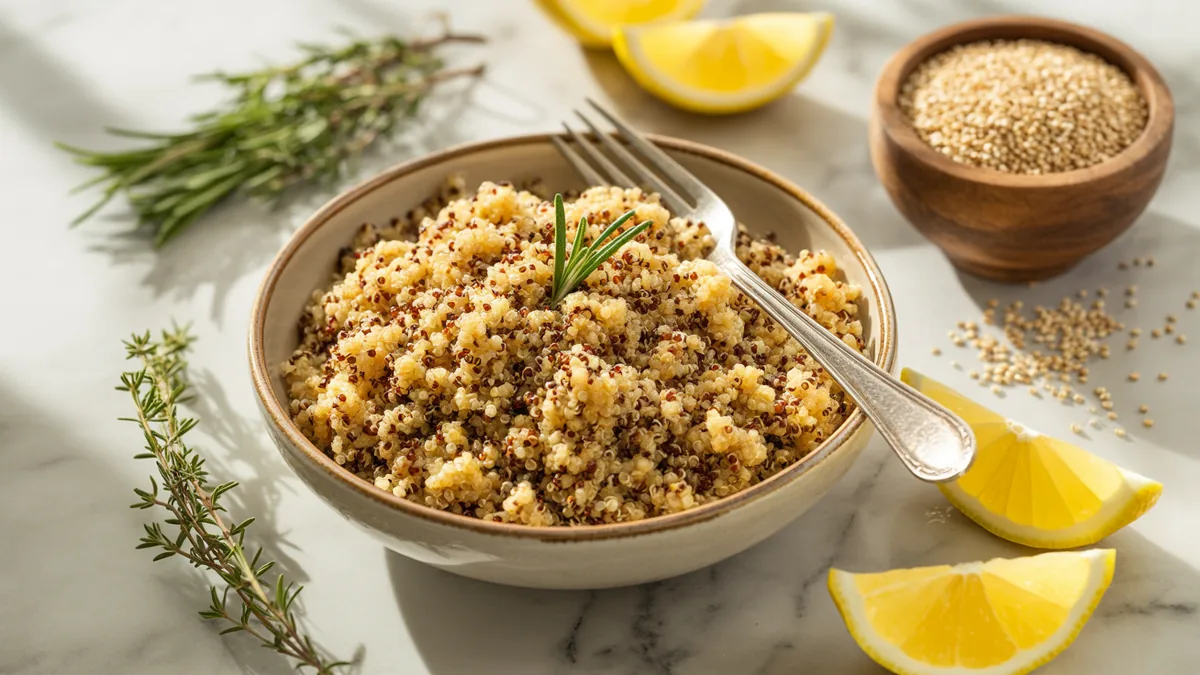
A cup of cooked quinoa carries about 8 grams of protein for roughly 220 calories. Per 100 grams cooked, that works out to around 4.4 grams. If you have seen a much larger figure floating around, somewhere near 13 or 14 grams, that one belongs to dry quinoa before it ever met water. Same food, two very different scales, and the gap between them is the single most common mix-up in almost every quinoa article I have read.
Quinoa came into my kitchen the way it came into most kitchens, sold as a superfood on a bag with too many adjectives on it. I cooked it badly for about a year, soggy and faintly bitter, and quietly decided it was overrated. What changed had less to do with the seed than with paying attention: rinsing it properly, using less water than the box suggested, and looking up what a serving genuinely gives you instead of trusting the marketing on the front.
I am not a dietitian, and where a real question comes up, iron absorption or a specific dietary need, I will send you to yours. What I can hand you is the arithmetic done carefully. Per cup, per 100 grams, dry against cooked, and where quinoa lands next to rice, couscous, farro, and oats. USDA figures are the spine of all of it so the numbers stay checkable. Then I will show you how a batch actually moves through my week.
| Nutrient | Per cup cooked (185g) | Per 100g cooked | Note |
|---|---|---|---|
| Protein | ~8g | ~4.4g | Dry quinoa reads about 13 to 14g per 100g |
| Calories | ~220 | ~120 | Dry sits near 368 per 100g before water |
| Fiber | ~5g | ~2.8g | High for a bowl base; well above white rice |
| Carbohydrate | ~39g | ~21g | Mostly starch, with the fiber included |
| Fat | ~3.5g | ~1.9g | Mostly unsaturated, from the seed itself |
| Iron | ~2.8mg | ~1.5mg | Non-heme iron; pair with vitamin C |
| Magnesium | ~118mg | ~64mg | One of quinoa's quiet strengths |
How much protein is in quinoa, per cup and per 100g
The number: One cup of cooked quinoa (about 185g) holds roughly 8g of protein and about 220 calories; per 100g cooked that is about 4.4g.
Start with the serving people actually eat. One cup of cooked quinoa weighs somewhere near 185 grams and gives you about 8 grams of protein at roughly 220 calories. Alongside that sits close to 39 grams of carbohydrate, about 5 grams of fiber, and 3.5 grams of fat, most of it unsaturated. That is the profile of a side dish or a bowl base, and it is a decent one: filling, moderately dense, with more protein than the grains it usually replaces on a plate.
Divide it down and cooked quinoa runs about 4.4 grams of protein per 100 grams, at around 120 calories. I mention the per-100-gram figure because most nutrition databases lead with it, and it is the number that makes quinoa look modest next to beans or dairy. Both readings are true. A cup is simply a good deal more than 100 grams, so the per-cup total nearly doubles. The full entries are on USDA FoodData Central if you want the whole column.
The half-cup portion is worth carrying in your head too, since that is what a restaurant bowl or a meal-prep container usually holds. Half a cup cooked is around 4 grams of protein and about 110 calories. Useful, but not the protein anchor of a meal. I say that plainly because quinoa has a reputation as a protein food, and the reputation runs a little ahead of the arithmetic. It contributes to your total. It rarely carries it.
The raw versus cooked number almost everyone gets wrong
Watch the state: Dry quinoa holds about 13 to 14g protein per 100g, but it roughly triples in weight once cooked, which drops it to about 4.4g per 100g.
This is the confusion worth clearing before anything else. Dry, uncooked quinoa runs about 13 to 14 grams of protein per 100 grams. Cooked quinoa runs about 4.4. Nothing has been lost along the way. The seed absorbs water and roughly triples in weight, so the same protein is spread across three times as much food. Every gram you measured out dry is still sitting in the pot, just diluted by everything it drank.
That is why headlines about quinoa's protein tend to sound better than dinner actually feels. A page quoting 14 grams per 100 grams is quoting the bag, not the bowl. And 100 grams of dry quinoa is a genuinely large amount, more than half a cup of dry grain, cooking up to well over two cups. Very few people eat that as a side dish on a Tuesday.
The measurement I find most useful sits in between the two. A quarter cup of dry quinoa is about 43 grams, gives roughly 6 grams of protein, and cooks up to about three quarters of a cup. That is a realistic single portion and an easy scoop to remember. When I am building a bowl I measure dry, because dry weight is stable while cooked weight depends entirely on how much water the pot held on to.
One quick check saves a lot of bad math. If you find a protein figure for quinoa above roughly 8 grams per 100 grams, it is describing dry grain. Below about 5, it is describing cooked. Anything landing in the middle is either an error or an unusual preparation. I run that test on every nutrition claim I see now, and it catches more mistakes than you would expect.
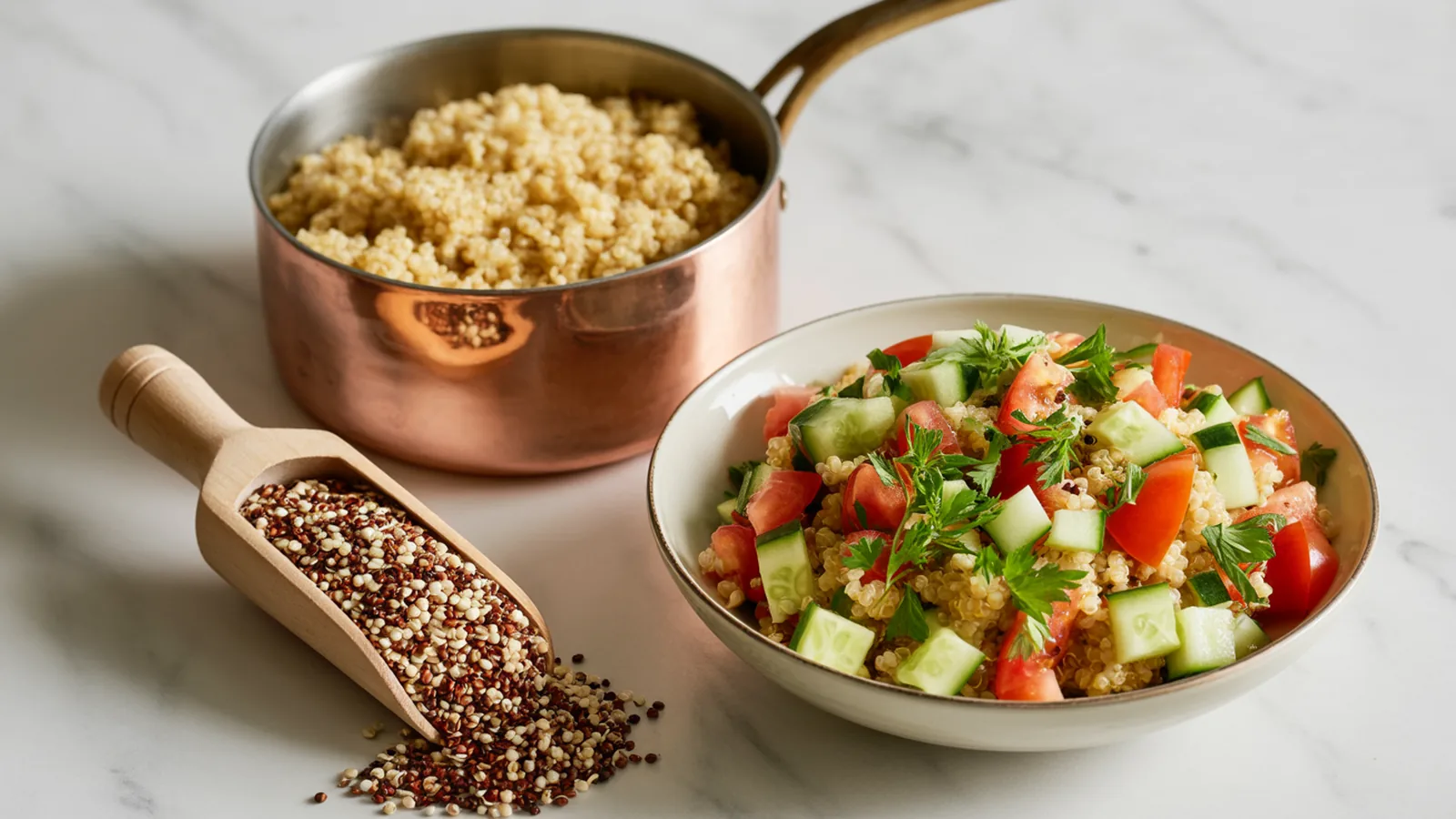
Is quinoa a complete protein? Yes, with a detail worth knowing
Complete: Quinoa supplies all nine essential amino acids in meaningful amounts, including lysine, which wheat, rice, and corn are typically low in.
Quinoa is one of the few plant foods routinely called a complete protein, and the label holds up under inspection. It supplies all nine essential amino acids, the ones your body cannot build for itself and has to take in from food, in amounts that count rather than the trace levels you would need a lab to find. For something you cook and serve like a grain, that is unusual.
The amino acid doing the heavy lifting is lysine. Cereal grains such as wheat, rice, and corn tend to run low in lysine, which is the classic reason rice-and-beans style pairings exist: legumes are rich in it and fill the gap. Quinoa, which is botanically a seed rather than a true cereal, carries a solid lysine content on its own. It also brings reasonable methionine, the amino acid many legumes are short on, which is why it plays well alongside beans.
So the claim is fair, and I have no interest in poking holes in it. Where I do get careful is what people build on top of it. Complete is not the same as plentiful. Quinoa's amino acid profile is well balanced, but the total protein in a cooked cup is still about 8 grams, roughly a third of what a cup of cottage cheese or a chicken breast delivers. Balanced and small is a different thing from balanced and large.
There is one more nuance I like. Because quinoa is a seed, its protein is distributed through the germ rather than concentrated in a starchy endosperm the way wheat's is. That is part of why the profile looks so even. It is a small botanical fact, but it explains why quinoa keeps turning up on lists where other grains do not.
Why complete protein matters less than your daily total
Perspective: The body pools amino acids across the day, so total daily protein matters far more than whether any single food is complete.
The complete-protein idea carries more weight than it deserves, and I say that as someone who found it genuinely exciting when I first learned it. The older advice held that plant proteins had to be combined at the same sitting, rice with beans, hummus with pita, or the body could not make use of them. That specific claim has been walked back by researchers for years now. Your body keeps a working pool of amino acids and draws on it across hours rather than minutes.
In practice that means you do not have to engineer a perfect amino acid profile at lunch. You need enough total protein across the day, from a reasonable spread of foods. Quinoa at dinner, eggs at breakfast, lentils somewhere in the middle, and the arithmetic sorts itself out without any planning. The Harvard Nutrition Source protein guide lays out that daily framing clearly if you want a fuller read.
So I treat quinoa's completeness as a pleasant property rather than a reason to build a meal around it. The more useful question when I look at a bowl is whether there is a real protein source in it at all. Usually that means adding something: a couple of eggs, a scoop of chickpeas, crumbled feta, leftover chicken. The shape I use most often is in my Balanced Breakfast Bowl: My Simple 4-Part Formula, and quinoa sits there as the base, not the protein.
If you eat fully plant based the practical advice barely changes, though variety matters more. Quinoa is a helpful piece of that variety precisely because of the lysine, and it pairs neatly with the grains and legumes that run lower in it. But it works as one member of a rotation. Leaning on any single plant food to cover your protein is a harder road than simply eating a few different ones across the week.
White, red, black, and tricolor: does the color change anything?
Color: White, red, and black quinoa are close on protein; the real differences are texture, cooking time, and how well each holds its shape.
White quinoa, sometimes sold as ivory or golden, is the mildest and the most widely stocked. It cooks fastest, around 15 minutes, and turns soft and slightly fluffy. This is the one I use when quinoa is a background element, folded into something else, or when I want it to sit quietly under a sauce rather than announce itself.
Red quinoa keeps a firmer bite and holds its shape better. It takes a couple of extra minutes on the stove and has a nuttier, earthier flavor. I reach for it in cold salads because it does not go mushy after two days in the fridge, which matters a great deal when you are eating out of the same container on Wednesday that you filled on Sunday. Black quinoa is firmer still, slightly sweeter, and the slowest of the three to soften.
On protein, the differences are small enough that I would not shop on them. All three sit in the same range, roughly 4 to 5 grams per 100 grams cooked, with the darker varieties carrying more of the pigment compounds that give them their color. Tricolor is simply the three mixed in one bag. It looks lovely in a bowl and cooks unevenly, since the white softens well before the black is ready. I buy it for the look and accept the slight texture mismatch.
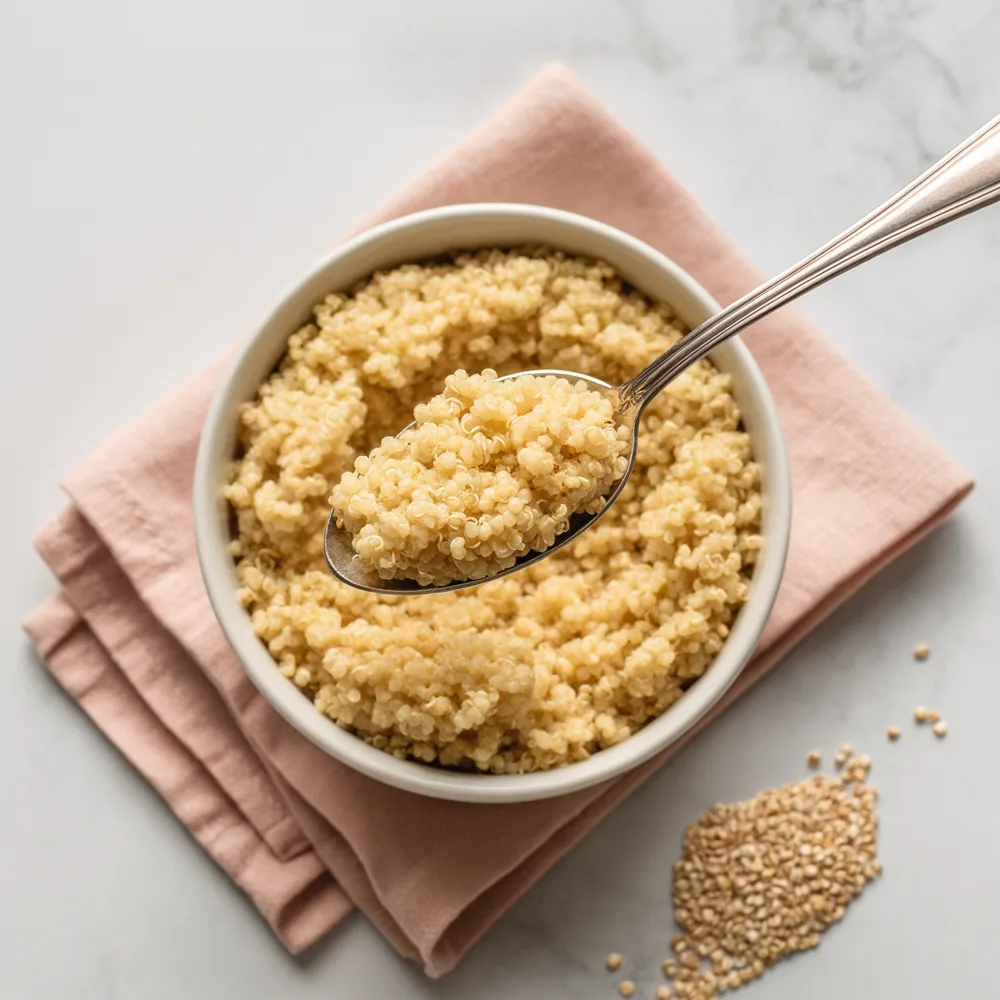
Quinoa vs rice, couscous, farro, and oats on protein
Comparison: Cooked quinoa's roughly 4.4g protein per 100g beats white rice at 2.4 to 2.7g and couscous at about 3.8g, and sits just under farro at 5 to 6g.
Quinoa's real advantage shows up in comparison rather than in isolation. Cooked white rice runs about 2.4 to 2.7 grams of protein per 100 grams, so quinoa gives you close to double for a similar volume on the plate. That swap is the one that actually moves a meal's numbers, and it is the reason quinoa kept its place in my rotation even after I stopped believing the copy on the bag.
Cooked couscous lands near 3.8 grams per 100 grams, closer to quinoa than most people guess, since couscous is made from durum wheat semolina. Farro is the one that quietly beats it, at roughly 5 to 6 grams cooked per 100 grams, with a chewier texture and plenty of gluten, which rules it out for some people. Cooked oatmeal sits low, around 2.4 grams per 100 grams, though dry oats read far higher for exactly the same water-weight reason quinoa does.
Here is the short version, all cooked and all per 100 grams:
- Quinoa: about 4.4g protein
- White rice: about 2.4 to 2.7g
- Couscous: about 3.8g
- Farro: about 5 to 6g
- Oatmeal: about 2.4g
Here is how I hold all of that. Quinoa gives the best protein per spoonful of the common gluten-free bowl bases, and it brings more fiber and magnesium along than rice does. It is still not a protein source the way meat, dairy, eggs, or beans are. Trading rice for quinoa might add 4 or 5 grams to a meal, which is real but modest. Cracking an egg on top adds another 6 for far less trouble.
The fiber, iron, and magnesium riding along
Beyond protein: A cup of cooked quinoa carries about 5g fiber, roughly 2.8mg iron, and around 118mg magnesium.
Protein is the question people search, but it is not the strongest thing quinoa does. A cooked cup brings about 5 grams of fiber. Set against a daily fiber goal somewhere in the mid twenties for most adult women, that is a meaningful slice from one side dish, and considerably more than the same volume of white rice offers. If I had to defend quinoa on one nutrient alone, I would probably pick the fiber rather than the protein.
Magnesium is where it quietly shines: around 118 milligrams per cooked cup, against a daily target near 310 to 320 milligrams for adult women. Magnesium is one of those minerals plenty of people run a little short on, and taking a chunk of it from a dinner side rather than a capsule feels like a fair trade to me. Manganese, folate, and phosphorus come along in the same spoonful.
Iron is about 2.8 milligrams per cooked cup, which reads well on paper but comes with a caveat attached. Plant iron, the non-heme form, is absorbed less readily than the iron in meat, and compounds naturally present in whole grains and seeds reduce that further. Squeezing lemon over a quinoa salad or folding in peppers and tomatoes helps, since vitamin C improves non-heme absorption. The NIH fact sheet on iron covers the mechanics well.
I do not eat quinoa for any single nutrient, and I would not want this read as a health claim of any kind. It is a whole food with a good spread across the label, and that spread is a better argument for it than the protein headline ever was. If you like eating from that end of the store, quinoa keeps easy company with the things on my Anti-Inflammatory Foods List: What I Actually Buy.
Rinsing, saponins, and why your first batch tasted bitter
Rinse it: Quinoa's natural coating contains bitter saponins; a thirty-second rinse in a fine mesh sieve removes the soapy taste that ruins a first batch.
If quinoa has ever tasted soapy or faintly bitter to you, the seed was not the problem. Quinoa grows with a natural coating of saponins, bitter compounds that discourage birds and insects from eating the crop in the field. They are harmless in the amounts involved but they taste genuinely unpleasant, and one unrinsed batch is enough to put a person off the food for years. That was my year, and I blamed the quinoa the whole time.
The fix takes about thirty seconds. Tip the dry quinoa into a fine mesh sieve, run cold water through it, and rub the seeds between your fingers until the water stops running cloudy or foamy. Drain it well so the pot is not carrying extra liquid. Most quinoa sold in the US is labeled pre-rinsed, which usually means it has been processed enough that you could skip this. I rinse anyway. It costs nothing and I have been burned.
The other half of the bitterness problem is water, not saponins. Quinoa is often cooked like pasta, drowned in a big pot of liquid, and it comes out waterlogged and bland. My ratio is roughly 1 part quinoa to 1.75 parts water, brought up to a boil, then covered and simmered low for around 15 minutes until the liquid is gone. Off the heat, lid on, five minutes to steam, then fluff with a fork. The little white spirals should be curling free of the seeds.
How I cook a batch and use it through the week
Batch method: One cup of dry quinoa makes about three cups cooked, keeps four to five days refrigerated, and works cold as easily as warm.
I cook quinoa on Sunday, usually one cup dry, which yields about three cups cooked and roughly 24 grams of protein spread across the whole batch. It goes into a glass container, left uncovered until it stops steaming so it does not turn slimy, then lidded and into the fridge. It keeps four to five days and it is one of the very few cooked grains I actually enjoy cold, straight out of the container.
Monday it usually becomes a lunch bowl: a scoop of quinoa, whatever roasted vegetables are left over, a spoonful of chickpeas or a soft-boiled egg, olive oil, lemon, salt. That last part matters more than it sounds. Quinoa without acid and salt is dull, and most of the complaints I hear about it trace back to underseasoning rather than to anything about the grain itself.
Midweek it goes savory or sweet depending on the morning. Warmed with milk, cinnamon, and berries it makes a breakfast porridge that holds me longer than oats do, which is the closest quinoa comes to being a genuine protein play at breakfast. Other mornings it gets stirred through scrambled eggs or tucked under a piece of fish. If you want more options in that range, I keep a running list in High-Protein Breakfast Ideas: My Real Morning List.
By Thursday whatever remains gets pressed into patties with an egg and grated cheese and pan-fried, or thrown into a soup for body. I have never once managed to make a batch last past Friday, and I stopped trying to. Cooking a modest amount you will finish beats cooking a heroic pot you resent by day six, which is a lesson quinoa taught me before any other food did.
How to make a quinoa bowl genuinely high in protein
Build up: Quinoa's 8g per cooked cup becomes a real protein meal once you add eggs, beans, dairy, or fish, typically doubling or tripling the total.
Since a cooked cup gives about 8 grams, a bowl built on quinoa alone lands somewhere near snack territory in protein terms, however virtuous it looks photographed. The fix is not more quinoa. Doubling the base adds 8 grams and another 220 calories, which is an inefficient way to buy protein and a heavy lunch besides.
The efficient additions are the obvious ones. Two eggs bring roughly 12 grams. A cup of canned chickpeas or black beans adds around 13 to 15. A half cup of cottage cheese or Greek yogurt on the sweet version adds 12 to 14. A can of tuna or a small fillet of salmon takes you past 20 on its own. Any one of these turns an 8-gram bowl into a 20-gram meal without changing what the meal fundamentally is.
Nuts and seeds are the smaller lever, worth knowing about but not worth overselling. Two tablespoons of pumpkin seeds add about 5 grams, hemp hearts closer to 6, and both bring the crunch that quinoa genuinely needs. I scatter them over almost everything. If you want the ones I keep stocked for exactly this kind of stacking, they are in High Protein Snack Ideas: 15 I Keep in My Kitchen.
The habit that helped me most was deciding the protein first and the base second. Once the eggs or the beans or the fish are settled, quinoa becomes what it is good at being, a base with better numbers than rice. Building the other way round, starting with a pretty grain and hoping the protein appears, is how you end up with a beautiful bowl that leaves you hungry by three.
When quinoa won't fit your life
Honest fit: Cost, digestive sensitivity, and simple dislike of the texture are all fair reasons to choose another base entirely.
Quinoa is not the right answer for everyone and it is not the right answer every night. It costs more than rice, often two or three times as much per pound, and if the grocery bill is the pressure in your week, that gap is a completely legitimate reason to stay with rice or barley and find your protein somewhere cheaper. Dried lentils cost less than either and carry more than double quinoa's protein for the same cooked volume.
Some people find quinoa hard on their stomach, and there are a few plausible reasons: the fiber load if your usual diet is low in it, leftover saponins if it was not rinsed, or a general sensitivity to seeds. If you have a diagnosed digestive condition, or you are managing iron or kidney concerns where mineral intake matters, that is a conversation for your doctor rather than for an article. I write about food and how it tastes, and I am not treating anything here.
And some people simply do not like the texture. The tiny popping seeds and the faint grassiness are not universally loved, and no amount of lemon or salt fixes a mouthfeel you dislike. That is reason enough to skip it without guilt. What I would keep is the underlying move, which is choosing a base with more protein and fiber in it than plain white rice. Farro, barley, lentils, or a mix of beans and greens all do that job well. The bowl matters far more than the particular seed sitting in it.
Helpful sources and next reads
Reliable external sources
More from Sabrina Saturno
You may also love
FAQ
How much protein is in a cup of cooked quinoa?
About 8 grams for a standard cup, which weighs roughly 185 grams, at around 220 calories. That same cup carries close to 5 grams of fiber and 39 grams of carbohydrate.
How much protein is in 100g of quinoa?
It depends on whether you mean cooked or dry. Cooked quinoa runs about 4.4 grams of protein per 100 grams. Dry, uncooked quinoa runs about 13 to 14 grams per 100 grams.
Why do some sites say quinoa has 14g of protein?
Because they are quoting dry weight. Quinoa roughly triples in weight as it absorbs water, so the same protein spreads across three times as much food. A cooked cup lands near 8 grams, not 14.
Is quinoa a complete protein?
Yes. It supplies all nine essential amino acids in meaningful amounts, including lysine, which wheat, rice, and corn tend to be low in. It also carries reasonable methionine, which many legumes lack.
Does quinoa have more protein than rice?
Roughly double. Cooked quinoa is about 4.4 grams per 100 grams, while cooked white rice sits near 2.4 to 2.7 grams. Quinoa also brings more fiber and magnesium to the same plate.
How much dry quinoa is one serving?
A quarter cup dry, about 43 grams, is a realistic single portion. It gives roughly 6 grams of protein and cooks up to about three quarters of a cup once the water is absorbed.
Is quinoa or farro higher in protein?
Farro edges it out, at roughly 5 to 6 grams per 100 grams cooked against quinoa's 4.4. Farro contains gluten though, so quinoa remains the stronger pick for anyone avoiding it.
Does red quinoa have more protein than white?
Not meaningfully. White, red, and black quinoa all sit in the same range of roughly 4 to 5 grams per 100 grams cooked. The real differences are texture, cooking time, and flavor.
Do I have to rinse quinoa?
It is worth doing. The natural saponin coating tastes bitter and soapy, and thirty seconds in a fine mesh sieve removes it. Most US quinoa is sold pre-rinsed, but rinsing again costs nothing.
How much fiber is in quinoa?
About 5 grams per cooked cup, or roughly 2.8 grams per 100 grams cooked. Against a mid-twenties daily fiber goal, that is a real contribution from a side dish, and it is roughly five times what the same volume of white rice gives you.
Is quinoa gluten free?
Yes, quinoa is naturally gluten free, since it is a seed rather than a cereal grain. If you are highly sensitive, check the packaging for cross-contamination warnings from shared processing facilities.
Can quinoa be my main protein source?
It is a stretch. At about 8 grams per cooked cup you would need a great deal of it to hit a normal daily target. Treat it as a base and put eggs, beans, dairy, or fish on top.
How long does cooked quinoa keep in the fridge?
Four to five days in a sealed container. Let it cool uncovered first so trapped steam does not make it slimy. It reheats well and it is genuinely pleasant eaten cold in a salad.
The version that lasts
What has actually stuck in my kitchen is small and unglamorous. One cup of dry quinoa on a Sunday, rinsed properly, cooked at roughly one to one and three quarters, cooled uncovered before it goes into the fridge. Then five days of scooping it into whatever is already happening. I barely think about it anymore, which is usually the sign that something has settled into a habit rather than a project I am still maintaining.
Knowing the real arithmetic is what let me relax about it. About 8 grams of protein in a cooked cup, about 4.4 per 100 grams cooked, about 13 to 14 per 100 grams dry, and a complete amino acid profile that is genuinely nice without being a reason to skip the egg on top. I stopped expecting quinoa to be a protein source and started using it as a better base than rice, which is exactly what it is.
If you carry one thing out of all this, make it the raw versus cooked check. It is the difference between planning a meal around 14 grams of protein and sitting down to 8, and that gap is where most of the disappointment with quinoa comes from. Rinse a batch, season it properly, put something with real protein on top, and it becomes a quietly useful thing to have waiting in the fridge. Not a superfood. Just a good base that earns its shelf space.