
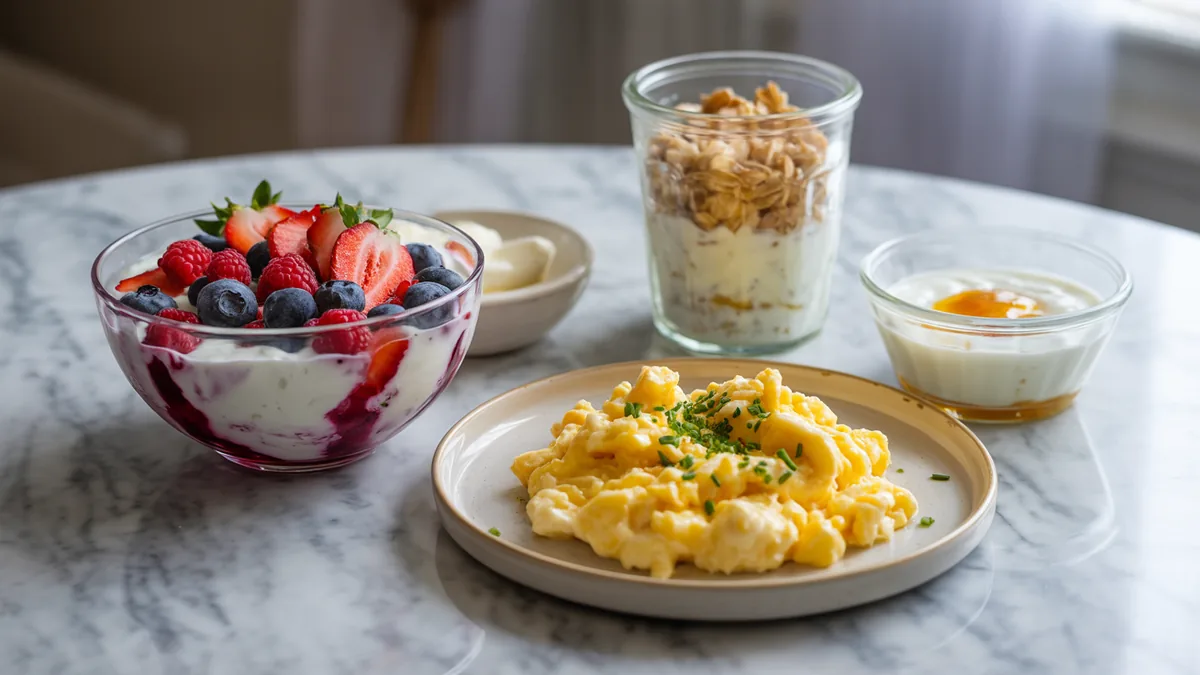
A high-protein breakfast, the kind that actually changes how your morning feels, means aiming for roughly 20 to 30 grams of protein on the plate. That is the number I keep coming back to, and it is the single most useful thing I can hand you before any recipe. Below that range, the meal tends to fade by mid-morning. Inside it, most of the usual breakfast problems, the crash, the snacky restlessness, the reaching for a second coffee, quietly settle down. Everything else in this guide is just different ways to reach that same target.
I did not always eat this way. For years my mornings were a slice of toast, a banana, maybe a bowl of cereal that felt healthy because the box said so. I was starving by ten and blamed my willpower for it. The day I started actually counting the protein in my breakfast, not the calories, the whole picture shifted. It was almost embarrassing how simple the fix turned out to be. So I built myself a real list of breakfasts that reliably clear 20 grams, and this is that list, with honest numbers next to every idea.
I am not a dietitian, and I will flag the places where your own body or your doctor should have the final word. What I can give you is a specific, practical set of ideas, each with a realistic protein figure I have cross-checked against USDA-style values so you are not taking my word alone. Some take five minutes, some take fifteen, and a few you make the night before while barely thinking. Pick the two or three that fit your real life and you will rarely need the rest. Let me walk you through the whole list.
| Breakfast idea | Protein | Calories (approx) | Why it works |
|---|---|---|---|
| Greek yogurt bowl with berries and nuts | About 20g | 300 to 350 | High protein per calorie, zero cooking, easy to repeat |
| Two to three scrambled eggs with toast | 18 to 21g | 300 to 340 | Complete protein plus fiber from whole-grain toast |
| Cottage cheese bowl, sweet or savory | About 24g | 220 to 280 | One of the cheapest complete proteins, no prep |
| High-protein overnight oats | 25 to 30g | 350 to 420 | Made ahead, blends fast carbs with a real protein dose |
| Protein smoothie with powder | 30g and up | 300 to 380 | Fully adjustable, easy to sip on a rushed morning |
| Smoked salmon with scrambled eggs | About 25g | 300 to 360 | Two complete proteins that keep you full for hours |
| Egg and black bean breakfast burrito | About 22g | 380 to 450 | Protein plus fiber that travels and reheats well |
| Protein pancakes | About 25g | 350 to 420 | A comfort breakfast that carries a genuine protein load |
Why 20 to 30g at breakfast matters
The why: A 20 to 30g protein breakfast steadies blood sugar, blunts mid-morning hunger, and supports the muscle you already carry.
The first reason is satiety, plain and simple. Protein is the the most satiating of the three macronutrients ounce for ounce, so a breakfast built around it holds you longer than the same calories in toast or fruit alone. When I hit that 20 to 30 gram range, the mid-morning hunger that used to send me to the vending machine mostly disappears. I am not white-knuckling my way to lunch anymore, I am just genuinely not that hungry, which is a much easier way to eat well.
The second reason is steadier energy. A breakfast that is mostly fast carbohydrate spikes your blood sugar and then drops it, and that drop is the shaky, foggy feeling a lot of us call a mid-morning slump. Pairing or leading with protein slows that whole curve down. My afternoons changed once my mornings did, which surprised me, because I had always treated the slump as just part of being a busy person rather than something my breakfast was quietly causing.
The third reason is the quiet one people skip: protein helps you hold on to the muscle you already have, especially as the years add up. You do not need to lift weights or chase any fitness goal for this to matter. Spreading protein across the day, starting with breakfast, gives your body a steadier supply to work with. The Harvard Nutrition Source has a grounded overview of why protein quality and timing both count, if you want the fuller picture behind the habit.
How much protein you actually need in the morning
The target: Aim for 20 to 30g at breakfast, roughly a quarter to a third of a typical daily protein goal.
Here is the honest range. Most guidance lands somewhere around 0.8 to 1 gram of protein per kilogram of body weight per day for general health, and many people who are active or older aim a bit higher. Whatever your daily number, spreading it across meals works better than backloading it all at dinner, and that makes breakfast a real opportunity. Twenty to thirty grams in the morning is a sensible slice of most people's day, which is exactly why I use it as the target.
You do not need to weigh anything or track macros to make this work. The 20 to 30 gram range is forgiving on purpose. If one morning you land at 18 and another at 32, you are still in a completely reasonable place. I stopped chasing precision the moment I realized the difference between a bad breakfast and a good one was not two grams, it was twenty. Getting from near-zero protein to a real dose is the whole game.
One helpful anchor: think in terms of the shape of the plate, not just a single hero food. A protein source, a bit of fiber, some color, and a little fat make a breakfast that holds together and tastes like a meal instead of a supplement. I laid out that structure in my balanced breakfast bowl formula, and almost every idea below is really just that shape wearing a different outfit. If the numbers ever feel abstract, you can check any single food yourself at USDA FoodData Central.
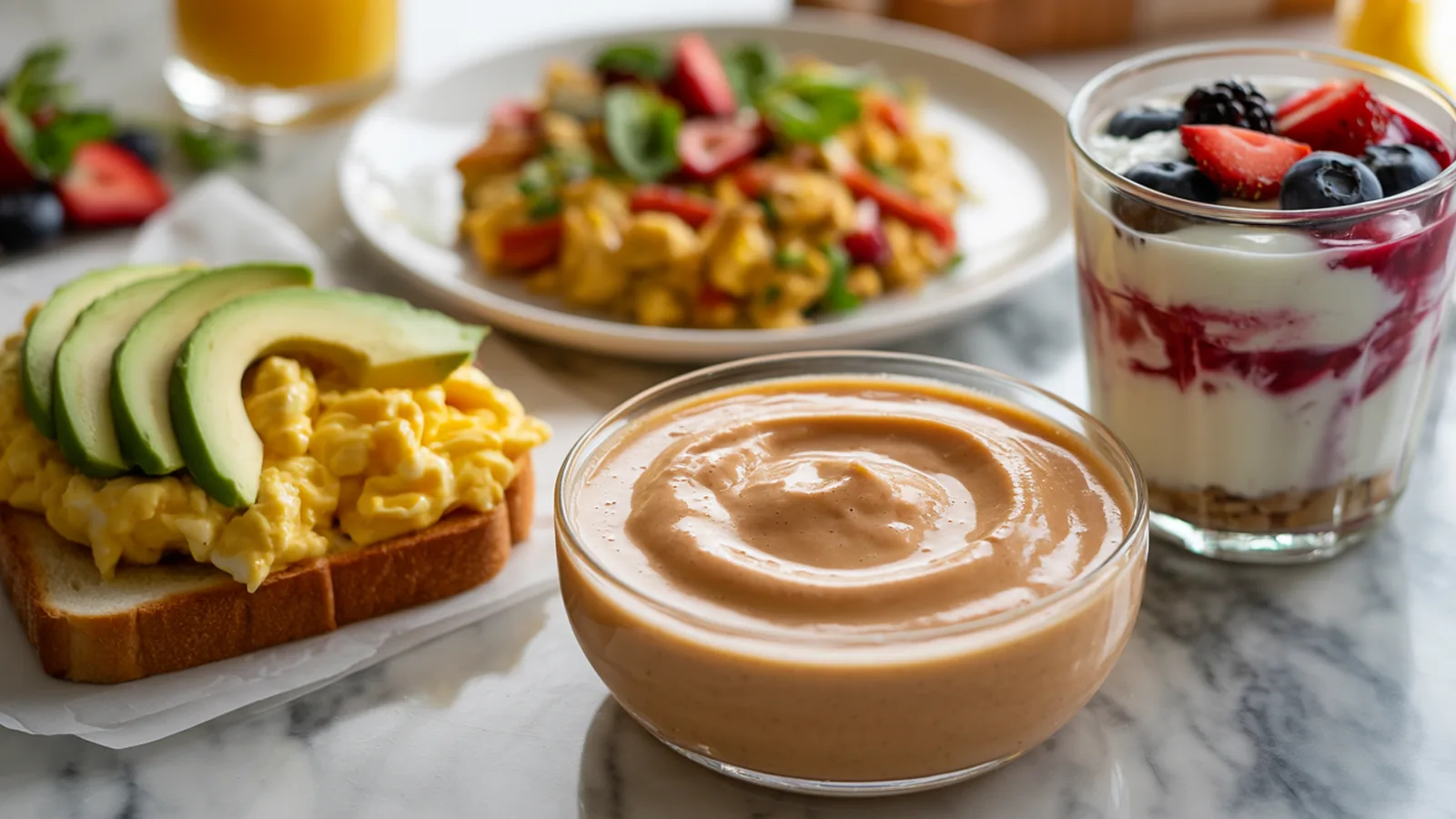
The egg-based ideas
Eggs: Two to three scrambled eggs give 12 to 18g; add smoked salmon and you reach about 25g.
Eggs are my default because they are complete protein, cheap, and endlessly flexible. One large egg carries about 6 grams of protein, so two eggs land near 12 and three near 18. My most common weekday breakfast is two to three scrambled eggs with a slice of whole-grain toast, which comes to roughly 18 to 21 grams once the toast adds its couple of grams. It takes about six minutes, it never gets old, and it clears the target without any special ingredients. If you want the full breakdown, I wrote it up in 2 eggs scrambled nutrition.
When I want to push the number up and make it feel a little special, I fold smoked salmon into scrambled eggs. Two eggs plus about two ounces of smoked salmon lands near 25 grams of protein, two complete sources stacked together, and it keeps me full well past noon. A squeeze of lemon, some dill or chives, cracked pepper, and it feels like a small treat rather than a health chore. This is my slow-Sunday version, but it comes together in under ten minutes on a regular day too.
A few honest notes on eggs. If you have been told to watch dietary cholesterol, this is a conversation for you and your doctor, not something to settle from a blog. For most healthy people, eggs are one of the simplest routes to a strong breakfast. And if plain scrambled feels boring, stir in a spoonful of cottage cheese for creaminess and a few extra grams, or pile in spinach and tomato so the plate has color and fiber alongside all that protein.
The dairy ideas: Greek yogurt and cottage cheese
Dairy: A Greek yogurt bowl lands near 20g and a cottage cheese bowl near 24g, both with zero cooking.
If I have no time and no patience, dairy is where I go, because the protein is already high and there is nothing to cook. A bowl of plain Greek yogurt, roughly a cup, carries about 18 to 22 grams of protein on its own. I top it with berries, a spoonful of nuts or seeds, and a light drizzle of honey, which turns it into something that tastes like dessert but lands right at 20 grams for the meal. Plain, not the pre-sweetened cups, is the move here, because the flavored versions trade a lot of that protein value for sugar.
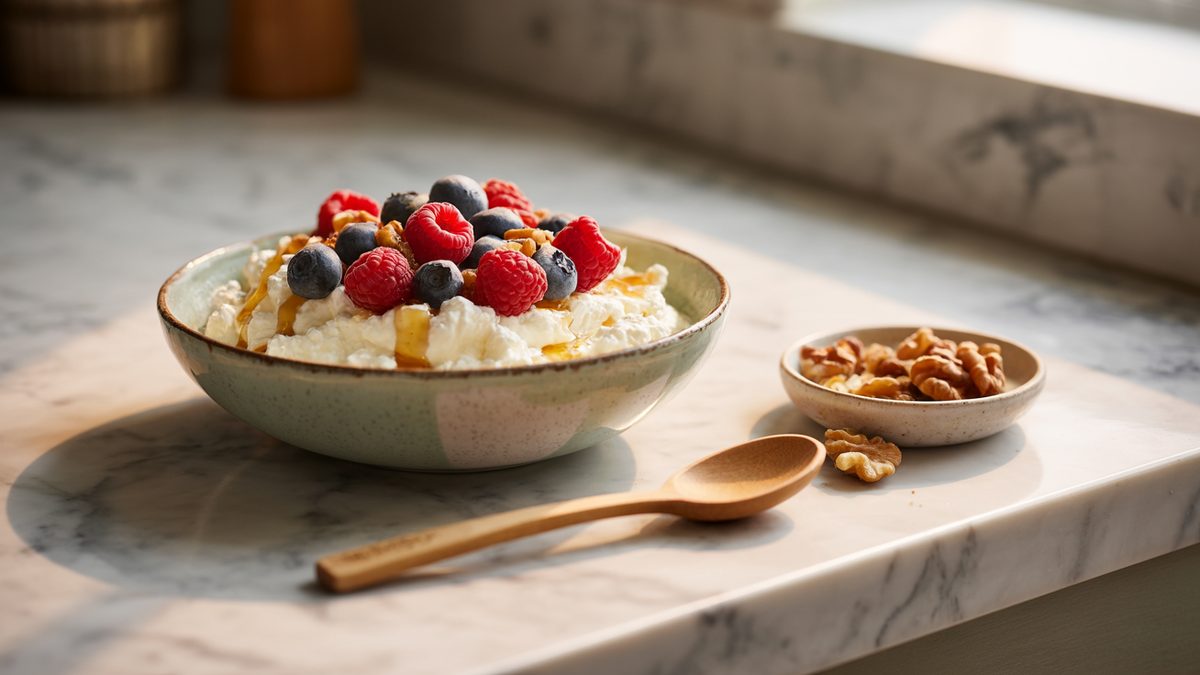
Cottage cheese is my other no-cook anchor, and it is quietly one of the cheapest complete proteins in the store. A cup runs about 24 grams of protein, and I build it sweet with fruit and walnuts or savory with tomato, pepper, and a little olive oil on toast. I go deeper on the exact figures, including how the fat percentage and brand shift things, in cottage cheese protein. Between yogurt and cottage cheese, I almost always have a 20-plus gram breakfast sitting in the fridge with no effort required.
The reason these two carry so much of my week is repeatability. A breakfast you enjoy and can assemble in ninety seconds is a breakfast you will actually eat on the chaotic mornings, and those are the mornings that decide whether a habit sticks. I keep both in rotation and swap the toppings so I do not get bored. Variety in the extras, not effort in the base, is what has kept dairy breakfasts in my life for years now.
The yogurt numbers move more by brand than most people expect, so I gave them their own piece in Greek Yogurt Protein: How Much Per Cup.
The make-ahead ideas: overnight oats and chia parfaits
Make ahead: High-protein overnight oats can reach 25 to 30g, and a chia and yogurt parfait lands near 20g.
The make-ahead camp exists for people whose mornings have no spare minutes, and I count myself among them often. High-protein overnight oats are the star here. Take rolled oats, milk or a milk alternative, a scoop of protein powder, and a spoonful of Greek yogurt, stir it in a jar the night before, and by morning it has thickened into something spoonable. Depending on your powder and yogurt, that jar can carry 25 to 30 grams of protein. Plain oats alone would land closer to 5, so the additions are doing the real work. I break down the exact boosters in overnight oats protein.
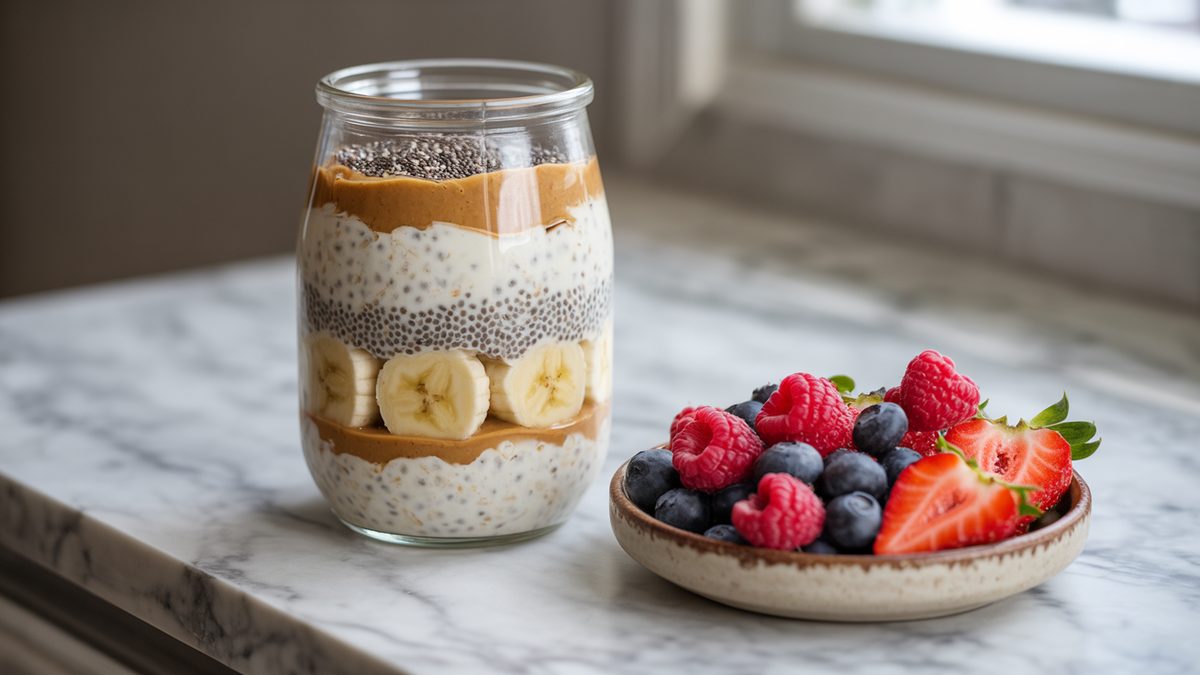
The chia parfait is my lighter make-ahead. I stir chia seeds into milk, let them swell overnight into a soft pudding, then layer that with Greek yogurt and berries in a jar. The yogurt provides most of the protein, landing the whole thing around 20 grams, while the chia adds fiber, a little plant protein, and a texture I genuinely love. Chia is a small ingredient doing quiet work, and I mapped out its full profile in chia seeds nutrition if you want to see what it actually brings.
What I love about this camp is that the effort happens when you have energy, the night before, and the payoff arrives when you have none. I make two or three a batch of jars on a Sunday evening, and they keep in the fridge for a few days. Future-me, half asleep and running late, just opens the fridge and eats a 20-plus gram breakfast without a single decision. That trade, effort tonight for ease all week, is one of the best deals in a busy morning.
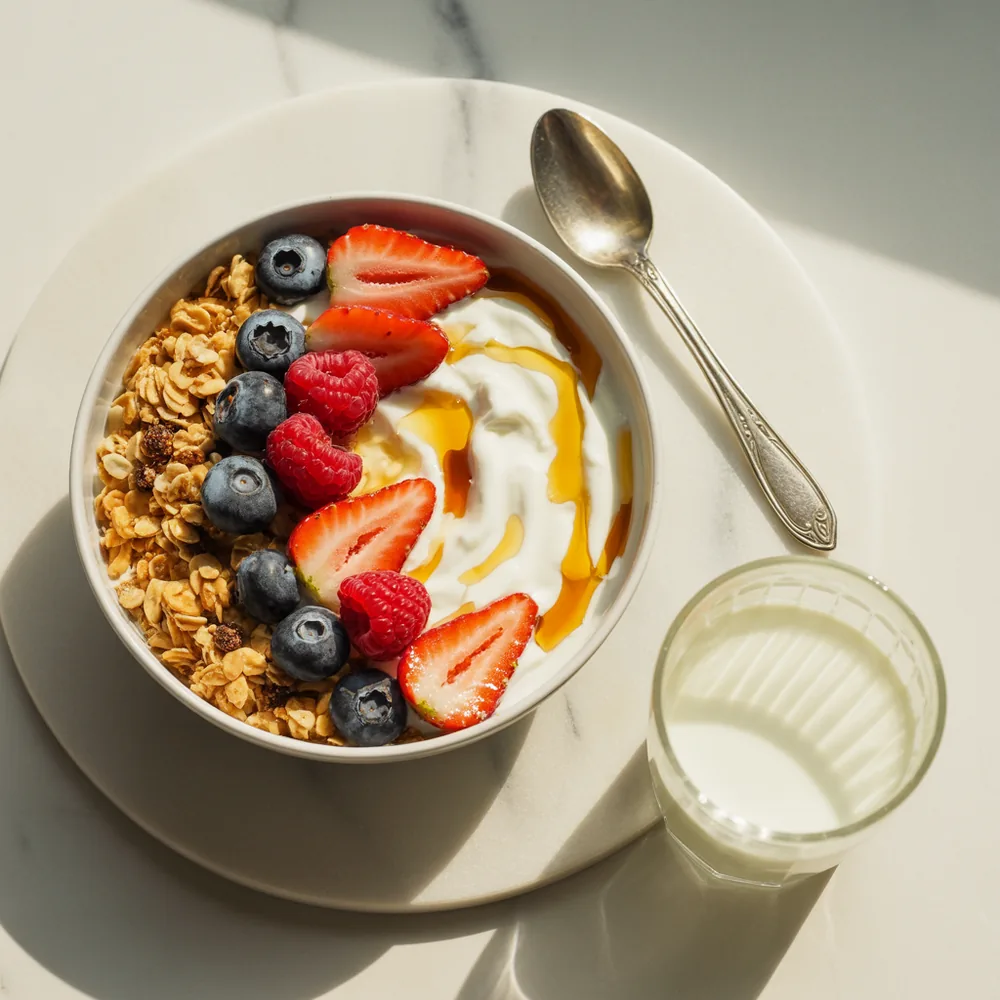
The blended ideas: smoothies and protein pancakes
Blended: A smoothie with protein powder clears 30g easily, and protein pancakes land near 25g per stack.
Some mornings I do not want to chew, I want to sip and go, and that is what the blender is for. My standard smoothie is a scoop of protein powder, a cup of milk or a milk alternative, a frozen banana, a spoonful of nut butter, and a handful of frozen berries or spinach. With most powders adding 20 to 25 grams and the milk another 8 or so, this clears 30 grams without trying. It is the easiest idea on this whole list to adjust up or down, since you simply add or hold back the powder.
Protein pancakes are the comfort end of blended. I blend eggs, oats, a scoop of protein powder, and a little banana or cottage cheese into a batter, then cook it like normal pancakes. A stack comes out near 25 grams of protein, which is a genuinely surprising number for something that feels like a weekend indulgence. They freeze well too, so I batch a stack and reheat two on a weekday when I want breakfast to feel like a small celebration rather than fuel.
One caution on smoothies specifically: it is easy to build a drink that is technically high in protein but also very high in sugar if you pile in juice, sweetened yogurt, and three fruits. Keep one to one and a half servings of fruit, lean on the powder and milk for the protein, and add spinach or seeds for substance. A blended breakfast should hold you like a meal, and it will, as long as it is not really a milkshake wearing a health label.
The savory and plant ideas: tofu, beans, salmon
Savory and plant: A tofu scramble gives about 18g, an egg and bean burrito about 22g, and leftovers vary but often win.
Not everyone wants a sweet or dairy breakfast, and honestly some mornings I want something that tastes like dinner. A tofu scramble is my go-to plant-based option. Half a block of firm tofu, crumbled and cooked with turmeric, a little nutritional yeast, and whatever vegetables I have, lands around 18 grams of protein and works beautifully for anyone skipping eggs or dairy. It scratches the savory itch, it takes about ten minutes, and it reheats fine if you make extra.
The egg and black bean breakfast burrito is my portable favorite. Scramble an egg or two, add warmed black beans, a little cheese, and salsa, then wrap it in a tortilla. Between the eggs and the beans you land near 22 grams of protein, plus real fiber from the beans, and the whole thing travels and reheats well. I wrap a few in foil and keep them in the freezer for mornings when I am eating in the car, which is more often than I would like to admit.
And then there is the idea people forget entirely: last night's dinner. A savory dinner leftover, a piece of salmon, some roast chicken, a scoop of lentil stew, is often the highest-protein breakfast in the house and needs nothing but reheating. The protein varies with the dish, but it is frequently well past 20 grams. I stopped believing breakfast had to look like breakfast, and my mornings got both easier and more filling for it. Cold leftover salmon over greens is a genuinely great start to a day.
Quinoa turns up in a lot of these savory bowls, and its protein count is smaller than its reputation suggests, which I get into in Quinoa Protein: How Much Per Cup Cooked.
How to add protein to a low-protein breakfast
Boosters: A scoop of powder, a spoon of Greek yogurt or cottage cheese, or a handful of nuts each add 5 to 25g fast.
You do not have to abandon the breakfast you already love, you often just have to reinforce it. If you are a toast-and-fruit person, you are probably sitting near 5 grams of protein, and a few small additions can push that into range. Spread nut butter on the toast for a few grams, add a side of Greek yogurt for fifteen more, or top the whole thing with a soft-boiled egg. None of this asks you to give up the meal you like, it just asks the meal to carry a little more weight.
My favorite boosters are the ones that disappear into what you already make. A scoop of protein powder stirred into oatmeal or a smoothie adds 20 to 25 grams almost invisibly. A spoonful of cottage cheese blended into scrambled eggs or pancake batter adds a few grams and some creaminess. A handful of nuts or seeds on yogurt or cereal adds protein plus fiber and crunch. These are small moves, but stacked onto a low-protein base they are often the difference between a breakfast that fades and one that holds.
The same logic works for snacks, which is where a lot of us actually feel the gap. If your breakfast runs a little light, a protein-forward mid-morning bite covers the difference without much thought. I keep a running list of options in my high protein snack ideas, and several of them double as breakfast add-ons. The point is that reaching 20 to 30 grams is rarely about a total overhaul. It is usually one or two deliberate additions to something you were going to eat anyway.
The 5-minute versus 15-minute breakdown
By time: Five-minute breakfasts skip the stove; fifteen-minute ones cook, but both can clear 20g easily.
Time is usually the real constraint, not desire, so I sort my ideas by how many minutes they cost. The five-minute camp is anything with no stove. A Greek yogurt bowl, a cottage cheese bowl, a jar of overnight oats you made last night, or a smoothie all land here. These are the breakfasts I lean on when the morning is already a scramble, because assembling is not the same as cooking, and all of them still clear 20 grams of protein without a pan in sight.
The fifteen-minute camp is where a little heat comes in. Scrambled eggs with toast, a tofu scramble, protein pancakes, or a breakfast burrito all sit here. They ask for a stove and a few more minutes, but they also feel more like a proper meal, which matters on slower mornings and weekends. I think of these as my weekend defaults and the five-minute options as my weekday defaults, and having both means a rushed day never becomes an excuse to skip protein entirely.
The practical trick is to have at least one option locked in from each camp so you are never stuck. On a wild Tuesday, the five-minute yogurt bowl saves you. On a calm Saturday, the fifteen-minute salmon and eggs feel like a small gift to yourself. You do not need all eleven ideas in this guide. You need two you can do half asleep and one you actually look forward to, and the rest are there for when you want a change.
Common high-protein breakfast mistakes
Pitfalls: Aiming too low, going all-carb, and trusting cereal boxes are the three that quietly sink most mornings.
The most common mistake is simply aiming too low. A lot of breakfasts people think of as healthy, oatmeal made with water, fruit and toast, a plain bagel, land closer to 5 or 8 grams of protein than 20. There is nothing wrong with those foods, but on their own they are not going to carry your morning. The fix is not to cut them, it is to add a real protein source alongside them so the meal reaches the range that actually keeps you full.
The second mistake is going all carbohydrate. A breakfast that is only fast carbs, juice, a sweet pastry, sugary cereal, spikes and drops your blood sugar and leaves you hungry and foggy an hour later. This is the classic mid-morning crash, and it is almost always a protein problem in disguise. You do not have to fear carbs at all, you just want to anchor them to protein and a little fat so the whole meal releases more slowly and holds you steady.
The third mistake is trusting the front of the cereal box. Plenty of cereals advertise protein in big letters, but a real bowl often delivers only a handful of grams once you check the actual serving on the back. The label math rarely matches the marketing. Flip the box over, look at the protein per serving against the amount you truly pour, and add milk or yogurt to close the gap. A quick look at the real number beats trusting the claim on the front every time.
When a high-protein breakfast won't fit your life
Honest fit: Early-morning appetite, fasting, tight budgets, and sensitive stomachs all make the principle matter more than any single recipe.
I would rather be honest than pretend a protein breakfast fits every life, because it does not. Some people genuinely cannot stomach food early in the morning, and forcing eggs down at 6am helps no one. If that is you, the target does not vanish, it just moves. Have a protein-forward first meal whenever your appetite actually shows up, even if that is ten or eleven o'clock. The point was never the clock on the wall, it was getting a real protein dose into your first meal of the day.
The same flexibility covers a few other real situations. If you practice intermittent fasting, your first meal simply lands later, and everything in this guide still applies to it. If your budget is tight, lean on the cheapest complete proteins, eggs, cottage cheese, and canned or dried beans, which stretch a long way and keep the cost per gram low. And if you have a sensitive stomach or a specific GI condition, some of these foods, dairy or beans especially, may not sit well, and that is worth working out with your own body or your doctor rather than pushing through.
Hold the principle more tightly than any single recipe on this page. The idea is a meaningful dose of protein, roughly 20 to 30 grams, in your first real meal of the day, arranged in whatever way you will actually repeat. For one person that is scrambled eggs at dawn, for another it is a smoothie at eleven, for another it is leftover lentils whenever hunger arrives. The number is the anchor. The form is yours to choose, and the best version is always the one that fits the life you are actually living.
Helpful sources and next reads
Reliable external sources
More from Sabrina Saturno
- Cottage Cheese Protein: How Much Is Really in It
- Overnight Oats Protein: How Much and How to Boost It
- Chia Seeds Nutrition: The Full Profile and Facts
- 2 Eggs Scrambled Nutrition: My Honest Breakfast Facts
- High Protein Snack Ideas: 15 I Keep in My Kitchen
- Balanced Breakfast Bowl: My Simple 4-Part Formula
- Greek Yogurt Protein: How Much Per Cup
- Quinoa Protein: How Much Per Cup Cooked
- Weekly Meal Prep Schedule: 7 Days
You may also love

FAQ
How much protein should a breakfast have?
Aim for roughly 20 to 30 grams. That range is enough to steady your blood sugar and hold off mid-morning hunger for most people, without needing to track anything precisely.
What is the highest-protein breakfast that is still easy?
A smoothie with a scoop of protein powder is the easiest way to clear 30 grams. For no-cook options, a Greek yogurt bowl or cottage cheese bowl both land around 20 to 24 grams with zero effort.
How much protein is in two or three scrambled eggs?
One large egg has about 6 grams, so two eggs give around 12 and three give around 18. Add a slice of whole-grain toast and you land near 18 to 21 grams for the meal.
Can I get enough protein at breakfast without eggs?
Yes. Greek yogurt, cottage cheese, a tofu scramble, a protein smoothie, or a bean burrito all reach the range without a single egg. Dairy and soy are especially efficient here.
Are overnight oats high in protein?
Plain oats are not, at around 5 grams, but a scoop of protein powder and a spoonful of Greek yogurt can push a jar to 25 to 30 grams. The boosters do most of the work.
Is Greek yogurt or cottage cheese higher in protein?
They are close. A cup of Greek yogurt runs about 18 to 22 grams and a cup of cottage cheese about 24. Both are strong, cheap, no-cook choices for breakfast.
What is a good high-protein breakfast for weight management?
Something high in protein and fiber for the calories, like a cottage cheese bowl with fruit or eggs with vegetables. Protein and fiber together support fullness, which makes eating less feel less like a battle.
How do I add protein to a breakfast I already like?
Stack on a booster. A scoop of protein powder in oatmeal, a side of Greek yogurt, nut butter on toast, or a boiled egg each add several grams without changing the meal you enjoy.
Is a protein smoothie a healthy breakfast?
It can be, as long as it is not really a milkshake. Keep the fruit to one or one and a half servings, lean on powder and milk for the protein, and add greens or seeds for substance.
Why do I crash mid-morning after breakfast?
It is usually an all-carbohydrate breakfast. Fast carbs spike and drop your blood sugar, leaving you foggy and hungry. Anchoring the meal to protein and a little fat slows that curve down.
Can leftovers be a high-protein breakfast?
Absolutely, and often the best one. Reheated salmon, roast chicken, or a lentil stew from last night can easily clear 20 grams and needs no new cooking. Breakfast does not have to look like breakfast.
What if I am not hungry in the morning?
Do not force it. Move your first protein-forward meal to whenever your appetite actually arrives, even late morning. The target is your first real meal of the day, not a specific time on the clock.
Is cereal a good high-protein breakfast?
Usually not on its own. Most bowls deliver only a handful of grams once you check the real serving on the back of the box. Add milk, Greek yogurt, and nuts to close the gap toward 20.
The version that lasts
The version of this that lasts for me is not a rigid meal plan, it is a small handful of defaults I can reach for without thinking. A yogurt or cottage cheese bowl when I have no time, scrambled eggs with toast when I have a few minutes, an overnight oats jar when I planned ahead, and leftovers when the fridge is already doing the work. I do not eat all eleven ideas in any given week. I rotate through three or four, and the sameness is the point, not a failure of imagination.
Knowing the numbers is what made the habit finally stick. I am not guessing whether my breakfast counts anymore. I know a yogurt bowl lands near 20 grams, eggs and toast near 20, a smoothie past 30, and a plain slice of toast nowhere close. That small amount of certainty took all the anxiety out of the decision. I stopped bargaining with myself over whether the morning was healthy and just built it to hit the range, then moved on with my day.
If you carry one thing away from this, let it be the target rather than any single recipe. Twenty to thirty grams of protein in your first real meal, arranged however you will actually repeat it, quietly fixes more of the morning than any trendy ingredient will. Pick the two or three ideas that fit your real life, keep them easy enough to do half asleep, and let the rest of this list be there for the days you want a change. The breakfast that holds you steady is the one worth keeping. These fit neatly into the two cooking sessions in my weekly meal prep schedule.