
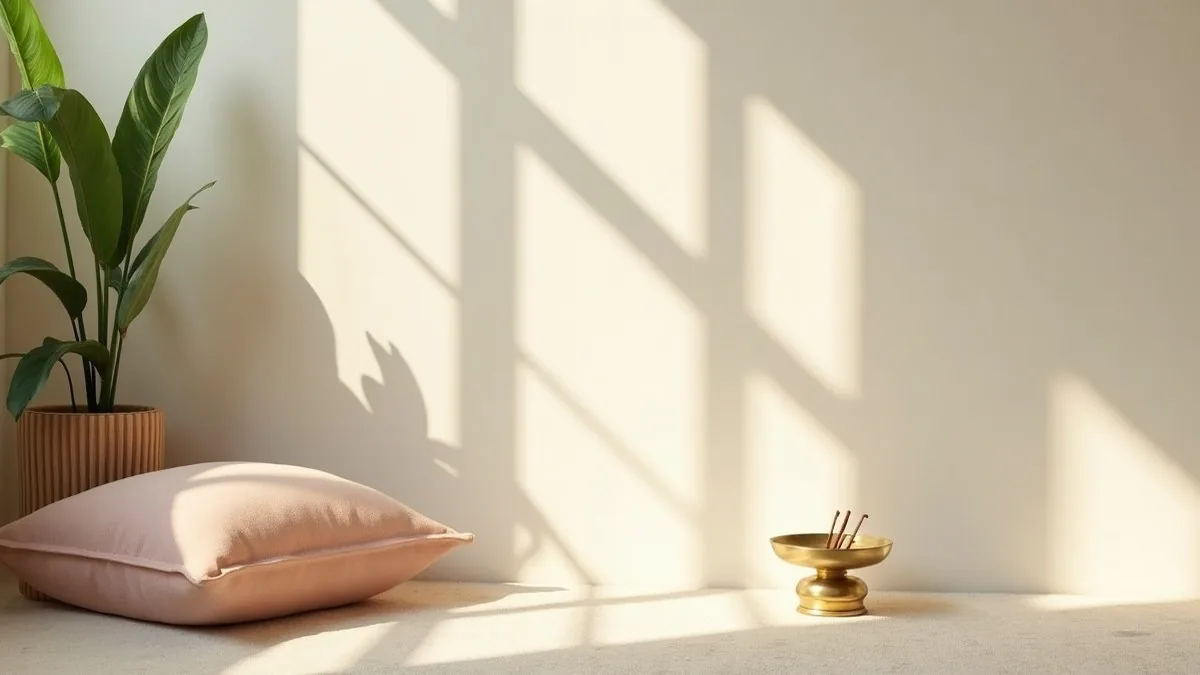
My whole apartment is 540 square feet, and for a long time I told myself there was simply no room to meditate. Then I realized I had been looking for a spare room when what I actually needed was a spare three feet. A meditation corner in a small home is not about finding empty space. It is about claiming one small spot, putting one soft thing on it, and letting that spot mean something. The square footage was never the problem. The decision was.
I write for women who live in apartments, shared rentals, and homes where every surface already has a job. You do not need a sun-drenched studio or a closet to convert. You need a chair you already own, a corner the cat ignores, the foot of your bed at the right hour. I want to show you how I built a calm spot in a tight place without spending much or pretending my home looks like a catalog.
What follows is the actual process I used: how I found the spot, what I kept and what I quietly returned, how the corner survives in a multipurpose room, and how I keep it tidy enough that walking past it still settles me. None of it is precious. All of it fits a real, slightly cluttered life.
| Question | Short answer |
|---|---|
| How much space do I really need? | About two to three feet of floor, or a single chair. A corner, a windowsill, or the foot of the bed all work. |
| What do I actually need to buy? | Often nothing. At most a cushion or folded blanket and a small anchor object. Skip the matching set the photos sell you. |
| How long to set it up? | Fifteen minutes to choose and clear the spot. The harder part is leaving it consistent rather than reclaiming it for storage. |
| Can it share a multipurpose room? | Yes. Pair the corner with a fixed cue like one cushion or one candle so your brain still reads it as the calm spot. |
| What if I have no permanent corner? | Make it portable: one claimed chair or a cushion you set down and put away. Keep the ritual identical so the consistency carries it. |
Finding three feet when there's no spare room
Start here: Do not hunt for an empty room. Walk your apartment slowly and notice where you already slow down. The best corner is usually a spot you instinctively drift toward, not a new one you build.
For years I treated this like a real estate problem. I would mentally rearrange furniture, imagine knocking down a wall, and conclude that meditation was for people with bigger homes. The fix was almost embarrassing. I stopped looking for a room and started looking for a square of floor about the size of a bath mat. Suddenly my apartment had four or five options I had walked past every single day.
Try this. Walk through your place without your phone and watch where your shoulders drop. There is almost always one spot that already feels a little quieter, a little softer than the rest. Maybe it gets afternoon light. Maybe it faces away from the front door. That instinct is data. Your body has been keeping a quiet list of calm places without ever telling you.
The spots that work better than people expect are humble ones. A chair you already own, angled slightly toward a window. A windowsill deep enough to lean against. The foot of the bed at an hour nobody is sleeping. A patch of floor beside a bookshelf, where the shelf gives you something solid at your back. None of these require new furniture, and all of them become a corner the moment you decide they are.
Light tends to be the quiet decider for me. A spot near a window hands you a free, shifting source of softness, and morning or late-day sun makes even a plain corner feel cared for. If natural light is not an option, a single warm lamp does the same job. What you want to avoid is harsh overhead light, which makes a small space feel like a waiting room rather than a refuge.
One rule keeps me honest: choose the spot you can actually keep, not the prettiest one. The dreamy corner by the balcony is useless if your partner uses that chair every evening. A slightly less photogenic spot that nobody fights you for will hold the habit far longer. Reliability beats beauty here, and a corner you return to daily quietly becomes beautiful anyway.
If you share the apartment, have the small conversation early. I told my roommate that the chair by the window was mine for ten minutes most mornings, and that was the whole agreement. Naming the spot out loud made it real for both of us, and it spared me the daily, draining question of whether I was allowed to sit down and be still.
What you actually need, and what the photos oversell
Search for a meditation corner online and you will see linen cushions in matching sets, woven baskets, a low altar table, a brass bowl, a trailing plant, and a stack of books nobody reads. It looks lovely. It also quietly tells you that calm costs two hundred dollars and arrives in a delivery box. That message kept me from starting for an absurdly long time.
Here is what you truly need. First, something to sit on that your knees and back forgive. A floor cushion is nice, but a folded blanket, a couch pillow doubled over, or simply a chair all work. Sitting comfortably matters far more than sitting correctly. If your body is bracing, your mind will not settle, and no beautiful cushion fixes that.
Second, soft light, which we covered, and which you almost certainly already have. Third, one small anchor object. This is the only piece I would call essential beyond a seat, and it is less about the object than what it does. A single stone, a small candle, a photo, a tiny ceramic dish, a sprig of something from the kitchen. It gives your eyes a gentle place to land and tells your brain, this again, the calm thing.
I keep my own object almost comically simple. A smooth grey pebble I picked up on a cold beach years ago. It cost nothing and it carries a memory of standing somewhere wide and quiet, which is exactly the feeling I am reaching for when I sit down. The point is not the pebble. The point is that one chosen object does more for the cue than a whole shelf of pretty things.
What I would skip, at least at first, is anything you have to assemble, store, or dust. A low altar table sounds romantic until it becomes another surface collecting mail. A plant is wonderful if you will water it and a burden if you will not. Start barer than feels right. You can always add later, and you will add far more thoughtfully once you know how you actually use the spot.
If you want to spend a little, spend it on comfort, not aesthetics. A genuinely supportive cushion is worth more than a matching basket, because it is the difference between sitting for ten minutes and giving up at three. Everything else can wait, and waiting for it is not failing. It is just letting the corner prove itself before you furnish it.
Letting the corner share a room that does everything
The key move: Give the spot one fixed cue that only appears when it is the calm corner. A cushion set down, a candle lit, a blanket unfolded. The cue, not the room, does the signaling.
In a small apartment, the corner almost never gets to be a corner full time. My meditation spot is also where I drop my bag, where the laundry basket lands, where a friend sits when they visit. For a while this felt like a problem. Then I realized the room did not need to change. The cue did.
Our brains read context fast. Sit in the same chair where you answer emails and your mind reaches for your inbox. The trick in a multipurpose room is to add one small, reversible signal that only appears during the practice. For me it is a particular cushion. The chair is just a chair until the cushion is on it, and then, by a kind of agreement I made with myself, it is the calm spot. Cushion off, it goes back to being furniture.
This is freeing, because it means you do not need a dedicated room or even a dedicated chair. You need a dedicated gesture. Lighting one candle. Unrolling a small mat. Setting your pebble on the sill. The gesture takes five seconds and it draws a soft line around the next ten minutes, telling both you and anyone watching that this stretch of time has a different job.
I learned to keep the cue object somewhere easy to reach, because friction kills the habit. My cushion lives on the end of the bed, one step from the chair. If it lived in a closet behind the vacuum, I would skip the practice on exactly the mornings I needed it most. The easier the cue is to deploy, the more reliably the corner appears.
It helps to pick a cue that is a little special and not used for anything else. A blanket you also nap under will blur the signal. A candle you only light to sit keeps a clean association. A similar idea shows up in my evening wind-down, where one repeated cue does more than any amount of willpower, but here the cue is doing double duty, carving a calm zone out of a room that refuses to hold still.
And when the room is genuinely chaotic, dishes stacked, laundry everywhere, the cue still works. That is almost the whole point. The corner does not require the apartment to be tidy. It requires one small object to say, just here, just now, it is quiet. Some of my steadiest sits have happened three feet from a mess I chose to ignore for ten minutes.
Texture, light, and scent in a tiny footprint
When you cannot make a space bigger, you make it feel different, and the senses are how you do that. A meditation corner does not need square footage to feel like a refuge. It needs to feel unlike the rest of the room the moment you settle in. Texture, light, and scent are the cheapest, fastest ways I know to draw that line.
Texture first. Something soft under your hands or against your back changes the whole experience. A nubby blanket, a worn cushion cover, a sheepskin you found secondhand. I keep one soft thing in my corner that I touch on the way down, almost like a handshake with the spot. It is a small sensory anchor, and on scattered days it lands before my mind does.
Light I have mentioned, but it deserves repeating because it matters most in a small room. Harsh overhead light flattens everything and keeps you alert. A low, warm source, a salt lamp, a single candle, a string of warm bulbs, a west-facing window in the late afternoon, tells your nervous system the day is softening. I dim whatever I can before I sit. The dimming itself has become part of the ritual.
Scent is the one I underrated for years. Smell reaches the older, quieter parts of the brain faster than almost anything, which is why a single consistent scent becomes a powerful cue. I am not precious about it. A drop of lavender on the cushion, a stick of incense, a candle I only burn here, even a cup of mint tea set beside me. Use the same scent enough and your body starts to soften at the first hint of it, before you have taken a breath on purpose.
Sound rounds it out. In a thin-walled apartment you cannot always control noise, so I stopped fighting it and started layering something gentle underneath. A small fountain, a fan, a quiet playlist, or just the honest sound of the street softened by a cracked window. The aim is not silence, which is rare in shared buildings anyway. The aim is a sound you have chosen rather than one imposed on you.
You do not need all four at once. Pick one or two that you will actually keep up. A single soft blanket and one warm lamp can do more for a tiny corner than a whole sensory shopping list, because you will reach for them every day. The senses are generous like that. A little, repeated, goes a remarkably long way in a small space.

How I keep the spot clear without a daily fight
Practical truth: A meditation corner in a small home survives on one habit: clearing it the moment it collects clutter, before the clutter decides the spot is now storage.
The hardest part of a corner in a tight apartment is not building it. It is keeping three feet of floor from quietly becoming a shelf. Flat surfaces in small homes are magnetic. Set the corner up and within a week a sweater, a charger, and two library books will have moved in, and the spot stops reading as calm and starts reading as another pile.
My one rule is to reset the corner daily, and to make the reset take seconds. Each evening or morning I move whatever has landed there and put the cushion or candle back. It is not deep cleaning. It is a thirty-second tidy that protects the meaning of the spot. The clutter is not the real threat. The real threat is the day you decide the spot is now where clutter lives.
It helps enormously to keep the corner nearly bare, because bare spaces resist clutter and busy ones invite it. The fewer objects in the corner, the more a stray item looks wrong and the faster you clear it. My corner holds a cushion, a pebble, and a small candle. Anything else that appears is obviously a visitor, and visitors are easy to escort out.
Storage nearby makes the reset painless. I keep a small basket within arm's reach for the cushion and blanket, so packing the corner down takes one motion. In a multipurpose room this also lets the spot disappear when you need the floor for something else and reappear in seconds when you want it back. The corner is not fragile. It folds.
I also stopped expecting the corner to stay perfect, which removed a lot of pressure. Some weeks it is pristine. Some weeks I clear it right before I sit. Both are fine. The standard is not a magazine spread. The standard is that when I want to sit down, I can, within a few seconds, without first excavating my own belongings. That low bar is exactly why the habit survives.
One more small thing: I never use the corner as a drop zone for anything, even briefly, even just setting my keys down for a second. The moment a spot becomes a convenient place to leave things, it becomes a place that leaves things. Keeping it sacred in that one tiny way, no drop-offs ever, does more to protect it than any amount of cleaning after the fact.
How I actually use the corner on a normal day
Most days I sit for five to ten minutes, not thirty. A short, kept practice in a small corner beats a long one I keep promising myself and skipping, and that single shift is what finally made meditation stick for me.
A beautiful corner does nothing if you never sit in it, and the leap from having the spot to using the spot is where most people stall. So let me be plain about what a normal day looks like, because it is far less impressive and far more sustainable than the version in my head when I started.
I tie the practice to something I already do, which is how it actually sticks. Mine lives right after I pour my morning coffee. Coffee is the trigger; the corner is the next step. Anchoring the sit to an existing habit means I am not relying on motivation, which is unreliable, especially before caffeine. If mornings are impossible for you, the ten minutes before bed work just as well.
The sit itself is short. I aim for five minutes, sometimes ten, almost never more, and I would rather you sit for three real minutes than plan thirty you never take. I set the cushion, light the candle, rest my eyes on the pebble, and breathe. I do not have a complicated technique. I follow my breath, my attention wanders off constantly, and I bring it back without scolding myself. That gentle returning is the whole practice.
On scattered days I lower the bar instead of skipping. A low-energy version still counts: I sit, I take three slow breaths, I get up. That tiny version keeps the corner alive on the weeks I need it most, and it stops one missed morning from becoming a missed month. The spot stays warm because I keep visiting it, even briefly.
Something quietly lovely happens once the habit settles in. The corner starts doing part of the work for me. After enough repetitions, my shoulders drop the moment I sit down, before I have done anything at all. The place itself becomes a cue for calm, which is the real reward of keeping one consistent spot rather than meditating wherever I happen to land.
I also let the corner be useful outside the formal sit. When I am frazzled mid-afternoon, I drift over and stand there for a moment, or sit with no agenda at all. The spot has become a small reliable source of steadiness in a busy, shared home, a square of floor that belongs to stillness no matter what the rest of the day is doing. That, far more than any cushion, is what makes a tiny corner worth the three feet it takes.

Why this matters more than it seems
The heart of it: A meditation corner does not require space or money. It requires one small, consistent place that signals to your body it is time to slow down.
Having a dedicated spot, even a tiny one, does something a wandering practice never quite manages. The place itself becomes a cue. Sit there enough times and your body begins to soften the moment you arrive, before you have done anything at all. The corner does some of the work of calming you, simply by being the calm place.
It also makes the practice real in a home that is otherwise busy and shared. A small corner is a quiet declaration that rest belongs here too, that your inner life gets a square of physical space alongside the dishes and the laundry. That declaration matters more than the size of the spot. It tells you, every time you pass it, that slowing down is allowed.
There is something quietly powerful about giving an intangible practice a tangible home. Our environments shape our behavior more than we like to admit, and a dedicated spot lowers the friction of starting, removes the daily negotiation of where and whether, and uses the room itself as a gentle reminder. The corner does some of the discipline for you, simply by existing and waiting, which is why it works when willpower alone often does not.
What I learned the hard way
I delayed having a corner for years because I was waiting for the right apartment, the right cushion, the aesthetic setup I saw online. The waiting was just procrastination wearing the costume of standards. Meanwhile I had a perfectly good chair by a window doing nothing, and I let the fantasy of a perfect space keep me from the actual practice.
When I finally just used the chair, it turned out to be enough, more than enough. The lesson humbled me. The corner does not need to be beautiful or large or photographed. It needs to be consistent. A plain spot you actually use beats a gorgeous one you are still saving for, and the saving was never about the space anyway.
I also found that the corner became a small anchor of calm in a busy, shared home, a square of space that belonged to stillness no matter what chaos surrounded it. On hard days, just looking at it reminded me that rest had a place here, that slowing down was permitted. The spot held the intention even when I was too scattered to, which is a kind of support a wandering practice never offered me.
How to know it's working
You will know your corner is working when it stops being a place you make yourself go and becomes a place you want to return to.
- Your body starts to relax a little just by sitting down there, before you have done anything.
- You find yourself drawn to the spot when you feel frazzled, almost without deciding.
- The corner stays a calm zone in your mind even when the rest of the home is chaotic.
- A few minutes there genuinely shifts your state, rather than feeling like a box to tick.
- You begin to protect the spot, keeping it clear, because it has become genuinely useful.
If the corner feels like dead space you never use, it may be in the wrong place. Move it somewhere you naturally pause, and keep it almost absurdly simple. Usefulness beats beauty every time.
When this won't fit your life
In a truly cramped or shared home, a permanent corner may not be possible, and that is okay. The practice can travel, a particular chair you claim for ten minutes, a spot on the floor, even a cushion you set down and put away. The consistency can live in the ritual rather than the real estate.
And if sitting still in silence makes anxiety louder rather than quieter, which happens for some people, that is important information, not a personal failing. Meditation is one tool among many, and movement, gentle company, or professional support may serve you better. The goal was always more peace, however you actually find it.
Keep it humble and let it evolve with you. A corner can be a chair, a cushion, a folded blanket, a single candle, and it can move rooms or change shape as your life does. The magic was never in the aesthetics or the objects. It was in having one consistent place that says, gently and reliably, that this is where you come to be still, and that is enough.
Helpful sources and next reads
Reliable external sources
More from Sabrina Saturno
You may also love




FAQ
How small can a meditation corner actually be?
Smaller than you think. About two to three feet of floor, or a single chair, is plenty. The size of the spot matters far less than how consistently you return to it.
What is the cheapest way to set one up?
Use what you already own. A folded blanket or a chair to sit on, a lamp you already have, and one small object like a stone or candle. You can build a real corner for nothing.
I have no spare corner at all. What then?
Make it portable. Claim one chair for ten minutes, or use a cushion you set down and put away. Keep the ritual identical each time so the consistency carries the practice instead of the location.
How do I stop the corner from collecting clutter?
Reset it daily in about thirty seconds and keep it nearly bare. The fewer objects in the spot, the more a stray item looks wrong, and the faster you clear it before it becomes permanent.
Can a meditation corner share a multipurpose room?
Yes, and most of mine always have. Add one reversible cue that only appears during the practice, like a cushion placed on the chair or a candle lit. The cue tells your brain it is the calm spot.
Where is the best place to put it in a studio?
Wherever you already pause and the light is soft. A spot near a window, the foot of the bed, or a stretch of floor by a bookshelf all work. Pick somewhere you can keep, not the prettiest option.
Do I need a special cushion or can I sit on a chair?
A chair is completely fine, especially if floor sitting hurts your knees or back. Comfort matters more than form. If your body is bracing, your mind will not settle, so choose whatever lets you sit easily.
What should the one anchor object be?
Anything small that your eyes can rest on and that means a little something to you. A stone, a photo, a candle, a tiny dish. Its job is to signal calm, not to be impressive.
How long should I sit each day?
Start with five minutes. Three real minutes you actually do beats thirty you keep skipping. On busy days, sit, take three slow breaths, and get up. That still counts and keeps the habit alive.
How do I remember to use the corner?
Tie it to something you already do every day. I sit right after pouring my morning coffee. Anchoring it to an existing habit means you are not relying on motivation, which tends to disappear when you need it.
Does scent or sound really make a difference in a small space?
More than you would expect. In a tiny footprint the senses do the heavy lifting. One consistent scent or one chosen sound can make three feet of floor feel unlike the rest of the room within seconds.
What if sitting still makes me more anxious, not less?
That is useful information, not a failure. Meditation is one tool among many. Gentle movement, soft company, or talking with a professional may serve you better. The goal was always more peace, however you find it.
How do I know the corner is working?
You will notice your body softening as you sit down, before you have done anything. You start drifting to the spot when frazzled. When it becomes a place you want to return to, it is doing its job.
One last thought before you clear your three feet
A meditation corner in a small apartment was never about square footage, and it was never about owning the right cushion. It was about deciding that stillness gets a place in your home too, even a tiny one, even three feet wedged between the bookshelf and the window. The deciding is the whole thing. The furniture is just where the deciding lives.
So go find the spot you already drift toward, put one soft thing on it, and sit down for five minutes today. Not the perfect version someday, the small honest one now. A plain corner you actually use will outgive a beautiful one you keep saving for, and your calm has waited long enough for a permanent home.