

The single-serve cup of plain nonfat Greek yogurt sitting in most refrigerator doors, the 5.3 ounce size, carries somewhere around 15 to 18 grams of protein for about 80 to 100 calories. Scoop out a full measuring cup instead, closer to 227 or 245 grams, and you land at roughly 20 to 25 grams. Those two figures cover almost every question people actually have about this food, and I wanted them written down plainly because the labels in the dairy case do a poor job of making the comparison easy.
My relationship with Greek yogurt is longer and less dramatic than my relationship with most foods I write about. It has just quietly been there. There is a large tub of Fage 5 percent on the middle shelf of my fridge right now, next to a smaller nonfat one, and both get opened for completely different reasons. The full-fat one is dinner adjacent, thinned with lemon and spooned under roasted vegetables. The nonfat one is the breakfast workhorse. Same aisle, different jobs, and different numbers on the back.
What follows is the specific arithmetic, brand by brand and fat level by fat level, plus the parts nobody puts on the front of the container: what straining actually does, why flavored cups quietly cost you eight to fourteen grams of sugar, and where skyr fits. I am not a dietitian, and anything touching lactose or blood sugar belongs in a conversation with your own clinician. I stick to USDA figures for the baselines so you can check my work rather than trust my memory.
| What | Typical amount | What shifts it |
|---|---|---|
| Protein per 5.3oz cup | 15 to 18g | Nonfat sits high; whole milk runs lower |
| Protein per full cup | 20 to 25g | About 227 to 245g of yogurt depending on scoop |
| Protein per 100g | 10 to 11g | Whole milk versions drop to roughly 8 to 9g |
| Calories, nonfat cup | 80 to 100 | Flavored versions climb past 120 |
| Calories, whole milk cup | 140 to 190 | Fat, not protein, drives the difference |
| Sugar in flavored cups | 8 to 14g added | Plain has only the milk sugar, about 4 to 6g |
| Calcium per cup | About 180 to 250mg | Straining removes some along with the whey |
| Regular plain yogurt | 5 to 6g per 100g | Roughly half of Greek, because it is not strained |
How much protein is in a container of Greek yogurt
The number: A 5.3oz (150g) single-serve cup of plain nonfat Greek yogurt delivers about 15 to 18g of protein; a full cup gives 20 to 25g.
Start with the container you are most likely holding. The standard single-serve cup in American grocery stores is 5.3 ounces, which is 150 grams, and for plain nonfat Greek yogurt that works out to roughly 15 to 18 grams of protein. The spread is real. Some brands strain harder than others and print 17 or 18 on the lid, while others sit closer to 15. Calories for that same cup usually run 80 to 100 when nothing has been added.
The full-cup measurement is where people get confused, because a cup by volume is not a tidy 150 grams. Depending on how thick the yogurt is and how firmly you pack the spoon, a cup weighs somewhere between about 227 and 245 grams. That translates to roughly 20 to 25 grams of protein. If you are scooping from a 32 ounce tub into a bowl, you are almost certainly eating more than a single-serve cup, and your protein number goes up accordingly.
There is also the larger single-serve format, the 7 ounce cup, which some brands sell and which sits at around 200 grams. That lands near 20 to 22 grams of protein on its own. I mention it because when a label boasts twenty grams, checking whether the cup is 5.3 or 7 ounces explains most of the difference between brands that look wildly apart on the shelf but are nearly identical per gram.
The per-100-gram figure, and why to use it
Per 100g: Plain nonfat Greek yogurt runs about 10 to 11g of protein per 100 grams, which is the only fair way to compare brands.
Per 100 grams is the figure I trust most, because it strips out container size entirely. Plain nonfat Greek yogurt sits at roughly 10 to 11 grams of protein per 100 grams. You can pull the reference entries yourself from USDA FoodData Central, where plain Greek yogurt is broken out separately from regular yogurt with the fat levels listed individually. Once you have that anchor, every container size becomes simple multiplication.
It is genuinely useful at the store. A cup marked 150 grams should give you about 15 to 16 grams of protein if it is truly a strained nonfat product. If the label says 12, something else is going on, usually added fruit, added sugar, or a softer strain. If it says 20 in a 150 gram cup, the manufacturer has almost certainly added milk protein concentrate or whey, which is not a scandal but is worth knowing.
European labels make this easier because they print per 100 grams by law. American ones give you per serving, and serving sizes shift between brands. I have started doing the division in my head at the dairy case, dividing protein grams by container grams, and it has changed which tubs I buy. It takes about four seconds and it is the single most useful habit I have picked up in this aisle.
Nonfat, 2 percent, and whole milk compared
Fat level: Nonfat Greek yogurt holds about 10 to 11g protein per 100g; whole milk versions drop to roughly 8 to 9g and add 50 to 90 calories per cup.
This is the opposite of what many people assume. With Greek yogurt, the fat percentage does move the protein, and it moves it downward as fat goes up. Nonfat sits around 10 to 11 grams per 100 grams. Two percent lands near 9 to 10. Whole milk, the 5 percent tubs, comes in closer to 8 to 9 grams per 100 grams. The reason is straightforward dilution. Fat takes up room that protein and water used to occupy.
Calories follow the fat, obviously. A single-serve nonfat cup runs 80 to 100 calories. The equivalent whole milk cup lands anywhere from 140 to 190 depending on brand and size. Neither number is a verdict. If you want the most protein per calorie, nonfat wins clearly. If you want something that tastes like food rather than a supplement, the 5 percent is a different experience entirely, and I say that as someone who buys both every week.
My rule has settled into something practical. When Greek yogurt is doing a nutritional job, breakfast protein, a post-walk snack, something stirred into oats, I use nonfat or 2 percent. When it is doing a culinary job, a sauce, a dollop on soup, the base of a dip, I use whole milk without a second thought, because the amount is small and the texture is the point. Two tubs, two purposes, no guilt in either direction.
Why straining is the whole reason for the protein
Mechanism: Straining removes liquid whey and lactose, concentrating what remains, which is why Greek yogurt roughly doubles regular yogurt's protein per gram.
Greek yogurt is not made from a different milk or a special culture. It is regular yogurt that has had a large share of its liquid whey drained away, traditionally through cloth. Remove the water and you concentrate everything left behind, protein most noticeably. That single process is why 100 grams of Greek yogurt carries roughly double the protein of 100 grams of the regular kind. Nothing is added. Something is taken out.
The ratio matters. It takes somewhere in the range of three to four cups of milk to produce one cup of properly strained Greek yogurt, which is also why it costs more per ounce than the regular kind. When you pay that premium, you are paying for evaporated volume. The protein density is the product. If a tub is cheap and still claims high protein, it may have been thickened with milk protein concentrate rather than strained, and the label will usually say so.
This is also why homemade works. Line a sieve with cheesecloth, spoon in plain whole milk yogurt, and refrigerate it for four to eight hours. You will pour off a startling amount of thin, yellowish whey and be left with something thick and tangy. I have done it when I wanted a specific texture for a dip, and the change in density is dramatic. It does not save money, but it demystifies the whole category in one afternoon.
Fage, Chobani, Oikos, Two Good, and store brands
Brand check: Plain Fage Total 0% and Chobani plain nonfat land near 15 to 18g per cup; Oikos Triple Zero and Two Good use added protein or sweeteners to hit similar figures.
Fage Total is the reference point for a lot of people, mine included. The 0 percent, 2 percent, and 5 percent lines are the same yogurt strained the same way at different fat levels, and the plain versions carry no added sugar. Per 5.3 ounce cup, the 0 percent generally lands in the 16 to 18 gram range, the 2 percent slightly below, and the 5 percent lower still, closer to 15, with calories climbing as you go up.
Chobani's plain nonfat sits in a similar band, roughly 15 to 17 grams per single-serve cup, and the brand's flavored line is where the numbers scatter. Oikos Triple Zero is built around a specific promise, no added sugar, no artificial sweeteners in the marketing sense, and no fat, and it typically advertises around 15 grams per cup with added milk protein concentrate helping it get there. That is a legitimate product, just a differently constructed one.
Two Good is the interesting outlier. It uses a slow-straining process that removes most of the lactose, and it markets around two grams of sugar per cup with protein usually in the 12 to 15 gram range depending on container size. Store brands from Kirkland, Trader Joe's, Aldi, and most supermarket lines are frequently indistinguishable from the name brands on protein per 100 grams, and often two dollars cheaper per tub. I buy store brand plain more often than not.
The honest summary is that for plain Greek yogurt, brand differences are small and mostly about texture and tang. For flavored products, brand differences are enormous, because that is where sugar, fruit purée, and protein additives enter. If you want to keep this simple, buy plain from whoever is cheapest and add your own flavor. That single decision removes almost all the label reading from your life.

Greek yogurt versus regular yogurt
The comparison: Regular plain yogurt holds about 5 to 6g protein per 100g against Greek yogurt's 10 to 11g, roughly double, because Greek is strained.
Regular plain yogurt, the unstrained kind, carries about 5 to 6 grams of protein per 100 grams. Greek carries about 10 to 11. That is close to a doubling, and it is the entire reason Greek yogurt took over the dairy case in the first place. A standard 6 ounce cup of regular plain yogurt gives you around 8 to 10 grams of protein. The same size in Greek gives 16 to 18.
Regular yogurt is not a lesser food, though. It has more calcium per gram, because calcium leaves with the whey during straining. It is thinner and pours, which makes it better for drinks, dressings that need to be loose, and cereal. It is also cheaper and often better tolerated by people who find Greek yogurt too dense or too sour. The two do genuinely different work in a kitchen.
My practical read is that if protein is the reason you are buying yogurt, Greek is the obvious answer and it is not particularly close. If you are buying yogurt because you like yogurt, either is fine and you should get the one you enjoy. I keep regular around in the summer mostly, for cold soups and for thinning into marinades where Greek would be too heavy. The rest of the year the Greek tub is the one that empties.
Where skyr and Icelandic-style yogurt land
Skyr: Icelandic skyr sits at the top of the range, roughly 11 to 12g protein per 100g, because it is strained even more heavily than Greek yogurt.
Skyr is technically a fresh cheese rather than a yogurt, though it is sold and eaten as one and nobody at the store is going to argue with you. It is strained more aggressively than Greek yogurt, which pushes it to the high end of the protein range, roughly 11 to 12 grams per 100 grams. A 150 gram cup of skyr can therefore reach 17 to 19 grams of protein, a bit above most Greek equivalents.
The texture is noticeably different. Skyr is denser, almost spoon-standing, and the tang is milder than Greek yogurt's sharpness. Siggi's is the brand most Americans have seen, and its plain versions typically advertise 16 to 17 grams in a 150 gram cup. Whether that extra gram or two over Greek matters to you depends on whether you are counting closely or just eating breakfast, and most days I am just eating breakfast.
What I actually notice is fullness rather than the label. Skyr's density means a smaller amount feels like more, which is a real advantage on mornings when I am not particularly hungry but want the protein anyway. It is usually a dollar or two more per container, and it is not something I keep constantly. When it goes on sale, I stock up, and when it does not, plain Greek covers the same ground fine.
The sugar trade in flavored cups
Watch this: Flavored Greek yogurt cups typically add 8 to 14g of sugar on top of the 4 to 6g of naturally occurring lactose in plain yogurt.
Plain Greek yogurt contains about 4 to 6 grams of sugar per cup, and all of it is lactose, the sugar that occurs naturally in milk. Nobody added it. Flavored cups are a different product. Depending on the brand and the flavor, they commonly carry 8 to 14 grams of added sugar on top of that, which can nearly triple the total. The protein usually stays roughly the same, so what you are buying is the same protein with dessert attached.
I am not going to be dramatic about this. A vanilla Greek yogurt with ten grams of added sugar is still a far better snack than most things in the same price range, and if a flavored cup is what gets you eating protein at ten in the morning, buy the flavored cup. The Harvard Nutrition Source lays out the general reasoning on added sugars if you want the full picture rather than my summary.
But the swap is easy enough that I default to it. Plain yogurt, half a mashed banana or a handful of frozen blueberries stirred through until they bleed purple, and a small drizzle of honey if it needs it. That gives me fruit sugar, fiber, and control over how sweet it ends up. It takes maybe forty seconds. The flavored cups still live in my cart occasionally, mostly when I am traveling and a spoon is all I have.
Lactose, calcium, and the straining side effects
Side effects: Straining removes lactose along with the whey, so Greek yogurt is often gentler than milk, but it also carries less calcium per gram than regular yogurt.
Straining takes lactose out along with the whey, which is why a lot of people who feel unwell after a glass of milk handle Greek yogurt without trouble. The live cultures help too, since they consume some of the remaining milk sugar during fermentation. That is not a promise. Lactose intolerance varies enormously person to person, and if dairy has been a real problem for you, this is a question for your doctor or a dietitian rather than something to settle from an article.
Calcium is the quieter trade. Because calcium partly dissolves in the whey, straining carries some of it away. Regular yogurt typically holds more calcium per gram than Greek does. A cup of Greek still contributes meaningfully, in the neighborhood of 180 to 250 milligrams depending on the product, against an adult daily target that sits around 1,000 milligrams for most people according to the NIH Office of Dietary Supplements.
So Greek yogurt is a strong calcium contributor, just not the strongest one in the dairy case. I mention it because the protein narrative is so loud that the rest of the nutrition profile gets flattened. There is also a decent amount of potassium, some B12, and the live cultures themselves, which research associates with digestive comfort for some people. None of that is why I buy it, but it is all sitting in the tub regardless.
How I actually eat it, savory first
In practice: Plain Greek yogurt works as a savory base with olive oil and salt, or sweet with fruit, and swaps in for sour cream and mayonnaise nearly one to one.
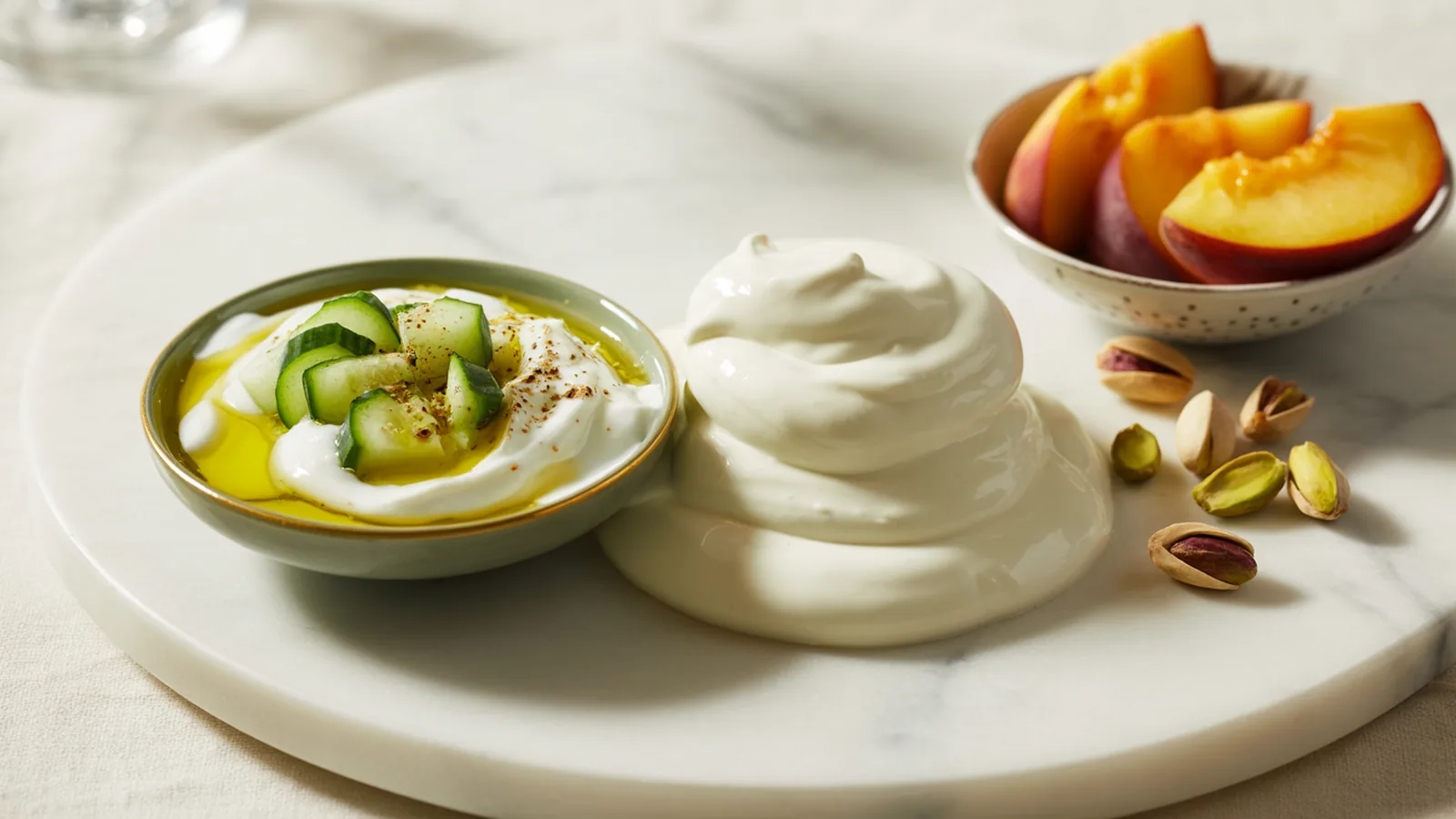
The thing I do most often with Greek yogurt is not breakfast. It is a spoonful of the 5 percent smeared across the bottom of a plate, hit with salt, lemon, and olive oil, with roasted carrots or chickpeas piled on top. That is dinner probably once a week. The yogurt is not the protein source in that meal so much as the sauce, but it contributes a few grams anyway and it costs nothing in effort.
For breakfast I keep it dull on purpose. Nonfat yogurt, frozen raspberries straight from the bag so they thaw into the bowl, a spoon of ground flaxseed, and some pumpkin seeds for crunch. Around 18 to 20 grams of protein, no cooking, and I can build it half asleep. When I want more staying power, I stir yogurt into oats the night before, which is a trick I go into properly in my notes on overnight oats protein.
A few swaps that have held up in my kitchen:
- Sour cream on tacos or chili: plain whole milk Greek yogurt, one to one, stirred smooth first so it does not seize.
- Half the mayonnaise in a chicken or egg salad, which keeps the richness and adds protein.
- A marinade base for chicken, where the acidity and enzymes tenderize better than lemon juice alone.
- Whisked into warm soup off the heat, never boiling, or it will split.
It also sits comfortably next to the other proteins I lean on. If I have had yogurt three mornings running I will switch to eggs, and I broke down those figures in 2 eggs scrambled nutrition. On the days I want something colder and thicker than yogurt, cottage cheese protein covers similar ground with a saltier, curdier personality. Rotating between them is what has kept any of it sustainable.
When Greek yogurt won't fit your life
Honest fit: Dairy allergy, significant lactose intolerance, a dislike of sourness, or a tight grocery budget are all fair reasons to get protein elsewhere.
A milk allergy takes Greek yogurt off the table completely, and the plant-based versions are a different food nutritionally. Almond and coconut yogurts usually carry one to three grams of protein per serving unless protein has been added back in, which is a fraction of what the dairy version gives. Soy-based yogurts do better, often six to eight grams, and are the closest substitute if you need one. Just read them as their own category rather than as a swap.
Then there is taste, which people underrate as a reason. Greek yogurt is sour and thick, and some people find that genuinely unpleasant rather than an acquired preference. Forcing yourself through a food you dislike every morning has never worked for anyone I know, including me. Cost is a fair objection too. Greek yogurt runs meaningfully more per ounce than regular yogurt or eggs, and if your grocery budget is tight, eggs and canned beans give you more protein per dollar.
The useful part of all this is the principle, not the tub. What Greek yogurt does well is put fifteen to twenty grams of protein in front of you with no cooking, no planning, and no cleanup beyond a spoon. Any food that clears that bar does the same job. If you want the full list of things I actually reach for on those mornings, my high-protein breakfast ideas covers the rotation, and high protein snack ideas handles the afternoon version. Keep the standard, swap the food.
Helpful sources and next reads
Reliable external sources
- USDA FoodData Central
- Harvard Nutrition Source: Added Sugar
- NIH Office of Dietary Supplements: Calcium
More from Sabrina Saturno
You may also love


FAQ
How much protein is in a single cup of Greek yogurt?
A 5.3 ounce single-serve cup of plain nonfat Greek yogurt holds about 15 to 18 grams of protein for 80 to 100 calories. A full measuring cup, closer to 227 to 245 grams, gives roughly 20 to 25 grams.
How much protein is in 100g of Greek yogurt?
Plain nonfat sits at about 10 to 11 grams per 100 grams. Whole milk versions come in lower, around 8 to 9 grams, because the fat displaces some of the protein and water.
Does whole milk Greek yogurt have less protein?
Yes, slightly. Whole milk Greek yogurt runs roughly 8 to 9 grams per 100 grams against nonfat's 10 to 11, and it carries substantially more calories, often 140 to 190 per cup.
Which Greek yogurt has the most protein?
Heavily strained plain products lead, particularly nonfat lines like Fage Total 0 percent, and skyr edges even higher at 11 to 12 grams per 100 grams. Always compare per 100 grams rather than per container.
Is Greek yogurt higher in protein than regular yogurt?
Roughly double. Regular plain yogurt carries about 5 to 6 grams per 100 grams while Greek carries 10 to 11, entirely because the whey has been strained out of the Greek version.
Why does straining increase the protein?
Straining removes liquid whey, which is mostly water and lactose. Everything left behind becomes more concentrated, so the same weight of yogurt now holds more protein than it did before.
Is skyr better than Greek yogurt for protein?
Marginally. Skyr is strained harder and lands near 11 to 12 grams per 100 grams. The difference in a single cup is a gram or two, which matters if you are counting closely and not much otherwise.
How much sugar is in flavored Greek yogurt?
Flavored cups typically add 8 to 14 grams of sugar on top of the 4 to 6 grams of lactose already present in plain yogurt. The protein usually stays about the same.
Can I eat Greek yogurt if I am lactose intolerant?
Many people can, because straining and fermentation both remove lactose. Tolerance varies a lot from person to person, though, so it is worth discussing with your doctor if dairy has caused you real problems.
Is Greek yogurt a complete protein?
Yes. It comes from milk, so it carries all the essential amino acids the body cannot produce on its own, putting it in the same quality tier as eggs and other dairy.
Does Greek yogurt have less calcium than regular yogurt?
It does, per gram. Calcium partly leaves with the strained whey. A cup still contributes about 180 to 250 milligrams against a typical adult target near 1,000 milligrams.
Are store brand Greek yogurts as good as name brands?
For plain yogurt, usually yes. Compare protein per 100 grams and you will often find store brands nearly identical to Fage or Chobani at a lower price per tub.
Is Two Good Greek yogurt worth it?
It depends what you want from it. Two Good uses slow straining to strip most of the lactose and sugar, so it suits people watching sugar closely, though protein per container is not the highest available.
The version that lasts
What has actually lasted is two tubs and one habit. A large plain nonfat container for the mornings, a smaller 5 percent for cooking, and the small mental step of dividing protein grams by container grams whenever I pick up something unfamiliar. That is the whole system. It survived because it never asked me to buy anything special or track anything, and because both tubs get used before they expire, which is more than I can say for half the things I have bought with good intentions.
Knowing the numbers changed how I shop more than how I eat. I no longer get pulled in by a label shouting about protein, because I can tell in a few seconds whether the figure is impressive or just a larger container. I know a 150 gram cup should give me fifteen or sixteen grams if it is honestly strained. I know whole milk costs me a couple of grams of protein and buys me a much better texture, and I choose that trade openly instead of feeling vaguely guilty about it.
If you take one thing from this, make it the plain tub. Buying plain and flavoring it yourself solves the sugar question, the cost question, and the label-reading question all at once, and it takes under a minute in the morning. The yogurt itself is not the point. The point is having something in the fridge that reliably puts real protein in front of you before the day starts making demands, and Greek yogurt happens to be very good at exactly that.