
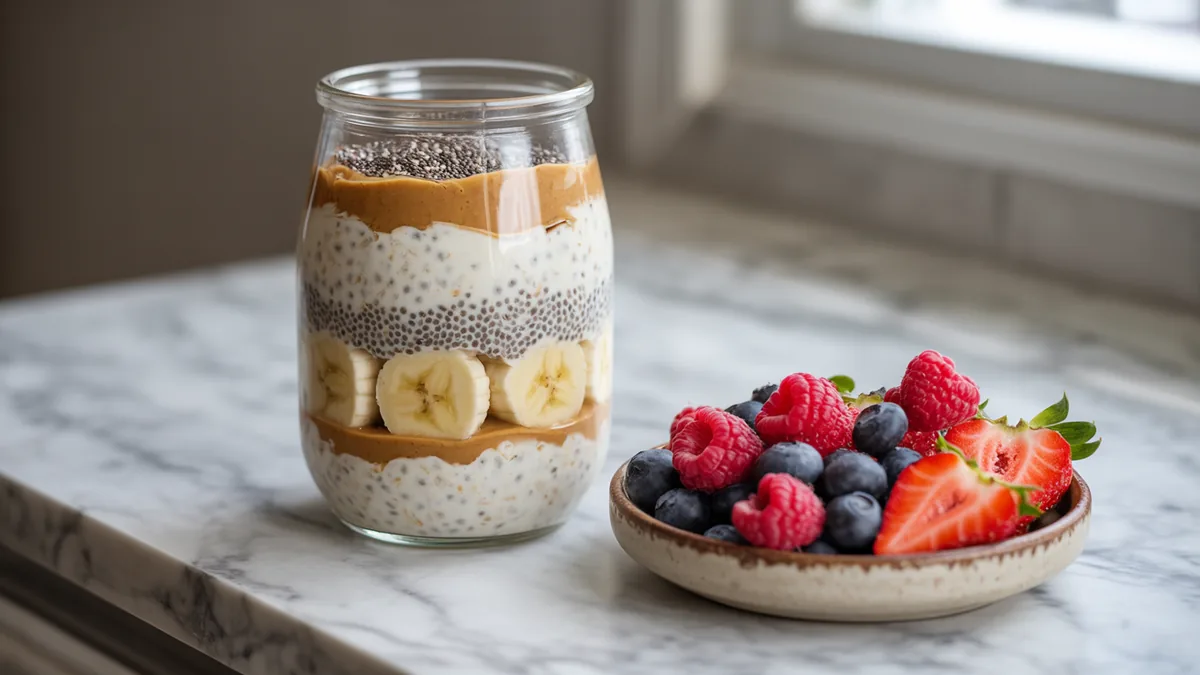
A standard jar of overnight oats, roughly half a cup of dry rolled oats stirred into half a cup of milk, carries about 8 to 12 grams of protein depending on which milk you pour in. That is the honest starting figure, and it is lower than most people assume for something that feels this hearty. The good news is that overnight oats are one of the easiest breakfasts to build up. With a spoon of Greek yogurt, a scoop of protein powder, or a scatter of seeds, that same jar climbs to 25 to 35 grams without much fuss.
I fell for overnight oats during a stretch of chaotic mornings, when the idea of cooking anything before coffee felt impossible. A jar I could stir together at night and grab half asleep was a small mercy. For a while I assumed it was carrying my whole morning, protein included, until I actually added up what was in it. The oats and almond milk I was using landed near 6 grams, which is not the sturdy breakfast I thought I was eating. That gap is what sent me looking at the real numbers instead of the cozy idea of a wholesome jar.
I am no dietitian, and I will say so wherever it matters. What I can offer is a specific, honest look at how much protein overnight oats really hold, which ingredients move the number most, and how I build a jar that keeps me full past ten in the morning. I lean on published USDA data for the baseline here, so you do not have to trust my memory for the grams. Let us start with the plain jar, then work through every lever you can pull to make it a genuine high-protein breakfast rather than a pretty bowl of carbohydrate.
| Build | Protein | Calories |
|---|---|---|
| Dry rolled oats only, 1/2 cup | About 5g | Around 150 |
| Oats plus dairy or soy milk, 1/2 cup | About 9g | Around 210 |
| Oats plus almond or oat milk | About 6g | Around 180 |
| Oats plus Greek yogurt, 1/2 cup | 17 to 19g | Around 250 |
| Oats, milk, plus a protein powder scoop | 28 to 32g | Around 290 |
| Oats, yogurt, plus chia and hemp | 22 to 25g | Around 300 |
| Fully loaded high-protein jar | 25 to 35g | 350 to 400 |
The real protein in a basic jar
Baseline: Half a cup of dry rolled oats gives about 5g protein; a full jar with milk lands near 8 to 12g.
Let me set the plain baseline, because it holds steady before any toppings enter the picture. Half a cup of dry rolled oats, the amount most jars start with, runs about 150 calories with roughly 5 grams of protein and 4 grams of fiber. That is a respectable amount of fiber for a small scoop, but 5 grams of protein on its own is a light start to the day. Oats are fundamentally a whole grain, so their strength is steady carbohydrate and fiber, not protein. You can confirm the raw figures at USDA FoodData Central.
The jump to 8 to 12 grams comes from the liquid you stir in. A standard jar uses about half a cup of milk, and dairy or soy milk each add roughly 4 grams of protein, which lifts the total to around 9 grams. Most other plant milks, almond, oat, coconut, and rice, add 1 gram or less, so a jar built on almond milk sits closer to 6 grams. That single choice, dairy or soy versus the lighter plant milks, is the difference between a jar in the low single digits and one comfortably into the double digits.
So the honest read is that a basic jar is a modest protein breakfast, not a big one, unless you choose it to be. That is not a knock on oats, it is just a clear picture of the starting line. Every gram past that 8 to 12 range is something you add on purpose, and the additions are easy. If you want to see where a well-built jar fits among other mornings, I keep it on my list of high-protein breakfast ideas, right beside eggs and yogurt bowls.
How your milk choice changes protein
The first lever: Dairy and soy milk add about 4g protein per half cup; almond, oat, and coconut milk add 1g or less.
Your milk is the first and simplest lever, and it is the one most people never think about. Dairy milk, whether whole, 2 percent, or skim, adds about 4 grams of protein per half cup, and the protein stays the same across the fat levels. Soy milk is the standout among plant milks, matching dairy at roughly 4 grams per half cup, because soybeans are naturally protein dense. If you want the protein of dairy without the dairy, unsweetened soy milk is the closest swap on the shelf, and it behaves the same way in a jar overnight.
The other plant milks are a different story. Almond, oat, coconut, cashew, and rice milk are mostly water with a little of their base ingredient, so they carry 1 gram of protein per half cup or less. They are lovely for flavor and texture, and I use them often, but they are not pulling any protein weight. If you build your jar on almond milk and stop there, you are looking at a breakfast near 6 grams of protein, which will not hold most people to lunch. Knowing that lets you plan the rest of the jar around it.
In practice I often split the difference. I like the taste of oat or almond milk, so I use it for the base and then lean on a different ingredient for the protein, usually yogurt or a scoop of powder. If dairy and soy are both off your table, you are not stuck. My guide to overnight oats without yogurt walks through plant-forward ways to reach a solid protein number without touching dairy at all. The milk sets your floor, and everything after it builds up from there.
The biggest lever: yogurt and protein powder
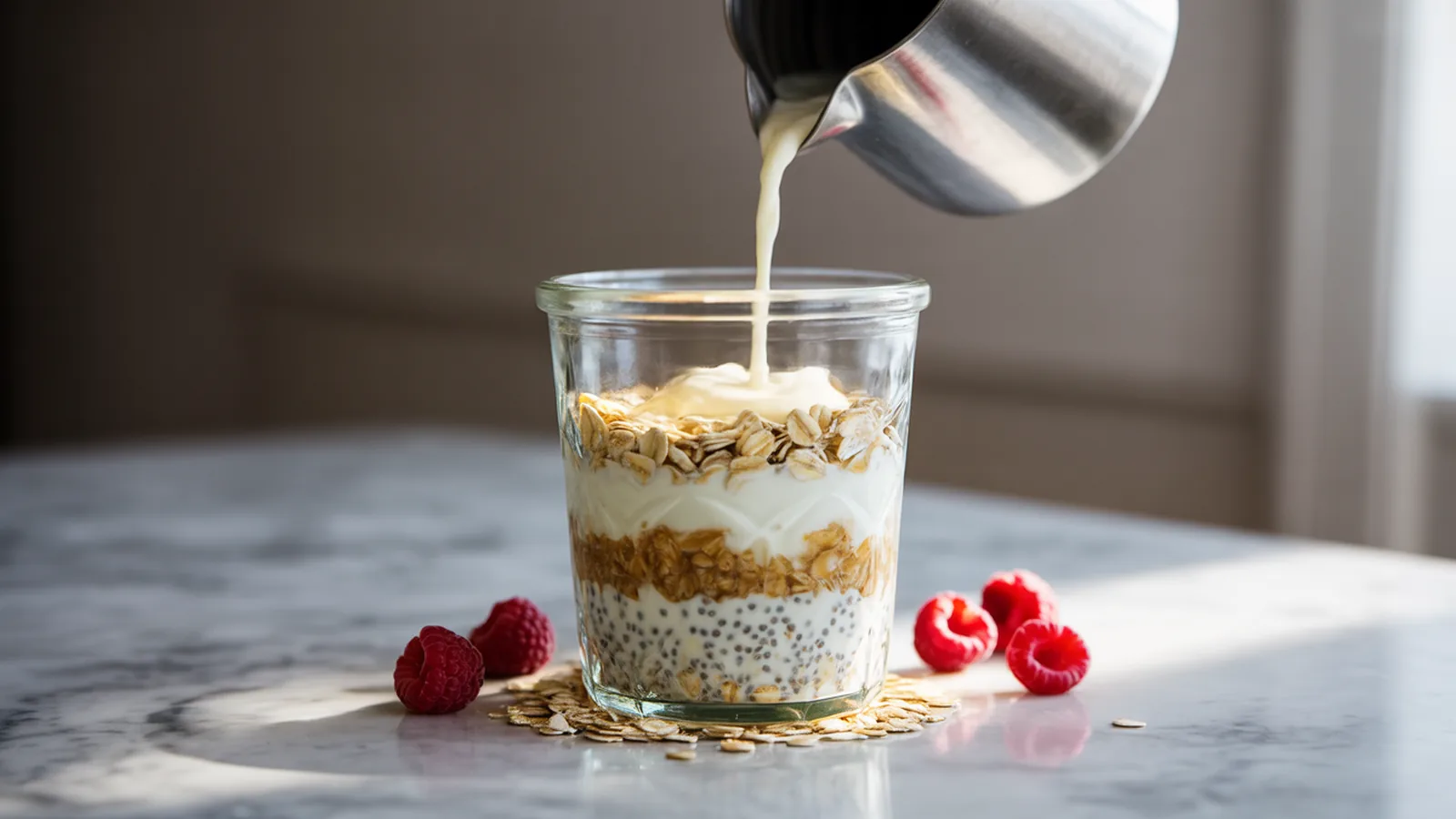
The biggest jump: Half a cup of Greek yogurt adds 10 to 12g protein; a scoop of protein powder adds 20 to 25g.
If you only change one thing, make it this. A half cup of plain Greek yogurt stirred into your jar adds roughly 10 to 12 grams of protein, which can more than double a basic build. It also brings a thick, creamy texture that makes the oats feel richer and more like a treat. I fold it in at night so it loosens the mixture and sets into something almost mousse-like by morning. For a lot of people, oats plus milk plus a scoop of Greek yogurt is the whole answer, landing a jar comfortably in the high teens or low twenties.
Protein powder is the heavier hitter. A single scoop of whey or a plant-based blend adds around 20 to 25 grams of protein, which is enough to turn a modest jar into a genuinely high-protein one on its own. Whey blends in smoothly and stays mild, while pea, rice, and soy blends can thicken the oats more, so you may want a splash of extra milk. I stir the powder into the liquid first, before the oats, which keeps it from clumping. One scoop is often the single biggest protein source in the entire jar.
You do not need both, and I rarely use both at once. Greek yogurt gives you protein plus creaminess and a little tang, while protein powder gives you the most grams for the least volume. On a normal week I reach for yogurt because I like the texture, and I save the powder for mornings after a workout when I want the number higher. Either one moves you from a light breakfast to a substantial one. This is the lever that matters most, so if you remember nothing else, remember the yogurt and the scoop.
Since yogurt is doing so much of the work here, it helps to know what a given tub really carries, which is what I measured out in Greek Yogurt Protein: How Much Per Cup.
Chia, hemp, and nut butter as boosters
The smaller boosters: Chia adds about 2g per tablespoon, hemp about 3g, and nut butter 3 to 4g, plus healthy fats.
The seeds and nut butters are smaller levers, but they add up and they bring more than protein. A tablespoon of chia seeds adds about 2 grams of protein and a big dose of fiber, and it does something no other booster does, it gels. Chia absorbs liquid and thickens the whole jar into a pudding-like set, which is why so many overnight oats recipes lean on it. I almost always add a spoonful for texture alone, and the protein and fiber are a bonus. If you want the full breakdown, I wrote a whole piece on chia seeds nutrition.
Hemp seeds are the quiet overachiever here. Three tablespoons carry close to 3 grams of protein along with a soft, nutty flavor, and unlike chia they do not gel, so they just fold in. Nut butter is my favorite for flavor, and a tablespoon of peanut or almond butter adds 3 to 4 grams of protein plus healthy fat that makes the jar more filling and satisfying. Ground flaxseed is another option, adding a gram or two along with fiber. None of these will carry a jar alone, but two or three of them together can quietly add 6 to 8 grams.
The way I think about it, seeds and nut butters are the finishing touches rather than the foundation. They round out a jar that already has a real protein source in it, adding fiber, fat, crunch, and a few extra grams. Stack a tablespoon of chia, a spoon of hemp, and a swirl of peanut butter onto a yogurt base, and you have layered protein from several angles at once. That is usually how my best jars come together, one solid base plus a handful of small, deliberate boosters that each earn their place.
A spoon of peanut butter adds richness more than protein, and the full breakdown of what is actually in that spoon lives in Peanut Butter Nutrition: The Full Profile.
Fiber and why oats keep you full
The other half of full: Half a cup of oats brings about 4g fiber, including beta-glucan, which slows digestion and steadies fullness.
Protein gets all the attention, but with oats, fiber is doing half the work of keeping you full. That half cup of dry oats brings about 4 grams of fiber, and a good share of it is a soluble type called beta-glucan. Beta-glucan absorbs water and forms a thick gel in your digestive tract, which slows how quickly the meal moves through and smooths out the rise in blood sugar afterward. That is a real part of why a bowl of oats feels steadying in a way a plain bagel does not, even before you add any protein.
Oats are a whole grain, meaning they keep the bran and germ that refined grains strip away, which is where much of the fiber and nutrients live. The Harvard Nutrition Source has a clear rundown of why whole grains earn their reputation. When you pair that fiber with a real protein source, you get the two most filling parts of a meal working together, slow carbohydrate and steady protein. That combination is the whole reason a well-built jar can carry me for hours instead of leaving me rummaging for a snack an hour later.
The fiber also compounds as you build the jar. Chia and flax each add several more grams, so a loaded jar can easily reach 8 to 10 grams of fiber, a meaningful chunk of a day's target. I will add one gentle caution. If you are not used to much fiber, a jar this loaded can feel heavy at first, so it is worth easing in rather than jumping to the biggest build overnight. But for most people, that pairing of fiber and protein is exactly what makes overnight oats feel like a real breakfast.
The make-ahead method and ratios
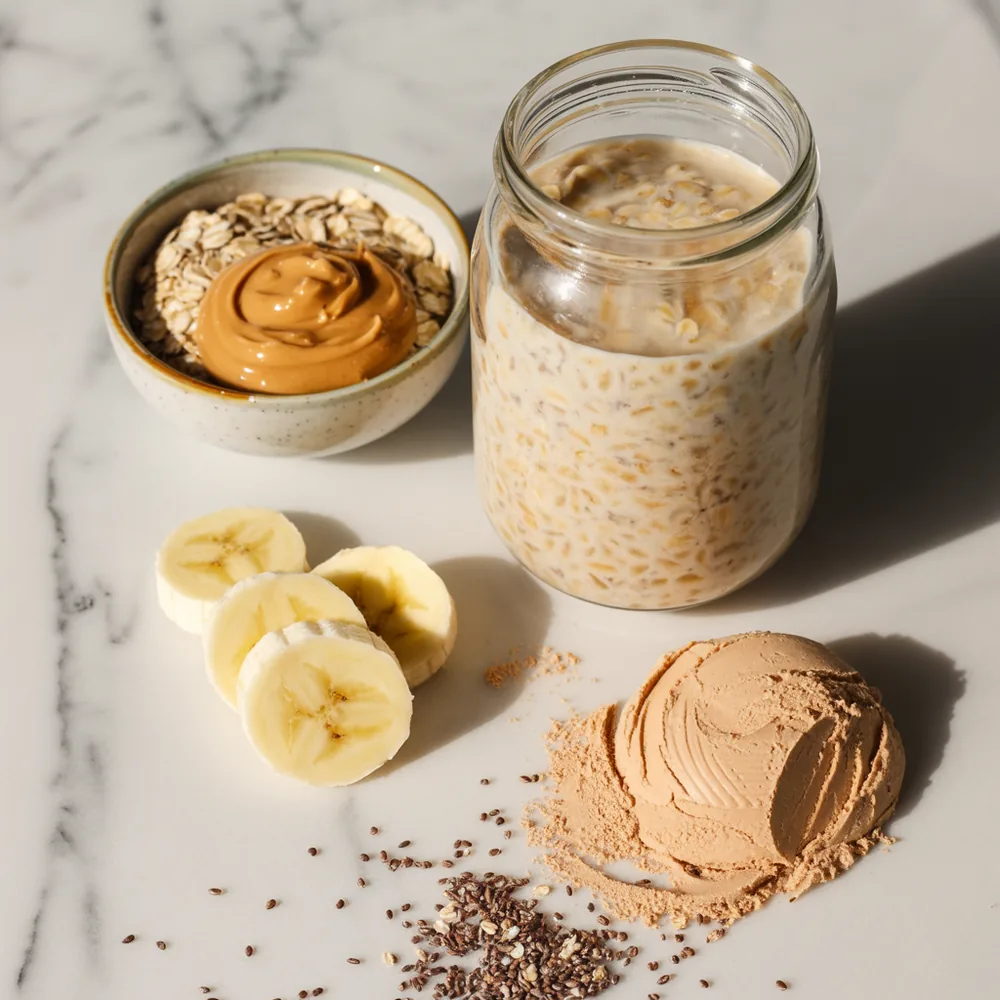
The ratio: Use about 1 part dry oats to 1 part liquid, add yogurt or chia to thicken, and rest at least 4 hours.
The base method is forgiving, which is part of the appeal. My default ratio is roughly one part dry rolled oats to one part liquid, so half a cup of oats to half a cup of milk, though I nudge it looser if I am adding thick Greek yogurt and tighter if I want a denser spoon. Rolled oats are the right choice here, since steel-cut stay too firm and quick oats turn to mush. Stir everything together in a jar, seal it, and let it rest in the fridge. The oats soften as they soak, no heat required.
Time is the only real ingredient you cannot rush. Four hours is enough to soften the oats, but overnight, meaning eight to twelve hours, gives the creamiest result, which is where the name comes from. They keep well too. I often make three or four jars at once on a Sunday, and they hold in the fridge for up to four or five days, so a batch covers most of the workweek. If you add fresh fruit, I stir that in the morning of rather than at the start, so it stays bright instead of breaking down.
The order you add things matters more than you would expect. I stir any protein powder into the liquid first so it dissolves cleanly, then add the oats, then the chia and seeds, and finally give it one more stir after ten minutes so the chia does not clump at the bottom. Toppings that should stay crisp, like nuts or granola, go on just before eating. Beyond that, it is hard to get wrong. A jar, a ratio close to even, and a night in the fridge is genuinely the whole technique.
A sample 30-gram protein jar
The build: Oats, soy milk, Greek yogurt, chia, and a spoon of peanut butter stack to about 30g protein in one jar.
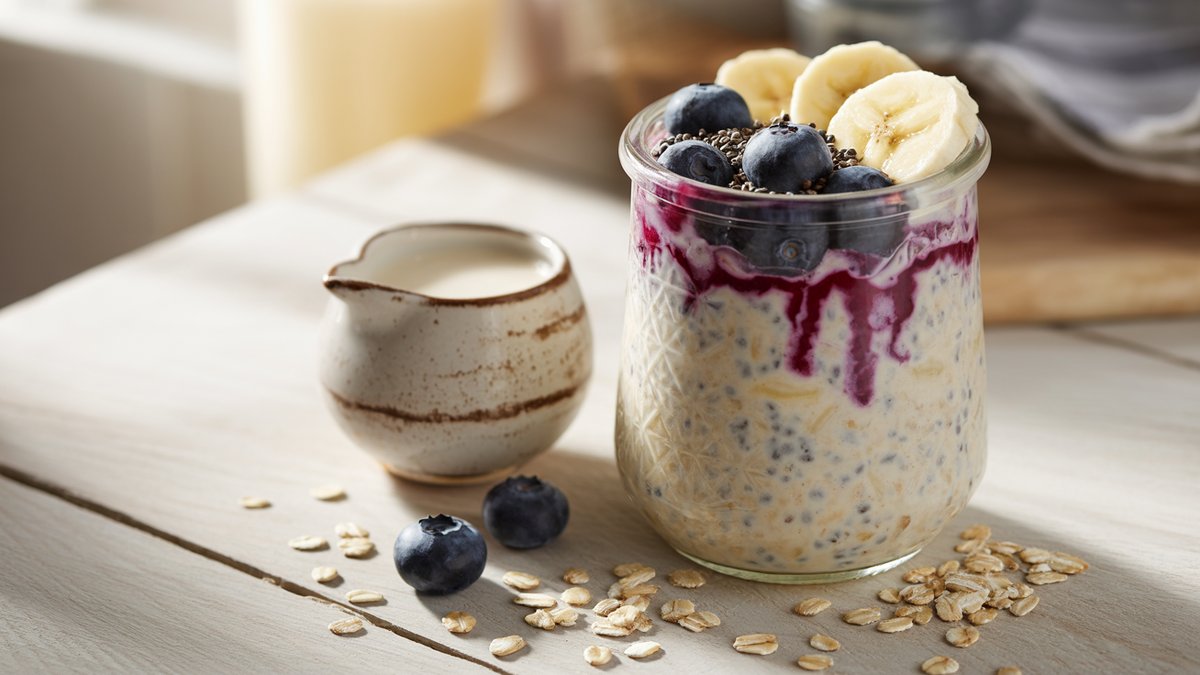
Here is a jar I actually make, with the amounts, so the numbers are not abstract. Start with half a cup of dry rolled oats, which gives you 5 grams of protein and 4 grams of fiber. Pour in half a cup of unsweetened soy milk for another 4 grams. Stir in half a cup of plain Greek yogurt, which adds roughly 11 grams. Already you are near 20 grams before any of the small boosters, and the base is creamy and thick from the yogurt sitting overnight.
Now the finishers. Add a tablespoon of chia seeds for about 2 grams of protein and a thicker set, then a tablespoon of hemp seeds for another 3 grams. Swirl in a tablespoon of peanut butter for 3 to 4 grams and a rich, satisfying flavor. That stacks up to around 30 grams of protein in a single jar, with something like 9 to 10 grams of fiber alongside it. The whole thing takes about three minutes to assemble at night, and it is genuinely filling in a way the plain version never was for me.
You can move the pieces around to fit what you have. Swap the soy milk for dairy and the number holds. Trade the Greek yogurt for a scoop of protein powder and a lighter milk, and you can push past 35 grams. Skip the peanut butter if you want it lighter, or add a handful of berries in the morning for color and a little natural sweetness. The point is not this exact jar, it is seeing how a few deliberate choices stack into a real breakfast. Once you see the math, you can build your own to whatever number you are aiming for.
Texture, sweetness, and small tips
Tips: Loosen a too-thick jar with a splash of milk, sweeten lightly, and add crunchy toppings only at the last minute.
A high-protein jar can turn stiff overnight, especially with lots of chia and protein powder, so a splash of milk in the morning is my standard fix. Stir it in and it loosens right back to a creamy, spoonable texture. If yours comes out too runny instead, add another teaspoon of chia and give it ten more minutes, since the seeds will drink up the extra liquid. The balance between oats, liquid, and thickeners takes a jar or two to dial in for your taste, and then it becomes second nature.
Protein powder and yogurt can make a jar taste tangy or a little chalky if you are not used to them, so a touch of sweetness helps a lot. I use a small drizzle of maple syrup or honey, or half a mashed banana stirred in, which sweetens and thickens at once. Vanilla protein powder does a lot of the flavor work on its own, and a pinch of cinnamon or a little cocoa can round out the taste. The goal is a jar you look forward to, because a breakfast you enjoy is one you will keep making.
Texture contrast is what keeps overnight oats from feeling like baby food, which is the most common complaint I hear. The soaked oats are soft and creamy, so I like to add something crisp right before eating, a spoon of granola, chopped nuts, cacao nibs, or toasted coconut. Fresh fruit adds a juicy brightness against the creamy base. Adding these at the last minute rather than the night before keeps them from going soggy in the fridge. That one habit, crunchy things on top at the end, does more for the eating experience than almost anything else.
When overnight oats won't fit your life
Honest fit: Gluten sensitivity, blood-sugar or portion concerns, and a simple dislike of cold oats are all fair reasons to skip them.
Overnight oats are not the right breakfast for everyone, and I would rather say so than pretend otherwise. Oats are naturally gluten free, but they are very often processed on shared equipment with wheat, so cross contact is common. If you have celiac disease or a real gluten sensitivity, look specifically for oats labeled certified gluten free, and know that plain oats still do not suit everyone even then. This is a place to follow your own body and your doctor's guidance rather than a general rule from an article, since these reactions are individual.
There is also a blood-sugar and portion angle worth naming honestly. Oats are a real source of carbohydrate, and a big jar loaded with banana, maple syrup, granola, and dried fruit can climb high in sugar and calories quickly, even while it looks wholesome. The fiber and protein help steady the response, but if you watch your blood sugar, the size of the jar and the sweet add-ins are worth keeping an eye on. Building the jar around protein and going easy on the sweet toppings is the version that stays balanced, rather than a dessert wearing a breakfast costume.
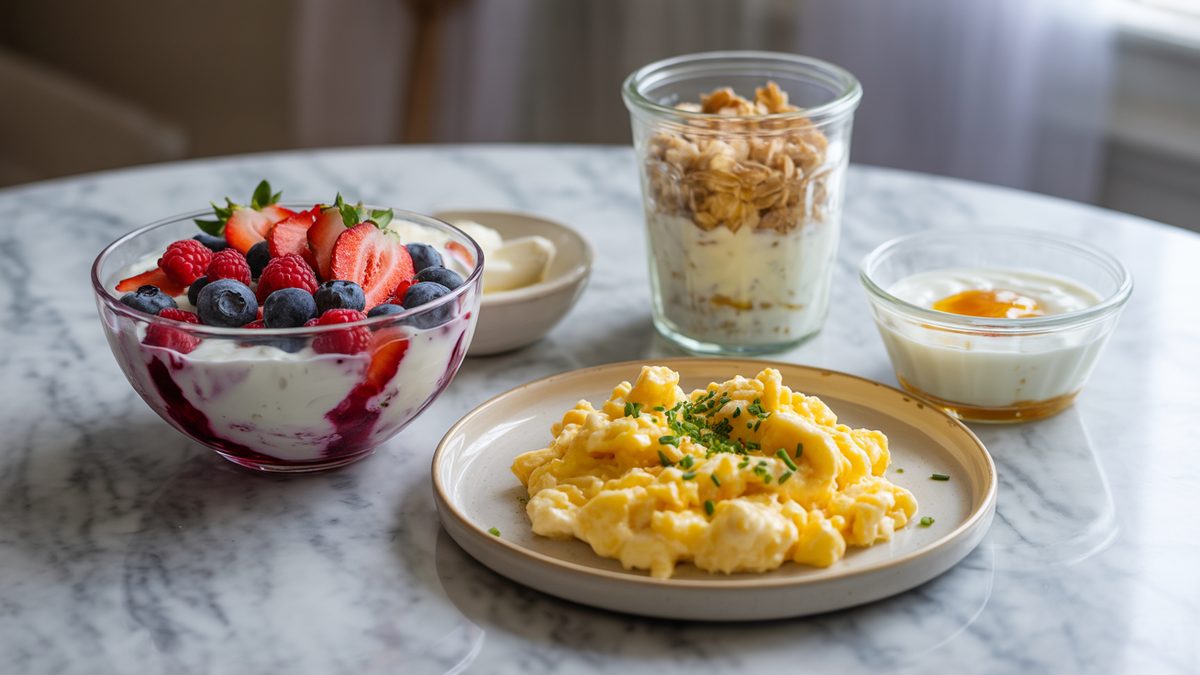
And plenty of people simply do not like cold, soft oats, and no amount of clever toppings will fix that. That is a completely fair reason to skip them. The good part is that the real goal transfers to any breakfast, which is anchoring your morning with a solid dose of protein and fiber so you stay full and steady. If cold oats are not it for you, warm oatmeal, a Greek yogurt bowl, eggs, or a protein smoothie all reach the same place. Hold onto the principle of a protein-forward, fiber-rich breakfast, and let the specific jar be optional.
Helpful sources and next reads
Reliable external sources
More from Sabrina Saturno
You may also love
FAQ
How much protein is in overnight oats?
A basic jar with half a cup of oats and half a cup of milk holds about 8 to 12 grams of protein, depending on the milk. Built up with yogurt, protein powder, or seeds, it can reach 25 to 35 grams.
How much protein is in half a cup of dry oats?
About 5 grams, along with roughly 150 calories and 4 grams of fiber. Oats are a whole grain, so their real strength is fiber and steady carbohydrate rather than protein.
Which milk adds the most protein to overnight oats?
Dairy milk and unsweetened soy milk both add about 4 grams per half cup. Almond, oat, coconut, and rice milk add 1 gram or less, so they barely move the number.
What is the easiest way to add protein to overnight oats?
A half cup of Greek yogurt, which adds roughly 10 to 12 grams and makes the jar creamier. A scoop of protein powder adds even more, around 20 to 25 grams.
How do I make 30 grams of protein overnight oats?
Combine half a cup of oats, half a cup of soy milk, half a cup of Greek yogurt, a tablespoon of chia, and a tablespoon of hemp seeds. That stacks to about 30 grams.
Does protein powder work in overnight oats?
Yes, and it is the strongest single booster. Stir a scoop into the liquid before adding the oats so it dissolves cleanly. Whey stays smooth, while plant blends thicken the jar more.
How much protein does chia add?
About 2 grams per tablespoon, plus a large dose of fiber. Chia also gels as it absorbs liquid, which thickens the whole jar into a pudding-like set.
Are overnight oats high in protein on their own?
Not really. A plain jar sits around 8 to 12 grams, which is a modest amount. The high-protein versions you see all rely on added yogurt, protein powder, or seeds.
How much fiber is in overnight oats?
A half cup of oats brings about 4 grams, including the soluble fiber beta-glucan. Adding chia and flax can push a loaded jar to 8 to 10 grams of fiber.
What is the best oats-to-liquid ratio?
Roughly one part dry rolled oats to one part liquid, or half a cup of each. Loosen it if you add thick Greek yogurt, and use rolled oats rather than steel-cut or quick oats.
How long do overnight oats need to soak?
At least four hours softens them, but eight to twelve hours overnight gives the creamiest result. They keep well in the fridge for up to four or five days.
Can I make high-protein overnight oats without dairy?
Yes. Use soy milk for its 4 grams of protein, add a plant-based protein powder, and lean on chia, hemp, and nut butter for the rest.
Are overnight oats good for weight management?
They can be, thanks to the protein and fiber that help with fullness. Just watch the portion size and go easy on sweet toppings like syrup, granola, and dried fruit.
The version that lasts
The jar I keep coming back to is not fancy. Oats, soy milk, a scoop of Greek yogurt, a spoon of chia, and whatever fruit is in the bowl by the sink. It lands somewhere around 25 grams of protein without me measuring anything anymore, because the ratio lives in my hands now. The sameness is the whole point. When breakfast is already decided and already in the fridge, I have one less thing to solve before coffee, and my mornings feel calmer for it.
Knowing the real numbers is what changed how I eat it. I stopped assuming a wholesome-looking jar was carrying my morning and started building it so it actually did. A basic jar is 8 to 12 grams, the yogurt or the scoop is the big lever, and the seeds are the finishing few. That small bit of math turned a pretty breakfast that left me hungry into one that genuinely holds me to lunch, which is all I ever wanted from it.
If there is a single idea to carry away here, let it be that a jar of overnight oats is only as high in protein as you build it to be. The oats bring fiber and comfort, and you bring the protein on purpose. Pick a base you enjoy, add one real protein source, finish with a few seeds, and keep it easy enough to repeat without thinking. The breakfast that keeps you full and steady is the one worth making, in whatever form you will actually eat most mornings.