
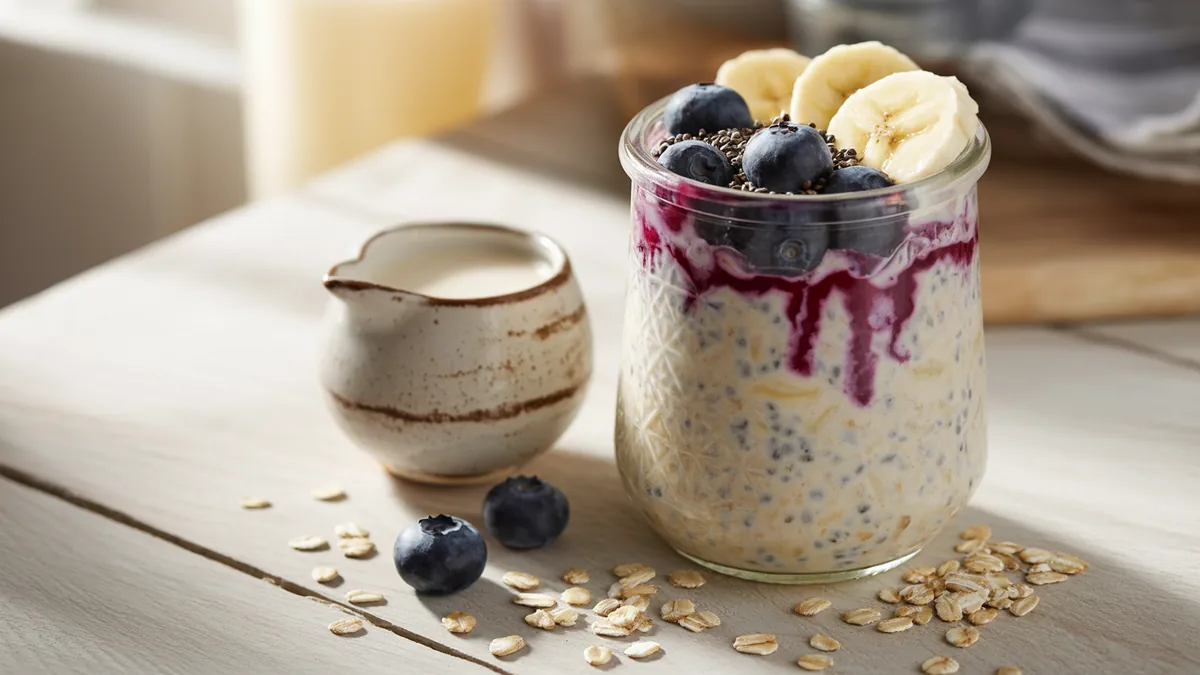
If you have been searching for an overnight oats recipe no yogurt version, here is the short truth before anything else: you do not need yogurt at all. I make overnight oats without yogurt almost every single morning of my life, and they come out just as thick, creamy, and spoonable as any photo you have ever scrolled past. The yogurt was never the magic. The milk is.
I think a lot of people assume yogurt is non-negotiable because every recipe they see piles a half cup of Greek yogurt on top of the oats. There is nothing wrong with that, but it leaves out the rest of us. Some of us are dairy-free. Some of us ran out of yogurt and want breakfast anyway. Some of us just do not love that tang first thing in the morning. This guide is for all of you, and it covers five honest ways to make creamy oats with no yogurt in sight.
I will give you my basic recipe, the small science of why the oats turn creamy without any yogurt, how to handle them with no chia seeds, how to get real protein without a scoop of powder, a head-to-head on almond versus coconut versus oat milk, five flavor variations I rotate, and yes, exactly how to heat them up when a cold jar is the last thing you want. No fluff, just the version that lasts.
| Base | Texture | Best for |
|---|---|---|
| Almond milk | Light and loose, gently nutty | A lower-calorie jar; add nut butter for body. |
| Coconut milk | Rich, thick, almost pudding-like | The creamiest dairy-free cup, no yogurt missed. |
| Oat milk | Naturally sweet and smooth | An everyday creamy jar that froths and blends well. |
| Dairy milk (no yogurt) | Classic, silky, mild | Not dairy-free, but still no yogurt and very creamy. |
| Without chia | Softer set, looser without the gel | Anyone who dislikes chia; lean on oats and rich milk. |
Can you make overnight oats without yogurt
Plain answer: Yes. Yogurt is optional in overnight oats. The oats soften because they soak in liquid overnight, so a creamy milk does everything yogurt was doing and more.
Can you make overnight oats without yogurt is the question I get most, and the answer is an easy yes. Overnight oats are simply rolled oats left to soak in cold liquid until they soften and swell. That softening happens whether or not yogurt is in the jar. The oats drink up the liquid, break down a little, and turn plush by morning. Yogurt is a flavor and a thickener, not a requirement.
When I first started making these, I followed a recipe that wanted both milk and yogurt. The oats were good, but I always felt like the yogurt was crowding the jar and adding a sourness I did not want at six in the morning. One day I left it out, doubled down on a richer milk, and the result was creamier, cleaner, and frankly easier. I never put the yogurt back.
So if a recipe insists you cannot skip it, ignore that. Dairy free overnight oats are not a sad compromise. They are the version a huge number of people, myself included, prefer once they realize the milk is the part doing the heavy lifting. The rest of this article is just me showing you how to get that texture right every time.
Why skip the yogurt
In short: People skip yogurt for dairy-free needs, a milder flavor, fewer ingredients, or simply because they ran out. None of those reasons hurt the texture.
There are a handful of honest reasons to leave yogurt out, and all of them are valid. The most common is dairy. If you are lactose intolerant or eating plant-based, traditional yogurt is off the table, and the dairy-free yogurts can be expensive, oddly sweet, or hard to find. Building your oats on plant milk alone is cheaper and simpler.
Then there is flavor. Yogurt brings a tang that some people love and some people genuinely do not want first thing in the morning. Without it, the oats taste softer and more like a gentle bowl of cereal, which lets the vanilla, fruit, and nut butter come through more clearly. I find the no-yogurt version tastes more like a treat and less like a health chore.
And honestly, sometimes it is just about what is in the fridge. I do not always have yogurt on hand, but I always have oats and some kind of milk. A breakfast you can make from two staples beats a fancier one you skip because you are missing an ingredient. That make-it-easy logic is the whole point. It runs through my wider meal prep approach too, where the best recipe is the one you will actually repeat.
One more reason: ingredient lists. A jar with oats, milk, a drizzle of maple, and fruit feels clean and uncomplicated. There is something calming about a breakfast you can name every part of. Skipping yogurt is not about it being bad. It is about keeping the bowl simple and letting it work for your real life.
What makes them creamy without yogurt
The creamy secret: The creaminess comes from the milk and the oat starch, not yogurt. A rich plant milk plus time in the fridge does all the thickening you need.

Here is the part that changes everything once you understand it. Rolled oats are full of starch, and as they soak overnight they release some of that starch into the liquid. The liquid thickens, the oats soften, and the whole jar turns creamy on its own. That is the mechanism. Yogurt only ever added extra body on top of a process the oats were already doing.
So the lever you actually control is the milk. The richer and fattier the milk, the creamier the result. Full-fat coconut milk makes an almost pudding-like jar. Oat milk, especially the barista kind with a little added fat, gives a smooth, naturally sweet creaminess. Even regular dairy milk without any yogurt comes out silky. Thin, watery milks give thinner oats, which is the single most common reason a no-yogurt jar disappoints people.
The ratio matters as much as the milk. My default is one part oats to one part liquid, so a half cup of each. That gives a thick, scoopable jar. If you like it looser, nudge the liquid up. If you want it almost solid enough to flip the jar over, keep the liquid tight and add a spoon of nut butter for richness. Oats are forgiving, so once you find your ratio you will rarely measure again.
The last creaminess trick is patience and a good stir. The oats need a real soak, ideally six to eight hours, to fully soften. And you must stir well at the start so there are no dry pockets at the bottom. A lazy stir is why some jars come out half-creamy, half-crunchy. Thirty seconds of mixing fixes it.
My basic overnight oats without yogurt recipe
Recipe in short: Stir a half cup of rolled oats with a half cup of almond or coconut milk, a little maple, vanilla, and salt, then refrigerate overnight and top with fruit.
This is the jar I make most, the one all the variations branch off from. It takes about five minutes the night before and gives one generous serving. I build it right in the jar I will eat from, because washing a separate bowl at night is a small chore I refuse to do. Double everything if you want two days at once.
Ingredients
- 1/2 cup rolled oats, old-fashioned not instant
- 1/2 cup almond milk or coconut milk, the creamier the better
- 1 teaspoon maple syrup, or to taste
- 1/4 teaspoon vanilla extract
- 1 pinch of salt, it really does wake up the flavor
- 1 tablespoon nut butter, optional, for richness and staying power
- Fruit to top, whatever you have, berries and banana are my default
Method
- Add the oats, milk, maple syrup, vanilla, and salt to a jar or small bowl. If you are using nut butter, add it now so it blends in while everything is loose.
- Stir well, really well, scraping the bottom so every oat is wet and no dry clumps hide underneath. This thirty-second step is what guarantees a creamy jar.
- Cover and refrigerate at least six to eight hours, or overnight. The oats will drink up the milk, soften, and thicken into a spoonable jar.
- In the morning, give it one more stir. If it is thicker than you like, splash in a little more milk. Top with fresh fruit and eat cold, or warm it if you prefer.
That is the whole thing. It is endlessly flexible, but those bones never change: oats, a creamy milk, a touch of sweetness, salt, and time. If you want a cozy caffeine-free drink alongside, like my golden milk, the two make a quiet, lovely slow morning together.
Overnight oats without chia seeds
No chia, no problem: Chia thickens oats by forming a gel, but you do not need it. Lean on a richer milk, a tighter oat-to-liquid ratio, and a full overnight soak.
A lot of recipes throw chia seeds into overnight oats, and plenty of people search specifically for overnight oats without chia seeds because they dislike the texture, the way chia gets between your teeth, or simply do not keep them stocked. Good news: chia is completely optional. It is a thickener, nothing more, and the oats can be plenty thick on their own.
Chia works by absorbing liquid and forming a soft gel, which firms up the jar and gives that slightly tapioca-like bite. If you do not want that, you replace its thickening job with two easy moves. First, use a richer milk, since coconut or full oat milk bring their own body. Second, keep your liquid ratio a touch tighter, closer to a scant half cup of milk per half cup of oats, so the oats are not swimming.
The other trick for chia-free oats that still hold their shape is a spoon of nut butter or a mashed half banana stirred in. Both add body and make the jar feel dense and satisfying without any gel. I genuinely prefer my oats this way. They taste like soft, creamy oatmeal rather than pudding, and that is the texture I reach for nine mornings out of ten.
If you have ever been turned off overnight oats entirely because of chia, please try a chia-free jar before you write the whole thing off. Many people who think they hate overnight oats actually just dislike chia gel. Take it out, lean on a good milk, and you may find the breakfast you assumed was not for you.
Protein overnight oats without protein powder
Real-food protein: You can make protein overnight oats without protein powder using nut butter, hemp seeds, soy or pea milk, and a sprinkle of nuts, no scoop required.
Protein is the one thing people worry they lose when they drop the yogurt, since Greek yogurt is a protein powerhouse. But you do not need a tub of powder to build a filling jar. Protein overnight oats without protein powder are easy once you know which whole foods to lean on, and they taste far better than any chalky scoop. If you want the actual grams, I break down how much protein overnight oats have and every lever for pushing a jar higher.
Oats themselves bring a surprising amount, roughly five grams in a half cup before you add a thing. Stack real food on top of that. A tablespoon of peanut or almond butter adds protein and fat that keeps you full for hours. A tablespoon of hemp seeds adds a quiet three to four grams and a pleasant nuttiness. A scatter of chopped walnuts or almonds on top adds a little more along with crunch.
The milk is your biggest lever here. Soy milk and pea milk carry close to the protein of dairy, far more than almond milk, so building your jar on one of those is the single easiest upgrade. If you do eat dairy and just skip yogurt, regular cow's milk brings real protein too. Pick a higher-protein base and the rest of the jar does the rest.
My favorite high-protein no-powder combo is soy milk, a heaping tablespoon of peanut butter, a spoon of hemp seeds, banana, and a pinch of cinnamon. It lands somewhere around fifteen to twenty grams of protein from food alone, keeps me full until lunch, and tastes like dessert. Many of these add-ins live on my anti-inflammatory grocery list, so they earn their place in more than one breakfast.
Nut butter is the easiest thing to reach for when yogurt is out, so it is worth knowing its real profile, which I laid out in Peanut Butter Nutrition: The Full Profile.
Almond milk vs coconut milk vs oat milk
Quick verdict: Coconut milk is the creamiest, oat milk is the best everyday all-rounder, and almond milk is the lightest, so add nut butter when you use it.
Since the milk is doing all the work in a yogurt-free jar, it is worth knowing how the popular plant milks actually behave. I have made overnight oats with all three on repeat, and they give genuinely different jars. Here is the honest rundown so you can pick by mood and not by guesswork.
Almond milk overnight oats are the lightest of the three. Almond milk is thin and low in fat, so on its own it makes a looser, gently nutty jar that some people find a touch watery. It is my pick when I want a lower-calorie breakfast, but I almost always stir in a tablespoon of nut butter or a mashed banana to give it the body it lacks. With that small addition, almond milk oats are lovely.
Coconut milk overnight oats are the richest, full stop. The carton kind gives a nicely creamy jar, and a splash of the full-fat canned kind turns the oats almost into pudding. Coconut brings a faint tropical sweetness that plays beautifully with mango, pineapple, banana, and dark chocolate. When someone tells me they miss the creaminess of yogurt, coconut milk is the first thing I send them to.
Oat milk sits right in the middle and is my everyday default. It is naturally a little sweet, smooth, and creamy without being heavy, and it never fights the other flavors. It is also the most neutral, so it works with any topping. If you only want to buy one milk for your oats, make it oat milk. It is the reliable all-rounder, the one that rarely lets me down.
5 flavor variations
Five jars to rotate: Start with the basic recipe, then swap toppings and a little milk to make berry, peanut butter banana, mango coconut, apple cinnamon, and chocolate jars.

Once you have the basic jar down, the fun is in the toppings. Each of these starts from my basic recipe, so think of them as the same oats wearing different outfits. I rotate through these so breakfast never gets boring, and not one of them needs yogurt to feel complete.
Mixed berry. Use oat or almond milk, stir in a few smashed raspberries the night before so they bleed pink into the oats, then top with fresh blueberries and strawberries in the morning. A squeeze of lemon makes the berries pop. This is the brightest, freshest jar of the bunch and my summer default.
Peanut butter banana. Stir a heaping tablespoon of peanut butter and half a mashed banana into the oats before they soak, then top with banana coins and a few cacao nibs. It tastes like dessert, holds you for hours, and is the one I make when I know lunch will be late.
Mango coconut. Build it on coconut milk, add a pinch of extra vanilla, and top with diced mango and a sprinkle of toasted coconut flakes. This one tastes like a tropical vacation in a jar and is the creamiest of the five thanks to the coconut base.
Apple cinnamon. Stir in a quarter teaspoon of cinnamon and a spoon of grated apple, then top with diced apple and a few chopped walnuts. Warmed up, this one tastes like apple pie and is my cold-weather favorite. It is cozy in the same way my balanced breakfast bowl is when I want a warm option instead.
Chocolate. Whisk a teaspoon of cocoa powder and a little extra maple into the milk before adding the oats, then top with banana and a few dark chocolate chips. It feels indulgent but is still just oats and milk. A treat that doubles as breakfast, which is my favorite kind of trick.
Can you heat up overnight oats
Yes, you can: Heat overnight oats in the microwave for sixty to ninety seconds, stirring once, or warm them in a small pot. Add a splash of milk first since they thicken cold.
Can you heat up overnight oats is one of the most asked questions, and the answer is a happy yes. There is no rule that overnight oats must be eaten cold. On chilly mornings I almost always warm mine, and they turn into the creamiest bowl of oatmeal you can imagine, with the bonus that the overnight soak means they heat through in seconds.
The microwave is easiest. Scoop the oats into a microwave-safe bowl, stir in a splash of milk because they will have thickened overnight, and heat for sixty to ninety seconds, pausing to stir halfway so they warm evenly. Add the milk first, not after, or the oats can heat unevenly and clump. Then add cold toppings like fresh fruit after warming.
If you prefer the stove, tip the oats into a small pot with a splash of milk and warm them over medium-low, stirring, for a couple of minutes until hot and loose. This is gentler and gives a slightly silkier result. Either way, hold off on adding nut butter until the end if you want it to stay as a soft pocket rather than melting all the way in.
One small note: glass jars are fine to reheat oats in if they are microwave-safe, but never put a sealed lid in the microwave, and skip it entirely for metal jars. I usually just scoop into a bowl to be safe. A warm jar of overnight oats with melting nut butter on a cold day genuinely feels like a small kindness to yourself, the same make-it-easy spirit as my brew up wellness drinks.
Make-ahead and storage tips
Prep and keep: Overnight oats keep four to five days in the fridge, so make several jars at once. Add fresh fruit and crunchy toppings the morning you eat them.
The real gift of overnight oats is that they batch beautifully. On Sunday night I often make four or five jars at once, line them up in the fridge, and breakfast is handled for most of the week. They keep well for four to five days refrigerated, which covers a whole work week with one short session of stirring.
The trick to batching is to keep the toppings separate. Stir the base ingredients, oats, milk, maple, vanilla, salt, and any nut butter or mashed fruit, into each jar, but hold the fresh fruit, nuts, and anything crunchy until the morning you eat it. Berries stirred in early stay nice, but sliced banana browns and granola goes soggy, so those go on at the last minute.
Use jars with tight lids and they travel well too, which makes these a genuine grab-and-go breakfast for busy mornings. I keep a couple of half-pint mason jars exactly for this. If a jar gets too thick by day three or four, a splash of milk and a stir brings it right back to creamy. Thickening over time is normal and easy to fix, never a sign the oats have gone off.
Batching oats like this is one corner of my wider meal prep approach, where I try to do one calm hour of prep so future-me, who is always more tired and rushed, gets to coast. Breakfast you do not have to think about is a quiet luxury, and these jars deliver it for the price of a Sunday stir.
When this won't fit your life
I love these oats, but I will not pretend they suit everyone or every morning. If you genuinely do not like cold, soft textures, overnight oats may never win you over, and that is completely fine. Try warming them first, but if soft oats just are not your thing, a hot stovetop bowl or a savory breakfast may simply fit you better. There is no prize for forcing a food you do not enjoy.
A few practical limits too. If you eat gluten-free, make sure your oats are certified gluten-free, since plain oats are often cross-contaminated with wheat. If you are managing blood sugar, the carbs in a big oat jar can spike some people, so pair them with extra protein and fat and keep the sweetener modest, or talk to your provider. And if mornings are so rushed you will not even stir a jar the night before, be honest with yourself and pick a grab-and-go option you will actually reach for.
None of this is meant to talk you out of overnight oats. It is just the honest line between a breakfast that genuinely serves your life and one you keep guiltily abandoning in the back of the fridge. The best breakfast is the one you look forward to and actually eat, yogurt or no yogurt, oats or otherwise.
Helpful sources and next reads
Reliable external sources
- Harvard Nutrition Source: oats, a food feature
- Harvard T.H. Chan School: The Nutrition Source
- Cleveland Clinic: the benefits of oatmeal
More from Sabrina Saturno
You may also love



FAQ
Can you make overnight oats without yogurt?
Yes, easily. Yogurt is optional. Overnight oats soften because the oats soak in cold liquid overnight, so a creamy milk like coconut or oat does all the work. The no-yogurt version is often creamier and milder, and many people, myself included, prefer it.
What can I use instead of yogurt in overnight oats?
Use a richer milk in its place. Full-fat coconut milk and oat milk give the creamiest jars without any yogurt. A spoon of nut butter or a mashed banana adds extra body, and even plain dairy milk with no yogurt makes a silky, satisfying jar.
Can you make overnight oats without chia seeds?
Absolutely. Chia is only a thickener. Skip it and lean on a creamier milk, a slightly tighter oat-to-liquid ratio, and a full overnight soak. A spoon of nut butter or mashed banana firms up the jar without any gel, and the texture is softer and more like creamy oatmeal.
How do I add protein without protein powder?
Build the jar on soy or pea milk, which carry near-dairy protein, then add a tablespoon of nut butter, a spoon of hemp seeds, and a scatter of chopped nuts. Oats themselves bring around five grams per half cup, so real food can stack to fifteen or twenty grams easily.
Is almond milk or coconut milk better for overnight oats?
Coconut milk makes a richer, creamier jar, almost pudding-like with the full-fat kind. Almond milk is lighter and lower in calories but thinner, so stir in nut butter or banana to give it body. Coconut wins for creaminess; almond wins for a lighter breakfast.
Can you heat up overnight oats?
Yes. Add a splash of milk first since they thicken cold, then microwave sixty to ninety seconds, stirring halfway, or warm them in a small pot over medium-low. They become a creamy, fast bowl of oatmeal. Add fresh fruit after heating so it stays bright.
How long do overnight oats keep in the fridge?
About four to five days when stored covered in the fridge, which makes them ideal for batching a whole week at once. Keep fresh fruit, nuts, and crunchy toppings separate and add them the morning you eat, since those do not hold up well over several days.
Are overnight oats without yogurt healthy?
They can be a genuinely nourishing breakfast. Oats are a whole grain with fiber that supports steady energy and heart health. Keep the sweetener modest, add fruit and a protein source, and a yogurt-free jar is just as wholesome as one with yogurt, often with a cleaner ingredient list.
Do overnight oats need to be refrigerated?
Yes. Because they sit in liquid for hours, overnight oats must soak and store in the fridge, not on the counter, to stay safe. Make them at night, refrigerate, and eat within four to five days. If a jar smells off or sour beyond a normal tang, toss it.
Can you make overnight oats with water instead of milk?
You can, but they will be far less creamy and more bland, since the richness comes from the milk. If water is all you have, add a generous spoon of nut butter or mashed banana to bring back body. Any milk, even a light plant milk, gives a much better jar than water.
Why are my overnight oats not creamy?
Usually the milk is too thin or the stir was rushed. Switch to a richer milk like coconut or oat, mix thoroughly so no dry pockets hide at the bottom, and give the oats a full six to eight hour soak. A spoon of nut butter or mashed banana also instantly boosts creaminess.
What oats are best for overnight oats?
Old-fashioned rolled oats are ideal. They soften to a creamy, plush texture while keeping a little bite. Skip instant oats, which turn mushy, and steel-cut oats, which stay too firm and chewy when soaked cold. Rolled oats are the reliable middle ground every time.
The version that lasts
Here is where I have landed after countless jars in the back of my fridge. Overnight oats without yogurt are not a workaround or a lesser version. For me and a lot of people, they are the better one: simpler, creamier, dairy-free when you need it, and built from two staples you almost always have. The yogurt was never the secret. The milk and a little patience always were.
Pick your base, get the ratio close to one to one, stir it like you mean it, and let the fridge do the rest overnight. Skip the chia if you do not love it. Reach for soy milk and peanut butter when you want real protein. Warm the jar on cold mornings. None of this is fussy, and that is exactly why it sticks around in a real, busy life.
So make a jar tonight with whatever milk is open and whatever fruit is on the counter. If it becomes the thing you grab without thinking, batch five at a time on Sunday and coast through the week. The version that lasts is the one you actually eat, morning after ordinary morning, and a creamy little jar of oats with no yogurt in sight has been exactly that for me.