
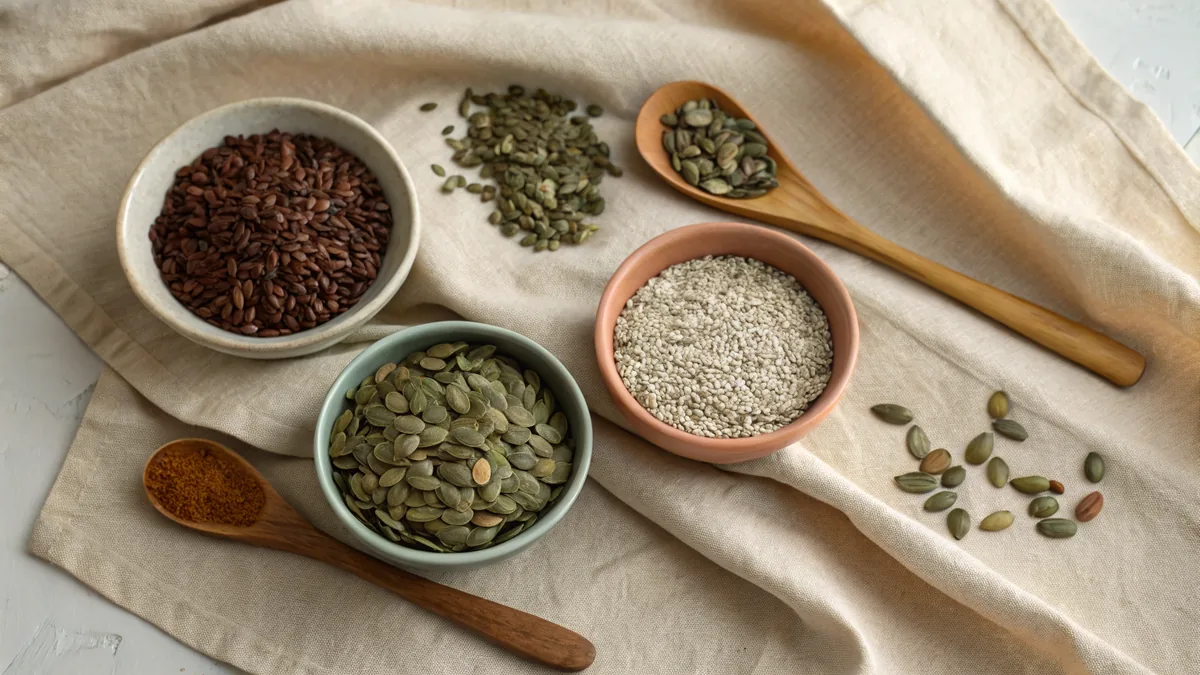
If you came here for the seed cycling chart, it is right below, and you can screenshot it and leave with my blessing. Two phases, four seeds, one tablespoon of each pair per day. Flax and pumpkin in the first half of your cycle, sesame and sunflower in the second. That is the entire system. Everything else in this guide is the part the charts on Pinterest never tell you.
Before we go further, I want to be clear about who is talking. I am not a doctor, a dietitian, or anyone qualified to treat a hormone condition. I am a woman in her thirties who tried seed cycling out of curiosity during a stretch of rough PMS, kept it because it made my breakfasts better, and stayed honest about what it did and did not change. This article is gentle food talk, not medical advice.
I also want to lower the temperature around the word hormones, because the wellness internet has turned it into a fear word. Your cycle is not a problem to be hacked. Seed cycling, at its most honest, is a pretty ritual that adds fiber, minerals, and healthy fats to your day on a schedule that helps you pay attention to your body. That alone earned it a permanent place in my kitchen.
| Phase | Cycle days | Moon version | Daily seeds | Gentle focus |
|---|---|---|---|---|
| Phase 1, follicular | Day 1 (first day of period) through day 14 | New moon to full moon | 1 tbsp ground flax + 1 tbsp pumpkin seeds | The estrogen-led first half: lignans from flax, zinc from pumpkin, steady fiber. |
| Phase 2, luteal | Day 15 through day 28, or until your period starts | Full moon to new moon | 1 tbsp sesame seeds + 1 tbsp sunflower seeds | The progesterone-led second half: sesame lignans, vitamin E and selenium from sunflower. |
| No cycle or irregular cycle | Follow the moon instead of the calendar | Switch pairs at each new and full moon | Same pairs, same amounts | A steady rhythm when your body does not give you a day 1 to count from. |
What seed cycling actually is
Plain definition: Seed cycling is the practice of eating two rotating pairs of seeds, flax with pumpkin, then sesame with sunflower, matched to the two halves of a menstrual cycle.
The idea is simple enough to fit on an index card. A typical menstrual cycle has two halves. The first half, called the follicular phase, runs from the first day of your period to ovulation, and estrogen is the louder hormone. The second half, the luteal phase, runs from ovulation to your next period, and progesterone takes the lead. Seed cycling assigns a seed pair to each half.
During the follicular phase you eat a tablespoon each of ground flax and pumpkin seeds daily. After ovulation you switch to a tablespoon each of sesame and sunflower seeds. When your period arrives, you start over. The theory says the lignans, zinc, vitamin E, and selenium in each pair nudge each phase along. The theory is also, and I will get into this properly later, thinner on evidence than most charts admit.
What pulled me in was not the hormone promise. It was the structure. I had been wanting to understand my cycle better for years, and tracking apps felt clinical. A bowl of seeds that changes twice a month turned out to be a softer way of paying attention. The chart became less of a protocol and more of a calendar I could taste.
The four seeds, in one breath
Flax brings lignans and omega-3 fats. Pumpkin brings zinc and magnesium. Sesame brings its own lignans plus calcium. Sunflower brings vitamin E and selenium. All four bring fiber, minerals, and the quiet satisfaction of eating something that crunches. Whatever the hormone story turns out to be, those nutrients are real, measurable, and genuinely useful in a normal American diet that tends to run low on several of them.
Phase 1: flax and pumpkin, days 1-14
Phase 1 in short: From the first day of your period through roughly day 14, eat one tablespoon of ground flax and one tablespoon of pumpkin seeds each day.
Day 1 is the first day of real bleeding, not spotting. From that day until about day 14, the chart calls for flax and pumpkin. I keep both pre-portioned in a jar by the coffee maker, because phase 1 usually starts on the exact morning I have the least energy for measuring anything.
Flax is the seed with the most interesting research behind it. Its lignans are plant compounds that interact weakly with estrogen receptors, which is the entire reason flax shows up in nearly every hormone conversation on the internet. Ground matters, and I will say this several times because it is the most practical fact in this article: whole flax seeds mostly pass through you intact. Grind them, or buy them ground and keep them cold.
Pumpkin seeds are the phase 1 partner mostly for their zinc, a mineral involved in ovulation and progesterone production, at least on paper. I stopped needing the rationale after a few weeks, honestly. Pumpkin seeds made my morning yogurt better, they kept me full until lunch in a way that surprised me, and they cost almost nothing in the bulk aisle.
What phase 1 looks like on a real morning
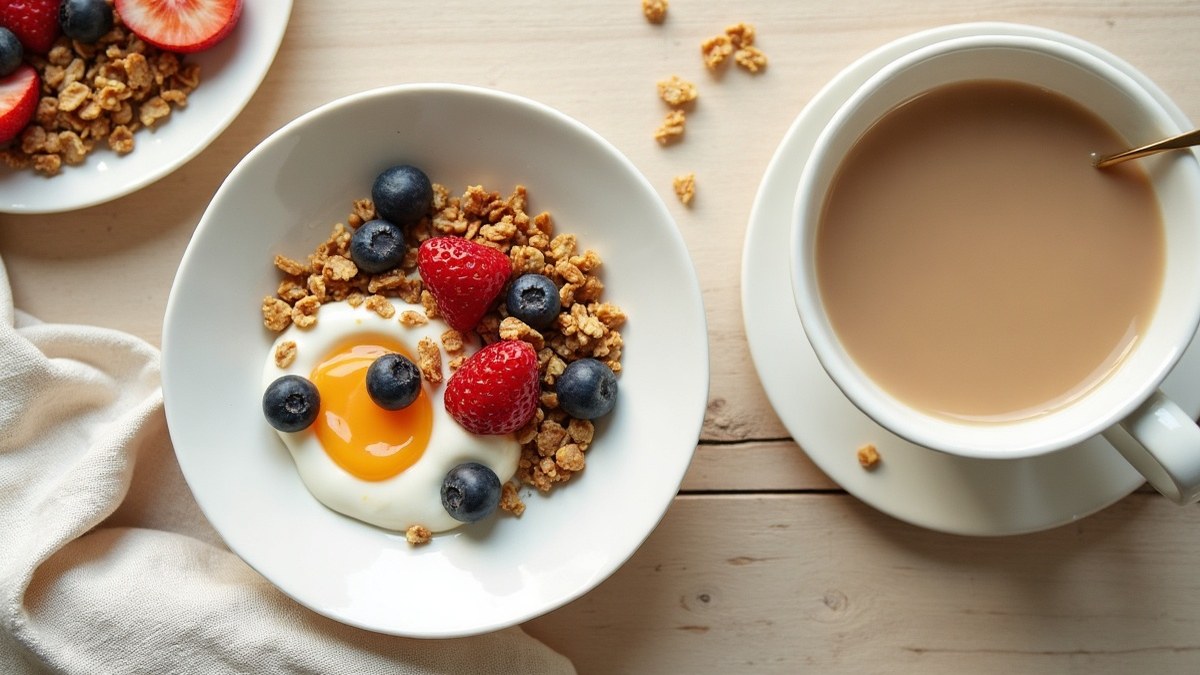
My default is embarrassingly repetitive. Greek yogurt or a smoothie, a tablespoon of ground flax stirred in, a tablespoon of pumpkin seeds on top, berries if I have them. Ninety seconds of effort. On oatmeal mornings both seeds go into the pot. On chaotic mornings they go into a balanced breakfast bowl I can assemble half asleep, which is the only kind of recipe that survives a workweek.
Phase 2: sesame and sunflower, days 15-28
Phase 2 in short: From about day 15 until your period begins, switch to one tablespoon of sesame seeds and one tablespoon of sunflower seeds daily.
Somewhere around day 14 or 15, ovulation happens for most people with a textbook cycle, and the chart flips. Out go flax and pumpkin, in come sesame and sunflower. This is the seed cycling second half that people search for and then second-guess, so let me make it concrete. Same amounts, one tablespoon of each seed, every day, until bleeding starts. Then you return to phase 1.
Sesame seeds carry lignans of their own, slightly different from the ones in flax, plus calcium and copper. Tahini counts, which is the single most useful thing I can tell you about phase 2, because a spoonful of tahini drizzled over roasted vegetables or whisked into a lemony dressing is far easier to love than dry seeds sprinkled on things out of duty.
Sunflower seeds bring vitamin E and selenium, two nutrients the luteal phase story leans on. They are also the cheapest seed of the four and the easiest to find toasted. I buy them raw and unsalted, toast a batch on Sunday while my meal prep is in the oven, and they taste like something you would actually choose rather than something a chart assigned you.
Knowing when to switch without lab equipment
You do not need ovulation strips for this. If your cycle is fairly regular, divide it in half and switch in the middle. A 30-day cycle switches around day 15. A 26-day cycle switches around day 13. If you are off by a day or two, nothing happens, because seeds are food, not medication with a dosing window. The gentlest version of this practice treats the chart as a rhythm, never a rule.
Seed cycling with the moon
The moon method: No period or an irregular cycle? Run phase 1 from new moon to full moon and phase 2 from full moon to new moon.
If you do not have a cycle to track, because of birth control, perimenopause, postpartum, PCOS, or simply a body that refuses calendars, the traditional workaround is the moon. Phase 1 runs from the new moon to the full moon. Phase 2 runs from the full moon back to the new moon. The lunar cycle is about 29.5 days, conveniently close to the textbook 28.
I will be straight with you: there is no biology connecting your ovaries to the moon, and anyone who tells you otherwise is selling something. The moon version exists because a rhythm needs an anchor, and the moon is a free, beautiful, universally available one. When my own cycle went strange for a few months during a stressful season, the moon dates kept the habit alive when day counting could not.
There is also something quietly lovely about it. Checking the moon phase before bed became part of my evening reset routine without my planning it. If a chart gets you to step outside and look at the sky twice a month, the chart has already paid for itself, whatever your hormones think.
How I actually eat the seeds every day
The honest method: Attach the seeds to a meal you already eat. Breakfast is easiest: stir them into yogurt, oatmeal, or a smoothie and stop thinking about it.

Every seed cycling chart fails at the same spot, and it is never the chart. It is day nine, when the novelty has worn off and a pile of dry seeds on a plate feels like homework. The fix is to stop treating the seeds as a separate wellness task and start treating them as a default topping that lives where you can see it.
Breakfast carries the habit for me. Yogurt, oatmeal, and smoothies absorb a tablespoon of ground flax without changing flavor much, and whole pumpkin or sunflower seeds add the crunch those breakfasts were missing anyway. If breakfast is not your meal, salads take all four seeds gracefully, soups take a sprinkle on top, and tahini handles sesame duty in dressings all phase 2 long.
Two practical notes that charts skip. First, flax loves water, so drink normally through the day; the extra fiber is real, and my whole hydration routine works harder during seed weeks. Second, start with half-tablespoons for the first week if your body is not used to fiber. Four tablespoons of enthusiasm on day one is how people end up bloated and blaming the seeds.
The visibility trick
The single change that made me consistent: the current phase's jar sits next to the coffee maker, and the off-phase jar lives in the fridge, out of sight. I never decide whether to eat the seeds. I just see the jar while the coffee brews. It is the same lazy-kindness logic that runs my entire anti-inflammatory grocery list: make the good choice the visible one and let tired-you take the credit.
Seed cycling recipes: energy balls and smoothies
Easiest recipe: Blend 1 cup oats, 10 dates, 1/2 cup nut butter, and 7 tablespoons of your current phase's seeds into 14 energy balls, two per day for a week.

Seed cycling energy balls are the reason I am still doing this two years later, so they get the full recipe. In a food processor, blend one cup of rolled oats, ten pitted Medjool dates, half a cup of peanut or almond butter, a pinch of salt, and seven tablespoons of your current phase's seed pair, roughly three and a half tablespoons of each seed. For phase 1, grind the flax first. Roll into fourteen balls.
Two balls a day delivers approximately the daily tablespoon of each seed, and the math does not need to be perfect because nothing about this practice is dose-critical. For phase 2 I roll the finished balls in extra sesame seeds, which looks bakery-level fancy for zero added effort. They keep five days in the fridge and a month in the freezer, which means one fifteen-minute Sunday session covers half a phase.
The smoothie version
When it is too warm for oatmeal, the seeds go into a smoothie: one frozen banana, a cup of frozen berries, a handful of spinach, milk of any kind, and the day's seed pair, flax ground, the rest whole. The blender erases all texture objections. It is the same formula I lean on across my wellful nutrition approach: protein, fiber, fruit, done thinking.
Beyond breakfast
For savory people: phase 1 seeds toast beautifully into a crunchy topping for soups and grain bowls, and pumpkin seeds blitzed with parsley, garlic, and olive oil make a five-minute pesto. Phase 2 is even easier, because tahini exists. A lemon-tahini dressing on a big salad, sunflower seeds over roasted broccoli, and you have covered the day without a single sweet bite. These little add-ons also do double duty on my high-protein snack rotation.
Grinding, storing, and the five-minute setup

The whole setup costs about fifteen dollars and five minutes. Buy the four seeds raw and unsalted, from the bulk bins or the baking aisle, where they are half the price of anything labeled wellness. You need two jars, or four if you like symmetry. A coffee grinder, a mini blender, or pre-ground flax handles the grinding question.
Storage matters more with seeds than people expect, because their healthy fats are exactly the kind that go rancid. Whole seeds keep for months in a cool pantry. Ground flax is the fragile one: it oxidizes within weeks at room temperature, so grind small batches, store them in the fridge or freezer, and trust your nose. Rancid seeds smell like old paint, and no chart benefit survives that taste.
My Sunday ritual takes the length of a kettle boil. I grind four or five days of flax if I am in phase 1, top up the counter jar, and put two energy balls' worth of ingredients in the processor if the batch is running low. That is the entire infrastructure. Anything more elaborate would not have survived my actual life, and surviving real life is the only metric I trust anymore.
My first three months, honestly
I started seed cycling in a January, for reasons that had nothing to do with science. My PMS had been loud for half a year, my doctor had run the sensible tests and found nothing alarming, and I wanted to do something kind for my body that did not involve buying supplements from an influencer. Seeds felt safe. Worst case, I figured, I would be out fifteen dollars and slightly more regular in the fiber department.
Month one was mostly logistics. I ate flax whole for the first week before learning the grinding rule, which means my first week was largely ceremonial. I forgot the switch day and ran phase 1 for nineteen days. None of it mattered. What did matter was that by week three, the seeds had attached themselves to breakfast so firmly that skipping them felt strange, the way skipping coffee feels strange.
Month two is when the noticing started, and I want to be careful here, because this is the part of every seed cycling story where the telling gets bigger than the truth. My afternoon snacking calmed down noticeably, which I now credit to the fat and fiber rather than anything hormonal. I slept a little better in my luteal week. My skin did nothing different whatsoever, despite what the prettier charts had promised.
By month three I knew my cycle the way I know my own street. I could feel the switch week coming. I had stopped being surprised by the tired days, because the jar on the counter told me they were scheduled. That awareness turned out to be the actual product. The chart was just the packaging it arrived in, and I say that with real affection for the packaging.
Would those three months hold up in a clinical trial? No, and I am not going to pretend otherwise. One woman with a jar of seeds is an anecdote, not data. But living inside your own anecdote is pleasant when the anecdote involves better breakfasts, and I have made peace with that being the most defensible claim on this entire page.
What the science honestly says
The honest summary: Seed cycling as a protocol has almost no direct research behind it. The individual seeds are genuinely nutritious, and that part is well documented.
Here is the section most seed cycling charts quietly skip, and the one I refuse to. If you search medical databases for trials testing the full seed cycling protocol, alternating pairs matched to cycle phases, you will find almost nothing. A couple of very small studies, none of them strong enough to build claims on. The protocol, as a protocol, is essentially untested. Anyone telling you seed cycling is proven to balance hormones is decorating.
What does exist is decent research on the individual seeds. Flax has the most: studies suggest its lignans can modestly influence estrogen metabolism, and one frequently cited older study found flax consumption associated with more regular cycles and fewer anovulatory cycles in a small group of women. Zinc, vitamin E, and selenium all play documented roles in reproductive health. The leap from those threads to a choreographed two-phase protocol is exactly that, a leap.
The Cleveland Clinic's take mirrors where I landed: the hormone-balancing claims outrun the data, but the seeds themselves are nutrient-dense, and adding them to your diet is a perfectly good idea. You can read their full take on seed cycling for hormones. The NIH's National Center for Complementary and Integrative Health says something similar about flaxseed specifically: promising threads, modest evidence, no miracles.
So why do people swear by it?
A few honest possibilities. Two tablespoons of seeds a day adds fiber, minerals, and fat that many diets lack, and people genuinely feel better when those gaps close. The ritual makes people track their cycles, and awareness alone changes how symptoms register. And yes, placebo is real and underrated; a practice that makes you feel cared for is doing something, even when the mechanism on the label is wrong.
My own results after two years sit exactly in that humble territory. My PMS did not vanish. My breakfasts got better, my snacking steadied, my fiber intake quietly doubled, and I know my cycle's rhythm in a way no app ever taught me. I consider that a win worth keeping. I just refuse to call it hormone balancing, because I promised you honesty over aesthetics.
Common mistakes
The big four: Eating flax whole, expecting results in one cycle, treating missed days as failure, and buying expensive pre-mixed blends you could assemble for a third of the price.
The first mistake is mechanical: eating flax seeds whole. Their shells are built to survive digestion, which is wonderful for the flax plant and useless for you. Grind them, buy them ground, or skip the flax half of phase 1 entirely rather than eating decorative seeds. Whole pumpkin, sesame, and sunflower seeds are fine as they are.
The second is impatience wearing a lab coat. People try the chart for three weeks, feel nothing dramatic, and declare it broken. Whatever seed cycling can or cannot do, a single cycle is noise. If you are going to experiment, give it three months and keep lazy notes, three words in a phone note on bad days counts. You are looking for trends, not lightning.
The third is perfectionism, my home discipline. Miss a day and the spiral starts: the phase is ruined, might as well quit until next cycle. Seeds are food. Missing a Tuesday means nothing. Resume Wednesday. The chart survives holidays, travel weeks, and stomach bugs, because it was never a precision instrument to begin with.
The fourth is the wellness tax. There are now subscription boxes selling pre-portioned seed cycling packets at boutique prices. The bulk aisle sells the same four seeds for a few dollars a month. If a subscription is genuinely the difference between doing this and not doing it, fine, no judgment. But know exactly what you are paying for, and it is not better seeds.
When this won't fit your life
If you have a seed allergy, this whole article is obviously not for you, and sesame allergies in particular are common and serious. If you have a digestive condition like IBS, the fiber jump can backfire; go slowly or skip it. If you are pregnant, breastfeeding, managing PCOS, endometriosis, thyroid disease, or a hormone-sensitive condition, or you are on medications that interact with fiber or vitamin E, talk to your doctor before adding concentrated daily seeds. Flax in particular is something to discuss during pregnancy.
And if tracking your cycle is emotionally loaded for you right now, because of fertility struggles, a recent loss, or a complicated relationship with your body, you have my full permission to close this tab. A seed chart should never become another place to grade yourself. The Office on Women's Health has solid, calm information about cycles if what you actually need is understanding rather than a protocol. Real symptoms deserve real care: painful periods, missing periods, and PMS that wrecks your week are conversations for a clinician, not a chart.
Helpful sources and next reads
Reliable external sources
- Research review: does seed cycling balance hormones?
- NIH NCCIH: flaxseed and flaxseed oil
- Office on Women's Health: your menstrual cycle
- Harvard T.H. Chan School: The Nutrition Source
- NIH Office of Dietary Supplements: vitamin E
More from Sabrina Saturno
You may also love

FAQ
What is seed cycling?
Seed cycling is a food ritual where you eat one tablespoon each of ground flax and pumpkin seeds during the first half of your menstrual cycle, then one tablespoon each of sesame and sunflower seeds during the second half, repeating every cycle.
What are the seeds for the second half of my cycle?
Sesame and sunflower. From roughly day 15 until your period starts, eat one tablespoon of sesame seeds and one tablespoon of sunflower seeds daily. Tahini counts toward the sesame portion, which makes the second half much easier to keep.
Does seed cycling actually balance hormones?
There is no strong scientific evidence that the protocol balances hormones. The individual seeds are genuinely nutritious, with fiber, lignans, zinc, and vitamin E, and that part is well documented. Treat it as a healthy ritual, not a treatment.
Can I seed cycle if my period is irregular or absent?
Yes, use the moon version. Eat flax and pumpkin from the new moon to the full moon, then sesame and sunflower from the full moon to the new moon. The moon simply provides a steady rhythm when your body does not.
Do the seeds have to be ground?
Only flax. Whole flax seeds mostly pass through digestion intact, so grind them or buy ground flax and keep it refrigerated. Pumpkin, sesame, and sunflower seeds can be eaten whole, raw, or lightly toasted.
Can I use roasted or salted seeds?
Lightly toasted is fine and often tastier. Heavily roasted, oiled, and salted snack-aisle seeds are still food, but if you are doing this for the nutrients, raw or home-toasted seeds keep more of their delicate fats intact.
How long does seed cycling take to work?
Give it three full cycles before judging anything, and keep simple notes on sleep, skin, energy, and PMS. Many people notice better digestion and steadier snacking within weeks, which is the fiber working, whatever the hormones decide.
Can I seed cycle while on hormonal birth control?
You can eat the seeds, they are just food, but your cycle is regulated by the medication, so the phase-matching logic does not really apply. Follow the moon schedule for rhythm if you enjoy the ritual.
Can I seed cycle during pregnancy, postpartum, or perimenopause?
Ask your doctor first, especially about daily flax during pregnancy. Postpartum and perimenopause have no fixed cycle to track, so the moon version is the practical option if you get the green light.
What happens if I miss a few days?
Nothing. Seeds are food, not medication with a dosing schedule. Pick the chart back up the next morning, in whatever phase the calendar says you are in, and skip the guilt entirely.
Are there side effects to seed cycling?
The main one is digestive: four tablespoons of seeds is a real fiber jump, so start with smaller amounts and drink water. Anyone with a seed allergy, especially sesame, should not do this at all.
Is seed cycling expensive?
No, unless you make it so. Bought from bulk bins, all four seeds cost a few dollars a month. Pre-portioned subscription kits charge several times that for convenience and packaging, not better seeds.
The version that lasts
Two years in, here is where I have landed. The seed cycling chart at the top of this page is real, simple, and worth trying if it sparks something in you. The hormone promises wrapped around it on social media are mostly decoration. Both things are true at once, and you deserve to hold both rather than choosing a side.
What lasted for me was never the protocol. It was the noticing. A jar that changes twice a month taught me to know where I am in my own cycle, to expect the tired week instead of being ambushed by it, to eat a little more fiber without a single rule. If the seeds do quiet things for my hormones too, lovely. I have stopped needing them to.
So borrow my chart, make the energy balls, check the moon if your cycle will not cooperate, and hold all of it loosely. If it becomes a chore, shrink it to one seed on one meal. If it becomes a joy, let it stay. The version that lasts is the one that feels like breakfast, not homework, and that version is allowed to be enough.