
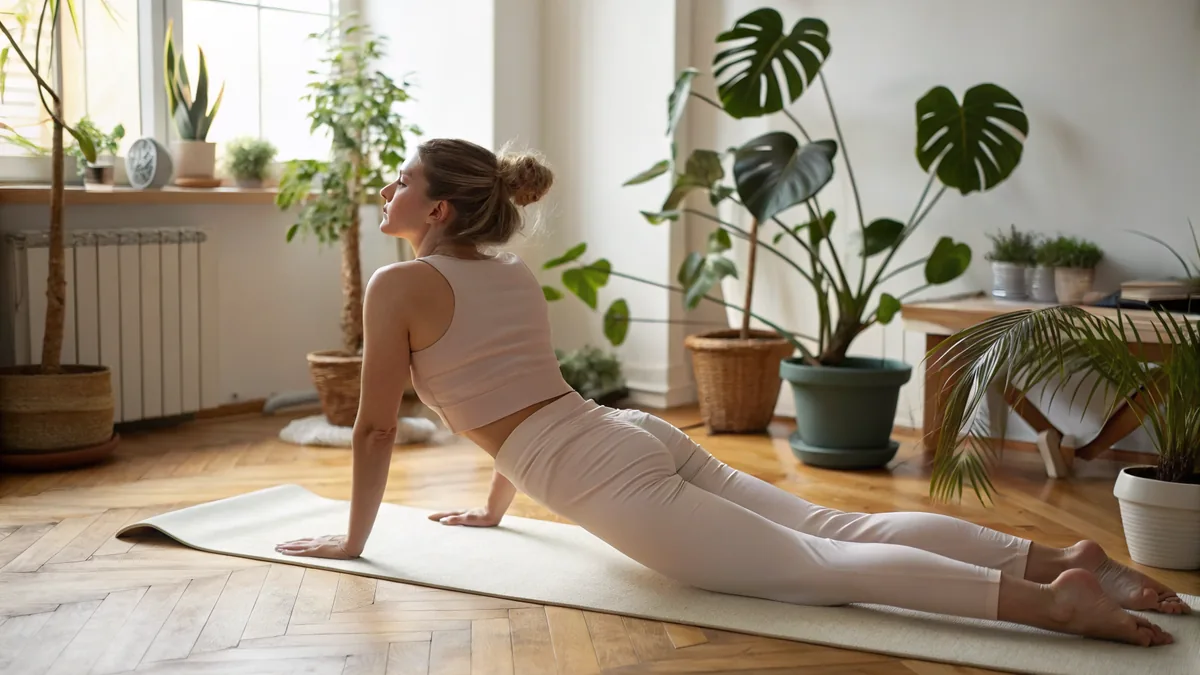
Somewhere on your feed right now, a woman with impossible posture is promising that pilates will give you her body. I want to talk about that promise honestly, because I have been doing mat pilates for over two years, I love it more than any movement I have ever tried, and it did not give me her body. It gave me mine, standing taller, moving easier, and far less at war with itself.
The phrase "pilates body" is doing a lot of quiet marketing work. It sells the idea that a specific aesthetic, long, lean, gently toned, ships with the workout like a free gift. The truth is less photogenic and more useful. Pilates changes how your body works and carries itself, noticeably. How it changes what you see in the mirror depends mostly on your genetics, your starting point, and your life.
I am not a trainer, a physical therapist, or anyone qualified to prescribe exercise. I am a woman who came to pilates burned out on punishing workouts, stayed because it was the first movement that felt like kindness, and kept honest notes along the way. This guide is what I wish someone had told me before my first class: what really changes, on what timeline, and what was never going to change because it was never real.
| Practice | What it mainly builds | What changes visibly | Best for |
|---|---|---|---|
| Pilates (mat or reformer) | Deep core strength, posture, alignment, controlled flexibility, breath. | Carriage and posture change noticeably; muscle definition changes modestly and varies by genetics. | People who want low-impact strength, back support, and precise, calm movement. |
| Yoga | Flexibility, balance, breathwork, nervous-system downshift, some strength in flow styles. | Mobility and ease of movement more than visible muscle; varies widely by style. | People who want movement woven with mindfulness and stress relief. |
| Gym strength training | Muscle size and maximal strength, bone density, metabolic effect. | The most visible muscle change of the three, given consistency and adequate protein. | People whose primary goal is building muscle or strength numbers. |
| Walking | Cardiovascular base, mood, joint-friendly daily movement. | Little visible change alone; pairs beautifully with any of the above. | Everyone, which is why it anchors my own week. |
The "pilates body" myth, kindly dismantled
The honest answer: There is no single pilates body. The long, lean aesthetic associated with pilates comes mostly from genetics and casting, not from the method itself.
Let me answer the search question directly, because you deserve a straight answer. What does a pilates body look like? It looks like the body of the person doing pilates. Tall bodies doing pilates look like tall bodies with better posture. Soft bodies doing pilates look like soft bodies that move beautifully. Muscular, curvy, thin, wide, postpartum, sixty-five years old: all of them, after six months, mostly look like themselves, carried differently.
The marketed version, willowy, lengthened, expensively toned, has a simpler explanation than the method. Pilates instructors and studio models are often selected, by hiring and by the algorithm, from people who already look that way. Dancers gravitate to pilates because it grew up alongside dance. The aesthetic came first; the workout gets the credit. Nobody is lying, exactly. The camera just edits out everyone the promise did not work on.
About "long, lean muscles"
One phrase deserves special attention because it appears in nearly every studio ad: pilates creates long, lean muscles. Physiologically, muscles do not lengthen from exercise. Their length is set by where they attach to your bones, which is set by your skeleton, which was set long before your first class. What pilates genuinely improves is posture and carriage, and a person standing at their full height with an engaged core reads as longer. That is real, and it is lovely. It is also not your muscles changing shape.
The before-and-after problem
While we are here, a word about those side-by-side photos. Most pilates before-and-afters compress three changes into one frame: better posture, better lighting, and better posing, with the workout taking credit for all three. Stand tall, breathe out, soften your shoulders, and you have produced an "after" photo this instant, no six-month program required. I do not say this to be cynical. I say it because comparing your week-two self to someone's curated after photo is how good practices get abandoned, and this practice deserves better than that ending.
I am spending this much time on the myth because believing it has a cost. If you start pilates expecting a body swap, you will likely quit around week six, exactly when the real benefits are starting to arrive quietly underneath the unmet expectation. The women I know who stayed long enough to love this practice all made the same shift I did: they stopped practicing toward a picture and started practicing toward a feeling.
How pilates actually changes your body
What really changes: Core strength, posture, balance, body awareness, breath control, and ease in daily movement. These changes are reliable; visible reshaping is not.
Here is what pilates is genuinely good at, and it is a meaningful list. The method is built around the deep core, not just the surface abs but the corset of muscles wrapping your trunk, the ones that hold you up all day. Strengthen those and a surprising number of small daily discomforts ease: the back that aches after standing at a counter, the shoulders that creep toward your ears by 3 p.m., the stiffness when you stand up from a long sit.
Posture is the change other people notice. Mine shifted enough by month four that two separate friends asked if I had gotten taller. I had not. I had simply stopped folding myself into the shape of my laptop. Pilates trains the muscles between your shoulder blades and along your spine to do their actual job, and the effect reads as confidence from across a room.
The change I value most is the least marketable: body awareness. Pilates is slow and precise on purpose, and after months of paying attention to where your pelvis is and what your breath is doing, you start inhabiting your body instead of just transporting it. I notice tension earlier now. I catch my bad lifting habits before my back complains. That awareness follows you out of the mat and into every grocery bag and long drive.
The quieter changes
Balance improves, which sounds boring until the first icy sidewalk of winter. Breath gets deeper and more deliberate, because the method choreographs it into every movement. Many women, especially after pregnancy, find pilates rebuilds a working relationship with their pelvic floor and deep abdominals, although anything beyond general conditioning there belongs with a pelvic floor physical therapist, not a blog. And sleep, for me at least, comes easier on practice days, the same gentle effect I get from walking, with the same lack of drama.
The honest timeline: 1, 3, and 6 months
Realistic pacing: Month one feels clumsy, month three brings posture and core changes you can feel, month six brings changes other people can see in how you carry yourself.

People searching for pilates before-and-after photos are really asking for a timeline, so here is mine, kept honestly, with the caveat that I practiced three short sessions a week. Half the speed gets you the same arrivals, later. There is no falling behind in a practice with no finish line.
Month one: the awkward apprenticeship
The first month is coordination school. You will spend it discovering that your breath, your pelvis, and your neck all have opinions, and that "engage your core" is a sentence you only think you understand. My notes from week two say, in full: everything shakes. Nothing visible changes in month one, and nothing is supposed to. What changes is vocabulary. Your body starts learning the difference between clenching and engaging, between effort and strain.
Month three: the felt changes
Somewhere in month two or three, the exercises stop being puzzles and start being movement. This is when the felt changes arrive. My lower back stopped announcing itself after long days. Carrying groceries up three flights got noticeably easier. I caught myself sitting upright in meetings without deciding to. None of this photographs. All of it improves an ordinary Tuesday more than visible abs ever could.
Month six: the visible-ish changes
By month six, there were changes another person could see, and almost all of them were carriage. I stand differently, walk more evenly, and hold my shoulders somewhere other than my earlobes. Was there a little more definition through my middle? Honestly, modestly, yes, the kind you notice yourself in good light, not the kind that launches an influencer career. The scale, for what it is worth, barely moved, because mat pilates is not primarily a calorie endeavor and was never pretending to be.
Pilates vs yoga vs the gym, without the tribalism
The short version: The gym builds the most visible muscle, yoga builds the most flexibility and calm, and pilates builds the strongest posture and core control. None of them installs a body type.
The table near the top of this page holds the summary, but the prose version matters because the internet loves to stage these three as rivals. They are colleagues. They solve different problems, and the honest comparison is about goals, not superiority.
If your goal is visible muscle, the gym wins and it is not close. Progressive strength training with real resistance, supported by enough protein, the kind of eating I lean on in my high-protein snack ideas, is the most reliable path to changing how your body looks. Pilates resistance, especially on a mat, tops out at your own body weight plus a band. It builds endurance and control in muscles, not bulk.
If your goal is flexibility, stress relief, and a practice that doubles as meditation, yoga has the deepest toolbox. The two methods share DNA and steal from each other constantly. I treat yoga as the breath-and-soul practice and pilates as the structure-and-spine practice, and on a good week I do both, badly, in my little corner by the window.
Can you combine them? Please do
The best answer to "which one" is usually "more than one, lightly." My own combination is pilates for structure, walking for cardio and sanity, and a short yoga flow when my nervous system needs the slower voice. Two pilates sessions, several walks, and one stretchy evening cover strength, mobility, and mood in under three total hours a week. No single discipline does all three jobs well, and none of them ever claimed to. The tribalism is a social media invention; your body has no brand loyalty.
And the "pilates vs yoga body shape" question that search engines love? Neither practice has a body shape to give you. Surveys of practitioners reflect who chooses each practice, not what the practice manufactures. Choose by what your body needs and what you will actually repeat, because the only practice that changes anything is the one still happening in March.
My small home practice, in full
My actual routine: Three 20-minute mat sessions a week at home, one beginner video on rotation, a band and a small ball, total equipment cost under forty dollars.

I want to demystify the practice itself, because "pilates" conjures reformer machines and ninety-dollar leggings, and mine involves neither. My entire setup is a mat that lives rolled by the bookshelf, a fabric resistance band, a small inflatable ball, and a water bottle that participates emotionally. Reformer classes are wonderful if your budget and city allow; they are also wholly optional. Joseph Pilates designed the mat work first, and it remains the heart of the method.
My week looks like this. Three sessions, usually twenty minutes, occasionally thirty when the day is generous, following free videos from two instructors whose voices do not exhaust me. Monday and Thursday mornings before work, plus one weekend slot that floats. I anchor the habit to my existing rhythms: mat after the morning tea, the same warm beginning I wrote about in the gentle wellness guide, and on Sundays it folds into my slower reset hours alongside the checklist.
The hydration bottle is not a joke, by the way. Twenty focused minutes of core work is sweatier than it looks, and my hydration habit earns its keep on mat days. Afterward there is a two-minute stretch, a shower, and the smug, upright feeling that is honestly half the reason anyone keeps exercising.
The five moves I would teach a friend
If a friend wanted to start tonight, I would teach her five moves and nothing else for two weeks: the hundred for breath and heat, glute bridges for the whole back chain, tabletop holds for deep core, side-lying leg lifts for the hips that sitting forgets, and cat stretch to close. Those five, done slowly with attention, are a complete beginner practice. Everything fancier is built from their grammar anyway.
A realistic week, written out
Plans fail in the gap between the idea and the calendar, so here is an actual week from my notes, chosen because it was ordinary, not because it was good. I am sharing the texture, not a prescription, and your version should bend around your own life the same way.
- Monday: 20-minute beginner mat video before work. Interrupted once by the cat sitting on the mat, which counts as added resistance.
- Tuesday: nothing. A long workday. The mat stayed rolled and the world kept turning.
- Wednesday: 25-minute walk at lunch instead, because my head needed it more than my core did.
- Thursday: 20 minutes of mat work, the same video as Monday. Repetition is not boring, it is how the moves get smarter.
- Friday: 10 minutes, just bridges, tabletop, and stretching, while dinner was in the oven. Short sessions count completely.
- Saturday: rest, errands, life.
- Sunday: 30 unhurried minutes in the late morning, the week's one session that feels like a ritual instead of a slot.
Notice the math. That week held roughly eighty minutes of pilates, spread over four casual appearances, none of them heroic. Six months of weeks like that one produced every change this article describes. The week you can repeat while tired is the only week that matters, and mine is deliberately unimpressive. Unimpressive is what surviving a real schedule looks like, and surviving the schedule is what six months of results are actually made of.
Movement without punishment
The heart of it: Pilates lasted for me because it was the first exercise I did toward my body instead of against it. That shift matters more than any visible result.

I need to tell you where I came from for this section to mean anything. For most of my twenties, exercise was a tax I paid on eating. Workouts were punishments with playlists. I tracked, burned, earned, and compensated, and I quit every program eventually because you cannot build a home in a place you only visit to be corrected. If that sentence lands somewhere tender, I wrote it for you.
Pilates was the first movement that did not fit that machinery. It is hard to hate-exercise through a practice that keeps asking you to slow down, breathe, and notice. Somewhere around the second month, I realized I was looking forward to the mat the way I look forward to a bath, not the way I used to brace for a treadmill. The practice was the point. The body composition conversation had quietly left the room.
So when this article says pilates probably will not dramatically reshape you, I do not mean lower your hopes. I mean redirect them at the real prize. A body that moves without aching, stands without slumping, and is spoken to kindly by its owner is a better outcome than visible abs, and unlike visible abs, it is available to almost everyone who practices. The wellness industry cannot sell that, which is exactly why nobody advertises it.
If the body-image piece is the hard piece for you, be gentle with the inputs too. I unfollowed every account that made my mat feel like a before photo, and the practice improved overnight. The same protective instinct drives my digital sabbath weekends: sometimes the strongest move in a wellness routine is curating what gets to talk to you.
What the research actually supports
The evidence: Research supports pilates for core strength, flexibility, balance, posture, and chronic low back pain. Evidence for body reshaping and "long lean muscles" is essentially absent.
Pilates research is genuinely encouraging, just not about the things the marketing claims. The most consistent findings: improvements in core muscular endurance, flexibility, and balance across age groups, and meaningful benefit for chronic low back pain, where pilates-based exercise performs as well as or better than other general exercise in several reviews. Posture measures improve in multiple studies, which matches every practitioner's lived experience, mine included.
What the literature does not show is the aesthetic transformation the phrase "pilates body" implies. Mat pilates is moderate-intensity exercise; it changes body composition about as much as other moderate exercise does, which is modestly and slowly, with diet doing most of the visible work. As part of an active life, it absolutely counts toward the strength and aerobic activity in the CDC physical activity guidelines. It is simply not a body-swap machine, because nothing is.
How I read fitness research now
A quick note on method, because wellness writing earns trust by showing its work. When I say "research supports," I mean systematic reviews and controlled trials, not a single small study amplified by headlines, and definitely not a testimonial with good lighting. Fitness science is full of twelve-person studies that say whatever the press release needs. My personal filter has three questions: how many people, compared with what, and who paid. Pilates passes that filter comfortably for core strength, balance, and back pain, which is why I make those claims plainly. It does not pass for body reshaping, which is why I refuse to.
The mood evidence deserves a mention too. Gentle, attentive movement reliably lowers stress and lifts mood, a pattern Harvard Health describes well in exercising to relax. Cleveland Clinic's plain-language overview of pilates benefits lands where I do: real strength, posture, and flexibility gains, honest caveats about the rest. That is the practice I can promise you. It is enough.
Common mistakes
The big four: Expecting weight loss, comparing yourself to instructors, rushing the reps, and treating soreness as the measure of a good session.
The first mistake is hiring pilates for a job it did not apply for. Mat pilates burns modest calories, and people who arrive for weight loss usually leave disappointed around week eight, blaming themselves for a mismatch that was never theirs. If body composition is your goal, pilates is a beautiful supporting actor next to strength training and patient nutrition habits like the ones in my wellful nutrition approach. It is rarely the lead.
The second is measuring yourself against the instructor, who has often practiced daily for a decade and, as covered earlier, was frequently built like that before her first class. Compare yourself to your own month one. That comparison is honest, and honest comparisons are the only ones that feed a practice instead of starving it.
The third is speed. Rushed pilates is just flailing with branding. The method's entire mechanism is control, and one slow, precise bridge does more than ten hurried ones. When a video outpaces me, I let it. The instructor finishes her reps, I finish mine, and we meet again at the next exercise. Nobody has ever knocked on my door about it.
The fourth is chasing soreness. A good pilates session often leaves you feeling taller and looser, not wrecked. If you grew up equating workout quality with next-day pain, this recalibration takes a while, and it is worth it. Soreness measures novelty, not progress. Showing up again on Thursday measures progress.
When this won't fit your life
Some bodies need more than a blog's encouragement before starting. If you are pregnant or recently postpartum, have a back injury, a hernia, significant pelvic floor symptoms, osteoporosis, or any condition that makes you hesitate, talk with your doctor or a physical therapist first, and consider a few sessions with a qualified instructor who can modify for you. Online videos cannot see you, and the core work that helps a healthy spine can aggravate an injured one done wrong.
And if exercise content of any kind currently sends you somewhere dark, body-checking, restricting, compensating, then the kindest version of this article is permission to close it. Movement can wait while you get real support; eating disorder recovery outranks any routine I will ever write about. The practice will still be here, gentle as ever, whenever coming back to it feels like care instead of a sentence. That is the only condition under which I would want you on a mat at all.
Helpful sources and next reads
Reliable external sources
- Cleveland Clinic: the health benefits of pilates
- CDC: physical activity guidelines for adults
- Harvard Health: exercising to relax
- MedlinePlus: exercise and physical fitness
- Office on Women's Health: getting active
More from Sabrina Saturno
You may also love




FAQ
What does a pilates body look like?
Like the person's own body with better posture and core control. There is no standard pilates body; the long, lean aesthetic in marketing reflects who is hired to model the method, not what the method produces.
How does pilates change your body?
Reliably: stronger deep core, better posture, improved balance and flexibility, easier daily movement, and more body awareness. Modestly and variably: muscle definition. Minimally on its own: weight and overall body shape.
Will pilates tone my body?
It builds genuine strength and endurance in the muscles it targets, and some people see modest definition over months. Whether that reads as "toned" depends on genetics and body composition, which pilates alone changes slowly.
How long does it take to see results from pilates?
Felt results, less back ache, easier movement, straighter sitting, typically arrive within four to eight weeks of consistent practice. Changes visible to other people, mostly carriage and posture, tend to take three to six months.
Is pilates better than yoga for changing body shape?
Neither reliably changes body shape. Pilates leans toward core strength and posture, yoga toward flexibility and stress relief. Choose by what your body needs, or alternate them, since they complement each other well.
Can pilates replace the gym?
It depends on the goal. For posture, core, and mobility, pilates can be your whole practice. For building visible muscle or maximal strength, progressive resistance training does what mat pilates cannot.
Is mat pilates or reformer pilates better?
Neither is better universally. Mat work is free, portable, and the method's foundation. Reformers add resistance and variety at a real financial cost. Most of my results came from a forty-dollar mat setup at home.
How many times a week should I do pilates?
Two to three short sessions weekly is the sweet spot for steady progress without burnout. Daily practice is fine if it stays gentle, but consistency across months beats intensity in any single week.
Does pilates help with belly fat?
Not directly. No exercise spot-reduces fat. Pilates strengthens the muscles underneath, which improves posture and how the area carries itself, but fat loss comes from overall energy balance over time.
Is pilates good for back pain?
Research consistently supports pilates-based exercise for chronic low back pain, often matching or beating general exercise. For an injured or acutely painful back, see a professional first rather than starting with online videos.
Can beginners do pilates at home?
Yes. Start with reputable free beginner mat videos, fifteen to twenty minutes, twice a week, and learn a handful of foundation moves slowly. Healthy beginners rarely need equipment beyond a mat at the start.
Is pilates enough exercise on its own?
Pilates covers strength and flexibility beautifully but is light on cardio. Pair it with regular brisk walking or similar aerobic movement and you have a complete, joint-friendly weekly routine.
The version that lasts
Two years in, my honest sales pitch for pilates contains no body at all. I practice because my back is quiet, my posture surprises me in shop windows, and twenty minutes on the mat reliably returns me to myself on days that scatter me. The shape I was promised never arrived. The life upgrades nobody mentioned arrived early and stayed.
If you take one thing from this guide, let it be the reframe. Stop asking what pilates will make your body look like, and start asking what it will make your body feel like. The first question has a disappointing answer and a six-week quit rate. The second has an answer good enough to keep women practicing into their nineties.
And if you only ever manage the unimpressive version, two short sessions a week, forever, know that you are not doing pilates lite. You are doing the version that lasts, which makes it the most advanced version there is. The women still practicing at eighty did not get there through intensity. They got there through Tuesdays.
Start with a mat, fifteen minutes, and five slow moves. Let it be unimpressive. Let it be yours. Somewhere around month three, when you catch yourself sitting tall in a meeting without having decided to, you will understand what a pilates body actually is. It is the one you already have, finally on your own side. If you are weighing this against a yoga practice instead, I put them side by side in pilates vs yoga.